0:00
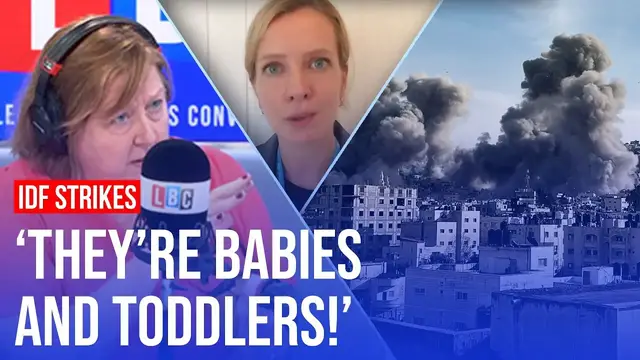
There's been, as you probably know, another incident, a water queue of people going to get water, trying to get fresh water
0:08
There was an airstrike by the IDF, misdirected. They're carrying out an investigation
0:14
They say it was an error or looks to have been an error, but a number of children died in this incident
0:21
Let's talk to Rosalia Bolin. Adults did as well. Rosalia Bolin, UNICEF communications specialist
0:27
Good afternoon to you. Good afternoon. Thanks for having me. What are you hearing, learning about this incident
0:35
The incident is actually pretty similar to what happened on Thursday morning
0:41
So there were children queuing around a water point in Al-Nusherat, which is an area in central Gaza
0:49
When the airstrike hit, seven children were reported to be killed yesterday
0:56
back on Thursday there were actually nine children who were killed on Thursday we were
1:03
able to deploy an international team to the site of the the airstrike in the immediate aftermath
1:08
and also to the hospital that received the bodies and and injured and it's it's just appalling that
1:15
families who are starving who are queuing for for assistance for humanitarian aid for water because access to safe water is also severely constrained that they have to do that risking their lives And what I want to underline as well here is that
1:32
these incidents make it to the headline, but in reality, this is what's happening day in
1:40
day out in Gaza. Just from the 1st to the 7th of July, over 100 children were reported killed
1:48
And, you know, those who are fortunate enough to survive, their chances of survival ultimately aren't that high either because hospitals are completely overwhelmed
2:00
They lack critical medical supplies, medical equipment, medicines. There's just this constant inflow of very severely injured people
2:11
And so injured children, the children that we met on Thursday, they don't necessarily get the care that they need
2:18
There was a boy who was unconscious with shrapnel lodged in his body, in his head
2:25
There was another girl with injuries to her legs. There's children with very severe burns, children who have to have limbs amputated
2:35
When you talked about that figure between the 1st and the 7th of July of 100 I think was the figure you said children killed in airstrikes or as a result of airstrikes Well in airstrikes because they were in an area that was targeted And you know we see day in day out is things like tents being hit school shelters
3:04
so schools turned into shelters hosting, refugees being hit, residences being hit
3:10
eight distribution points being hit as well. It's not an exception. And that is the real thing here
3:18
And the other thing I also wanted to underline is that we're talking about numbers
3:24
I personally think the numbers are overwhelming. We're looking at over 17,000 children
3:32
reported killed since the start of the war. That's massive. That's just really hard to imagine
3:38
And yet at the same time, we shouldn't focus on the numbers because these are numbers
3:44
These are girls. And every individual life matters, of course. There are babies and toddlers
3:48
Can I ask you about water? I mean, you know, we've talked a lot historically and we continue to do so about the lack of food that's getting where it needs to be
3:59
What about water? What's going on with water supplies in Gaza? Yeah water is as critically lacking as food is and obviously families need both food and water to be able to survive Already before this war the availability of clean water has been an issue inside Gaza
4:24
In Gaza, you have brackish water that needs to be rendered drinkable, potable
4:31
So something that UNICEF, for instance, does is that we have been supporting before the war
4:36
and also throughout this war, the desalination of water through desalination plants
4:42
And we've also been supporting... Of seawater? Because, of course, it's a coastal, long coastal stretch, isn't it
4:48
Exactly, exactly. So to make brackish water drinkable and safe, we've been supporting water wells, other water production systems
4:57
as well as systems to distribute that water to families inside Gaza
5:02
Now, to do that, this infrastructure obviously needs energy. It needs electricity to operate
5:09
electricity was cut off from the Gaza Strip at the beginning of the war. And that means that
5:16
this critical infrastructure, just as hospital generators, for instance, is running on fuel
5:23
And fuel hasn't been allowed to enter the Gaza Strip. And of course, that will make it all the
5:29
more necessary for people to go to these water collection points and again, putting themselves
5:34
in exposed positions. I must leave it there. Thank you, Rosalia, for speaking to us today
5:38
Rosalia Bollin, UNICEF communications specialist