Up next in 10



Why "Nobody" Lives In Upstate New York
Show More Show Less View Video Transcript
0:00
New York is home to about 19.5 million people, making it the fourth largest state in the United States
0:06
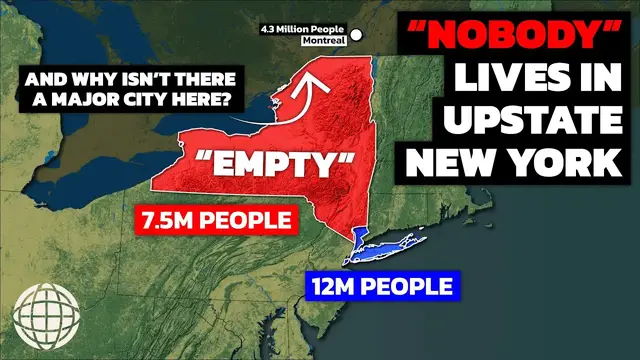
But despite its size, about 62% of the state's entire population exists on just 4% of its land in the far southeast corner, also known as New York City
0:15
This has left the rest of New York feeling pretty empty, so why don't more people live in upstate New York
0:24
Welcome to Geography by Jeff. New York is one of the most interesting states in the country
0:30
No other state is as dominated by a single state in the same way that New York is
0:34
though perhaps Illinois comes close with Chicago. Still, this has led to the otherwise really large state of New York
0:40
feeling rather empty when you travel even a little farther north than the city
0:44
And as usual, there's a geographic reason for this. But first, be sure to check out this week's podcast episode all about map projections
0:51
and how they distort our planet so that it doesn't even really look like our planet anymore
0:56
You can now watch full video versions of our podcast right here or on whatever app you use to listen to podcasts
1:02
All links are in the description below. New York is one of the original 13 states of the United States
1:12
but despite this fact, the actual state itself has largely been forgotten
1:15
in favor of the city it shares a name with, and this relationship between New York City and upstate New York
1:21
has been locked in a tug-of-war ever since the days of the early colony
1:25
The land that is now New York was originally inhabited by various indigenous tribes
1:30
most notably the Iroquois Confederacy. This powerful alliance, consisting of the Mohawk, Oneida, Onondaga, Cayuga, Seneca
1:39
and Tuscarora tribes, played a pivotal role in the region. The Iroquois were known for their sophisticated political system and social organization
1:47
as well as their skills in agriculture and craftsmanship. Their matrilineal society, where descent and inheritance were traced through the mother
1:54
was a fundamental aspect of their culture, contrasting sharply with the patriarchal norms of European settlers
1:59
when they arrived in the early 1600s. In 1614, the Dutch, under the command of Hendrik Christensen
2:06
built Fort Nassau, now Albany, the first Dutch settlement in North America
2:10
and the first European settlement in what would become New York State. The Dutch would go on to establish the city of New Amsterdam in 1624
2:18
Unfortunately for the Dutch, in 1664, the British would invade and take control of New Netherlands, renaming the colony New York
2:27
New Amsterdam would also be renamed to New York City. Fast forward 100 years to the American
2:32
Revolutionary War, New York would play an integral role in the war. Even the Iroquois found themselves
2:37
divided over the conflict with the Mohawk, Seneca, Onondaga, and Cayuga remaining loyal to the British
2:42
and the Tuscarora and Oneida siding with the colonists. This division of the Iroquois led to
2:47
devastating consequences for the Confederation, as post-war treaties and policies disregarded their sovereignty
2:53
and led to the loss of their lands. During the 1800s, New York transformed into a bustling economic powerhouse for the United States
3:00
The construction of the Erie C in the 1820s was a landmark achievement
3:05
connecting the Great Lakes with the Atlantic Ocean and boosting trade and migration It was during this time that New York City became known as the first truly global city as millions of immigrants from Europe and Asia moved to the city
3:17
With that population migration came a boom in production, construction, housing, and economy
3:23
leading to New York City becoming the wealthiest city in the world. Today, New York State is a microcosm of America
3:30
It's dominated by New York City, and yet, the city itself is only a small part of the
3:34
entire state's geography. But before we explore the geography of New York State, if you're enjoying this video
3:40
hit that subscribe button. More fun geography videos are just a single click away
3:48
New York State, perhaps most often associated with the iconic skyline of New York City
3:53
offers a much more interesting and varied geography than that of its famous urban center
3:57
This diversity includes mountains, rivers, lakes, and forests, each contributing to the state's
4:03
unique environmental and geological makeup. The state can be broadly divided into several
4:08
distinct regions. In the northeastern part of the state lies the Adirondack Mountains
4:12
a vast, dome-shaped area that is part of the vast Canadian Shield. The Adirondacks are
4:17
characterized by rugged terrain, with Mount Marcy standing as the highest point in New York
4:22
at 5,343 feet. This area is also known for its dense forests, abundant wildlife
4:28
in numerous lakes and streams, making them a popular destination for outdoor recreation
4:33
and a vital habitat for a wide variety of species. To the southeast of the Adirondacks is the Hudson
4:39
Valley, a region that extends from the tip of Manhattan north to Albany. The Hudson River
4:43
which flows through this valley, is more than just a geographic feature. It's a vital waterway
4:49
that has historically been crucial for trade and transportation. The valley is also known for its
4:53
rich agricultural land, producing a variety of crops and serving as the backbone of many
4:58
rural communities. Central New York is dominated by the Finger Lakes region, a series of long
5:03
narrow lakes formed by ancient glaciation. This region is renowned for its wine production
5:08
thanks to the favorable microclimates created by these lakes. In fact, New York ranks third
5:13
in great production by volume after California and Washington. The Finger Lakes also contribute
5:18
to the state's water resources, feeding into rivers and cs, including the historic Erie
5:23
C. Further west lies the Great Lakes region, with New York bordering both Lake Ontario and
5:28
Lake Erie. This area is crucial for its commercial and recreational opportunities. Niagara Falls
5:34
located at the border with Canada, is not only a breathtaking natural wonder
5:39
but also a significant source of hydroelectric power. Finally, despite not being thought of as
5:44
a coastal state, New York does have a surprisingly long coastline due to Long Island, a large
5:50
densely populated island extending eastward from New York City. According to the National Oceanic and Atmospheric Administration
5:58
New York has approximately 2,625 miles of coast, more than New Jersey, Georgia, and even Oregon
6:05
But despite all this geography, New York's population has overwhelmingly amassed in New York City
6:11
leaving the rest of the state feeling pretty empty. New York State is home to 19 million people making it the fourth largest state in the country behind only California Texas and Florida But within the state itself about 62 of the population lives within the New York City
6:29
metropolitan area, leaving just 38% of the state's population to live on 96% of all land
6:36
That's an incredible population distribution that's shared by few other places in the world
6:40
And, as usual, there are multiple geographic reasons for this. First, the climate differences between upstate New York and New York City are significant
6:49
Upstate New York experiences a more severe continental climate with colder winters and
6:54
relatively mild summers compared to the coastal climate of New York City
6:57
This isn't to say that New York City doesn't get cold, but it's definitely more mild compared
7:01
to say Buffalo, which experiences dreadful lake effect snow which can subject the city
7:06
to hazardous blizzards. This climatic variation has historically influenced settlement patterns as the harsher climate
7:12
in the north made it less attractive for early settlers and continues to be a deciding factor
7:17
for people today. But while climate has played a role, historically the establishment of the Dutch
7:22
colony of New Amsterdam, which later became New York City, set the stage for the region's
7:27
demographic development. As a port city, New Amsterdam quickly became a hub of commerce
7:32
trade, and immigration, drawing people from various parts of the world. Its strategic location
7:37
combined with its accessibility to Europe and other colonies, allowed it to grow rapidly in
7:41
both wealth and population. In contrast, upstate New York was far more isolated during this period
7:47
with no natural ocean ports and a less favorable climate for agriculture and year-round living
7:53
Additionally, the presence and prominence of the Iroquois Confederacy in upstate New York
7:57
played a crucial role in shaping these early settlement patterns. The Iroquois, a powerful
8:02
and sophisticated alliance of tribes, controlled a large portion of what is now upstate New York
8:07
Their well-established and organized society, along with their military strength, initially acted as a deterrent to European settlement inland
8:16
The Iroquois were effective in maintaining their territory and autonomy for a significant period
8:21
which slowed the pace of colonial expansion into these areas. But perhaps more than all of this combined is the sheer economic power of New York City as a global financial center
8:31
During the 1800s and into the 1900s, the city grew exponentially. In fact, between 1890 and 1900, the city grew by more than 120%, growing from 1.5 million
8:42
to 3.4 million people. In contrast, upstate New York, while rich in natural resources and agriculturally productive
8:49
lands, did not experience the same level of immigration or industrial development
8:54
The rise of the Erie C did bring some growth to certain upstate cities, but this
8:58
was relatively modest compared to the explosive growth of New York City
9:01
In more recent decades, economic factors have continued to influence demographic trends
9:07
New York City's diverse economy offers a wide range of job opportunities in finance
9:11
technology, media, and other industries, attracting a continuous influx of new residents
9:17
Upstate New York, while home to several universities, industries, and tourist attractions
9:22
has not seen the same level of economic growth and job creation, leading to a slower rate of population increase
9:28
Today New York City is by far the largest city in the state with about 8 million people in the city itself Including the entire metro area which includes parts of New Jersey and Pennsylvania
9:40
would increase this population to 19.2 million people. This would be followed by Buffalo with
9:45
1.2 million, Rochester with 1.1 million, Albany with 900,000, and Syracuse with 650,000 people
9:53
From there, metro area populations drop quickly. But one thing that's perhaps most interesting
9:59
about upstate New York is that, unlike Canada, there are no major U.S. cities along the St
10:04
Lawrence River, one of the largest rivers in all of North America
10:12
The absence of a major U.S. city along the St. Lawrence River in New York State
10:16
despite its strategic location and significance as a waterway, is kind of odd, especially when
10:21
you see that Montreal, home to 4.2 million Canadians, is located only about 63 miles
10:26
downstream from the New York state line. Historically, the development of major cities
10:30
has often been closely linked to trade and transportation. When European settlers arrived
10:34
in North America, river access was crucial for these purposes. The St. Lawrence River
10:39
serving as a natural border between the United States and Canada, was a significant route for
10:44
trade and movement. However, the political boundary it represented also played a role
10:48
in hindering the development of a major American city along its banks. During the colonial era
10:53
and the early years of the United States, there was considerable tension and conflict between the US and British Canada
11:00
This tension made the St. Lawrence River a less attractive location for settlement and development
11:04
compared to other areas that were more securely within US borders. Additionally, the harsh climate of the region, with its long, cold winters
11:12
made it less hospitable compared to other areas in the US. Another factor is the geographic competition the river has with the Great Lakes and the Erie C
11:20
The Great Lakes region and the Erie C, which was completed in 1825, became major hubs for trade and transportation
11:27
The Erie C in particular provided a more direct and economically viable route for goods to travel from the interior of the continent to the Atlantic coast via the Hudson River
11:36
This diverted potential development away from the St. Lawrence River towards New York City and other areas along the c
11:43
And while the St. Lawrence River was significant for trade and transportation, due to Canada owning the mouth of the river at the Atlantic
11:48
there was little reason for the U.S. to invest in it in the same way. Throughout history, the river has been a vital route for shipping and transportation
11:56
but this function was balanced with Canadian interests, which benefited most from the river's prominence
12:01
Today, there are some towns along the U.S. side of the St. Lawrence River, such as Messina and Ogdensburg
12:07
but they haven't grown to the same scale of major U.S. cities. And unless something drastic changes
12:12
there's little reason to believe they'll grow significantly in the future. New York State is big in both size and population
12:19
but despite its size, most New Yorkers have opted to live within New York City
12:22
and not upstate New York. But in recent years, New York City has been losing population
12:27
meaning that perhaps there's more of a desire to live in more affordable cities elsewhere in the state
12:32
I hope you enjoyed learning more about New York State and its population distribution. If you did, please subscribe to my channel
12:38
If you wanna watch more of my videos, click here. If you wanna check out the podcast, click here
12:43
Thanks for watching. See you next time
education