Up next in 10



To try everything Brilliant has to offer for free for a full 30 days, visit https://brilliant.org/GeneralKnowledge/ or scan the QR code onscreen—or you can click on the link in the description. You’ll also get 20% off an annual premium subscription.
In this episode of General Knowledge I talk about English Counties. Explaining the difference between Historical, Local Government, and Ceremonial Counties. Then going into the name origin and meaning (etymology of each one). From the 'Horn People' origin of Cornwall, to the 'Crossing Point' origin of Bristol. Understanding the common presence of the suffix 'Shire' and how it's related to the old territorial organization of English Kingdoms in Medieval Times, many associated with a Sheriff working as the monarch's personal representative.
TIMESTAMPS:
00:00 English Counties
00:39 Instagram
00:59 England's Different Types of Counties
01:42 Ceremonial Counties
02:03 Local Government Counties
02:26 Historical Counties
03:15 Brilliant Offer
04:35 Alphabetical Order
04:44 '-Shire' Suffix Explained
04:53 Cardinal Direction Prefix
05:06 Bedfordshire
05:40 Berkshire
06:06 Bristol
06:37 Buckinghamshire
06:53 Cambridgeshire
07:18 Cheshire
07:42 City of London
08:05 Uncertainty Disclaimer
08:12 Cornwall
08:31 Cumbria
08:53 Derbyshire
09:29 Origin of 'Derby' in Football
09:43 Devon
10:01 Dorset
10:28 Durham
10:42 East Riding of Yorkshire
11:32 East Sussex
11:53 Essex
12:08 Gloucestershire
12:40 Greater London
12:52 Greater Manchester
13:20 Hampshire
13:44 Herefordshire
14:02 Hertfordshire
14:22 Isle of Wight
14:55 Kent
15:47 Lancashire
16:18 Leicestershire
16:29 Lincolnshire
16:40 Merseyside
16:59 Norfolk
17:10 North Yorkshire
17:21 North Hamptonshire
17:30 Northumberland
18:13 Nottinghamshire
18:47 Oxfordshire
18:56 Prevalence of River Names in Etymology
19:20 Rutland
19:47 Trend of naming places after local rulers
19:59 Shropshire
20:14 Somerset
20:53 South Yorkshire
20:59 Staffordshire
21:31 Suffolk
21:43 Surrey
21:50 Tyne and Wear
22:11 Warwickshire
22:41 West Midlands
22:53 West Sussex
23:03 West Yorkshire
23:14 Wiltshire
23:33 Worcestershire
24:13 Summary
24:44 Patreon Credits
Become a member on Patreon & get your name in the credits + exclusive content! https://www.patreon.com/generalknowledge
Stay up to date on more content from me:
Tiktok: https://www.tiktok.com/@general.knowledge.yt
Twitter: https://twitter.com/GKonYoutube
Instagram: https://www.instagram.com/genknowledge/
▶ Join the Discord Server: https://discord.com/invite/f4neAVWZfF
▶ Business Contact: [email protected]
#GeneralKnowledge
Show More Show Less View Video Transcript
0:00
English counties. In this video we are going to find out what English counties
0:05
are, how many there are, and especially what their names are, what they mean and
0:09
where they come from. Understanding for instance how Cornwall comes from an old
0:14
Celtic name meaning people of the horn, how Durham comes from the Old English
0:19
word for hill and the Old Norse word for island, or how Bristol is named after an
0:24
old English term meaning meeting place by the river among many others
0:39
By the way guys I don't know if I've mentioned it but I have a Instagram account where I post
0:45
reels stories and just like other smaller pieces of content so if you want to follow me there just
0:50
just for some extra content and to keep up with my, I don't know, daily video making life
0:58
you can follow me on there. First, we need to clarify something because English counties are
1:02
a little bit confusing. So give me one or two minutes to just explain the context here. Counties
1:08
are a type of subdivision within England. They have been used as administrative areas in England
1:13
since Anglo-Saxon times. That was a long time ago, like fifth century long ago. And while the
1:19
territorial organization and division of the country into counties has changed, as it's normal
1:25
that it does with any country over time. Various definitions of counties exist in England today
1:30
with significant differences from each other. There are three definitions of counties within
1:35
England. First, the ceremonial counties, then the local government counties, and then the historic
1:42
counties. The ceremonial counties are 48, and they're used for the purposes of lieutenancy
1:47
Each of them has a Lord Lieutenant assigned to it who is the personal
1:51
representative of the monarch in the area. Historically each lieutenant was responsible for sort of raising the militia of the county in time of war
2:00
but this was fully abolished in 1921. The local government counties are perhaps
2:05
the most relevant of all. There are 84 of them which are then divided into parish
2:11
councils, but the first can also be different among themselves, some being
2:14
unitary local authorities, others non-metropolitan counties, others are metropolitan districts. I don't know, it's just a big mess of tiered and also parallel local government structures
2:26
And finally, the historic counties, which are 39. And they were used as the local government
2:32
counties until 1974. They were mostly formed as shires or subdivisions of the earlier kingdoms
2:39
which gradually became united by the 10th century to become England. This kind of brought about a challenge when I started writing the video which is
2:47
which set of counties do I explain the names of? The historic ones seem a bit outdated and at the same time the local government ones are so
2:57
numerous and so confusing that I think this video would be a couple hours long
3:01
And so using a form of the Goldilocks principle I chose the one in the middle, the ceremonial counties
3:07
So in this video, we are going to find out the meaning and origin of each of those 48
3:13
county names. Now guys, as I have mentioned recently, these videos are a great place to learn about history
3:20
geography, or in this case, etymology. But if you want to learn about other things like math, data ysis, or even AI, you
3:27
should try this video sponsor, Brilliant. Brilliant is where you learn by doing, and they offer thousands of interactive lessons
3:34
in these areas. The fact that they are interactive I think really makes a difference
3:38
I've never been a fan of learning only in theory, at least for me putting things into
3:42
practice really makes a difference. And Brilliant is somewhere where you can do this
3:48
Through their interactive lessons, Brilliant helps you increase on your critical thinking
3:52
skills through problem solving, not just memorizing. Something else that I really like about them is that they're not a one stop learning place
4:01
It's not something that you do for 8 hours a day for 1 week and then you're done
4:05
It's about building a habit for learning so you can take a few minutes a day off of mindless
4:11
scrolling to build real knowledge for yourself. So if you want to learn a little bit every day through practice and interactive lessons
4:19
go to brilliant.org slash general knowledge and you can try it for free for 30 whole days
4:26
And if you want to give a try to the premium subscription, you'll also get a 20% discount
4:30
Thank you so much to them for sponsoring this video and now let's get back to the name origins
4:35
So let's get started, I'm going to be doing these alphabetically, so I'll add timestamps
4:39
in the description so you can skip ahead to any specific county you want to learn about
4:44
A lot of them end with the suffix shire which just refers to their status as a government
4:49
territory unless you are referring to the shire in Middle-earth. Many also have a cardinal direction prefix like West Sussex which of course shares the
4:59
same etymology as Sussex just being west of it. But now, let's jump into the meanings themselves
5:06
Let's start with Bedfordshire, named after Bedford, which derives from Bedda's Ford
5:12
referring to a crossing point over a river associated with an early settler or leader
5:18
named Beda. The first recorded use of the name dates back from 1011 and wrote it as Bedanfortsir
5:26
By the way, I'm gonna mispronounce a lot of names in this video, especially the Old
5:30
Anglo-Saxon, Old English and Old Norse names. I tried looking up the pronunciation for some of
5:35
them but it just doesn't exist in most cases so you're gonna have to excuse me there
5:40
Then we have Berkshire, derived from the Old English Bearosir which in turn comes from the
5:46
Celtic Bearok, meaning hilly or wooded land, signifying the landscape. Berkshire also received
5:52
the title of Royal County in 1957 due to the presence of Windsor Castle there, a royal residence
5:59
and incidentally, the oldest and largest continuously occupied castle in the world
6:06
Moving on to Bristle, the oldest recorded name given to Bristle was Kair Odor, meaning
6:12
the City of the Gap. It honestly sounds much cooler to call it City of the Gap than Bristle and it kind of
6:17
gives it a Game of Thrones vibe, but I guess Game of Thrones is very much based on medieval
6:22
England so that kind of makes sense. Bristol then became known as Brixtau from 1064 to 1204 with the Saxons then changing the city name to Brsixto referring to a place by the bridge on the Avon River Then we have Buckinghamshire named for Buckingham of course which comes from
6:41
Bucca's home or Bucca's people, referring to land owned by someone named Bucca, who is believed to
6:48
have been the leader of the first Anglo-Saxon settlers to arrive in England. And then Cambridgeshire
6:55
which originates from Cambridge. It was also named by the Anglo-Saxons as they arrived and set up a
7:00
settlement there, which became known as Grante Bricks, something like Grante Bridge. By Middle
7:07
English, the settlement's name was changed to Gambrit Co, deriving from the word Camboricum
7:13
meaning passage or ford of stream in a town or a settlement. And a third shire in a row is
7:20
Cheshire. The name refers to the Shire of Chester, which derives from castra, the Latin word for
7:26
military camp, referencing its Roman heritage. It was first recorded as Legge Castercir in the
7:33
Anglo-Saxon chronicle, meaning the Shire of the City of Legions. Again, City of Legions is such a
7:40
cooler name than Cheshire. And speaking of cities, next we have the City of London. The etymology of
7:46
London is a little uncertain. It's believed to derive from the pre-Roman name Londinium
7:52
and this possibly meant place belonging to a man called Londinus, or to a pre-Roman Britain king
7:59
King Lund. There are a lot of proposed etymologies for London, but none of them are completely certain
8:05
which is a good reminder that many of these are speculation, or kind of our best guess
8:10
Don't take them as 100% certain. Moving on to Cornwall. The name combines
8:15
Cornovi, an ancient Celtic tribe meaning people of the Horn, referring to the peninsula and its shape
8:21
with the Anglo-Saxon Velas for foreign or Welsh, so I guess it would mean something like the
8:27
strange foreigner people of the Horn peninsula. When it comes to Cumbria, it seems to derive from
8:34
the Welsh word Cymri meaning compatriots or fellow countrymen, reflecting the area's historical
8:40
Celtic inhabitants. Interestingly, Kimru is the native name for Wales too, sharing the same origin
8:46
All of them seem to be traced to Combroges in common Britonic, which originally meant
8:52
compatriots too. And then Derbyshire. Named for the town of Darby derived from the old Norse
8:57
Diorabi, meaning village of deer, signifying its Norse settlement roots and the fact that I guess
9:03
there were a lot of deers there when they arrived. But like almost all cases, there is a debate about
9:09
the exact origin and many point out multiple influences, such as a variation of the original
9:15
Roman name, Derventio, with pronunciation of the letter V as B, becoming Derventio and later Derby
9:22
along with a link to the river Dervent, a Celtic word meaning valley thick with oaks
9:27
which flows through the city. Interestingly, the football term Derby, used when two teams of the
9:33
same city play each other, comes from this place as well. It originated from a game of football
9:37
between two teams, All Saints and Saint Peter's in the city of Derby, due to the close proximity
9:42
of the two churches. Moving on to Devon. It may come from the name of the Dumnoni tribe
9:47
a Celtic group living in the area before Roman times. Devon would have therefore evolved from
9:53
Dumnonia, meaning land of the Dumnoni, the name of the tribe, in turn is thought to mean deep
9:59
valley dwellers. And what about Dorset? It's named after the town of Dorchester. Dorchester
10:05
Itself seems to come from the Roman name for the settlement, Durnovaria, which was a latinized
10:12
version of a common Bretonic word, possibly meaning placed with fist-sized pebbles
10:19
The Saxons then renamed the town to Dom Varakester, the suffix Kester being the old English name
10:26
to describe a Roman town. And then we have Durham, which seems to have a pretty simple explanation
10:33
It derives from the Old Norse dún holm, meaning hill island, later anglicized
10:39
Dun is hill and holm is island. Then we move on to perhaps the longest county name, which is East Riding of Yorkshire
10:47
Riding comes from the Old Norse, which I think is pronounced as trithri, meaning a third part
10:52
reflecting its division of the historic county of Yorkshire, one of three writings alongside the north and west
10:59
The east obviously refers to it being in the east, While Yorkshire removing the Shire shares its etymology with York, which is first believed to have originated from the Celtic word eburakon, which means place of yew trees
11:12
This theory is supported by the fact that yew trees were once abundant in the area
11:16
And that the city was known for its skilled bow makers, who used yew wood to make their bows
11:23
This became Eburacum to the Romans, Eorfoic to the Angles, and then most famously Jorvik to the Vikings, then evolving to York in modern English
11:32
Another geolocated name is East Sussex, and very interestingly, it's actually double geolocated
11:40
East refers to the east part of Sussex, but Sussex itself is already geolocated
11:45
because it comes from Suth-Seax, meaning Land of the South Saxons, from when it was a part of the
11:52
Saxon kingdom. And another very similar case is Essex, which means precisely Land of the East
11:58
Saxons, reflecting its foundation as an early Saxon kingdom too, but in the east side. Wessex
12:04
shares the same logic, being in the west and Middlesex being in the middle. Then Gloucestershire
12:10
By the way, it's kind of, I think it's impressive that I was able to pronounce that. So you have to give me a little credit even if I am mispronouncing all the other ones. The name originates from
12:18
Gloucester of course and this place name was originally Glewum which was related to the Welsh
12:23
gloi meaning bright. The old English kester came as we saw from the Roman Latin name for a fort
12:30
or walled city. So essentially it would be something like the bright walled city. Maybe
12:36
the city was bright or maybe the walls were colored in a light color. I don't know. Next we have
12:41
Greater London. London comes, as we saw, from Londinium, as previously noted, and the greater
12:46
prefix refers to its role as defining the greater area surrounding London proper. A similar situation
12:53
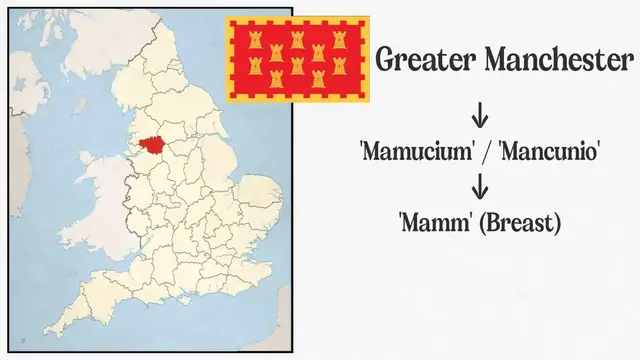
actually happens with the next one, Greater Manchester, while Manchester itself originates
12:58
from the Latin name Mamukium or its variant Mancuniu These names are generally thought to represent a Latinization of an original Britonic name The generally accepted etymology of it is that it comes from the Britonic mum meaning breast
13:15
in reference to a breast-like hill, possibly referring to the terrain of the region
13:20
And then Hampshire. Removing the shire, it leaves us with hemp, which presents a little bit of confusion
13:25
The Saxon settlement at Southampton was known as Hampton, while the surrounding area was called Amtunsyr. The old name was recorded in the Domesday book as
13:36
Amtasair, probably evolving into the current Hampshire. The word in Saxon is likely to have
13:42
meant something like trading center. Moving on to Herefordshire. It's first mentioned in an
13:47
Anglo-Saxon chronicle of 1051. The name Hereford probably derives from the old English for
13:54
army crossing, being the location of the settlement on the river Y. So potentially the place where
13:59
armies would be best suited to cross the river. And the next one, Hertfordshire, is similar. It
14:05
derives from Herudford, meaning Deerford, indicating a crossing used by Deer in the area
14:11
The name Hertfordshire was first recorded in another Anglo-Saxon chronicle, this one in 1011
14:17
And Deer feature in many county emblems, so it makes sense that that is the case
14:22
Next, we have the Isle of Wight, and its origin seems to be the Latin term
14:26
Vectis for the white part. The isle, of course, refers to the fact that it is an island. The oldest
14:33
records that give a name for the island are from the Roman Empire. It was called Vectis or Vecta
14:39
in Latin. The Domes de Buc then called the island Wit, likely a halfway point between the Latin term
14:45
and the modern English one. These are all variants of the same name. It may mean place of division
14:51
since the island seems to divide the two arms of the Solland
14:55
Then we have Kent, named for the Celtic tribe Conti who lived there before Roman occupation
15:01
It's actually one of the earliest recorded names in Britain, known to the Greeks since the explorer Pythias recorded it as Cantion
15:09
during his voyage around the British Isles in around 325 BC. It's pretty crazy to think that this random Greek guy was just traveling along the British islands
15:19
thousands of years ago, sort of like tourism as we do now. As such, it's been claimed as the oldest
15:25
recorded name still in use in England. The meaning has been explained as coastal district, cornerland
15:31
or land on the edge, so the tribe may have been named after the location in which they lived due
15:38
to its place in the southeast corner of England. Interestingly, the Portuguese word for corner is
15:43
cantu, so maybe they share a common meaning and origin. Moving on to the L's we have Lancashire
15:49
Lancashire takes its name from the city of Lancaster, whose name means Roman fort over the
15:55
river Loon, combining the name of the river with the old English kaister which, as we saw
16:01
derives from the Roman word for fort or camp which was castra. The Loon River took that name
16:07
from the Anglo-Saxon term Ea Leon with Ea meaning river and lawn meaning something like healthy
16:13
apparently. Keep in mind, again, many of these are uncertain and up for debate. And then Lycestershire
16:19
which has the same origin in half of its name, which comes from Leicester. Leicester seems to
16:24
come from Ligore Caistar, referring to the Roman settlement of the Ligore people. Moving on to
16:30
Lincolnshire. It originates from Lincoln, whose name means lake, pool, colony or something
16:36
combining the Britannic word Lynn with the Latin word colonia. Then we have the only ceremonial
16:41
country starting with an M which is Merseyside named after its location next to the River Mersey
16:48
Mersey itself comes from the Old English Mairis Ea meaning boundary river. The Mersey was possibly
16:54
the border river between the Old English kingdoms of Mercia and Northumbria. Next we have a very
17:00
simple etymology for Norfolk which means Northfolk contrasting with Suffolk which means Southfolk
17:07
And they refer to the people of East Anglia. Then we have North Yorkshire, which is a repeat on our list
17:14
York, as we saw, comes from Eburakum, with shire added for the county and the north for its geographic location
17:21
Another one is Northampton shire. Northampton comes from the Old English hamtoon, meaning home settlement
17:26
Ham is home and toon is town. And yet another north is Northumberland
17:32
The name is recorded in the Anglo-Saxon chronicle as Nord Imbraland, meaning the land north of the Humber
17:40
The connected name of the Kingdom of Northumbria derives from the Old English, meaning the people or province north of the Humber, written in this way that I'm not even going to try to pronounce
17:52
The Humber is a river, and its name may have Celtic origins. It may be derived from the ancient British word humbri, which could relate to water, rivers, or estuaries
18:03
Some scholars also suggest a connection to a proto-Indo-European route, meaning dark or muddy
18:09
and this would be reflecting the appearance of the river's water. Then Nottinghamshire
18:15
I keep pointing the paper at you when I say it. It's a very thick stack of paper. The script for this video is like 17 pages
18:22
But anyway, Nottinghamshire. It comes of course from Nottingham which emerged from Snottagham meaning something like home of
18:30
Snott's people, a local leader in the Anglo-Saxon period. Around 600 AD the Snottagas gave their name
18:36
to the settlements of Nottingham which were first recorded as Snottagham. Over the years the city's
18:41
name was gradually modified until it became known as Nottingham around the 12th century
18:47
Next is Oxfordshire, which means Ford of Oxen in Old English, indicating a place where Oxen would cross the river
18:56
Again, the river crossing origin. It's very interesting as you learn about etymology to find out the enormous amount of place names across the world that are named after rivers
19:07
and how often the rivers themselves are named for whatever the native word for river was
19:14
And so a lot of places in the world are just called something like river river
19:19
I don't know. It's interesting. Moving on to Rutland. It's a possible derivation from Rotland or linked to the old English word rut meaning castle
19:30
Rutland is also referred to as Rotland in the Domesday book which was completed in 1087
19:35
The name there carries a meaning that is more connected to the first hypothesis land belonging to rota with rota being an old English personal name that meant the pleasant or cheerful one So
19:47
in addition to the trend of places being named after river crossing locations, we also have this
19:53
other trend of places being named after a local leader or somebody that owns the land in that
19:58
place. Returning to another shire, we have Shropshire. Originally, a word that, again
20:04
I guess I can try to pronounce it. It's Scrobe Biriskeir. It's named for Shrewsbury
20:11
meaning fortified place in the scrub. Then Somerset. Somerset's name derives from an
20:17
Old English word, Sumorset, meaning the people living at the Somerton. Somerton, in turn
20:24
may come from Old English for Sea Lake Enclosure, Somertown, or Summer Farmstead. The first known
20:31
use of Somerton is in the law code of King Ine. He was a Saxon king of Wessex in the year 688
20:38
and this would also make Somerset one of the oldest units of local government in the world
20:43
An alternative suggestion is that the name derives from Seomere Saitan, meaning settlers by the
20:49
sea lakes, connected to the origin of Somerton too. Then, South Yorkshire, part of Yorkshire
20:55
and we already learned about the etymology of that with York. We can therefore move on to
21:00
Staffordshire, which comes from Stafford and Stafford is derived from Old English
21:05
Steph, which I guess we could read as stave and ford, implying again a cross supported by poles
21:12
A ford is an Old English term for a shallow part of a river that can be easily crossed
21:18
while a stave is a vertical wooden post or a plank in a building, some type of other structure
21:24
So perhaps referring to the constructed structure that allowed the crossing of the ford
21:29
I guess some type of bridge. And then Suffolk which, as we saw in opposition to Norfolk
21:34
refers to the southern people of East Anglia. It derives from Old English sud, meaning southern
21:40
and folk, meaning people. After that we have Surrey, from the Old English Southrig, meaning
21:47
southern kingdom, of the Middle Saxons territory. Tyne and Ware has a pretty simple etymology
21:52
it's named after the rivers Tyne and Ware. Tyne is likely Celtic in its origin from the term
21:58
tin meaning river while wer may mean water in old English. Again this is a perfect example
22:05
of a place being named after rivers and the rivers are just named after the native term
22:10
for that river. Going into the w's and starting to wrap up the video we have Warwickshire
22:16
Name for Warwick. Warwick's origin in turn seems to be the old English wer, werwig joining
22:22
two terms, Vair meaning dam or ver and Wyk meaning settlement or farmstead. So, Warwick
22:29
roughly translates to war settlement or the settlement by the ware. The town's location
22:35
on the River Avon suggests that the second interpretation related to a water feature may
22:40
have been the most relevant. Then we have the West Midlands, a regional designation derived from being the western
22:47
part of the Anglo-Saxon Kingdom of Mercia. There's not much to it, it was the middle
22:52
of the land. Another west is West Sussex, again a double geolocated name. It arrives from South
22:59
Seax, the land of the South Saxons, but here only referring to its western parts. And another west
23:04
is West Yorkshire, which for a third or fourth time we already saw, it comes from Yorkshire
23:10
which comes from York, which comes from the native Eburacum. When it comes to Wiltshire
23:16
it seems to be named after Wilton. Wilton itself seems to come from either the Old English
23:22
wellig, meaning willow, or wella, meaning spring or stream, plus tun, which means enclosure
23:29
settlement, or town. So either the willow town or the town by the stream. And finally for this video
23:35
Worcester, which is also the name of the sauce that nobody can pronounce, including me. After
23:40
removing the shire suffix, we are left with Worcester. The origin of this name is uncertain
23:45
and various theories exist. Some state it comes from the Old English Veogora, the name of a local
23:51
tribe. Others believe the name comes from the Saxon term Vege Rakaistar, meaning war castle
23:58
referring to a castle in the region. And a third option that seems more likely connects it with the
24:03
first is that it would derive from an Old English name, meaning Roman town of the Veogora. Veogora
24:09
in this case being a Britannic name meaning from the Whiting River
24:14
So those are the origins and meanings, so the etymology of the names of English ceremonial
24:20
counties, all 48 of them. Do you think there are any key counties that I left off by choosing to do the ceremonial
24:27
ones or did you spot any mistakes? Do you have any additional information
24:31
Let me know in the comments along with any suggestion for which other countries regions
24:35
I should make a video explaining the names of. Is that a right sentence
24:40
I don't know. Which names do you want me to explain? Which countries regions do you want me to explain
24:45
As always, thank you so much to my patrons for supporting me directly. We just hit 50 paying patrons and we're way over 100 in total, so if you want to support
24:53
the channel and access exclusive, extra content and behind the scenes looks, make sure to
24:58
support me there as well. Either way, thank you so much for watching this video and I will see you next time for
25:04
more general knowledge. When I tell you that I have recorded this video three times and every time something went wrong
25:20
the audio got messed up in one of them, the other one, the camera stopped recording because it ran
25:28
out of space and I didn't notice until I was completely done. So third time's the charm
25:35
let's hope otherwise i will go insane so today's movement cup is this one it's one of the new ones
25:44
that's we just got back from norway and it is i think it's like the monster of the show
25:52
and then some people some guys are like afraid of him but he looks pretty nice i think he's just a
25:59
little misunderstood because he's he's like big he's big and scary but it's cool to see that these
26:07
cops are like a little bit of a weirder not weirder but like a more different style than the other ones
Hobbies & Leisure
education
History
Educational Resources