Up next in 10



Go to our sponsor https://betterhelp.com/generalknowledge for 10% off your first month of therapy with BetterHelp and get matched with a therapist who will listen and help.
Which Countries have neighbouring capitals? In this video we take a look at some of the ones that do; such as Vienna and Bratislava, Tallinn and Helsinki, Vatican City and Rome, Buenos Aires and Montevideo, Brazzaville and Kinshasa, Maputo and Mbabane, Beirut and Damascus, Tel Aviv and Jerusalem, or Ljubljana and Zagreb.
TIMESTAMPS:
00:00 Intro
01:05 Austria (Vienna) & Slovakia (Bratislava)
02:03 Estonia (Tallinn) & Finland (Helsinki)
04:22 Vatican (City) & Italy (Rome)
05:27 Argentina (Buenos Aires) & Uruguay (Montevideo)
06:28 Congo (Brazzaville) & DRC (Kinshasa)
07:31 Mozambique (Maputo) & Eswatini (Mbabane)
08:55 Lebanon (Beirut) & Syria (Damascus)
10:04 Israel (Tel Aviv) & Palestine (Jerusalem)
11:11 Slovenia (Ljubljana) & Croatia (Zagreb)
12:02 Summary
Support me on Patreon & get exclusive / ahead of time content! https://www.patreon.com/generalknowledge
Follow me on Twitter: https://twitter.com/GKonYoutube
Join the Discord Server: https://discord.com/invite/f4neAVWZfF
Business Contact: [email protected]
Thanks for watching, remember to subscribe to catch future videos!
Show More Show Less View Video Transcript
0:00
Capital cities. Every country has one, some of them even have two. A capital city is very often a country's main center for business, culture and population
0:09
They were established, often a long time ago, as centers of trade and transportation, key areas where the main institutions of a certain kingdom, empire and now modern countries are located
0:20
London in England and Paris in France developed hundreds of years ago around large rivers, as is the case with many capital cities throughout the world
0:28
In the absence of rivers or in addition to them, many capitals are often located on the coast
0:34
This cool map shows us which countries have coastal capitals. But speaking of the location of a capital within a country, I had this question come up in my mind
0:43
Are there any countries that have their capital near their border? And if they do, do their neighbors have it close by as well
0:49
In this video, we're going to take a look at a few countries in the world with neighboring capitals
0:54
There's not a lot of them. In fact, I believe I will cover all of them in this video
0:58
If you notice any missing, just let me know. So let's jump right into them
1:05
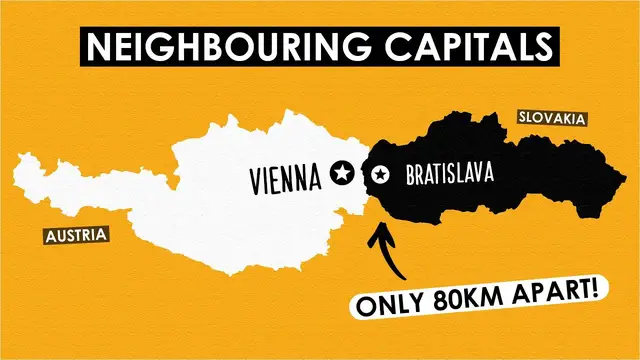
Let's start with Austria and Slovakia. Their respective capitals of Vienna and Bratislava are extremely close together
1:12
only about 55 kilometers apart, although it takes around 80 kilometers if you drive since there isn't a straight line to drive through
1:19
Austria and Slovakia had close bonds just prior to World War I
1:24
after all they were ruled together in the Austro-Hungarian Empire. And it seems up until 1918 they were actually very close, even having a railway connecting
1:32
them, with Bratislava having a sizable German-speaking population. In fact, it seems German and Hungarians were the majority of the town before the 20th century
1:41
with it previously being known as Pressburg. After Czech and Slovak independence, they became further separated, perhaps only closer
1:48
during German occupation, but during the Cold War they grew apart, being on opposite sides
1:53
of the Iron Curtain. In modern times and especially after both countries became a part of the European Union
1:58
they have grown closer once again and some even call them sister cities due to their proximity
2:04
Next are Estonia and Finland. Tallinn and Helsinki are also only about 80km apart
2:09
They are only separated by the Gulf of Finland and with both capital cities being coastal
2:14
ones, you could probably look across to each of them if you have a pair of binoculars
2:18
There's a proposal to build an underwater tunnel between them which would be the longest
2:23
in the world. Finland are even listed on the European Union website as an example of cooperation across the
2:29
sea. They state the cities are closed both geographically but also culturally with this
2:34
proximity going back in history. They both belong to the same Fino-Ugric group and their languages
2:39
are very close with around 60% similar words. In addition, Helsinki and Tallinn have traditionally
2:45
strong historic and economic ties. Both cities were controlled by the Swedish and once belonged
2:51
to the Antsiatic trade league. Helsinki was established by order of the Swedish king
2:56
Gustav Vasa in 1550. Tallinn previously known as Reval already existed but it also came under
3:03
Swedish rule in 1560 They also grew a little apart during the cold war but have been becoming closer again since Estonia independence Now before we keep going a quick thank you to BetterHelp for sponsoring this video BetterHelp is the world largest therapy service and it 100 online
3:21
With BetterHelp, you can tap into a network of over 25,000 licensed and experienced therapists
3:27
who can help you with a wide range of issues. To get started, you just answer a few questions about your needs and preferences in therapy
3:35
That way, BetterHelp can match you with the right therapist from their network
3:40
Then, you can talk to your therapist however you feel comfortable, whether it's via text, chat, phone, or video call
3:47
You can message your therapist at any time and schedule live sessions when it's convenient for you
3:52
If your therapist isn't the right fit for any reason, you can switch to a new one at no additional charge
3:58
With BetterHelp, you get the same professionalism and quality you expect from in-office therapy
4:04
but with a therapist who is custom picked for you, more scheduling flexibility, and at a more
4:09
affordable price. Get 10% off your first month at betterhelp.com slash general knowledge
4:16
and I've also linked them below in the description, or you can just scan the QR code
4:21
And now, back to the video. I'm not sure if this next one counts, but they are technically two
4:26
capital cities that border each other, Vatican City and Rome. Vatican City is a microstate
4:31
or a city-state even, and all of its country is located inside of Rome, the capital of Italy
4:36
Necessarily with their capital just being their entire territory, this is also located inside Rome
4:41
which would make the distance between the two capitals of the sovereign states zero kilometers
4:46
or whatever the thickness of the Vatican walls is. There is also an interesting historical
4:50
connection here. Rome itself used to be the capital of the Papal States, a much larger country
4:56
that took up a big portion of central Italy prior to Italian unification, and which is the
5:01
predecessor of the current Vatican City. As Italy became unified, the people states lost their
5:06
territory and were first reduced to Rome. After Rome was finally taken by the unified Italians
5:12
the people states' control was reduced to what the Vatican is today. And it actually took a long
5:17
time for them to formally abdicate control over the city and accept their new reality of being a
5:22
micro-state. And today, I guess you could consider both capitals as being neighbors
5:27
Next, we leave Europe and go to South America for two other close capitals, those of Argentina
5:33
and Uruguay. Buenos Aires and Montevideo are pretty close, although still around 200 kilometers apart
5:39
and it does take 4 hours to drive from one to the other, but the ferry between them is
5:43
only 2 hours. But look at the map, they're both coastal towns at the mouth of the Uruguay river, and
5:48
historically they are incredibly connected since colonial times to the Portuguese and
5:53
Spanish colonial empires. Buenos Aires was one of the largest cities in Spanish South America
5:57
Just across the river, the Portuguese founded Montevideo, seeking to compete with the Spanish in this important region for trade
6:04
They eventually lost it to the Spanish too in the 18th century, and since then, the two cities grew closer
6:09
becoming key parts in the Spanish commerce of South America, both functioning as major hubs for transatlantic trade
6:16
Eventually, both countries fought for independence against the Spanish, and even united in some of these efforts the proximity and constant interaction between the two throughout history somewhat lasts up to today Speaking of transatlantic trade let move across the Atlantic Ocean for the next example
6:33
the Congo and the Democratic Republic of the Congo. Their respective capitals of Brazzaville and Kinshasa are very close together, if you don't
6:40
count the Vatican City and Rome they're the closest in the world. The distance is even said to be non-existing, they're just across the river from each other
6:48
and the ferry takes only 5 minutes, but there's oddly no bridge between them for some reason
6:52
Some say the two settlements already existed close by during native rule
6:56
and only became separated because the French colonized one side and the Belgians the other
7:01
I'm not sure if this is true, in reality it seems both of these colonial powers
7:05
chose to establish their local colonial capitals in the same region, because it was the best place for the exploration and trade of local resources
7:14
especially up and down the Congo River. But they didn't get along very well and separate railways
7:19
were built for each on each side of the river. The rivalry and distrust between settlements
7:24
according to some, still lasts until today. They may be close by but the cooperation between them
7:29
is not the same as many on this list. Also in Africa are Mozambique and Iswatini. Maputo and
7:35
Mban are pretty close together too. If you drive it's only around 4 hours and 216 kilometers apart
7:42
However, unlike previous examples on the list, their proximity seems to be absolutely coincidental
7:47
Maputo was founded in 1850 by the Portuguese as a settlement in their colonial empire
7:52
with its location likely being chosen due to the ability to build a seaport there
7:56
given that it's situated on a large natural bay and this allowed the Portuguese to have an import-export location
8:02
from which to trade with their other colonies in the Indian Ocean and Asia
8:06
A fun fact, Portugal actually wanted to unite their colonies of Angola and Mozambique
8:11
The famous pink map shows their plan which was ultimately refused by the British
8:15
which in turn wanted to unite their colonies of Egypt and South Africa
8:19
The acceptance of British terms by the Portuguese king is said to be one of the main causes that led to the end of the monarchy in Portugal
8:26
But anyway, what about Mban in Iswatini? Why is it so close to Maputo
8:31
It really does seem like a coincidence. It's located on the Mbane River and was likely built there
8:35
due to this freshwater axis like thousands of other cities in the world
8:39
So, to answer the capital proximity question, the answer we have to find is that of another
8:44
question, why is it a capital? The answer, because throughout history, their local leaders were able to negotiate concessions
8:50
with the British, not becoming a part of the South African colony and thus retaining their independence
8:55
Lebanon and Syria are next. Beirut and Damascus are only 115 kilometers away, you can drive between them in just over
9:03
an hour. Beirut is a coastal city while Damascus is not. But while Beirut had bigger importance in trade more recently, the Syrian capital was also an important center throughout history
9:13
Damascus is one of the oldest continuously inhabited cities in the world, first settled in the 3rd millennium BC
9:19
It was even chosen as the capital of the Umayyad Caliphate. The two are also connected historically, cooperating in economic development of the region
9:28
For instance in the 1700s with the help of Damascus Beirut successfully broke Acre monopoly on Syrian maritime trade In 1888 Beirut was made capital of Aviliyat in Ottoman Syria therefore existing within the same imperial province In 1894 French engineers built a harbour
9:46
and a city and a railway connection across it, connecting it to Damascus and Aleppo. Today I
9:52
believe a highway also connects the two capitals. They were also connected precisely through the
9:56
French when the European country took control of the region from the Ottomans after World War I
10:00
through the French mandate for Syria and Lebanon in 1922. Just nearby are Israel and Palestine, which are also a good example of neighboring capitals
10:09
although the status of them is disputed, as is everything else in the region
10:13
Israel recently stated it was moving its capital to Jerusalem, while government offices, I believe, remain in Tel Aviv
10:19
Palestine also seems to claim at least East Jerusalem as its capital
10:24
even though Ramallah is the de facto administrative center. If both countries were in agreement, this could even be a case of a shared capital city
10:31
I believe the only one in the world, and the distance between them would therefore be non-existing
10:35
Unless we count Northern Cyprus as a country, in which case it also shares the capital of Nicosia
10:40
with the Republic of Cyprus since the island is divided between the south and north
10:45
the latter being a Turkish protectorate. Nicosia itself, I believe, is only divided through a very
10:50
thin wall. If we assume Tel Aviv as Israel's capital and Jerusalem as Palestine's
10:56
They're still very close together, only one hour of driving away and a mere 68 kilometers
11:01
Jordan's capital city is also close by. The city of Amman is only 72 kilometers away from Jerusalem and 163 kilometers from Tel Aviv
11:11
And finally for this video, we go back to Europe to Slovenia and Croatia
11:15
Liubljana and Zagreb are only around 100 kilometers apart, taking two hours to drive from one to the other
11:21
But again, the proximity seems to be coincidental. they are two cities that happen to become the capitals of their respective countries
11:27
The history of Zagreb dates as far back as 1094 AD, and it seems to have grown around a church built by Hungarian king Larislaus
11:35
growing more and more, it became the capital of the Croatian kingdom in 1557
11:40
Liubljana seems to have grown around a castle with the same name around the 12th century
11:44
also becoming the capital of local regions such as Carniola or the Napoleonic Illyrian provinces
11:50
and then Drava Banovina within Yugoslavia. After Slovene independence, it remained the national capital, which just happens to be very close to that of Croatia too
11:59
They are said to be very different cities despite their proximity. So, those are some of the closest capital cities in the world, some of them being incredibly close, almost coexisting together, while others are a little further away but still close by
12:12
Some are connected in their establishment and have cooperated throughout history, while others are distant despite their geographical proximity
12:19
There's a few other examples of nearby capitals. Island nations for one have this as a common feature, in the Caribbean for instance, but
12:26
it's only because the islands are next to each other and each of them are their own
12:30
country slash capital, so I didn't think it would count for this video
12:34
Are there any other neighboring capital cities in the world that I didn't mention, and do
12:38
you know any more interesting facts about these ones? Let me know in the comments
12:41
Thanks so much for watching this video, subscribe if you want, and I will see you next time
12:46
for more general knowledge
Hobbies & Leisure
education
People & Society