Up next in 10


Watch the moment Israel destroys the Qasmiyeh Bridge over the Litani River in southern Lebanon, as strikes on Hezbollah targets intensify. The escalation follows rocket fire into northern Israel, with growing fears of a wider conflict involving Iran and rising global energy prices.WATCH ABOVE.
Show More Show Less View Video Transcript
0:00
This is the moment Israel strikes the Kazmier Bridge, a key crossing over the Latani River
0:09
in southern Lebanon in a dramatic escalation of the conflict with Hezbollah
0:14
The blast tears through one of the main routes in the region
0:31
part of a wider Israeli operation targeting infrastructure it says is being used by Hezbollah
0:38
And this wasn't an isolated strike. A separate Israeli strike hitting the city of Tyre
0:57
as Israel signals it is prepared to push further into southern Lebanon
1:02
potentially up to the Latani River. The escalation comes after Israel's defence minister, Israel Katz
1:09
ordered the destruction of bridges across the Latani and an increase in demolitions near the Israeli border
1:16
Israeli officials say the objective is clear, to prevent further attacks and secure northern communities
1:24
That follows a deadly incident earlier in the week. An Israeli civilian was killed in his car near the Lebanese border
1:31
after what the military described as a launch from Lebanese territory, the first civilian death of its kind in this phase of the conflict
1:40
Two Israeli soldiers have also been killed in fighting in southern Lebanon
1:45
The latest round of violence began after the Iranian-backed group Hezbollah fired rockets into northern Israel in retaliation for Israeli strikes
1:54
and the killing of senior Iranian leadership. Since then, the situation has rapidly spiralled
2:01
According to Lebanon's health ministry, more than 1,000 people have been killed
2:06
including children and medical workers with over one million people displaced International concern is growing The United Nations has criticised Israel actions particularly strikes on infrastructure and the scale of evacuation orders
2:23
noting that international law generally prohibits attacks on civilian sites. But Israel maintains it is acting in self-defence
2:32
targeting militant positions and infrastructure linked to Hezbollah operations. And the conflict is widening. Israel says it has also killed an Iranian Navy chief linked activity in the Strait of Hormuz, one of the world's most critical oil routes
2:48
The fallout is now being felt globally. Energy prices are rising and the UK is expected to be among the hardest hit major economies from the economic shock linked to the conflict
2:59
This is no longer a regional issue. It's a global one. And it's a war that continues to raise serious questions about security
3:07
proportionality and the risk of further escalation. So, where does this go next
3:13
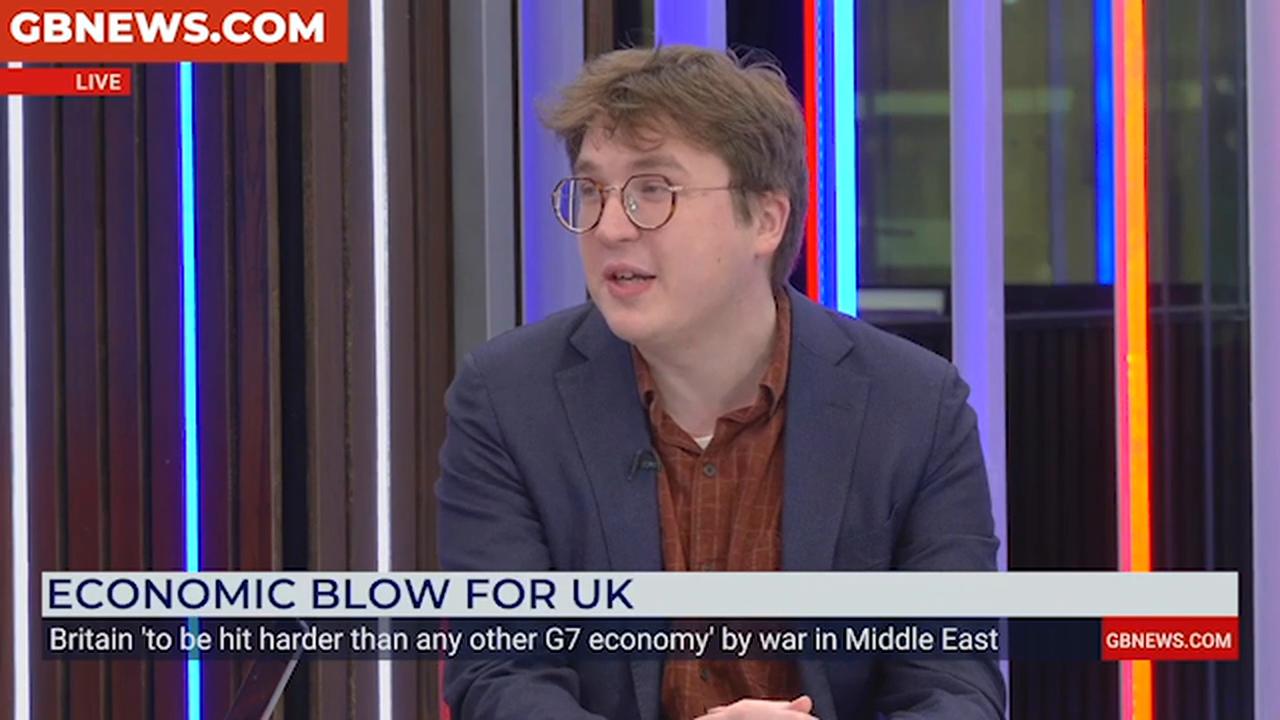
Commentators on GB News have had their say. Britain is set to take the biggest economic hit from the Iran conflict
3:20
more than any other economy in the G7. Yeah, a new forecast from the OECD show
3:26
Britain's growth outlook has been sharply downgraded, expected to rise by just 0.7% this year
3:33
one of the weakest rates in the developed world. Well, ysts say that Britain is particularly vulnerable
3:38
due to its high borrowing and reliance on imported energy. Joining us now is City editor at City AM, Simon Hunt
3:46
Simon, you are here rather a lot, but we do need your expertise. Well, I always do think it's a bit of a recession indicator
3:52
of financial giants or Ontario, so maybe it's not a good thing on here. You know, I mean, if you were summing up the economy, what emoji would you use at the moment
4:00
Probably one that's not safe for you to broadcast. But no, it's really not good news
4:05
We have to at least thank good old reliable Italy from saving us from being at the bottom of the league table
4:11
But only tiny. Only tiny, yeah. I mean, there's really no way to sugarcoat this
4:15
We have seen a very sharp downgrade in the UK's growth projections
4:20
Of course to be fair virtually every G20 economy has seen its growth projections downgraded So the UK is no exception in that respect But we have seen the sharpest of all the G7
4:33
And there are several reasons for this. Of course, the most obvious one is the energy shock that we've seen from the conflict in Iran
4:41
And we're very exposed to that because we're a net importer of oil and gas
4:45
But it's worth remembering that actually the UK's economy wasn't in a particularly healthy position before the outbreak of war in Iran
4:52
In fact, if you look at some of the economic data that's come out the last few days that relates to February, it doesn't show very good news
4:59
Unemployment was high. Growth was virtually at zero. Inflation was above target
5:04
So what's happened in Iran? Borrowing as well. Indeed. So what's happened in Iran has only exacerbated an already bad situation for the UK's economy
5:11
And yet I've already heard the government. I've heard this argument from government ministers
5:16
I've heard it from the prime minister saying everything was improving. Everything was getting better and then, bam, this war comes around and now, sorry, we're not going to be able to meet our targets
5:26
We're not going to be able to fulfil our promises. I mean, it's a load of baloney, isn't it
5:29
Yeah, I mean, as I say, there was very little to cheer about in previous economic data
5:34
Certainly, it does give the government an excuse or something to blame if the economic situation does deteriorate over the next few months
5:44
Perhaps the only bit of good news, ironically, is actually because unemployment is so high
5:49
we won't see the same kind of jump in inflation in the UK that we did in the last energy crisis
5:54
following the Russian invasion of Ukraine. So at least we won't, at least according to the OECD
5:59
see north of 10% inflation, but it's still going to go up to about 4% this year, they say
6:04
What can the government do? Well, I mean, there's very little in the way of options open to it
6:10
not least because public debt is so high at the moment. so we certainly can't introduce a kind of huge energy package or energy bailout package
6:18
The OECG has recommended against that for the UK, but has said to the extent that we do try and mitigate the surge in energy
6:26
it has to be very targeted, very carefully spent, so that it doesn't itself push up inflation
6:31
I was fascinated to read in the New York Times this week about the Saudi crown prince and how he was rather quite enjoying this war reducing the power of Iran in the Middle East But also potentially I was thinking to myself Saudi Arabia as an oil
6:47
producing nation, doesn't much mind it if the price of oil goes up. And that got me thinking
6:53
well, it wasn't so long ago, it was within all of our lifetimes that Britain was a net energy
6:59
exporter. I mean, if we really had gone hell for leather, digging our own, drilling
7:05
our own oil and gas in the North Sea in particular, then
7:08
an energy price shock like this, instead of being a bad indicator on the macro level for the British
7:15
economy, would actually be a windfall boon to our economy. Indeed, and you've seen actually
7:20
the growth rate for the US has also been slightly upgraded, I think, for the OEC
7:25
as well. I believe that's the case just by a little bit, because it's
7:29
a big oil producer. So, yeah, absolutely, it is conceivable that the oil production
7:35
that we have today could be a lot larger than it currently is in the UK
7:40
I don't know if that would get us to the point of being a net exporter again, but there are decisions that have been made the past 18 months
7:48
but also have been made by previous governments that mean we're not exploiting our full oil resources
7:55
And Simon, you're a financial journalist, a very, very good one. and that's why we have you in all the time
8:00
But why don't the government look forward in the way financial journalists do
8:06
I mean, you know, most people, even those of us that aren't economically literate like myself
8:11
can see this coming. Why can't the government? That's a very good question
8:16
I know there was a survey on which news websites MPs read the most this week
8:22
and Bloomberg, the sort of foremost financial website, was only about 6%, so that might give you an idea
8:27
of how financially literate some of our politicians are. But, yeah, it does feel as though the government has felt
8:35
it's in this constant firefighting state where it's trying to manage today's struggle
8:40
or today's car crash situation. It's not thinking about the next two, three, four years
8:45
And that means we could well end up in a similar situation in the future. We'll be seeing a lot more of you then, Simon
8:50
Thank you very much. That's City Editor at City AM, Simon Hunt. Thank you so much for joining us
#news