Up next in 10



Greetings and salutations to those finger-clicking, mirror-loving tricksters of Star Trek lore.
Show More Show Less View Video Transcript
0:00
In 1966, William Campbell burst onto our screens as Trelane, the energetic and fiercely powerful
0:05
demigod, intent on having his fun no matter the cost. Why, it was all a lark, so what does it
0:10
really matter if you're all my prisoners now? Though Kirk had his thoughts on the matter
0:15
this wouldn't be the last time Starfleet would encounter beings of near omnipotence in their
0:19
travels. Along the way, we would meet Metrons and we would meet Organians, the Dowd would be
0:24
dower while the Vesda continue to puzzle. Through it all, there is but one continuum
0:30
The Q-continuum is almost as abstract as the original statement Star Trek is. The Q-continuum
0:36
is a road, a battleground, an ever-changing empire ready to overpower mortality with a swish and a
0:43
flick. There is so much that we now know, mixed with the tomes of lore we've yet to learn
0:49
The Q are at once eternal and not, evidenced by a certain 21st century example by way of an
0:54
alternate 24th. They can experience pain and suffering, both physical and mental. They are
0:59
not without conscience, though their fierce intelligence lifts them to lofty heights above us
1:04
mere mortals. Above all else, through matter manipulation and entertainment via torture
1:11
one must remember that to a cue, time is like a predator with no teeth. That is to say
1:18
sometimes we learn more as we travel farther backwards in time. I'm Sean Ferrick for Trek
1:24
culture and here is everything we now know about the Q continuum. Number 10. Three cheers for the
1:32
original Trelane. The squire of Gothos was an oddity for more than 20 years. The godlike child
1:39
Trelane took Kirk and crew hostage, played jaunty tunes on his harpsichord, and to wrap up the day
1:45
he engaged in a game of dueling pistols. This might have been a standard Tuesday for him
1:49
but was anything but for Starfleet. The inspiration behind Trelane, created by Paul Schneider
1:55
was the image of children playing at war. Here was a being godlike with his toys, but childlike
2:00
in his understanding of consequence. At the episode's conclusion, and after a couple of
2:05
ornamental revelations, Trelane was given a good spanking by his cloudy with a chance of green
2:11
parents. He was, after all, just a bold boy playing a little rough in the toy box
2:15
With his second appearance on screen, this childlike nature remained, even if the character has a new dimension in terms of familial connections
2:25
What does this mean for the biggest family of them all? With his fabulous costumes, outdated research on Earth's history, and ever-winning smile, except for all the losing
2:35
Trillane was unique in Star Trek's pantheon of gods and monsters. He then served to inspire the original named member of the vaulted continuum
2:45
9. I am the Guardian of the Continuum Wedding Bell Blues has not only added a new beat to the history of the Continuum
2:55
but it has also recontextualized some Star Trek lore in its wake
3:00
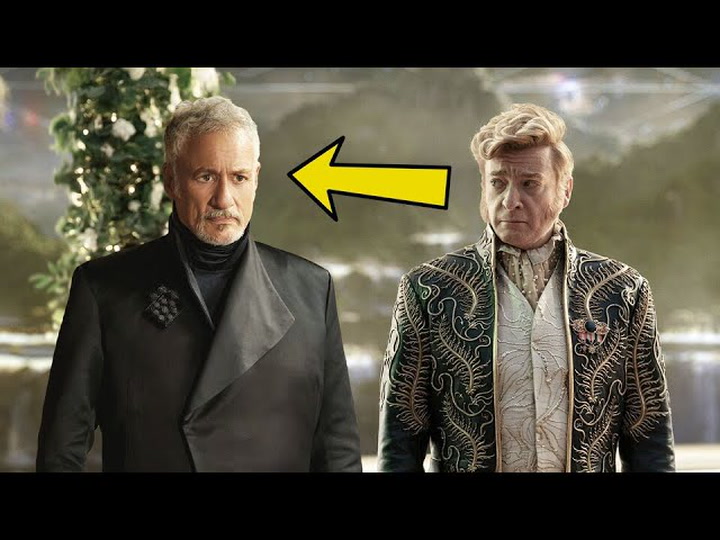
John Delancey's guest appearance as Trelane's dad may seem like a fun little gag to end the story with
3:08
but it connects to another ancient being while doing so. In The Squire of Gothos, Trelane is scolded by his parents at the close of the episode
3:17
His mother and father are voiced by Barbara Babcock and Bartel LaRue respectively
3:21
LaRue would go on to voice another iconic character in the original series
3:26
and Discovery via archived audio, the Guardian of Forever. The Guardian could change its natural state, consider Carl
3:34
move as it willed through space and also possessed the ability to affect time
3:39
All of these are traits that we, the audience, have seen as part of the continuum
3:44
As the studio has confirmed that Rhys Darby was playing Trelane, it stands to reason that Delancey was playing that same role that LaRue originated
3:54
Two men with French names playing some cosmic giants? Well, it's not to like
3:59
Perhaps this may best be read with tongues firmly in cheeks but connecting the continuum to the Guardian of Forever However when one considers the powers and abilities of both may not seem like that much of a stretch
4:11
Number 8. It's all about the fans. John Delancey is the most immediately recognisable member of the
4:18
Q Continuum for good reason. His Q, the apparently eternal trickster, debuted in Encounter at Far
4:24
Point thanks to some rewrites, some padding, and a little tip of the hat to a fan club president
4:29
Janet Quarton had led the Star Trek Action Group, the group responsible for hosting the first UK Star Trek convention in 1974
4:37
She later met Gene Roddenberry, Majel Barrett and Susan Sackett, which in turn led to several appearances at conventions
4:44
When Roddenberry received Dorothy Fontana's script for the TNG pilot, he hastily began some rewrites
4:51
Q was added by Roddenberry in part to extend the pilot into feature length
4:55
Naming the character for Quarton became an ongoing gag as many of the episodes that feature the character, or the continuum, play with the letter in the title
5:04
Hide and Q, Cupid, the Q and the Grey. Ensuring the legacy of Quarton's friendship with Jean remained ever present
5:13
7. It's Been a Long Road By now, the image of the Q continuum, represented as one long, unbroken road, is familiar to many fans
5:23
Originating in the episode Death Wish, this version of the continuum served only to allow
5:28
Janeway and Tuvok to understand the nature of the beast. It was not meant to be taken literally
5:34
nor was it the precursor for the greatest theme song of them all. The road that would form the
5:39
basis of a crucial scene in the episode was also a stand-in for the then-journey of the character
5:47
John Delancey's Q had appeared several times on The Next Generation, and once on Deep Space Nine
5:52
Rick Berman was initially resistant to having him simply pop up on Voyager as well, particularly if it meant more of the same
6:01
In Star Trek Monthly issue 10, Berman noted, Bringing Q to Star Trek Voyager has to be done carefully
6:07
We don't want to give the impression that, of all the Starfleet ships around, the only ones Q visits are those that have on-air series
6:15
Delancey's appearance on Deep Space Nine was an attempt at bringing his trickster god character to the spin-off, but it didn't seem to click
6:21
so even though he initially believed he was being pitched another script for that series
6:26
Delancey had no idea Voyager was on the cards, as per the official Star Trek Voyager magazine issue 6
6:36
Kenneth Biller, who was a staff writer on Star Trek Voyager, was assigned the Q and the Grey
6:43
This episode would go on to have lasting repercussions for the continuum
6:47
not least in introducing the character who would eventually pop Spock into a glass
6:52
and put down pee pads for Corby. According to Cinefantastique, volume 29
6:57
Biller described himself as the least avid Star Trek fan on the team
7:02
Creating the script for the episode involved looking backwards. Biller drew on one of the ideas that Sean Pillar, son of Michael
7:08
had included in his story for Death Wish. There, Q had warned that the death of a Q would result in a grave fallout
7:16
and may involve the entire galaxy. The Q and the Grey, at least in part, sees that promise through
7:22
Much like the road in the previous episode, Biller decided to represent the continuum in a way that
7:27
humans could understand. As there was to be a Q Civil War, it was presented as the American Civil
7:34
War, redressed Hollow Mansions included. Returning star John Delancey enjoyed almost every aspect of
7:40
this latest offering, believing the episode to be well-rounded, creative, and fun, as per the
7:46
Star Trek Monthly issue 34. However, he also said, there is always a problem when you make the choice
7:52
of showing something like the baby Q at the end. I just didn't think showing the baby was a good
7:57
thing to do. Number 5. Q Me? The sixth season episode of The Next Generation, eventually titled
8:05
True Q long after production had commenced was pitched by a young writer named Matthew Corey and originally titled Q Me This was the first of two Q episodes in the show sixth season
8:18
and the last time in The Next Generation that anyone from the main cast other than Picard
8:23
encountered Delancey's Q. Amanda Rogers was originally written as a male character
8:29
one whom Jerry Taylor believed Corey intended to play himself, according to the Star Trek The Next Generation companion
8:35
This episode is the first chronological mention of a Q offspring, though one that doesn't break canon with later outings
8:43
While Q Jr., introduced in The Q and the Grey, would be the first true child of 2Q
8:50
Rogers was a child of 2 human Q, making her an unexpected anomaly
8:54
That she inherited powers was a mistake, thus resulting in Q's inspection
8:59
as well as the very real chance of her execution. Delancey was delighted to return to a mad, bad and dangerous to know character, as per the companion
9:09
but felt that the episode fell short. He agreed with Michael Piller that Q had been softened somewhat in his frequent outings
9:16
and tried to imbue this performance with something a little edgier. The inclusion of Q's shadowy contact, another member of the continuum
9:23
was added to Corey's story to add some tension. However, per Delancey
9:28
I tried to put malevolence in places there, but that didn't really lend itself again
9:33
I can't do it within the context of birthday parties and babysitting and stuff like that
9:37
It's something you need to have the setup for. I would have liked to have taken it one step further, where Amanda was killed
9:43
As presented, the continuum may have been fully capable of dropping a tornado on some errant members
9:49
but would stop short of killing a young woman. Number four, the trouble with mirrors
9:54
The Q Continuum had always existed, according to Q, and by the time Quinn encountered Captain
10:00
Janeway and the USS Voyager, they had been everywhere and seen everything. This was the
10:05
story that led to the creation of a new Q Child, which sent ripples through time and led to a
10:10
potential plot hole in Star Trek's history. Trelane, posing as the Squire of Gothos
10:16
focused his powers using a mirror machine, one that was destroyed by Captain Kirk
10:20
Though this did little to rid Trelane of his powers, it did seem to weaken him for however brief a time
10:25
However, Wedding Bell Blues confirms that Trelane is Q Jr., the child of Q and the female Q, so what need was there for a mirror machine at all
10:35
Trelane's true nature had previously been explored in Beta Canon in Peter David's novel Q Squared
10:41
Here, David suggested that the mirror machine was a sort of training device for young Q, like the wheels on a child's first bicycle
10:47
When this is combined with Strange New Worlds' revelation, we can surmise that although Q Jr. had previously demonstrated his abilities in Q2
10:56
this device was a sort of assignment, or even punishment, for a period of his existence
11:01
Wedding Bell Blues seems to take place mid-Q2 in the interval where both he and his father leave Voyager
11:08
with the former episode clearly demonstrating Q's supervision over his son. In truth, the machine has never truly fit into established Q-continuum continuity
11:18
though for a species that exists outside of non-spacetime, that's not all that shocking to discover
11:24
Number 3. Q-fight at the Galactic Barrier True to their nature as omnipotent beings, the Q-continuum was never going to be confined to
11:32
a single type of media. They leapt from the screen to novel form, though this jump almost
11:38
destroyed the galaxy, Q himself, and had a fairly large impact on Star Trek canon, including two
11:43
barriers and a bunch of rockmen who may or may not have been seen on screen. Greg Cox's series
11:49
involves flashbacks to a younger version of Q, while also helping to explain part of his frequent
11:54
dealings with humans. Instead of, at least initially, it being his happiness at seeing
11:58
his human friends, he was there by way of punishment from the continuum for inadvertently
12:03
helping to destroy several civilizations. In this version of Q's story, he is still connected to the
12:08
Guardian of Forever though rather than vocally he abuses it Perish the thought Q discovers an ancient being known as Nil Nil manages to trick Q into releasing him into our plane of existence despite the protestations of the Guardian What follows is a war that includes
12:25
the Tikkan, Sargon's people, the Ancient Ones, and even the Calamaran. Nil allies himself with
12:30
the Beta-12a creature, the Gorgon, and the One, who is better known as the Shakari being
12:36
Facing them are Q, Quinn, Q2, and the Female Q. The end result is destruction, escape, banishment
12:43
and barriers. The Great Barrier at the centre of the galaxy and the Galactic Barrier encircling the
12:48
Milky Way galaxy are both direct outcomes of this Q war, which is something that Cybok
12:54
Dr. Elizabeth Daner and Gary Mitchell may all have something to say about. Number 2. What is a life worth when a continuum doesn't know what happens when it's over
13:02
In 2012, Kirsten Beyer, who would go on to co-create Star Trek Picard as well as write
13:07
several stories and scripts for Discovery and Strange New Worlds, was already an established
13:11
author. She took over the Star Trek Voyager relaunch novels and, as part of that series
13:16
was responsible for a major revelation about the continuum. Her novel, The Eternal Tide
13:21
reveals that the continuum has its own set of commandments, including one that specifically
13:26
warns Q not to reanimate the dead. The Q continuum don't fully know what happens after death
13:33
In Hyde and Q, Riker, when imbued with Q's powers, refuses to bring a dead child back to life
13:39
though as part of his promise to Picard rather than any restrictions on power
13:44
Worf and Wesley are both seemingly killed by soldiers in Q's war game while the aforementioned child stays dead
13:50
Worf and Wesley are returned to life without any real repercussions. From Q Who onwards the dead tend to stay dead with a notable exception
13:59
Byer's novel seems to confirm this is a conscious choice by the continuum
14:04
so as not to disrupt reality and those living in it any further
14:09
However, there is another consideration here. According to the captain's logs, the complete unauthorised Trek voyages
14:16
Rene Echevarria felt that hide and cue was symptomatic of some early season teething issues
14:21
He said, A lot of first season stuff we try not to feel bound by because a lot of it wasn't well executed
14:28
By his own admission, as the years went on, some of the writers hoped that people hadn't watched the debut season of The Next Generation
14:33
Byers' novel may simply be another extension of that hope. Number 1. We all have our favourites, Jean-Luc. And now, I die. So came the final act of John
14:45
Delancey's familiar cue in Star Trek Picard's second season finale, Farewell. With a click of
14:51
his fingers, he returned J.L., Raffi, and Seven to the right time and place, while also resurrecting
14:56
Elnor, and seemingly killing himself in the process. Farewell was written after the publication
15:02
of the Eternal Tide by Christopher Monfette and Akiva Goldsman. In this episode, Q states that
15:07
as he is about to die, he is about to experience something new. This, reminiscent of Quinn from
15:13
Death Wish, may be another state of being entirely, something already experienced by Worf, Wesley
15:19
and Elnor, or different again thanks to their different physiologies. Thanks to this uncertainty
15:24
the Q continuum get to have their cake and eat it. They are both unable to know what it is beyond
15:29
death while still having the power to recall people from it, even if it breaks their own rules
15:34
The episode also suggests that Delancey's Q is definitely dying, though what is time to a time
15:39
traveller? The post-credits scene in The Last Generation shows Q admonishing Jack Crusher for
15:45
thinking in three-dimensional terms. So, for as much as we know about the continuum, do we really
15:49
know anything at all? One thing is for sure, if William Campbell, Rhys Darby, and John Delancey
15:54
have proven anything, it's that whatever they do, they do it in style. And that's everything for
15:59
our list today folks thank you so much for watching along we really really appreciate it
16:02
please make sure that you're subscribed and please make sure you're following us on the various socials we're at trek culture or at trek culture yt on instagram i have been sean you can
16:10
catch me at sean fabric on the various socials too if you want to grab yourself some merch you
16:13
can do so by following the link underneath the description of this video you look after yourselves
16:17
until i see you again lead with love lead with peace put some kindness out into the world and
16:22
wherever you are stay safe live long and prosper