0:05
First, Deputy Prime Minister Dennis
0:07
Manturov has publicly outlined the
0:09
timeline for a major national space
0:12
initiative, emphasizing that the
0:14
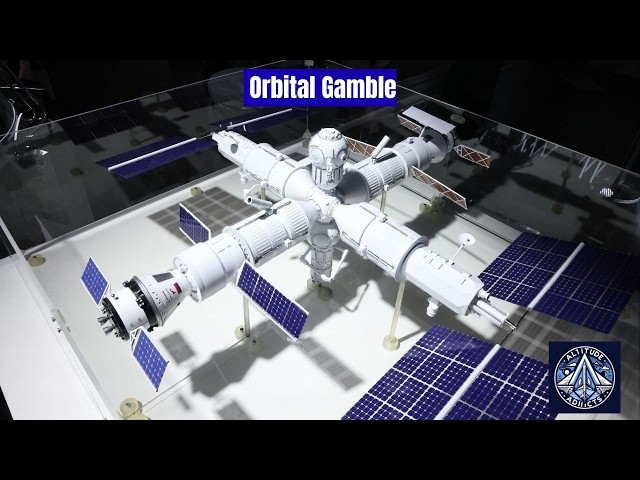
development of a Russian orbital station
0:16
and next generation launch systems,
0:18
including rockets with reusable first
0:21
stages, ranks among the country's
0:25
He stated that deployment of Russia's
0:27
own orbital station is expected to begin
0:29
in 2028 and is intended to support deep
0:32
space exploration, including
0:35
preparations for a future Russian lunar
0:39
Altitude Addicts, the YouTube channel
0:41
presenting this analysis, explains that
0:44
this announcement reflects a broader
0:45
shift toward building a self-sufficient
0:48
space architecture centered on the
0:50
Russian orbital service station, often
0:56
The strategy signals a gradual move away
0:58
from reliance on international
1:00
frameworks toward a national orbital
1:04
Looking at how this concept emerged
1:06
helps explain its importance because the
1:08
idea of a new Russian station evolved
1:11
from earlier plans for a modular orbital
1:13
complex capable of supporting spacecraft
1:16
assembly and longduration missions.
1:20
Interest in an independent station grew
1:22
as officials cited aging infrastructure
1:25
and the desire for strategic autonomy.
1:28
During the early 2020s, policymakers and
1:31
engineers explored ways to preserve
1:34
continuous human spaceflight capability
1:36
while reducing dependence on
1:38
international partnerships.
1:40
The proposed station is designed as a
1:42
self-contained outpost that could
1:45
eventually replace Russia's role on
1:47
existing orbital platforms and become
1:49
the centerpiece of its human spaceflight
1:53
Turning to timelines provides a clearer
1:56
picture because current plans indicate
1:58
that construction could begin with the
2:01
launch of the first module around 2027
2:04
to 2028, followed by early crude
2:07
missions soon afterward.
2:10
Initial phases would include essential
2:12
modules such as a science and power unit
2:15
with additional modules added through
2:19
By the middle of the 2030s, the complex
2:22
could consist of multiple modules
2:24
forming a fully operational station
2:27
capable of supporting research,
2:29
logistics, and spacecraft servicing.
2:32
Officials have suggested that the
2:33
station may operate largely in automated
2:36
mode with crews visiting periodically
2:39
rather than maintaining a permanent
2:40
presence, reducing both costs and
2:46
Altitude Addicts notes that Mantrov's
2:48
emphasis on the 2028 deployment aligns
2:52
with these broader plans and highlights
2:54
the project's importance at the highest
2:56
levels of government planning.
2:59
Automation and flexibility appear to be
3:01
key design philosophies.
3:04
Examining the technical architecture
3:06
reveals that the station is intended to
3:08
operate in low Earth orbit at an
3:11
altitude of several hundred km, roughly
3:14
between 400 and 500 km above Earth's
3:18
surface or about 200 ft to 310 mi. A
3:23
central science and energy module would
3:25
provide electrical power, life support,
3:28
and research facilities.
3:30
Over time, additional elements such as
3:32
docking ports, laboratory modules, and
3:35
storage compartments are expected to
3:37
expand operational capabilities.
3:40
Advanced robotic systems are planned to
3:43
assist with maintenance and assembly,
3:45
reflecting a broader trend toward
3:47
automation in orbital infrastructure.
3:51
Another concept involves using the
3:52
station as a hub for deploying small
3:55
satellites directly from orbit
3:57
supporting Earth observation,
3:59
communications, and scientific
4:02
Mantrov also highlighted plans for new
4:05
launch vehicles with reusable first
4:07
stages designed to improve cost
4:09
efficiency and competitiveness in the
4:11
global launch market.
4:14
Considering its role beyond Earth orbit
4:16
shows that one of the main purposes of
4:18
the station is to act as a staging
4:20
platform for missions aimed at deep
4:25
Technologies required for sustaining
4:27
human presence on the moon could be
4:29
tested there as part of preparations for
4:35
Altitude Addicts explains that the
4:37
station could support astronaut
4:38
training, propulsion experiments, and
4:41
validation of life support systems for
4:43
longduration missions.
4:46
Such capabilities would help maintain a
4:48
presence in deep space exploration amid
4:51
growing global competition.
4:54
Looking at its relationship with
4:55
existing orbital programs shows that
4:58
Russia has indicated plans to gradually
5:01
reduce participation in current
5:03
international stations as they approach
5:05
the end of their operational lifetimes.
5:08
Decades of experience in operating
5:11
earlier stations are expected to inform
5:13
the design and procedures of the new
5:17
Lessons learned from previous missions
5:19
regarding safety, operations, and
5:21
longduration habitation are likely to
5:24
shape engineering decisions and mission
5:26
planning. This continuity highlights
5:29
Russia's long history of building and
5:31
operating orbital platforms.
5:34
From a political and strategic
5:36
perspective, the station carries
5:38
symbolic importance as well because
5:41
space achievements are closely tied to
5:43
national technological identity and
5:46
international standing. An independent
5:48
station allows research agendas to
5:51
proceed without reliance on external
5:53
partners in a changing geopolitical
5:57
Altitude Addicts notes that space
5:59
infrastructure also supports
6:01
communications, navigation, and earth
6:03
observation, giving the project broader
6:06
national security and economic
6:09
Autonomy in orbit can influence multiple
6:12
sectors beyond scientific research.
6:15
Comparing the plan with China's Tiang
6:17
Gong station illustrates different
6:19
approaches because China maintains a
6:22
continuous crew presence supporting a
6:24
wide range of experiments while Russia
6:27
may emphasize automation and periodic
6:29
missions. Both reflect a global trend
6:33
toward national orbital capabilities.
6:36
Looking at the United States reveals
6:38
another model in which commercial
6:40
companies are developing private
6:42
stations intended to host research,
6:44
manufacturing, and astronaut missions in
6:47
a competitive orbital economy. Russia's
6:50
approach remains largely state-led,
6:53
consistent with its traditional space
6:57
Considering India's plans adds further
6:59
context because India has announced
7:01
ambitions to build its own station
7:03
within the next decade as part of its
7:06
expanding human space flight program.
7:09
Although likely smaller initially, it
7:11
similarly represents a step toward
7:14
autonomous orbital capability.
7:16
Turning to challenges highlights that
7:19
funding constraints, technological
7:21
development timelines, and modernization
7:23
of launch infrastructure could affect
7:27
Developing new modules and ensuring
7:29
reliable launch capability will require
7:32
sustained investment and coordination
7:34
between government and industry.
7:37
The increasingly competitive global
7:39
space environment with multiple nations
7:42
and private companies pursuing their own
7:44
projects adds further pressure to
7:46
maintain momentum and meet schedules.
7:50
Altitude Addicts emphasizes that
7:52
long-term commitment will be essential
7:56
Looking at broader implications shows
7:58
that the emergence of multiple national
8:00
stations points toward a more multi-olar
8:03
space environment where several orbital
8:06
platforms support different missions.
8:09
Such a network could enable scientific
8:11
research, commercial activities, and
8:13
exploration beyond Earth orbit.
8:16
In conclusion, Dennis Manturov's
8:19
statement that deployment could begin in
8:21
2028 underscores the central role of the
8:24
Russian orbital service station in the
8:26
country's long-term space strategy.
8:29
The project represents both continuity
8:32
with decades of spaceflight experience
8:34
and adaptation to evolving global
8:38
Altitude Addicts concludes that by
8:40
supporting lunar ambitions, hosting
8:43
advanced research, and serving as a hub
8:45
for satellite operations, the station
8:48
aims to position Russia as a significant
8:50
space power in the decades ahead. Its
8:53
progress will be closely watched as
8:55
nations around the world shape their own
8:57
visions for the future of human activity
9:04
If you like the video, please subscribe,
9:06
share and like. Also, please take the
9:09
membership of Altitude Addicts to