
Russian Helicopter Duel - How the Ka-50 Beat the Mi-28 (But Still Lost)"
Dec 23, 2024

In the midst of the Cold War, two legendary Soviet design bureaus – Mil and Kamov – embarked on a remarkable journey that would reshape military aviation. From their humble beginnings in a 1939 autogyro factory, these bureaus, led by pioneers Nikolai Kamov and Mikhail Mil, would forge distinct paths in helicopter design that continue to influence modern warfare.
By the mid-1970s, the Soviet military faced a critical challenge. Their renowned Mi-24 "Crocodile" gunship, while formidable, was showing its age. Meanwhile, the United States was developing the AH-64 Apache, pushing the boundaries of attack helicopter capabilities. This sparked an intense competition between Mil and Kamov to create the next generation of Soviet combat helicopters.
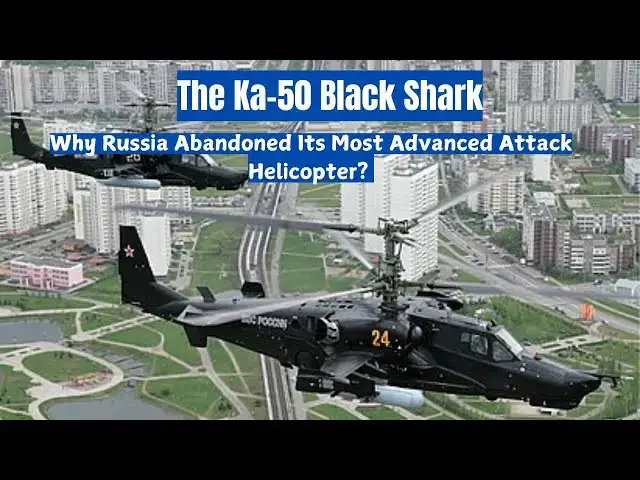
The result was a tale of two distinct approaches: Mil's conventional Mi-28 and Kamov's revolutionary Ka-50 "Black Shark." The Ka-50, with its unique coaxial rotor design, emerged victorious in the 1985 trials, showcasing unprecedented maneuverability, firepower, and technological innovation. It became the first Soviet aircraft to feature a sophisticated pilot ejection system and represented the pinnacle of helicopter automation for its era.
However, the Black Shark's story took an unexpected turn. Despite its technical superiority and combat experience in Chechnya, the Ka-50 never achieved full-scale production. Financial constraints in post-Soviet Russia, design limitations revealed during operations, and military concerns about its single-pilot configuration all contributed to its limited deployment.
Yet, this wasn't the end of the story. The competition between these design bureaus ultimately led to the development of two complementary systems: the upgraded Mi-28N "Night Hunter" and the two-seat Ka-52 "Alligator." Today, both helicopter families serve in the Russian military, proving that the decades of Soviet engineering innovation weren't in vain.
This compelling narrative showcases not just the technical evolution of military helicopters, but also how economic, political, and practical considerations shape the development of military technology. It's a testament to Soviet engineering prowess and the enduring legacy of two competing design philosophies that continue to influence modern military aviation.
#Ka50 #Mi24 #Mi28
Be a Member for exclusive privileges - https://www.youtube.com/channel/UCviEFTf1xIPKsjmyF_zvFug/join
Twitter : https://x.com/AltitudeAddicts
Website: https://www.altitudeaddicts.com
Show More Show Less #Drones & RC Aircraft
#Science