0:01
Russian space agency Ros Cosmos recently
0:04
released visuals from rkk energia at the
0:06
end of October where Yuri borisov the
0:09
chief of Russia's State space
0:11
Corporation conducted a meeting that
0:13
focused on the progress of the Russian
0:16
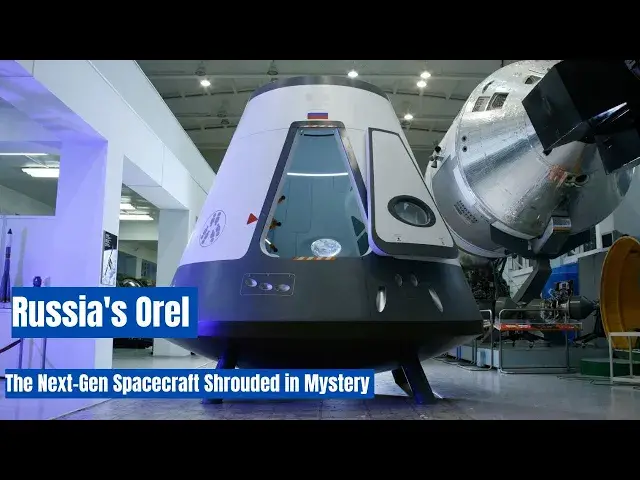
Ros nevertheless the photographs of the
0:19
Prototype of the potential Russian
0:21
spacecraft orl were the ones that
0:24
captured the Public's attention the soyu
0:26
spacecraft is currently employed for
0:28
trips to the international space station
0:31
it continues to be the most appropriate
0:33
method of transporting cosmonauts to and
0:36
from orbit despite its Advanced age it
0:39
has consistently demonstrated
0:41
reliability has endured over six
0:43
upgrades and has transitioned to digital
0:45
technology nevertheless there are
0:48
certain deficiencies that cannot be
0:49
rectified through small modifications
0:52
The Descent module's small internal
0:54
volume is a significant concern
0:56
cosmonauts are seated in close proximity
0:59
to one another which can be
1:00
uncomfortable during extended flights or
1:03
when descending in water in the latter
1:05
scenario they are required to remove
1:08
their space suits and Dawn specialized
1:10
wet suits in a relatively confined space
1:13
imagine attempting to accomplish this in
1:15
a Mini Cooper cabin that lacks access to
1:18
the rear seat the soyu spacecraft had
1:20
been created for a mid-range R7 rocket
1:23
which is why it has a diameter of 2.25 M
1:27
development of the Next Generation crew
1:29
transport a vehicle initially called
1:31
Orel commenced in 2009 for a heavy
1:35
rocket with a diameter of 4.4 m in
1:38
comparison Boeing CST 100 Starliner has
1:42
a diameter of 4.5 meter and crew dragon
1:45
has a diameter of 4 meter it is intended
1:48
for a four-person crew another
1:50
disadvantage of the soyu is its
1:51
single-use design Orel attempts to
1:54
resolve this issue by including reusable
1:56
components into the new spacecraft
1:59
comparable to those produced by Boeing
2:01
and SpaceX the spacecraft has been in
2:03
development for 15 years for a variety
2:06
of reasons although this may appear to
2:08
be a long list it is worthwhile to
2:11
evaluate alternative International
2:13
initiatives Additionally the cst1 100
2:17
which was in development for 14 years
2:19
was responsible for transporting
2:21
astronauts to the International Space
2:22
Station in June but was unable to return
2:25
them due to technical
2:27
difficulties the American European ran
2:30
spacecraft is also still in the process
2:32
of being developed despite being in
2:35
development since 2006 it has not yet
2:38
conducted a man Mission despite having
2:40
flown to space the prototypes shown in
2:43
the photographs are intended for static
2:45
testing they show the propulsion section
2:48
and thermal Shield as well as one of the
2:50
three payload fairing panels the return
2:53
module's vibration strength testing
2:55
prototype appears to be more assembled
2:58
effectively this model will function as
3:01
a completely functional spacecraft that
3:03
is used to evaluate intricate assembly
3:05
points with the primary objective of
3:08
ensuring that it can withstand the
3:10
vibrations of Rocket engines during
3:12
launch the oral spacecraft will be
3:14
composed of two primary components the
3:17
propulsion section and the return module
3:19
reuse will be limited to the return
3:21
module a similar design with a
3:23
detachable single use section is
3:25
employed by Boeing's CST 100 Starliner
3:29
and crew driver Dragon nevertheless the
3:31
Russian spacecraft will descend in a
3:33
manner that is distinct from that of its
3:35
International counterparts its Landing
3:38
legs or more precisely Landing support
3:40
devices are its most distinctive
3:42
characteristic Orel will be the first
3:45
spacecraft to implement a landing system
3:47
of this nature which will enable the
3:49
return module to be utilized on numerous
3:52
occasions upon descent the solid fuel
3:55
Landing engines will reduce the speed
3:57
under the parachute and metallic legs
4:00
will deploy to Shield the spacecraft
4:02
from damage and cushion The Landing the
4:04
soyu spacecraft that is presently in use
4:07
is not entirely single use The Descent
4:09
module descends gently as a result of
4:11
the six soft Landing engines the
4:14
cosmonauts are pulled out and the
4:16
spacecraft is subsequently transported
4:18
to rkk energia in Moscow for the purpose
4:20
of testing and reusing its Electronics
4:24
customized seats are also reused for
4:26
each cosmina The Descent modules are
4:28
primarily donated to museums and other
4:31
public locations If You observe one on
4:33
exhibit you can be certain that the
4:35
contents are not reusable regrettably
4:38
there are no publicly accessible images
4:40
of the interior of Orel additionally
4:43
there is no information available
4:44
regarding the arrangement of seats
4:47
controls or the design of facilities
4:49
such as the lavatory the final design of
4:52
Orel is anticipated to differ from the
4:54
model currently on display at the Space
4:56
Museum in kuga nevertheless the Imes
5:00
suggest that the spacecraft is making
5:02
progress which gives rise to the
5:04
possibility that it will be completed in
5:06
the near future the Orel is technically
5:09
capable of transporting four cosmonauts
5:11
to the ISS or Ross and is also in a
5:14
position to participate in future
5:16
Russian lunar missions in addition to
5:18
the photographs from rkk energia there
5:21
are additional indicators that suggest
5:23
the imminent testing of Orel the angera
5:26
rocket launch complex at the VTO
5:28
cosmodrome is currently undergoing
5:31
modifications and comprehensive tests
5:33
were successfully conducted in August
5:36
the service apparatus for the new crude
5:38
spacecraft underwent autonomous tests on
5:40
October 25th which concluded another
5:43
series of tests a new assembly and
5:46
testing facility for heavy class space
5:48
apparatus is currently under
5:50
construction at vastos this facility
5:52
will also be responsible for the
5:54
preparation of Orel and Ros modules
5:57
additionally Orel has been assigned a
5:59
new Landing site rather than the
6:01
orenberg region which was the original
6:03
proposal it will now be located in the
6:05
Amar region near the town of blish sakin
6:08
to accommodate returns from both the ISS
6:11
and Rous these developments indicate
6:13
that the new reusable Russian crude
6:15
spacecraft May shortly make its
6:17
inaugural space flight and subsequently
6:19
land on its own now do you think Russia
6:23
is more advanced in manned spaceships
6:25
let us know in the comments please like
6:28
and share our videos And subscribe to
6:30
our Channel please also take membership
6:32
of our channel to encourage us