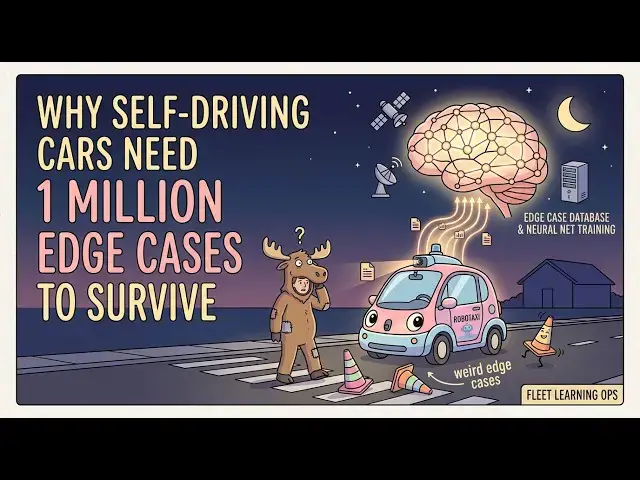

Why Self-Driving Cars Need 1 Million Edge Cases to Survive
Oct 26, 2026
What happens when a self-driving car encounters something it has never seen before?
An autonomous vehicle can drive a million miles perfectly. It can handle rain, traffic, pedestrians, and highways. But then, one day, it sees something completely new—a fallen mattress, a construction worker waving a stop sign in the dark, or a flock of geese crossing a four-lane intersection.
This is the long tail of reality. The 1-in-a-million scenarios that nobody wrote a rule for.
In this cinematic 3D explainer, we break down the Autonomous Edge Case Loop (Shadow Mode)—the hidden infrastructure that allows a robotaxi fleet to learn from a single failure without taking the entire system offline.
What you'll learn in this video:
🔴 Scene 1: The Trigger — How the vehicle's perception stack detects an anomaly and triggers a "shadow mode" protocol, dumping the previous 30 seconds of raw multi-sensor data from a circular RAM buffer to its SSD.
☁️ Scene 2: The Ingestion Conduit — How the vehicle routes back to the depot and uploads gigabytes of raw sensor data to cloud storage buckets, where the 3D scene is reconstructed and auto-labeled.
🖥️ Scene 3: The Synthetic Sim Farm — How the cloud takes one real failure and spawns 10,000 synthetic variations (changing weather, lighting, and angle) inside a massive GPU container farm to train the model.
🚀 Scene 4: The OTA Patch — How the updated model weights are deployed back to the fleet using a "canary rollout"—testing on 1% of the fleet before pushing to 100%.
This is the flywheel of safety. The car doesn't just fail; it learns. And the next mile is always smarter than the last.
Subscribe for more deep dives into Autonomous Tech, AI Infrastructure, and 3D Explainer Animations.
#SelfDrivingCars #AutonomousVehicles #AI #MachineLearning #TeslaFSD #Waymo #TechExplained #3DAnimation
Show More Show Less