Up next in 10

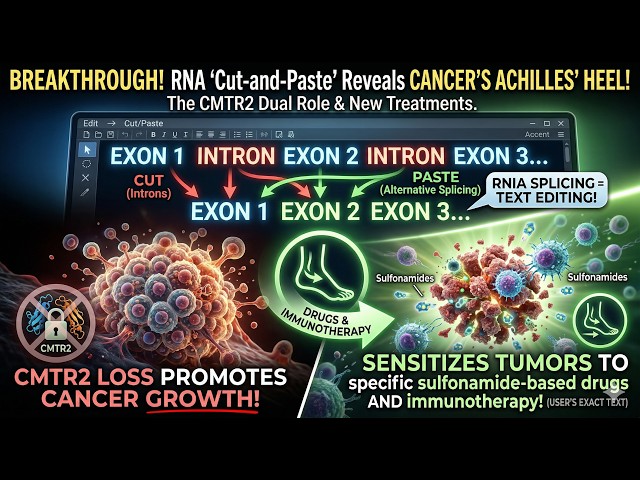
Immunotherapy has revolutionized cancer treatment, but it doesn't work for everyone. Why? A groundbreaking new study just found a major piece of the puzzle. Patients with a specific loss-of-function mutation in the CMTR2 gene show an incredible 90.9% disease control rate when treated with immune checkpoint blockade therapy. By messing up the cancer cell's RNA, this mutation likely creates unique "neoantigens" that practically beg the immune system to attack. Here is what this massive discovery means for the future of lung cancer treatment
Show More Show Less View Video Transcript
0:00
RNA splicing dysregulation has been
0:02
identified as a hallmark of cancer,
0:05
functioning as a distinct engine for
0:07
tumor evolution. Alternative splicing is
0:10
the biological process where a single
0:12
gene is cut and reassembled in different
0:14
combinations to produce multiple
0:16
messenger RNA molecules and protein
0:18
isoforms. To map the landscape of these
0:21
alterations, researchers analyzed RNA
0:24
sequencing data from over,200 lung
0:26
adenocarcinoma samples. They used TNE a
0:30
statistical method for clustering
0:32
highdimensional data to visualize
0:34
percent spliced in values. These values
0:37
quantify how frequently a specific exxon
0:40
is included in the final genetic
0:41
transcript. This tsne plot shows samples
0:44
labeled by ankco genes like eGFR and
0:46
KAS. The scattered distribution
0:49
indicates standard mutations don't
0:51
dictate splicing. However, viewing
0:53
canonical splical mutations reveals a
0:55
different pattern. Tumors with U2 AF-1
0:58
and RBM10 mutations form tightly
1:01
isolated islands at the map's periphery.
1:03
However, the map revealed a central
1:06
anomaly, an entirely separate cluster of
1:09
tumors lacking known splicing factor
1:12
mutations. The driver of this rogue
1:14
cluster is CMTR2.
1:17
This capping enzyme creates a splicing
1:19
profile as distinct as any known
1:22
splicing factor. The existence of this
1:24
isolated group proves that splicing
1:27
chaos can be directed by non-splazal
1:30
enzymes challenging the standard
1:32
assumptions of cancer transcrytoics. To
1:35
understand this anomaly, we must look at
1:37
the demographic and genomic footprint of
1:39
the CMTR2 mutation across different
1:42
cancer types. This panc cancer atlas
1:44
chart shows that while CMTR2 mutations
1:47
appear in various malignancies, they are
1:50
exceptionally frequent in long
1:52
adnocarcoma occurring in roughly 5.7% of
1:56
cases. The mutational profile is
1:58
predominantly composed of truncating
2:00
nonsense mutations. A nonsense mutation
2:03
is a genetic change that introduces a
2:05
premature stop signal resulting in a
2:08
shortened and non-functional protein.
2:10
These mutations carry a massive C to A
2:13
transversion signature. This specific
2:16
genomic pattern is the direct mutational
2:18
footprint left by tobacco smoking. When
2:21
tobacco carcinogens enter the lung, they
2:24
physically strike the DNA within
2:25
epithelial cells. This direct chemical
2:28
damage permanently encodes the CMTR2
2:31
truncation into the lung tissu's genome.
2:34
The data shows that CMTR2 mutations
2:36
exhibit mutual exclusivity. They almost
2:39
never co- occur with RBM10 or U2 AF-1
2:42
mutations in the same tumor. This
2:44
implies redundant evolutionary pathways.
2:47
A tumor only needs to compromise one of
2:49
these distinct regulatory systems to
2:52
achieve the splicing dysregulation
2:53
required for survival. CMTR2 acts as a
2:57
trunal tumor suppressor. It is
2:59
selectively eliminated early in
3:00
development by tobacco exposure,
3:02
enabling the transcrytoic flexibility
3:04
required for tumor revolution. To
3:07
understand the consequences of this
3:08
loss, we must look at the molecular
3:11
bedrock, the normal biological function
3:13
of CMTR2 in a healthy cell. CMTR2 is a
3:18
methyl transferase responsible for the
3:20
cap 2 modification on mRNA and small
3:23
nuclear RNA. It uses SAM or SADO
3:27
Lmethionine, a universal methyl donor
3:30
molecule to modify the RNA structure.
3:33
The enzyme methylates a second
3:35
transcribed nucleotide at the two prime
3:37
O ribos position. This modification is
3:40
critical for maintaining RNA stability
3:43
and facilitating proper RNA processing.
3:46
This catalytic process is executed by
3:48
the KDK triad, a specific sequence of
3:51
amino acids located in the enzymes n
3:54
terminal catalytic domain. Researchers
3:57
mapped clinical misssense mutations
3:59
directly onto this triad, focusing on
4:01
the K117N variant identified in the lung
4:04
cancer cohort. These
4:06
supercomputer-driven molecular dynamic
4:08
simulations compare the wild type enzyme
4:11
to the K117N mutant. The substitution
4:14
physically distorts the interaction
4:16
network, increasing the distance between
4:19
the catalytic residues and the RNA
4:21
substrate. Pathogenicity mapping across
4:23
the protein surface shows that mutations
4:26
clustered around the fivep prime
4:28
capbinding pocket are likely pathogenic
4:30
as indicated by the concentrated red
4:32
zones. Whether the protein is truncated
4:35
by smoking or disabled by targeted
4:37
misssense mutations. The structural
4:39
failure of the KDK triad totally
4:41
disables cap 2 methylation. If CMTR2 is
4:45
a capping enzyme, why does its loss lead
4:47
to the systemic splicing disregulation
4:49
observed in clinical patient data?
4:52
Protein interaction databases reveal
4:54
that CMTR2 has a secondary structural
4:56
role. It physically associates with the
4:58
splicing machinery itself. Immuno
5:01
precipitation using wild type CMTR2
5:04
successfully isolates core components of
5:06
the U1 SNRP complex which initiates
5:09
splicing by recognizing inron. In
5:11
contrast, the K117N mutant completely
5:14
fails to bind to SNRP70, a core protein
5:17
within this complex. This failure leaves
5:19
the capping enzyme and the massive
5:21
splicome complex physically uncoupled.
5:23
By severing this mechanical connection,
5:26
the entire splicing assembly becomes
5:28
unstable. Without this physical anchor,
5:31
the splyosome loses its targeting
5:33
fidelity. This leads to thousands of
5:36
skipped exxon events, errors where
5:38
coding regions of a gene are
5:40
pathologically omitted from the final
5:42
transcript. This PCA plot and volcano
5:45
plot show the transcrytoic fallout.
5:48
Crisper knockout models of CMTR2
5:50
perfectly replicate the chaotic splicing
5:53
profile identified in human tumors.
5:55
Specific genes define the subtype such
5:58
as the consistent inclusion of exxons in
6:00
SPPL2A
6:02
and exclusion in SMARK1 visible in these
6:05
read coverage plots. CMTR2 is a vital
6:08
structural lynch pin for the U1 SNRP.
6:11
Its loss uncouples the splicome and
6:13
rewires the tumor's entire transcriptto.
6:16
While splicing chaos provides
6:18
evolutionary flexibility, it pushes the
6:20
cell's baseline viability to its
6:22
absolute limit. This creates a
6:24
pharmacological trap. If the splyosome
6:27
is already strained by CMTR2 loss,
6:30
forcing further disruptions will trigger
6:32
cellular collapse. Indicellum is a
6:35
sulfonomide based compound that targets
6:37
and degrades RBM39,
6:40
another critical splicing factor.
6:42
Healthy cells tolerate the loss of RBM39
6:45
because their primary splicing machinery
6:47
remains robust and functional. CMTR2
6:50
deficient cells cannot compensate. The
6:53
combined instability of the U1 SNRP and
6:56
the degradation of RBM39 pushes the
6:59
splicing machinery into catastrophic
7:01
failure. This is an example of synthetic
7:04
lethality. Synthetic lethality occurs
7:06
when two individually survivable
7:08
defects, one genetic and one chemical,
7:11
become fatal when they occur together in
7:13
the same cell. The compounding errors
7:15
force the biological system past a
7:18
critical threshold, leading to an
7:19
irreversible wave of programmed cell
7:21
death. The tumor's greatest evolutionary
7:24
trick, its splicing chaos, becomes a
7:27
fatal vulnerability when exploited by
7:29
precisely targeted degradation.
7:31
Catastrophic exxon skipping disrupts
7:34
internal biology while simultaneously
7:36
altering the proteins displayed on the
7:38
tumor surface. Scrambled RNA sequences
7:41
are translated into tumor specific neo
7:44
antigens, newly formed protein markers
7:47
that the patients immune system has
7:48
never seen before. These unfamiliar
7:51
surface proteins act as beacons with
7:53
immune cells rapidly clustering around
7:56
and binding to the mutated target. This
7:58
high volume of neo antigens makes CMTR2
8:02
deficient tumors highly sensitive to
8:04
immune checkpoint blockade therapies.
8:06
This recontextualizes the original
8:08
population data. The isolated cluster on
8:11
the TNE plot is not just an anomaly. It
8:14
is a precisely mapped target zone for
8:16
patients who would otherwise fail
8:18
standard treatments. This cluster
8:20
identifies a specific therapeutic
8:22
window. By charting the highdimensional
8:24
landscape of alternative splicing, we
8:27
expand our definition of splical
8:29
mutations. Mapping these complex
8:31
biological networks exposes hidden
8:34
structural dependencies, revealing
8:36
specific targets for precision oncology.
#Cancer
#Health Foundations & Medical Research