Up next in 10

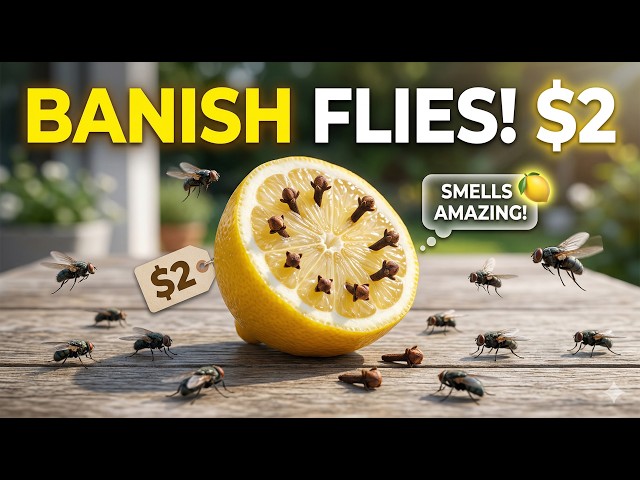
Are flies and mosquitoes ruining your summer? Stop buying toxic sprays and head straight to your pantry! All you need is a lemon and a handful of whole cloves. https://ehomeremedies.com/healthy-home/home-remedies-flies/
Citrus peel releases limonene, while cloves contain eugenol—two powerful compounds that completely overload a fly's scent receptors and force them to flee. This natural, chemical-free hack costs about $2, looks beautiful on your counter, and keeps your home bug-free. Watch to see how it works!
Show More Show Less View Video Transcript
0:00
The common housefly is a highly adapted
0:02
biological scavenger. Its sensory
0:05
navigation relies on maxillary pulps,
0:07
tiny appendages near the mouth used to
0:10
taste and smell the environment. These
0:12
specialized receptors allow flies to
0:14
detect food sources from great
0:16
distances. When they breach your home,
0:18
they act as mechanical vectors,
0:20
physically carrying pathogens from
0:22
decaying outdoor matter onto your
0:24
counters and food. Modern households
0:26
typically respond to these intruders
0:28
with synthetic neurotoxic bug sprays.
0:30
These aerosols are designed to kill, but
0:32
they come with a hidden biological cost.
0:35
The same neurotoxins meant for the
0:37
insects settle on your kitchen surfaces
0:39
and circulate through your indoor air
0:41
where they can be inhaled by children
0:43
and pets. However, we can achieve better
0:46
results by utilizing the chemical
0:47
defenses the plant kingdom has been
0:49
perfecting for millions of years. True
0:52
household hygiene isn't found in a can
0:54
of chemicals. It's a matter of applying
0:56
biological intelligence to make your
0:58
home an impossible place for a fly to
1:01
survive. The first step in securing your
1:03
home is altering the physical
1:05
environment to eliminate the specific
1:07
spots where flies breed. In most
1:09
kitchens, the primary vulnerability is
1:12
the drain. Organic bofilms, the sticky,
1:15
nutrient-rich layers that form inside
1:17
pipes, act as ideal incubators for fly
1:20
larae. You can destroy this bofilm by
1:22
combining baking soda and white vinegar.
1:25
This creates a powerful fizzing reaction
1:27
that physically scour the grime away,
1:30
stripping the flies of their habitat
1:31
without using corrosive cleaners. To
1:34
secure structural gaps and cracks, you
1:36
can use a fine powder known as
1:38
dietimmacous earth. This powder is made
1:40
from fossilized algae. At a microscopic
1:43
level, its edges are sharp enough to
1:46
slice into an insect's exoskeleton,
1:48
leading to desiccation, a process where
1:51
the fly rapidly loses its internal
1:53
moisture and dies. When you
1:55
systematically remove these micro
1:57
environments, you are performing an
1:59
architectural task, ensuring that even
2:01
if a fly enters, it cannot reproduce.
2:04
Once the breeding sites are neutralized,
2:07
you can project an active biochemical
2:09
barrier using the natural systems found
2:11
in aromatic herbs. The scents of basil,
2:14
lavender, and lemongrass evolved as
2:16
chemical weapons. These plants produce
2:19
volatile oils to protect themselves from
2:21
being eaten or damaged by insects. These
2:24
defense mechanisms rely on secondary
2:26
metabolites like tarpen and phenols.
2:29
Common examples include lemonine in
2:31
citrus fruits and eugenol, the active
2:33
compound found in clothes. When these
2:35
compounds are released into the air,
2:37
they violently overload the fly's
2:39
olfactory receptors. This leaves the
2:42
insect spatially confused, unable to
2:44
navigate toward food. This synergy makes
2:47
a clove studded lemon, a pomander, so
2:49
effective. Lemonine and eugenol combine,
2:53
creating a dense vapor barrier a fly's
2:55
nervous system cannot tolerate. Modern
2:58
applications are even simpler. Using an
3:00
essential oil diffuser or a DIY room
3:03
spray made with witch hazel can create
3:05
an active shield at your most frequent
3:06
entry points. Even common culinary herbs
3:09
like rosemary are engineered for this
3:11
purpose. Placing these plants near
3:13
windows and doors serves as a constant
3:15
passive perimeter defense. This approach
3:18
transforms your home into a fortress
3:20
using scents that humans find soothing
3:22
but flies find neurologically
3:24
overwhelming. Because no system is
3:26
perfect, you can add a final layer of
3:28
protection, a biological trap for the
3:30
few insects that manage to slip through
3:32
the perimeter. A bowl of apple cider
3:34
vinegar weaponizes the flies natural
3:36
attraction to fermentation. The smell
3:39
signals a prime location for feeding,
3:41
drawing them in irresistibly. To make
3:44
the trap effective, however, you must
3:46
break the liquid's surface tension. By
3:48
adding a few drops of dish soap, you
3:50
change the physics of the fluid. Instead
3:53
of the fly landing on the surface and
3:54
flying away, it instantly sinks, losing
3:57
its ability to use the water as a
3:59
launchpad. This method requires no
4:02
neurotoxins. It simply uses the fly's
4:04
own evolutionary drives to ensure its
4:06
removal. By integrating remediation,
4:09
botanical barriers, and biological
4:11
traps, you build a comprehensive defense
4:13
system for your home. This strategy
4:16
moves away from the toxicity of
4:17
synthetic sprays, prioritizing safety
4:20
and effectiveness without introducing
4:22
harsh chemicals into your kitchen.
4:24
You're trading hazardous aerosols for
4:26
the therapeutic scents of lavender,
4:27
lemon, and rosemary. Managing pests
4:30
naturally is about more than just
4:32
convenience. It's a way to align your
4:34
home's hygiene with the sophisticated
4:36
chemical intelligence of the natural
4:38
world.
#Pest Control
#Alternative & Natural Medicine
#Household Supplies