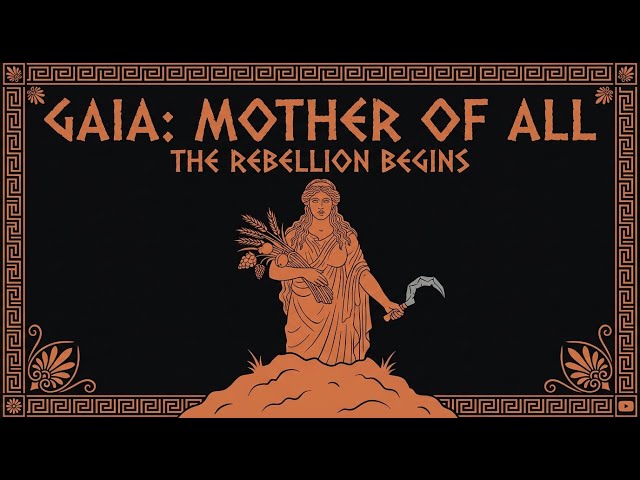

The Story of Gaia - The Primal Mother of All Creation #ancientgreekmythology
Jan 29, 2026
Gaia is the primordial Greek goddess who represents the physical Earth and serves as the ever-sure foundation of all existence.
Emerging directly after the yawning void of Chaos, she possessed total biological autonomy, parthenogenetically giving birth to the Sky (Uranus), the Mountains (Ourea), and the Sea (Pontus) to establish the universe's architecture.
As the all-mother (Pammētōr), she later united with her son Uranus to produce the twelve Titans, the one-eyed Cyclopes, and the hundred-handed giants known as the Hecatoncheires.
Her narrative is defined by a fierce protective instinct and a persistent resistance to divine tyranny.
When Uranus imprisoned their monstrous children within the dark "secret places" of her own body, causing her immense physical suffering, she fashioned an adamantine sickle and masterminded the castration of Uranus.
Later, she defied her son Cronus by siding with her daughter Rhea to save the infant Zeus. She hid Zeus in a remote cave on Mount Aigaion and provided Rhea with a stone wrapped in swaddling clothes—the omphalos—to deceive the Titan king.
During the Titanomachy, Gaia’s prophetic advice led Zeus to victory by encouraging him to free the imprisoned giants from Tartarus.
However, her favor shifted when Zeus banished her Titan sons, leading her to incite the Gigantomachy and produce the hundred-headed, fire-breathing monster Typhon as a last challenge to Olympian rule.
Beyond these cosmic wars, she was the original source of prophecy, holding the Oracle at Delphi long before it was usurped by Apollo.
In ancient art, Gaia is often depicted rising from the soil (Anodos), and her enduring legacy survives today in the Gaia Hypothesis, which views Earth as a single, self-regulating organism.
Show More Show Less