Up next in 10

Watch the video guide about PTSD in dogs and how to overcome this scary condition!
To get more in-depth information, we suggest visiting the source material by Doggozila Magazine on the link below: 👇
🔗 https://doggozila.com/can-dogs-have-ptsd/
👆
#dogbehavior #PTSDINDOGS #dogptsd #doganxiety #doganxietyrelief #dogtrauma #servicedogs #doglife #confidentdog #doglove #dogguides #pets #petlove #dogmagazine
Show More Show Less View Video Transcript
0:00
Welcome to the explainer. Today we're
0:03
suiting up and diving into what it means
0:05
to be the hero our dogs need, especially
0:07
when they're facing a really tough
0:09
invisible battle, K9 PTSD. All right, so
0:13
for this explainer, we are digging deep
0:15
into the archives of Dogazilla magazine.
0:18
They published this incredible article
0:19
that really shines a light on a super
0:21
important and honestly often
0:23
misunderstood part of our dogs lives.
0:26
So, our mission today is all about
0:28
understanding and treating canine
0:30
post-traumatic stress disorder. We're
0:32
going to break down what it actually is,
0:34
see how it impacts our best friends, and
0:37
most importantly, figure out how we can
0:39
help them heal. You know, this single
0:41
sentence from the article just gets
0:43
right to the heart of it all, doesn't
0:44
it? Dogs can carry the invisible scars
0:47
of trauma just like humans. This is so
0:50
crucial because we're not talking about
0:51
a dog being bad or disobedient. We're
0:54
talking about deep wounds that we just
0:56
can't see. Okay, so let's tackle the big
0:59
question that's probably on your mind
1:01
right now. Can dogs actually get PTSD?
1:05
Is this a real thing? The answer is a
1:07
huge resounding yes. Absolutely. The
1:11
science on this is crystal clear. It's a
1:13
recognized and diagnosible condition.
1:16
So, the question really isn't if it
1:17
exists anymore. The real question is
1:19
what do we do about it? Okay, time to
1:22
put on our science hats. Let's look at
1:25
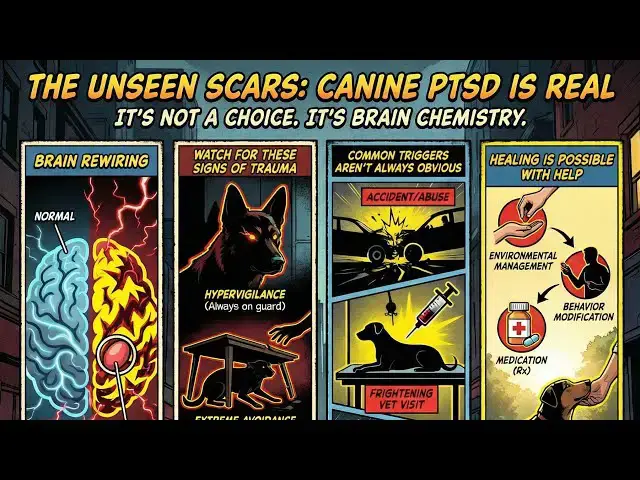
the neurological evidence. We're going
1:27
to go inside a dog's brain to see how
1:28
trauma can literally rewire it. And
1:31
that's key. This is a physical change,
1:33
not just a behavioral choice. So, what
1:36
does this look like? Well, their brain
1:38
is basically under siege. You've got two
1:40
things happening. The amygdala, which is
1:42
the brain's alarm system, gets stuck in
1:44
the on position. It's just screaming
1:46
danger 24/7. At the same time, the
1:48
prefrontal cortex, you know, the
1:50
rational thinking part of the brain,
1:52
shows way less activity. It's basically
1:54
offline. Think of it like a smoke
1:56
detector that doesn't just go off for
1:58
burnt toast, but also sets off the fire
2:00
sprinklers and deadbolts all the doors.
2:01
It's a massive uncontrollable
2:03
overreaction happening inside their
2:05
head. So, we know what's going on
2:07
inside, but what does that internal
2:09
battle actually look like on the
2:10
outside? Let's talk about how to
2:12
recognize the symptoms, the distress
2:14
signals our dogs might be sending us.
2:16
One of the biggest signals is what you
2:18
could call a code red alert. This is
2:21
hypervigilance. Their nervous system is
2:24
just fried from being on guard duty all
2:27
the time. A drop set of keys can sound
2:29
like a bomb going off. They can never
2:32
ever truly relax. You might also see a
2:35
strategic retreat. We're talking about
2:37
avoidance. And this isn't your dog being
2:39
moody or unfriendly, hiding under the
2:41
bed, refusing to walk past a certain
2:43
house. It's a strategy. They are
2:45
desperately trying to feel safe in a
2:47
world that to them feels incredibly
2:49
dangerous. They're building their own
2:51
little fortress of solitude. So, every
2:53
story has a villain, right? In this
2:55
story, the villains are the common
2:57
triggers, the events that can leave
2:59
these lasting invisible scars on our
3:01
dogs. And these villains can show up in
3:04
a lot of different ways. It might be a
3:06
single big event like a bad car
3:08
accident. or it can be the slow burn of
3:11
chronic neglect, like the horrible
3:13
conditions in a puppy mill. The most
3:15
important thing to get here is that
3:16
trauma is subjective. What matters is
3:19
the dog's own experience of terror and
3:21
helplessness. Now, to defeat the
3:23
villain, you've got to understand its
3:25
secret weapon. In this case, that's the
3:27
biology of fear. This is so much more
3:29
than just being scared. It's a whole
3:31
survival system that has gone completely
3:33
haywire. This brings us to a really
3:36
critical idea, the hijacked amydala.
3:39
Remember that alarm system we talked
3:40
about? Well, it basically takes over the
3:43
whole operation. The alarm bell just
3:45
rings and rings, completely bypassing
3:47
the thinking, rational part of the
3:48
brain. And that's exactly why you can't
3:50
reason with a panicked dog. Logic is
3:52
literally left the building. Survival
3:54
instincts are in the driver's. But
3:56
here's the good news, and it's really
3:58
good news. This diagnosis is not a life
4:01
sentence. No way. Just like in any good
4:03
hero story, this is where the comeback
4:06
begins. There is absolutely a path to
4:08
healing. So, every hero needs their
4:11
toolkit, their arsenal. And for healing,
4:13
you need a few different tools. First,
4:16
professional guidance is a must. Get a
4:18
trusted vet and a veterary behaviorist
4:20
on your team. Then you've got behavior
4:22
modification. That means using smart
4:24
training techniques to help change their
4:26
emotional response to triggers. And
4:28
finally, environmental management. This
4:30
is huge. It's all about making their
4:32
world feel predictable and safe again.
4:34
Now, let's talk about one of those tools
4:36
that can sometimes feel a bit tricky.
4:39
Medication. This quote just nails it.
4:41
Medication is not a copout. It's really
4:44
not an easy way out. Think of it more
4:46
like turning down the volume on all
4:48
their background anxiety. It just quiets
4:50
the noise enough so that they can
4:52
actually learn and benefit from all the
4:54
behavioral therapy you're doing.
4:56
Recovery isn't just about making the
4:58
fear go away. It's about actively
5:00
building a new story for your dog. A
5:02
story that's filled with confidence,
5:04
resilience, and joy. It's about adding
5:07
more of the good stuff back into their
5:08
life. So, how do we do that? We give
5:12
them their power back. Activities like
5:14
scent work or find it games are
5:16
fantastic because they let the dog be
5:18
the expert. It allows them to use their
5:20
natural talents to succeed. Also,
5:22
choice-based training, which can be as
5:24
simple as letting them choose which way
5:25
you turn on a walk, gives them back a
5:27
sense of control. We are literally
5:29
replacing those feelings of helplessness
5:30
with repeated experiences of success.
5:34
And this of course brings us to the most
5:36
important character in this entire
5:38
story, the real superhero on this
5:40
journey, and that's you. So what are
5:43
your superpowers in this situation?
5:45
Well, your number one power is immense
5:48
patience. You also have to manage your
5:50
own stress and emotions because your dog
5:52
feeds off your energy. You need to be
5:54
their safe harbor, their calm in the
5:56
storm. celebrating every tiny little
5:58
win, building a great team around you,
6:01
that's your heroic role. And I think
6:03
this quote just says it all really. Your
6:05
patience, showing up calmly day after
6:07
day, is the most powerful medicine you
6:10
can provide. More than any training
6:12
technique, more than anything else, your
6:14
steady, calm presence communicates total
6:16
and unconditional safety to your dog's
6:18
nervous system. And that is the most
6:20
powerful medicine there is. You know,
6:22
the resilience these animals have is
6:24
just mindblowing. With the right support
6:26
from us, many of them don't just heal,
6:28
they go on to become heroes themselves.
6:31
I mean, some of these dogs actually
6:32
become service animals for humans who
6:35
are also struggling with trauma. It's an
6:37
incredible full circle journey. So,
6:39
we'll leave you with this question to
6:41
think about. How can we all create a
6:43
safer world for our most loyal heroes?
6:45
Honestly, it starts with understanding.
6:47
It starts with conversations just like
6:49
this one. By recognizing that K9 PTSD is
6:52
real, we can all help build a more
6:55
compassionate, patient, and safer world
6:57
for our best friends.
#Dogs