Up next in 10


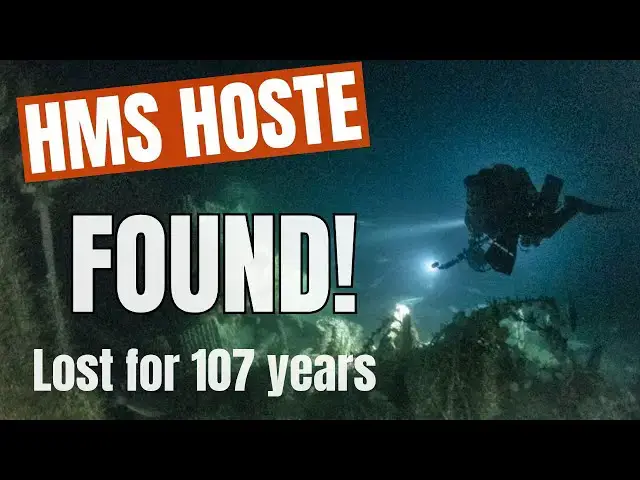
For over 107 years, HMS Hoste remained lost until in August 2023, our Lost in Waters Deep/Gasperados Expedition team became the first divers to positively identify this WWI destroyer wreck at 104 meters depth using closed circuit rebreathers.
HMS Hoste was a British Parker-class flotilla leader destroyer that sank on December 21st, 1916 after a collision with another destroyer that caused one of her own depth charges to detonate. Until we found it, no-one knew where it was.
This is technical diving on the limits: 104 meters (340 feet) on trimix with closed circiuit rebreathers, over 2 hours of decompression, and a very long way offshore.
⏱️ TIMESTAMPS:
0:00 - Introduction: The 107-Year Mystery
2:03 Kevin Heath, Lost in Waters Deep & the Gasperados
3:29 Problems with the pill
05:57 Crockery
06:59 Ammunition
07:51 Boilers!
09:14 Engines
11:52 More Yarrow boilers
12:58 Royal Navy Crockery!
15:02 Anchor Chain
16:05 Removing strobes
16:41 More divers
18:!2 Decompression profile
Show More Show Less View Video Transcript
0:00
For over a hundred years, HMS Host was
0:03
missing. A World War I destroyer
0:06
crippled by her own death charges.
0:09
Everybody knew she was down there
0:11
somewhere, but no one had ever
0:13
identified her wreck. I'm Dom Robinson,
0:16
and this is the story of how our Lost in
0:19
Waters Deep expedition dived to over a
0:22
100 meters on close circuit rebreathers
0:25
to solve a century old naval mystery. It
0:29
all started in December 1916
0:32
when the Grand Fleet sorted from Scarpa
0:35
Flow to carry out exercises between
0:37
Norway and the Shetland Islands. HMS
0:40
Host was leading a convoy of other
0:42
destroyers in absolutely foul weather
0:46
when it suffered a failure of steering
0:48
gear and was detached from the fleet to
0:51
return to Scalpa Flow for repairs.
0:54
Escorted by a number of other vessels,
0:56
including HMS Negro, it suffered
0:59
steering failure again, causing HMS
1:02
Negro to crash into the stern, releasing
1:05
a depth charge that exploded underneath
1:08
both vessels. Almost immediately, HMS
1:12
Negro broke in half and sank with the
1:15
loss of most of the crew. HMS Host was
1:18
less badly damaged and the captain
1:21
elected to try and continue to port,
1:23
escorted by several other ships. Several
1:27
hours later, it was clear that Host was
1:30
not going to make it, and the captain
1:32
gave the order to abandon ship. In an
1:35
incredible feat of seammanship, another
1:38
vessel, the aptly named HMS Marvel,
1:42
repeatedly came alongside HMS Host,
1:45
allowing almost the entire crew to leap
1:48
from HMS Host to HMS Marvel. Sadly, four
1:53
men died, but given the conditions and
1:56
the state of HMS Host, it's testimony to
1:59
the skill and courage of everyone
2:00
involved that so many survived. And
2:03
that's where the story would have ended
2:05
were it not for the tenacity of Kevin
2:07
Heath and his determination to make sure
2:10
that all the shipwrecks around Ornne are
2:13
identified and the final resting places
2:16
of their sailors known. Working through
2:19
old survey data, he identified potential
2:22
targets for both ships. And that's where
2:25
my involvement in the story starts
2:27
because he called in the divers in the
2:30
form of the gasp barados team headed up
2:33
by Steve and Barbara Mortimer who very
2:35
kindly asked if I would be willing to
2:37
join them on this great endeavor. Now
2:40
the Orcnes are a long way from pretty
2:42
much everywhere in the UK and that's
2:45
even more so when you live in Plymouth
2:46
like I do, but the opportunity to dive
2:49
on wrecks of this significance simply
2:52
couldn't be passed up. Also
2:55
diving in the knowledge that you are the
2:57
first person to ever reach this wreck is
3:01
one that you simply you can't be beaten.
3:03
It's it's an incredible incredible
3:05
feeling. And Rick and myself had the
3:08
great privilege on this uh expedition of
3:11
diving four consecutive never before
3:14
dived wrecks and three of them that we
3:17
identified. So, it was a a brilliant,
3:19
brilliant experience. And you can see
3:22
here that we've just arrived at the
3:24
wreck. Conditions are absolutely
3:27
incredible. You can see the viz is
3:28
phenomenal. Um, even though it's pitch
3:31
black, our torches are reaching for for
3:33
I don't know how far that is, but it's
3:35
brilliant visibility. Anyway, as always
3:38
with any dive, you've there's a bit of
3:39
admin to do. And for us here, what we're
3:42
going to do is release the pill or the
3:44
pellet or whatever you want to call it
3:45
just to confirm that the shot is on the
3:48
wreck. And you can see here we used a
3:49
slightly different system to the one
3:51
that we normally use. And basically what
3:53
it is is we have to send that is the
3:56
pill there. It's on the shot line and it
4:00
should be buoyant enough to go up by
4:02
itself. But clearly uh that's not
4:04
working. So we have a bit of a problem.
4:06
It's 100 m deep and everybody else is
4:10
relying on that pill to get to the
4:11
surface before they get in the water.
4:13
So, um the question is what do we do?
4:17
Now, you often kind of have
4:19
contingencies for various different
4:21
situations and you know you've planned
4:23
it in your head. You you thought about
4:25
how what's going to happen, but this
4:27
wasn't one that we we had thought about.
4:29
We assumed that the that that kind of
4:32
ball was watertight and therefore, you
4:35
know, it's obviously solid. So, it would
4:37
be buoyant enough to get the um get the
4:40
pill up to the surface. As you can see,
4:41
that that didn't happen. So, what I'm
4:44
doing now is you can probably see that
4:46
is my spare DSMB that I'm just attaching
4:49
to the pill. Now, this is a really
4:52
straightforward solution to the problem
4:54
and it's going to it's going to fix it.
4:57
So, that's no problems at all. What I
4:59
would say is you might be surprised how
5:02
disruptive these kind of things can be.
5:05
You always feel under a little bit of
5:07
pressure when you're deep diving and
5:10
particularly when you get to the bottom
5:11
of the shot. You kind of think, ah, you
5:14
know, I've got all these things that I
5:15
need to be doing. I need to be
5:16
identifying the wreck. I need to be
5:18
putting my strobes on. All that kind of
5:19
stuff. And even something as simple as
5:21
as that that we've just seen there, I
5:24
often find it kind of mocks around with
5:26
my equilibrium and it can take me a few
5:30
minutes before I kind of get back in my
5:32
zone. Maybe that's just me, but I
5:34
suspect other people feel the same as
5:36
well. So, it can be really disruptive.
5:39
But, as you can see on this dive, I'm
5:41
back in the groove. So, I've put my
5:43
strobes on there. And you can see below
5:45
me, Rick is uh Rick is away. He's about
5:47
to put his strobes on. I think he
5:49
forgot. And now having done that, it's
5:52
the big question of trying to figure out
5:54
what it is that we've landed on. And we
5:57
want to find out this Royal Navy ship.
5:59
We want to find that it's armed. We want
6:01
to find uh something that identifies it.
6:03
And bingo. Immediately, I have spotted
6:06
something. You can probably see there.
6:08
It's not the crab. It is the plate. Now,
6:11
anyone who's watched any of my other
6:13
videos will know that I'm a big fan of
6:15
crockery. It can tell you so much about
6:18
the ship that you are on or or the wreck
6:21
that you found. Um although not in this
6:23
particular case because that piece is
6:25
stuck in there. And you can also uh
6:27
hopefully you saw that there were no
6:29
markings on it. Although certainly none
6:30
on the uh on the top and as you saw
6:32
there I couldn't get it out. So that
6:34
wasn't helpful in identifying it. Now
6:37
continuing to move along the wreck. You
6:39
probably saw there's a load of port
6:40
holes that I've just gone past on the
6:42
left hand side. And I'm starting to look
6:44
at what else uh we might find. There's a
6:46
port holes again. You can probably see
6:48
there's a big big row of them. And we
6:51
knew that HMS Host in the barrel section
6:54
did have a lot of port holes. So
6:56
potentially that's what we're seeing
6:58
here. You can also see on the right hand
7:00
side there that Rick has managed to
7:01
identify something as well. And that is
7:03
a big pile of ammunition. You can see
7:05
there's ammunition that's come out of
7:07
boxes. There's boxes of ammunition. So
7:10
that's a really good sign. We're on an
7:12
armed ship. Potentially, it's in the
7:15
bow. Now, it's relatively unusual for
7:18
civilian ships to have guns in the bow.
7:21
Certainly, World War I era ships that
7:24
were defensively armed. The very n fact
7:27
they were defensively armed meant that
7:29
the guns were in the stern. And that was
7:31
that was one of the things at the time
7:33
that was the way you indicate it wasn't
7:35
an offensive ship. So, I'm now moving
7:38
along the side of the wreck. Again, you
7:39
can see there's a few cables. Not huge
7:41
numbers, which you might expect if it
7:43
was a World War II or more modern ship.
7:46
Anyway, the other thing you can see, or
7:49
you probably heard there was me uh
7:50
shouting to Rick. And the reason I'm
7:52
shouting is because in front of me there
7:54
are the boilers and their Yarrow
7:57
boilers. Very distinctive shape,
8:00
V-shaped boilers. They allowed ships to
8:03
maximize uh space. You can see there's
8:05
actually two of them there. So, I
8:07
spotted at least two. And we knew that
8:09
Host had Yarrow boilers as in fact did
8:12
uh HMS Negro. In fact, you can just have
8:14
a look. There's a a third set behind
8:16
that as well. So, the clues are starting
8:18
to add up now. We've got ammunition.
8:20
We've got Yarrow boilers. We've got at
8:22
least three Yarrow boilers. The host had
8:24
four, but potentially when it broke
8:27
apart, one of those or more of the one
8:29
of those, you know, may be missing. We
8:31
also know there's three shafts. So, if
8:34
we get to this, you know, the stern
8:35
area, that's what we're going to be
8:37
looking out for. And I think I've just
8:39
seen the fourth set of boilers there.
8:41
So, four sets of boilers. These are
8:44
really strong indications that we found
8:48
uh HMS Host. There are only two
8:51
similarsized vessels lost in this kind
8:54
of area. One of them is HMS Negro, but
8:56
the sinking position for that is nowhere
8:59
near here. And actually we dive it the
9:01
next day and we identify it by the bell.
9:04
So we know for certain this is an HMS
9:06
negro. So really the only other
9:09
possibility for it to be given, you
9:12
know, what we know about it already
9:13
right at this moment in the dive is that
9:15
this is HMS host. So I've gone past the
9:19
boilers and I'm into right at the back
9:21
of the wreck and there's some sort of
9:23
engine type stuff here. Now I'm not an
9:26
expert on engines, steam engines. I'm
9:29
certainly not an expert on Royal Navy
9:31
engines, but you can see here that these
9:34
are there's lots and lots of engine
9:36
components and they are like all these
9:39
kind of torpedo destroyers of this era.
9:41
HMS Host was built for speed and that's
9:44
what kept it alive. That's what allowed
9:46
it to fulfill its mission and that's why
9:48
the entire vessel pretty much was either
9:51
full of boilers or engines or associated
9:54
equipment. So, these were super fast,
9:57
super slender uh boat destroyers,
10:00
although they were really more like
10:01
large torpedo boats. Dived quite a few
10:05
similar ones as well as Host and Negro.
10:08
I also dived the USS Jacob Jones, which
10:11
is very, very similar to both of these.
10:13
and the wrecks look really similar in
10:16
the sense that there is stuff everywhere
10:19
that is to do with machinery to do with
10:21
making ships go faster and basically
10:24
very little of anything else. Completely
10:26
different from a steam ship, a a cargo
10:29
carrying ship or even a passenger liner.
10:32
Instantly you get on one of these
10:33
things, you realize that's what it is.
10:35
Now, that thing there, I don't know.
10:37
Maybe a condenser, might be part of the
10:40
engine system in some some shape or
10:42
form, but this is this is a of the
10:45
boilers. So, right at the back. And you
10:47
can see I've kind of gone round where
10:48
the brake is, and I'm now heading back
10:50
towards uh what I assess to be the bow.
10:53
For those of you who are watching my
10:55
dive computer, you can see that I've
10:57
basically been down 11 minutes or not. I
11:00
haven't been on the bottom for 11
11:01
minutes, but the dive is 11 minutes long
11:03
and I've already got over an hour of uh
11:06
TTS. So, it shows how little time you
11:08
have when you do this kind of diving.
11:10
You got to get as much in as possible.
11:12
Now, you probably just see the boiler on
11:14
on the right hand side there, one of
11:15
those Yarrow boilers. There's also a lot
11:18
of hole plating on both sides, which is
11:21
the first kind of clue to me that this
11:23
wreck was inverted. And you can also see
11:26
if you look at them that the arrow
11:27
boilers are on their sides, so they're
11:30
not um upright, which is really
11:34
interesting, but also at the same time
11:36
really frustrating because it means all
11:39
the good stuff is underneath wreckage.
11:41
And that means the bell, the bridge
11:44
gear, the weapons, the anchors, all that
11:48
kind of stuff. It's all underneath what
11:50
we're looking at here. And you can
11:52
probably see I'm just going past the end
11:53
of the boilers there. So those holes
11:55
there are uh how they would they would
11:58
have chucked in coal and everything to
12:00
uh to stoke it. You see there more
12:02
boiler tubes on the right hand side. And
12:03
this is me just uh turning to have a
12:05
look there. And that that shows really
12:07
well the inverted boiler. So the the two
12:10
sides of the boiler, one of them is
12:11
sloping towards me and and the other one
12:13
is is actually the base of that V and
12:16
then you can see there's there's another
12:17
end. So it's really clear that the
12:20
boilers are on their side and that's
12:22
obviously a V. You can't it can't be
12:25
inverted because it's going to topple
12:26
one way or another, which is what has
12:29
happened to these. So that's kind of
12:31
disappointing, but at the same time,
12:34
it's still really clear that we know,
12:36
you know, that we've encountered a
12:38
military vessel here. It's got the
12:41
boilers. It's armed. And what we could
12:43
really do with now is some other stuff
12:45
just to kind of confirm that this is a
12:48
Royal Navy vessel because that would be
12:50
the icing on the cake and give us those
12:54
kind of those points that that just
12:57
confirm it for certain. And then you can
12:58
see here that what I've spotted is more
13:01
crockery. And I've already told you how
13:03
much I love crockery. So I'm going to
13:05
have a look at this sort of stuff and
13:07
see if I can I can find anything on
13:09
here. And obviously what I would really
13:11
like is a a crest of some sort because
13:14
if you get a crest, you know for certain
13:16
that it's um you know well you don't
13:18
know for certain but you know. And there
13:20
you go. Look at that. As if on Q. I
13:23
couldn't have planned it any better.
13:25
There we go. That is a broken plate. And
13:26
on the top of it is a Royal Navy crest.
13:30
It's in no doubt whatsoever. That plate
13:31
is really clean. That crest is really
13:33
clear. Under ordinary circumstances, I
13:36
would have brought that plate up and,
13:38
you know, shown it on the surface and
13:41
documented and all that kind of stuff.
13:43
But this was a lost in waters deep
13:44
expedition on board MV Cleina. And the
13:47
skipper of Cina, Bob Anderson, is really
13:50
ke clear that he doesn't allow any
13:52
artifacts on his boat. So, it's his
13:54
rules, his boat. So, that plate is still
13:58
down there along with, as you can see
14:00
here, that's the uh the big pile of
14:01
ammunition that I saw at the beginning
14:03
as well, which I guess shows how small
14:06
this wreck is, or rather how easy it is
14:09
to get round even with the short amount
14:11
of bottom time that you get 100 odd
14:13
meters. You can see those port holes
14:15
again. So, this is me back up in the
14:17
bow. And you what I'm doing now is is
14:20
I've realized this is the bow. The the
14:21
boilers and the engine compartment
14:23
orientate you. So I know this is the
14:24
bow. And what I'm clearly doing is
14:27
looking for anything. I'll be honest,
14:30
what I'm looking for is the bell here
14:31
because that would be uh just
14:33
phenomenal. But I've also by now figured
14:35
out that the uh the wreck is probably
14:38
inverted. So therefore, I know that it's
14:41
really unlikely I'm going to find
14:42
anything. And you can see there's the uh
14:44
the shot line off to my right hand side
14:46
looking under all these kind of bits of
14:48
plate. Just kind of hoping maybe that
14:50
there's something there. And this I
14:52
think is is right at the bow where you
14:54
can see there the seabed stretching away
14:56
in front of me. But it's it's really
14:58
clear the wreck is upside down. That is
15:00
the uh the chain there. So that is the
15:02
anchor chain. Big part of chain. The
15:04
bell might actually be underneath all of
15:06
that. There's Rick. He's coming to get
15:09
his customary photos. and he got some
15:12
absolutely brilliant ones on this dive.
15:15
Largely due to the fact that the wreck
15:16
is super photogenic and the visibility
15:19
was uh phenomenal. Now, I've cut a bit
15:22
of the dive out, not least because not
15:25
very much interesting happens in it.
15:27
You've seen all the good bits already.
15:29
So, you can see here this is quite close
15:31
to the end of my bottom time. I've got
15:33
140 minutes of TTS. So, that's well over
15:36
2 hours. I'm just heading up. This is
15:38
the uh what would be the port side, but
15:40
it's inverted. So, heading back up to to
15:43
the shot line bows in front of me. And
15:45
you probably just seen I've got over
15:47
some toilets there. They seem to be the
15:49
thing that survived particularly well on
15:51
shipwrecks. Porcelain. Don't know why.
15:54
They should probably make ships out of
15:55
it. It's so good. But my dive is is now
15:58
done. And I'm saying goodbye to the host
16:01
knowing full well that almost certainly
16:03
I will never ever dive it again. And
16:06
I'll be honest, I'll be surprised if
16:08
anyone else does as well because we've
16:10
now identified it. It's a long way from
16:13
anywhere. It' be extremely difficult for
16:14
divers to get to. And as you can see, we
16:17
have solved uh the mystery. So, there's
16:20
probably not really any reason for
16:22
anybody to go back. And all that is left
16:24
then is for Rick and myself to make our
16:28
ascent, get ourselves up to the surface.
16:30
You can see Rick is is he's still
16:32
staying down there. I'm telling him that
16:34
I'm heading back up and he is going to
16:36
join me in a second.
16:39
You can see now I've ascended a long
16:41
way. I'm up to 50 meters, my first deco
16:44
stop. You can see there there's some
16:45
divers coming down. Now, it was a real
16:47
surprise to me that there wasn't any
16:48
divers on the wreck when we were there.
16:51
And the reason is that whole kafle with
16:53
the pill and me sticking a DSMBB on it
16:56
confused everybody on the surface. So
16:58
they waited as you can see 15 or 20
17:01
minutes and then just decided to give it
17:03
a go and they all jumped in and
17:05
everybody was very pleased that they
17:08
that they did. But it does it does I
17:10
think show um how sometimes you know
17:13
going back to the point even simple
17:14
things can cause confusion when you
17:17
don't have good methods of
17:18
communication.
17:20
For those of you who like to watch such
17:22
things, you can see here that I'm
17:24
changing the set point on my
17:26
inspiration, pushing it up to 1.5, which
17:29
will accelerate my decompression
17:32
and and therefore get me out of the
17:34
water earlier. And I normally do it
17:37
round about the depth of my first
17:38
decompression stop, which is, as you can
17:41
see, about 50 m. And so that my offboard
17:45
uh sheer water is keeping track as well,
17:47
I'm going to do the same thing on that
17:48
one. And on a dive of this kind of
17:50
length, that will probably save me about
17:53
maybe 10 or 15 minutes of uh additional
17:56
decompression time, which is always um
17:59
appreciated.
18:01
And of course, if you want to, you can
18:03
change gradient factors and all that
18:05
kind of stuff on the sheer water. I
18:07
don't. I tend to use 608. You've
18:09
probably seen that on my handset as
18:11
well. So, for those of you who are
18:13
interested in my decompression profile,
18:15
here's a quick whiz through. You can see
18:17
what a 100 odd meter dive looks like.
18:20
You don't get very long at the bottom.
18:22
First eco stop is 50 odd meters and
18:25
head. You're going to spend an awful
18:27
long time getting back up to the
18:29
surface. And right at the end there, you
18:31
can see a couple of extra minutes just
18:33
for the wife and kids. And from being
18:36
really quiet and lonely when you're at
18:38
the bottom, all of a sudden it gets
18:40
really busy at the end with divers all
18:42
over the place doing their bits and
18:44
pieces. You can see there's Rick to my
18:46
right. I'm just completing my deco and
18:49
that's going to be me be getting out the
18:51
water. And it's always a lovely feeling
18:54
when you get to the surface and it's
18:57
nice conditions and you look around and
18:59
there you go, your chariot awaits.
19:01
That's MV Cleina, Bob Anderson's boat.
19:05
And it was a fantastic platform for this
19:07
trip which obviously had some amazing
19:10
results. On this dive, we identified the
19:12
wreck of HMS Host. The day after we
19:15
identified the wreck of HMS Negro. The
19:18
day before we'd identified a wreck
19:20
called SS Express, which is really
19:22
important to people who live in the
19:24
Orcne Islands. So, I hope you've enjoyed
19:27
watching this story. And if you'd like
19:29
to watch another one very, very similar,
19:31
although probably even better because we
19:34
found the bell, that's the dive on HMS
19:36
Negro, which is also on my YouTube
19:38
channel, and in many ways was a better
19:41
dive. It was upright. We got to dive on
19:44
both parts of it and we found the bell
19:47
which is got to be brilliant. So, you'll
19:50
probably really enjoy watching that
19:51
video. There's loads of other videos on
19:53
my YouTube channel about shipwreck
19:55
identification dives. As always though,
19:58
if you could leave us a like, if you
20:00
could drop us a comment if you haven't
20:02
already done so, subscribe, turn on
20:04
notifications, all that kind of stuff.
20:06
And as always, please watch another
20:08
video.