Up next in 10


1980 Tour De France Winning Bike Vs Modern Road Bike
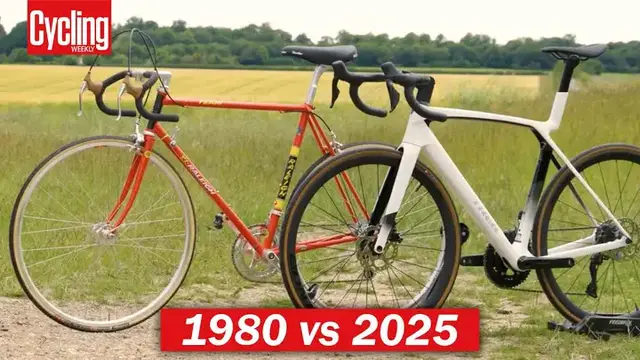
The 2025 Tour de France will be raced on carbon fibre road bikes that claim to be better than ever...but what's it like to ride a road bike that won the Tour de France in 1980? With his trusty set of Favero Assioma Pro RS2 pedals Jamie set about finding out in this modern bike vs retro bike test.
Road bikes have changed quite a bit over the last 40 years, there's now wide road bike tyres, Di2 and disc brakes but have they got any faster? To find out we pit a Trek Madone against a TI Raleigh - A replica of the bike that won the 1980 Tour de France
This video contains paid promotion on behalf of Favero
Show More Show Less View Video Transcript
0:00
This is a TI Rally, a very pretty and very limited edition of the bike that Joupes Settamelk won the
0:07
1980 Tour de France on. And this is a 2025 Trek Madone. It is the epitome of a modern race bike
0:16
It has carbon fiber tubes, it's got carbon fiber wheels, it's got disc brakes and gears that go
0:21
beep boop. But how do two bikes that are 45 years apart actually feel to ride? Well
0:28
thanks to Favaro's new Asioma Pro RS pedals, we're going to find out
0:34
Looking at these two bikes, and they couldn't be further apart, disc brakes have replaced these fan-favorite
0:41
rim-squeezing contraptions, the tires have absolutely ballooned, the gears now require electricity to operate
0:48
and modern bikes seem to sometimes have extra holes. Somehow, up until now
0:55
I have managed to evade ever riding a bike with down tube shifters so today we're going to change all of that to find out the difference
1:04
between the two bikes we're going to be subjecting them to a series of tests first of all we're going
1:10
to do a flat test riding a set power output then we've got hill climb test and then finally a sprint
1:17
test to see how both bikes behave first of all though got to get these fevere power pedals on
1:23
i think probably the pedal threads are about the only thing the only standard which hasn't
1:28
actually changed in the last 45 years. To make matters even easier all of the technical stuff
1:34
is inside the pedal axles so the batteries, the strain gauges, the gyroscopes is all in this
1:42
stainless steel axle and that's really good because it means there's not pods to knock
1:47
or damage or I'm quite clumsy so it's nice that everything's housed inside there. There's also the
1:53
added benefit because they're pedal based you can fit them to one bike on one day of the week and if
1:59
you're lucky enough to have a second bike you can swap them over at the weekend and get your power
2:03
data on that as well also because i already use shimano cleats i won't need to change those over
2:09
and these new pedals are 100 shimano compatible we've just discovered that uh we've got a hack
2:16
putting on pedals uh cameraman ed has apparently wasted many hours not doing this so if you just
2:22
do the first few threads and then hold the axle and just wind the pedals backwards it's done up
2:30
then you get your pedal spanner do the final bit there you go hack
2:36
right it is time for our first test and i have a feeling that this one is going to be my favorite
2:43
because it's flat now the aim of the game here is to ride at a set power output for the lap
2:50
and then we'll get back see which one's fastest and if there's any meaningful differences between
2:56
the two bikes so as with any real world testing you do need to take the results with a little bit
3:01
of a pinch of salt because it's not a wind tunnel still haven't got one of those but we have done
3:07
everything in our power to make it a fair test so we've chosen quite a still day we've chosen
3:13
traffic free roads so there's nothing to pull us along or hold us up and we're going to obviously
3:18
be using the Fervero power pedals to measure our power to plus or minus 1% accuracy
3:25
Right, enough procrastinating, let's get going. The course for our flat test was a 10km loop, not planned flat but about as flat as most
3:40
real life rides get. And as you can see from the numbers from the Fervero power pedals, I managed to get pretty
3:45
close to my 250 watt target on both efforts. On the rally I finished the loop with a time of 17
3:52
and a half minutes and on the track I was 26 seconds faster. Now it should be said that this
3:58
difference probably wasn't all down to the aerodynamics of the bikes. I definitely felt
4:02
more confident when cornering on the modern bike probably in part because that's what I'm used to
4:08
If we wanted to ride the rally at the same speed i.e about a kilometer per hour faster
4:12
then it would require about 15 to 20 watts more So next up hill climb test The all important So there three things that are going to make the difference when riding up a hill
4:26
A, the stiffness of the bike and how that translates the power onto the road
4:32
B, the rolling resistance of the tyres. And C, the bike weight
4:37
So, I've got to hold the boot up so I now can't see what it weighs. 9.8. 9.8, what did I guess
4:42
9.8. 9.8. although we do have to take the weight of the pedals off of this one but they claim to be the
4:49
lightest power meter pedals in the world 123.5 grams per pedal which is pretty impressive but
4:55
we are going to validate that we're going to put them on a set of scales we're going to use ed's
4:59
drug scales to give them away we'll validate that claim right time to get the track on it
5:06
my drug scales right the track it should be lighter it's not the lightest Madone build but
5:15
this Madone is a lot lighter than the previous generation Madone which was full-on aero the
5:22
wheels aren't the lightest 105 di2 also got a bit more weight over Ultegra or Dura Ace so I'm
5:29
gonna guess, what did I guess for this one? 8.6. Gotta hold the boot up but less
5:37
8.45. 8.45, what on track? You've outdone yourself. So to find out if this
5:46
weight saving makes a difference I'm going to need to go and ride up a hill
5:52
Ah, right. Yes, well it's time for hill climb test and Ed's chosen me that
6:02
Well that wasn't very friendly. That tractor can't even get up it
6:06
Now I've gotta get up on this. Let's go
6:22
Oh, Christ, that's a long hill. How was that
6:44
They were quite fit in the 80s. Oh, you're such an arse
6:49
You could have picked so many nicer hills. but we've got time. I don't know if back in the day they have different shaped hands
7:01
his flat test in the drops are absolutely fine. Up here it's just these bits get in the way
7:09
which is rather annoying. Yeah so it wasn't the most comfortable experience. Gears I was actually
7:15
really impressed with how well they work. They're indexed beautifully. You can feel each gear
7:21
and that is absolutely lovely but i could have done with a few more up there
7:25
yeah i was out the saddle for most of it right back down got to do it all over again not i
7:32
right let's get these swapped over so yeah trek has most definitely taken on the uh
7:41
one bike one race bike to do it all concept um they used to have the madone which was their aero
7:49
bike and then the Amondo which is their climbing bike and this this latest one is designed to do
7:56
both so it's got much skinnier tubes than the old aero one much more Amondo like but it supposedly
8:02
is as aero although that was with a set of aero bottle cages fitted let me know what you think of
8:07
this paint job I don't know about it I do rate that track has made the logo a lot smaller but
8:14
let me know in the comments below and whilst you're there make sure you subscribe to the channel
8:19
The hill climb that Ed chose me was near enough 1km long, an average gradient of 10%, but the times were really rather close
8:30
On the Raleigh I set a time of 3 minutes and 27 seconds but despite being lighter I was only 2 seconds faster on the Madone In fairness though that was at a lower wattage and I think the downside of all that gear range is I probably wasn forced to push myself as hard
8:47
That and maybe there was some fatigue in the legs by this time in the day. Looking at the data from the Pro RS pedals
8:53
and we can see that my average cadence on the retro bike was 8 RPM slower for the effort than on the modern bike
9:00
By no means an insignificant difference. uh i don't know about easier definitely different uh this bike is a lot smoother
9:14
um which you wouldn't think you'd feel that much at low speeds yeah you can just apply that power
9:22
just that little bit smoother and also i changed gear a lot more on that one just because it was
9:29
easier and there's also more gears not only is this 12 speed so more quantity of gears but
9:36
also more range of those gears. Also I think because of that smoothness and the gearing I did
9:43
a lot more of that sat down. I think that this one probably was quicker and not because it's slightly
9:48
lighter. Now I think this test really does highlight the benefit of using a pedal-based
9:56
power meter over a crank-based or spider-based version because we can fit it to basically any
10:00
bike. It doesn't matter if it's a bike that's getting on a bit like this one you can use them
10:05
on a new bike and because the pedal bodies are actually removable with an allen key you don't
10:11
even need any proprietary tools you can swap them out for the pro mx spd pedal bodies and that means
10:17
that you could use them on your mountain bike or gravel bike so for our test we're using the
10:22
dual sided version which cost this much but there is also a single sided version which cost this
10:29
much and you can also upgrade from the single-sided to the double-sided version for this much
10:36
I didn't know you were going to do that. I didn't know I was going to do that. If that sounds
10:40
tempting then we'll pop a link in the description below and the other really good thing about these
10:45
pedals is it's not going to change how either bike rides so that's because it's got a really
10:50
low stack height that's the distance between the pedal axle and your cleat that's 10.5 mil which
10:55
is really rather low for a power meter pedal and also the q factor that's how far away my feet are
11:03
from the crank arm it's the same as on a standard spd sl pedal so 53 mil so it's not going to
11:09
affect how either bike rides because i want to ride this in all of its glory and for my final
11:15
very scientific test i'm going to be sprinting on both bikes now this one is less scientific because
11:22
we're not going to be measuring how much power gets put through the frames or anything i literally
11:25
literally just wanted to see what it was like to sprint on a bike from the 80s. I think this might be where we feel the biggest difference
11:32
because there's obviously a huge difference in materials. The new bike is composites, everything
11:38
It's got carbon fibre handlebars, carbon fibre frame, carbon fibre wheels. This one, I'm pretty sure, well, it was state of the art in the day
11:46
but it's got Reynolds 753 tubing, which is obviously steel. And back in the day, it was very special
11:52
because they managed to make the tubes so thin that they then had to solder it with silver solder
11:58
so they could do it at a lower temperature as to not damage the walls. I think the only bit of composite on this bike
12:05
is the lightweight pedal bodies of the Favaro paddles. So yeah, there's quite a difference there
12:12
Let's see how it handles. I mean it's a bucket list item ticked off. It was a bit nerve-wracking because I really
12:32
didn't want to crash on this lovely bike. I think one thing that's weird is the gears
12:40
I think it's just a case of getting used to them to be honest because obviously well A
12:45
you can't change gear whilst on the hoods or drops. There's no sprint shifters either
12:50
but I had them on my bike. None of that. Yeah, it's just like, am I in that gear
12:56
Am I half in between it And then you sort of get out And to sprint it actually felt like felt pretty good I can only imagine like what it would have felt like you know mass bunch sprint with everyone like playing
13:07
with their gears and stuff like that. Really cool but yeah I'll stick to my bike for sprints for now
13:16
Right sprint number two it should be a lot more like what I'm used to. Let's go
13:27
It's amazing how a bike can be both stiffer and more compliant, isn't it
13:39
I've never really got my head around that, but it is a thing
13:44
The bottom bracket does feel like it translates that power a bit better
13:49
but then you sit back down, you don't feel all those road vibrations
13:53
through both your bum and through your hands. I must admit I'm getting on with this cockpit much better that's the main change that feels
14:03
different to ride both bikes like this bars on the rally are just so skinny whereas these are
14:09
really quite quite chunky I find the hoods much more comfortable obviously that doesn't matter so
14:14
much while sprinting it wasn't at all in favor of this one though like the rally is just so much
14:19
more involving to ride it feels like a bit of an event whether that's a sprint or just riding it
14:27
like if i could choose one bike to go and ride to the cafe on a sunday i think it would have to be
14:32
the rally like it feels like an adventure going out on a ride it feels like you have to do something
14:39
whereas on this you just kind of sit there does that make sense so how much difference have the
14:46
last 45 years or so made? Well if you look at the results from the power pedals then potentially
14:52
less than you might think. You see the thing is even with bikes that are decades apart they couldn't
14:59
be more difference in their frame construction and in their componentry and wheels and yet
15:04
the difference is still mainly made by the rider and that shouldn't really be any big surprise
15:12
80% of your air resistance comes from your body and not from the bike
15:17
I've been dropped by many people on much worse bikes than me
15:22
because they've just got stronger legs or bigger lungs. I don't know what it is, but they're just much stronger
15:28
So if you want to get faster on the bike, probably just do some more training rather than buy a new bike
15:35
But don't worry, the last 40 years or so haven't been a complete waste of time
15:39
the trek was so much more comfortable and i think that's true of if we'd chosen any modern race bike
15:46
it would be so much more comfortable than this ti rally no doubt the frame material comes into that
15:52
but i think in main that is down to the tires the trek's got 28 mil tires on it our ti rally's got
15:59
23 mil tires on it and that was actually fairly large for the time the other thing is that you can
16:05
get on the track and thanks to its geometry and the geometry of a lot of modern race bikes you can
16:11
just get on it and you can ride to your potential you can get on it and you can do a sprint you can
16:18
get on it and smash it up a hill as hard as you can without having to worry about anything else
16:23
they're very pretty this gear set but down tube shifters they look cool and they're definitely
16:30
of their time but for actually riding a bike I don't think anyone will argue that they actually
16:37
function better you you can argue with me in the comments below but keeping your hands on the bars
16:43
with the STI shifters just so much nicer and I think that's what it comes down to the geometry
16:49
the frame materials that is where the evolution has been yes it is probably a bit faster it was a
16:56
little bit faster in our testing but the biggest difference was its comfort and its ease of use
17:03
So there you go there's some progress. Let me know which of these two bikes you would choose to have
17:08
in your garage down in the comments below. If you want to find out any more details or get yourself
17:13
a set of those Favaro pedals then we'll pop a link in the description. Make sure you subscribe
17:18
to the channel, give this video a like and we'll see you next time
sports
Sports
Road Bikes