live_tv
Livestream Starting Soon
00
Hours
:
00
Minutes
:
00
Seconds
Up next in 10



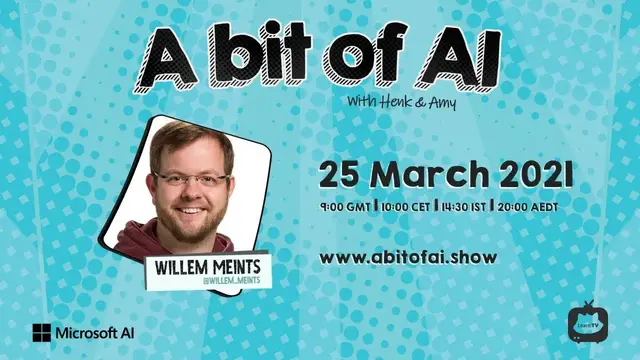
What is it like to work in the field of AI? How do you get started with AI? And what is going on this week? Find out in this 30-minute show hosted by cloud advocates Henk and Amy. In this show, we will enter a conversation with our guest who works with AI daily and challenge you to expand your skillset with a recommended weekly MS Learn module.
This week we will have a chat with Willem Meints about his work in AI.
GUEST SPEAKER
Willem Meints is a software architect and engineer with a wide variety of interests. His background in software engineering hasn't stopped him from exploring new areas like machine learning as part of his daily work. This sparked a deep passion for everything related to artificial intelligence and deep learning.
Willem is the author of the book "Deep learning with Microsoft Cognitive Toolkit quick start guide".
Willem Meints : https://www.linkedin.com/in/wmeints/
A bit of AI Show Page: https://www.c-sharpcorner.com/live/a-...
C# Live - Dev Streaming Destination: https://www.c-sharpcorner.com/live
C# Corner - Community of Software and Data Developers
https://www.c-sharpcorner.com
#abitofai #talkshow #podcast #csharpcornerlive #csharpcorner
Show More Show Less View Video Transcript
0:00
Thank you
0:29
We'll be right back
0:59
Thank you
1:29
Thank you
1:59
Thank you
2:29
Thank you
2:59
Thank you
3:29
Thank you
3:59
Thank you
4:29
Thank you
4:59
Thank you
5:29
Thank you
5:59
Thank you
6:29
Thank you
7:55
Thank you
8:24
We'll be right back
8:54
We'll be right back
9:24
Thank you
9:54
Thank you
10:24
Welcome to the A Bit of AI Show with your hosts, Hank and Amy
10:45
Hi, everyone, and welcome to the third bit of AI Show with myself, Hank Buhlmann, and Amy Boit
11:00
We both work at Microsoft as cloud advocates in the AI space
11:04
Hey, Amy, good morning. How are you doing? Yeah, not too bad, not too bad
11:10
I just want to say hi to everyone. Thank you for joining us again. our third episode how exciting and yeah really excited to talk to our guest today I think
11:20
demystifying these AI roles is exciting exactly because we in our jobs meet so many people from
11:28
around the globe and this show is really about showing and what people in the AI space do and
11:36
what type of skill sets are needed when you're building an AI solution and I think that is from
11:43
Actually, it starts all with pre-sales, maybe recruiting, up to consultancy, and to people that actually lead the teams and create the deep neural networks and run them in production like we saw in the first episode
11:57
So in this episode, we're going to talk to Willem about his life in AI
12:04
And we are having some really cool AI Learn modules this week
12:08
and before we forget you're going to say that Amy ah yeah nice
12:17
I wanted to take this one in today's show but don't forget that after this show
12:22
we only have 30 minutes with you and so what we wanted to do was actually have that kind of like
12:28
connection zone where we can sit and chat you can ask us questions
12:32
you'll probably want to ask Willem questions more than you'll want to ask us questions
12:36
but we've called it a bit like cafe and it's a friendly teams meeting where yeah we can all just stay connected for 30 minutes
12:45
after the show so hopefully you can join us there if you go to aka.ms slash a bit of ai dash cafe
12:56
nice so um let's not wait any longer and get willem into the into the show hey good morning
13:03
hey morning how are you doing yeah pretty good this morning it's it's nice outside i mean it's
13:12
it's getting sunny it's a bit foggy in the netherlands but uh yeah that will clear up
13:17
during the day i hope yeah no we've had the same here in the uk it's starting to get brighter which
13:25
is quite nice um it's not necessarily any warmer but it's certainly brighter so that's always good
13:31
start. It's the small things. It is the small things. It is the small things. Welcome to the
13:39
show, Willem. Thank you so much for joining us. Yeah, we've all worked together. I'm sure many
13:44
people from the global AI community recognize us three in the same space. So this is, it's
13:50
brilliant to have you on the show. I guess let's kick things off straight away with, Willem
13:55
tell us who you are and what do you do in the AI space? So I'm Willem Mainz. I've been doing AI for
14:03
quite a long time, nine years now. Back in the day, it wasn't as cool as it is now, I have to say
14:09
and it's a lot easier too. My daily job is actually, I'm sort of an AI architect. I used to
14:15
run the global AI community. People might know me from that. I had to step back a little bit for my
14:21
own sanity and health. But I'm very, very happy with what they are doing now because a lot of
14:28
people jumped in and helped me out, get the community up and running again. And so while
14:35
that was happening, I was just relaxing for a little bit and I'm currently back doing AI stuff
14:42
from an architecture standpoint rather than what I used to do. So I used to build models
14:47
I even wrote a book about it, Deep Learning. If anybody remembers that, that's a while ago
14:54
So yeah that my job Oh fabulous AI architect love it I actually think that a new role for the show So three out of three
15:05
completely different roles on every single show. So that's really, really good
15:09
Definitely not designed that way. So, yeah, really, really exciting. I guess, Willem, love the piece around the community
15:19
I know you're very active in the community. We might get a chance to chat with you a little bit about learning
15:25
But I guess one of our key questions that we always start with is what does a day in your role look like
15:32
The average day, what do you actually get up to as an architect
15:37
So, yeah, let me tell you a little bit of an example, actually
15:41
I think that best gives you a picture of what I'm doing on a daily basis
15:47
So one of the projects that I'm working on currently is a system that we're designing to help in the diagnosis of Parkinson's disease
15:55
And that's quite a heavy project. We have a few terabytes of data collected from people in the hospital
16:04
And one of the things that I do in this project is actually think about how do you set up a machine learning platform that's scalable and keeps on running, even if we throw bad things at it, which can happen
16:16
Sometimes the training run gets out of whack and we have a crashed machine and we have to recover that
16:22
Sometimes the graphics card doesn't want to cooperate, that sort of stuff. So I mainly focus on the non-functional requirements
16:29
in that space. So what sort of graphics card do you need to train a model
16:33
How much disk space do you need to actually store those models and data sets
16:38
But I also care a lot about doing AI safely. So responsible AI is a top of mind thing for me
16:45
model fairness and in this case also combating bias as we know colored images people have
16:54
different colors and we have a lot of people that have a lighter skin color and not a lot of people
16:58
that have a darker skin color so that's a challenge for us and that's where i help guide the team to
17:03
solve those problems so it's a lot of background work i would say yeah yeah no no no perfect perfect
17:14
I guess it just shows the breadth of an architecture role in general, right
17:18
You have to really turn your hand to then most things. Like you were talking a bit about hardware, a bit about responsible AI, a bit about the actual models as well
17:28
We know you're an expert in that space. Speaking of the book, Henk, we should pop that on our website
17:33
um so the the kind of breadth of your knowledge do you do you find yourself um having to learn a lot
17:44
as you're going through these projects or is it stuff from experience that you're finding
17:48
um some of the stuff is from experience i've been doing this for a long time so i can i can dig up
17:54
old things and um maybe the technology changed over the years but the principle is the same
18:01
I do have a lot of experience in software engineering as well, so that helps a lot because AI is not only about the models
18:07
It's also about proper software engineering, so DevOps pipelines, infrastructure as code
18:13
All the modern stuff that a regular software developer does is also involved in AI
18:18
That makes it extra complicated. But there's also a lot of new stuff. So the deep learning space is changing all the time
18:25
so I will have to keep on learning and learning and learning. And luckily, I don't do this alone
18:29
I do this with a couple of experts. So I've got two colleagues currently helping out
18:34
and they are experts in the field of computer vision. So sometimes they show me a paper, and I read that
18:41
and that gives me enough information. Sometimes I do experiments myself. I do try to use deep learning still because I love it on the one hand
18:49
And on the other hand, I think it gives me an edge as architect to know how to build a model, actually
18:56
So, yeah, it's a bit of experience, a bit of learning new stuff. it varies between projects
19:03
So I have a follow-up question for that. So you're working as an architect on that project
19:12
Who else are involved in that project? Which other roles do you have to work with
19:17
to actually deliver the product? So for this project, we have a couple of researchers from the University of Nijmegen
19:26
a Dutch university very active in healthcare and in medical science those people do research
19:34
assignments so they don't build production code but they do research on the same environment as
19:38
we run production code then from the side of info support where I work for we have a data scientist
19:47
working on the models and making sure that's production ready and we do have a couple of
19:53
software engineers working on actually building the API that accepts the data for making predictions
19:59
using the model. So it's a combination of DevOps engineers and AI researchers and one or two data
20:06
scientists. Currently, there's only one, but I expect to get more on that project, actually. It's
20:11
a pretty large thing to work on. Cool. So the end result of your project is delivering the API
20:23
Yeah, so there's actually two goals to this project. On the one hand, we like to support research in this area
20:30
I think it's very valuable that doctors can keep on researching while they work
20:35
And on the other hand, we want to enable the knowledge that they gained for other people in the world
20:41
So in this case, you can imagine that someone in Africa doesn't have the same resources that we do in Europe
20:47
And the idea here is that by using a machine learning model
20:52
we gather up all the experience that you have in Nijmegen and in other places in Europe and in Australia, actually
20:58
it's also involved, and bundle that in a model. So that can be used by a doctor who doesn't have access
21:05
to the same people and the same resources, can still do the best he can or she can to diagnose a patient
21:13
and help those patients. and that's so great about this project. Interesting
21:20
That's really cool. That's very cool. Let's chat a little bit about responsible AI
21:28
because you kind of brought it up. I know you do a lot in this space. I know you share a lot with the community as well
21:35
How do you do responsible AI within your team? How does that work
21:41
Obviously, it's got many, many areas to it, I'm sure. Yeah, yeah, there's a ton of areas to it
21:47
And it's not all ready to go and amazing yet. It's a very new development
21:54
We've seen last year during the Build Conference, I actually got to chat to a couple of scientists working on this space
22:00
We talked about Fairlearn. Well, we use that on a daily basis. But for computer vision, it's quite hard to apply
22:07
So that's one of the challenges that we still face. Other things that we do, we do look at bias in datasets
22:14
So it's sort of an interactive process, if you will. We start with the small things
22:20
So if we have a tool that we can apply to adjust small things in our model to make it better less biased more fair more robust also I seen some hacking attempts breaking deep learning models
22:35
so that's interesting. And we try to improve continuously. So we build a first version
22:42
We apply best practices for bias detection and fairness. Then we deploy it in production, and we keep on monitoring that model
22:49
And then we go back and we manually research the data and figure out what's going on
22:54
What sort of predictions are they firing off against that model? And that gives us a picture of, of course, we train that model on a certain data set
23:02
but reality catches up with us, so it changes. And the thing we do is by monitoring the model and storing the predictions also
23:10
we can detect the difference between the data set that we use for training and the data set that we use for predicting
23:16
And essentially, you're capturing prediction drift. Almost the model is drifting away from reality
23:22
and we're constantly updating the model to make sure that that doesn't happen too much
23:26
It still happens, but not too much. And that way we can be sure
23:32
that it's at least as safe as we can make it. It's never going to be perfect, that's for sure
23:39
But yeah, that's how we do that currently. And it's a benefit in our development process too
23:44
We have a whole guidance document for machine learning projects. It's a, I believe, a 13 chapter long document by now
23:51
I could turn it into a book, actually. And it explains to people working on the project how to actually do responsible AI with tools, with links to blog posts, with videos, all that stuff, just to make sure that people know how to do it
24:07
And that helps. It's getting better. Yeah, I feel like we're seeing a theme when we speak about Responsible AI and something you just said then like triggered me
24:17
I'd like deja vu, which was reading and sharing and learning seems to be currently the best way
24:24
Like if we're doing something and it works, share it. If we're doing something, it doesn't work, share it
24:29
Like and everyone kind of gets is able to level up then around the Responsible AI area
24:36
Yeah, and it's funny that you mentioned failure. I actually like to say embrace failure
24:41
If you fail at a deep learning project or a regular machine learning project
24:45
that's an opportunity to learn something new. And it's more effective to learn from a failure than from something that succeeded in this field
24:55
So we quite like that at InfoSupport. So we have frequent meetings with data scientists where we talk about what are we doing
25:02
What happens actually in production when our model failed? And that's really important
25:07
That's helping us get better at this because we're certainly not there
25:11
AI is way too new for that. Wonderful. And, Hank, I know you have our question of the show, isn't it
25:20
Our slightly controversial question. Yes. And it's going to be interesting because Willem already told that failure is not..
25:30
He just talked about failure. So that can't be the answer that machine learning projects failed
25:36
So the question is, what is the most annoying thing about your role in AI
25:42
Oh, man. There's only one thing, and that's data quality. I loathe it
25:49
It's evil. I don't know what we're doing in production. Why? It's sort of torture almost
25:57
So one of the hardest things in AI is getting the right data into your model
26:03
And it sounds so easy. Just grab a database from production and pull it into your machine learning environment
26:07
And you're up and going. It doesn't work that way, sadly. Not even close, I think
26:13
So going back to this project for the diagnosis of Parkinson's disease, we had to gather up new videos for our first experiment
26:25
And lo and behold, they have these videos on DVDs in a shoebox somewhere
26:32
and we don't know how to read those DVDs actually. So it's pretty exciting how that's going to fly
26:39
Another good example is if you look at a database in production
26:43
and I think we've all been there, those are pretty much crap
26:48
ERP systems, CRM systems, those are just so bad. I mean, you've tried to find one customer
26:56
and suddenly 17 copies of that customer turn up and you don't know which one is the right one to get
27:03
And this is why I find that the most difficult and the most problematic area of AI
27:10
And sadly, we spend 80% of the time in that. So it's like, yeah, I'm just happy I'm an architect
27:15
and I have data engineers to help me, to be perfectly honest with you
27:21
I was going to say, I'm glad that you've mentioned the 80-20 split of how much time you spend on data processing
27:32
versus the exciting part that we all enjoy, I think, which is the actual building of the model and the production system
27:39
That's what we talk about. I mean, when we talk about cool demos at Microsoft conferences
27:44
at global AI community events, at local events, it's all about the last 20% of the work, and that's pretty cool
27:52
But I also think that the 80% is sometimes pure torture and really hard to get solved
27:59
But at the same time, once you get there, you're so excited about the end result
28:04
you completely forget about 80%, and it's fine. And also, we get better at this
28:12
I've seen some pretty great developments in the area of feature stores, actually
28:17
Those are stores where you can store pre-processed machine learning features completely documented
28:22
You know who's responsible for that, where it comes from, statistics. Everything is included
28:26
And that's a good development. We also see a lot of tools
28:30
around data quality monitoring. So Azure Synapse is one of those samples
28:35
that comes up, pops up in my mind. It's getting better. So I'm positive about the future
28:42
but we're not there yet. It's quite hard work for the data engineers
28:45
Don't worry about your job. We'll keep you. amazing but what we would like to do Willem is move on to a segment we call our quick fire
28:57
questions round so in the next five minutes we're going to talk to you about five different
29:02
quick fire questions in which we want you to um basically just come the first thing that you think
29:10
of when we ask that question um so Willem has not been prepped for these questions this is
29:15
live on air and that is kind of one of the key things about this is finding patterns across our
29:22
guests where there's similarities and differences. So me and Henk will ask you a question one by one
29:27
and just try to keep the answer as short as possible. Okay so first question Willemt
29:34
are you ready? I'm ready, whatever. So what was your first programming language
29:44
Oh, QBasic. What programming language was used in the last project you worked on
29:54
C-sharp. Oh, interesting. That is interesting. a surprise, a new answer. Okay, so what was the last thing you learned in AI
30:06
And if possible, keep it to about a sentence. Oh, I learned about using transformers in NLP models
30:14
It's a totally new thing. Very nice. Well, it's not entirely new. Yeah, we had an NLP answer, actually
30:21
I think from Terry in our first episode. So that's interesting. Text is still the thing
30:26
Still the thing. Cool. favorite event in the AI calendar? Oh, that's a hard one
30:36
Global AI bootcamp, it must be that. I mean, yeah. It's got to be us
30:40
I'm honestly looking forward to that one. Yeah. Yeah. Oh, no, bootcamp's fun
30:48
Okay, final question. You're doing a brilliant job, Willem. What area of AI is on your list to skill upon next
30:56
So what's the next thing in AI you want to learn? Yeah, actually information retrieval using deep learning
31:05
That's one of the areas that I find very interesting at the moment
31:09
Yeah, it's something. So they've been transforming search engines into machine learning models and it's quite exciting
31:15
So I'm looking forward to diving into that a bit more. Yeah, that's great
31:21
I think it's Googling quickly. What's that? Oh, typing into our document just here
31:28
We are changing the format of the show on the fly. Henk, have you got another question by any chance
31:33
Yes, we have. So I'm interested in what training framework you used last
31:41
Oh, the last one I used was TensorFlow. And yeah, it's just a standard thing, I think
31:50
if we're talking about training frameworks PyTorch could be the other one but I'm
31:55
biased towards TensorFlow at the moment yeah that's cool also this is now not our five question
32:03
quickfire round in the future it's going to be a six questions quickfire round because that was a really good
32:07
question I was Hank nice one nice one amazing I guess Willem
32:15
we are already getting close to time on our chat with you We kind of always end our guest talk with what advice do you have to someone getting into the ai space oh um yeah find a group of people to work with i mean is
32:38
there's one constant factor that i've learned from my work in the global ai community is that
32:42
having a group of people who cheer you on in this journey is the best you can have. There's a lot
32:48
a lot of free material online, but it's all very hard to understand. And we all know this because
32:53
that we've been all, we've all been there. So learning AI, it takes a long time. Even after
33:00
eight years, I can still say I'm learning every day. But it's cool to have a group of people who
33:05
can point you towards a good solution, or maybe have some videos that you can watch, or just help
33:11
to debug the thing that you're building. That's great, yeah. Wonderful. Well, thank you so much for your time, Willem
33:20
It's been a pleasure speaking with you. And obviously you are online quite a lot
33:27
You're always sharing content. So please, everyone check out Willem on social media
33:33
all the great blogs he writes and stuff like that. And yeah, keep in touch
33:38
Thanks, and good luck. Are you going to be in the AI cafe
33:44
Absolutely. Yeah. Yeah. I will be there. I'm happy to answer any questions that people might have
33:49
I may not be able to help you debug your code, but we'll figure something out
33:57
Nice. Then we talk to you a bit later in the AI cafe
34:02
The link is on top of our website, or it is ak.ms slash a bit of AI dash cafe
34:15
Yes, so let's move on to next. We always have a list of events that are upcoming
34:22
and are nice to maybe attend. So I don't have a list of upcoming events
34:30
but I have a list of events that have opened CFPs. So that also might be interesting if you want to submit a paper
34:38
and these events are likely to be in person again because they end of the year So thumbs up So that is NDC Oslo
34:51
That is Build Stuff. And that is AI Life in Orlando, which is a great conference if you want to learn about programming
35:03
and the AI space and machine learning, cognitive services and chatbots and so on
35:11
So Amy, it's time for our learn module. Yes, often the most exciting part of my week is picking our learn modules after speaking with our guests
35:24
So we and Hank always have a quick chat with our guests before the show just to really dig into what they do so that we can get some great questions to you
35:34
But through that, we can also often find passions. And so we connect our guests to our learning challenge
35:43
And so this week, I've got three modules for you. So a little bit of extra learning
35:47
We normally try to keep it to two, but it felt like it was the right thing to do
35:52
So first ones first, Willem is someone who actively is building models as well as that whole piece of architecture
36:00
And so that end-to-end system made me think of the Azure Machine Learning Service
36:05
So what I've put in there is just how to get started, how to train your model learning with Azure Machine Learning
36:13
And then the other two are actually related to the topic around responsible AI that Willem mentioned
36:20
So he was fortunate at Build to actually be chatting with some of the people who were building this kind of technology
36:26
And so I wanted to fit these two technologies in. So the first module is explain machine learning models with Azure machine learning
36:34
So that's some of our explainability and interpret ML pieces. And then we've actually got the detect and mitigate unfairness in models with Azure machine learning as a module
36:46
And that was that fair learn piece that Willem just mentioned as well, which I was really happy about that he mentioned it live because I was like, oh, perfect
36:55
I chose that module. So we always put these into a challenge called a Cloud Skills Challenge
37:01
So if you want to go ahead and take these challenges go to aka slash a bit of AI dash learn or check it out on the website abitofai and you be able to grab the links from there
37:17
Amazing. So Hank already, we've come to the end as we always do
37:22
So to close us out, I just want to say thank you so much as always for joining us today
37:28
This is our third show. We are always trying to improve. If there's anything you think would be really interesting to see on the show, please get in touch
37:38
We are on Twitter and we're on LinkedIn. We're on Facebook. Just can find us on the Internet, a bit of AI dot show
37:46
We are here every Thursday. That's 10 a.m. CET, 2.30 IST and 8 p.m. over in AEDT
37:59
daylight saving yes there's been changes of clocks recently so do tell us if we are
38:04
slightly out of sync on any of our timings um and then do come and join us in our a bit of ai cafe
38:11
so the whole idea of the cafe is meeting up informally uh chat with myself and hank or
38:18
probably more likely you want to chat with our guests so come and chat with me willem and hank
38:23
in our AI cafe. So go to aka.ms slash abitofai-cafe or it's at the top of the website
38:32
If you want to re-watch this episode or any of our previous ones
38:36
go to abitofai.show, which is our website. And with that, Henk, any final words for this episode
38:45
No, I hope to see you all in the cafe. Thanks so much for joining us today
38:53
All right. Thank you, everyone. And we'll see you for the next A Bit of AI show with Henk and Amy
#Dating & Personals
#Photo Rating Sites
#Online Goodies
#Social Network Apps & Add-Ons
#Photo & Video Sharing
#Social Networks
#Computer Education
#Communications & Media Studies
#Machine Learning & Artificial Intelligence