0:00
Imagine you're sitting in your
0:01
Mercedes-Benz, a masterpiece of German
0:03
engineering, but suddenly it starts
0:05
acting like a completely different car.
0:07
You try to turn on your heated seats.
0:09
Nothing happens. You try to adjust your
0:12
mirrors. They're frozen. You go to turn
0:14
up the climate control fan, but it feels
0:17
weak, like it's barely breathing. Then
0:19
you look at your dashboard and see a
0:21
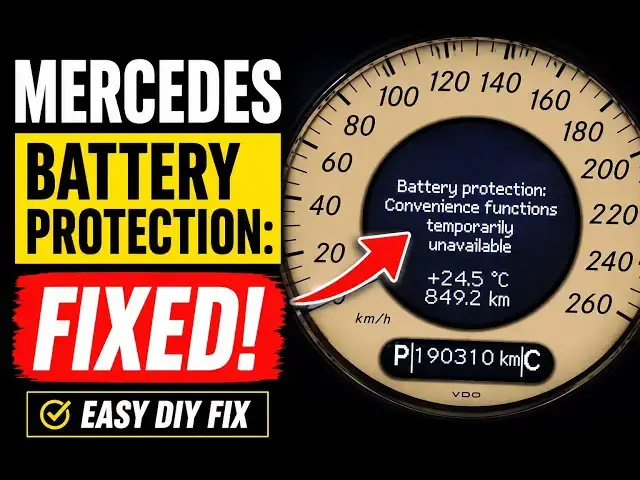
cold, mysterious message that reads,
0:24
"Battery protection, convenience
0:26
functions disabled." It feels like your
0:29
luxury car is slowly shutting down and
0:31
your mind immediately jumps to a failing
0:33
alternator, a fried computer, or a
0:35
massive 4-f figureure repair bill at the
0:37
dealership. But what if I told you your
0:39
car isn't actually broken? In fact, it's
0:42
doing something incredibly smart to save
0:44
itself. And if you know the secret
0:45
behind this message, you can fix it in
0:48
your own driveway tonight without
0:49
spending a single dime. Most owners
0:51
panic when they see this, but today I'm
0:54
going to show you exactly why your
0:56
Mercedes is ghosting your favorite
0:58
features and the one simple trick that
1:00
brings them back to life instantly. To
1:02
understand why this is happening, you
1:04
have to stop thinking of your Mercedes
1:06
as just a car and start thinking of it
1:08
as a highly intelligent energy manager.
1:10
This warning isn't an error code or a
1:12
mechanical failure. It's a strategy.
1:15
Your Mercedes is equipped with a
1:16
sophisticated power management system
1:18
that acts like a bodyguard for your
1:20
engine. When the onboard computer senses
1:23
that the battery voltage has dipped
1:24
below a specific safety threshold,
1:27
usually around 11 to 11.5 volts, it
1:30
enters a survival mode. In this mode,
1:33
the car begins shedding weight
1:34
electronically speaking. It looks at all
1:36
the components drawing power and starts
1:38
a hierarchy of sacrifice. It cuts off
1:41
the high draw luxury items, things you
1:43
don't technically need to stay on the
1:45
road. This includes the rear window
1:47
defroster, the seat heaters, the
1:49
interior ambient lighting, and even the
1:51
high-speed setting on your blower motor.
1:53
The car is effectively telling you, "I'm
1:55
going to stop pampering you right now so
1:57
I can make sure I have enough energy to
1:59
crank the engine the next time you turn
2:01
the key." It is prioritizing your
2:03
ability to get home over your ability to
2:05
be perfectly comfortable. If you've
2:07
spent any time looking for a solution to
2:09
this on the internet, you've likely come
2:11
across a very popular video titled
2:13
MercedesBenz battery protection
2:16
convenience functions temporarily
2:18
unavailable. That viral phrase has
2:20
become the go-to search term for
2:22
thousands of confused owners. While the
2:25
wording might vary slightly depending on
2:27
whether you drive an E-Class, a C-Class,
2:29
or an S-Class, the core issue is exactly
2:32
the same. The car is warning you that
2:34
the buffer of energy in your battery is
2:36
gone. So, why did this happen today?
2:38
There are usually three main culprits,
2:39
and none of them necessarily mean you
2:41
need a new battery yet. The first is
2:43
what I call the modern commute. If
2:45
you've been doing a lot of short trips,
2:47
5 minutes to the gym, 10 minutes to the
2:49
store, your battery is in a state of
2:51
constant depletion. It takes a massive
2:53
surge of amperage to start a Mercedes
2:55
engine, and a short drive doesn't give
2:57
the alternator enough time to put that
2:59
energy back. Over a week of short trips,
3:01
the battery becomes starved. The second
3:04
culprit is the weather. Batteries are
3:06
chemical devices and they hate the cold.
3:08
A drop in temperature can reduce a
3:10
battery's capacity by up to 30%. If your
3:14
battery was already slightly weak, a
3:16
cold morning is often the final straw
3:18
that triggers the convenience protection
3:20
mode. The third culprit is a parasitic
3:22
draw where a small electronic component
3:25
doesn't go to sleep properly when you
3:26
lock the car, slowly sipping power while
3:29
the car is parked in your garage. Now,
3:31
let's talk about how to fix it. Before
3:33
you call a tow truck or head to the
3:34
dealership where they will likely charge
3:36
you a couple of hundred just for a
3:39
diagnostic fee, try the recharge run.
3:42
This is the most effective free fix. You
3:45
need to take the car on a continuous
3:47
highway drive for at least 30 to 45
3:50
minutes. City driving with stopand go
3:53
traffic won't work as well because the
3:55
alternator output fluctuates. You need
3:57
consistent RPMs as you drive. The power
4:00
management system constantly monitors
4:02
the voltage. Once it sees the battery
4:04
has climbed back up to a healthy 12.6
4:07
volts or higher, you'll actually hear a
4:09
faint click from the dash or see the
4:11
lights brighten, and those convenience
4:12
functions will magically reactivate
4:14
right before your eyes. If a long drive
4:17
doesn't fix the issue, you need to check
4:19
the hidden hardware. Many modern
4:21
Mercedes-Benz models actually use a dual
4:23
battery system. You have the large main
4:26
battery usually located in the trunk or
4:28
under the hood which starts the engine.
4:30
But you also have a smaller auxiliary
4:32
battery. This small battery is
4:34
responsible for supporting the sensitive
4:35
electronic modules and the EQO start
4:38
stop system. If this auxiliary battery
4:40
starts to fail, it can trigger the
4:42
convenience functions disabled message
4:44
because the car no longer has a reliable
4:46
backup for its computer systems.
4:49
Replacing this small battery is often
4:51
much cheaper and easier than replacing
4:53
the main one. The bottom line is this.
4:55
Don't ignore this message. It is a
4:57
courtesy warning. Your car is being
4:59
polite and telling you that it's
5:00
struggling before it completely refuses
5:02
to start. If you see this message, treat
5:05
it as an invitation to give your car a
5:08
little bit of maintenance and attention.
5:10
By understanding the language your
5:11
Mercedes speaks, you can avoid
5:13
unnecessary stress and keep your luxury
5:16
experience exactly as it was meant to
5:18
be. If this deep dive helped you
5:20
understand your car better and saved you
5:22
a stressful trip to the mechanic, we'd
5:24
love to have you as part of our
5:25
community. Please give this video a
5:27
thumbs up and subscribe to the channel.
5:29
We're dedicated to helping you master
5:31
your vehicle and save money by knowing
5:33
exactly how these complex systems work.
5:36
If you have a specific warning light on
5:38
your dash that's driving you crazy,
5:40
leave a comment below and let us know.
5:42
We might just make our next video for
5:43
you. Safe driving and we'll see you in
5:45
the next one. This is Car Justify.