Up next in 10

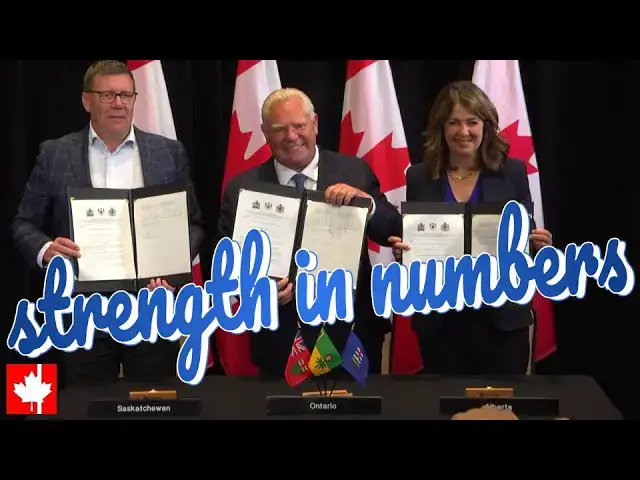
Strength in numbers: 3 provinces sign MOU to build pipelines and expand trade corridors
Jul 22, 2025

Today we're signing a Memorandum of Understanding that makes Saskatchewan an official signatory and partner as we work together on building oil and gas pipelines and expanding trade corridors to global markets. This agreement will see our three provinces advanced pipelines and pathways to boost exports of homegrown energy, potash, critical minerals and agricultural products to markets across Canada and across the world.
And when it comes to advancing these goals, it's undeniable that there is strength in numbers.
--
This video has automatic dubbed versions.
Go to Setting / Audio track and select your preferred language among the following:
- English
- Dutch
- French
- German
- Hindi
- Indonesian
- Italian
- Japanese
- Korean
- Polish
- Portuguese
- Spanish
Thanks for watching!
Show More Show Less View Video Transcript
0:00
Today marks an important step forward in uniting our country as Saskatchewan jumps on board with Alberta and Ontario
0:06
to pursue our shared goals of economic growth, opportunity, and prosperity. Today, we're signing a memorandum of
0:12
understanding that makes Saskatchewan an official signator and partner as we work together on building oil and gas
0:17
pipelines and expanding trade corridors to global markets. This agreement will see our three provinces advance
0:23
pipelines and pathways to boost exports of homegrown energy, pod ash, critical minerals, and agricultural products to
0:29
markets across Canada and across the world. And when it comes to advancing these goals, it's undeniable that there
0:35
is strength in numbers. Together, we're taking an unprecedented step to further unify our efforts to get shovels in the
0:40
ground on major projects across industries with uh one ultimate outcome in mind, connecting our worldclass
0:46
resources and value added products to Canada's growing list of customers. Our three provinces will also continue our
0:53
joint calls for the removal of federal barriers to nation building projects so we can collectively advance pipelines,
0:59
rails, transmission, infrastructure, and other major projects. We know their strength in taking a united front, but
1:05
we cannot achieve our shared provincial goals without cooperation from the federal government. Alberta knows this.
1:11
Saskatchewan knows this. Ontario knows this. And it's time for the federal government to acknowledge it as well.
1:17
And if Prime Minister Mark Carney doesn't want to work with us, it's not just myself and Scott Mo he'll have to
1:22
worry about. He'll also have to contend with Premier Doug Ford, who has said many times he'll be all over him like an
1:27
800lb gorilla. So, it's time to get rid of the bad laws that have harmed Canada's ability to grow the energy
1:32
sector and other industries such as mining and manufacturing. By now, you should all know these bad laws that I
1:39
speak of quite well. Bill C69, the oil and gas emissions cap, the tanker ban, the net zero vehicle, and net zero
1:46
electricity mandates. Removing these anti-resource anti-development laws will allow Alberta, Saskatchewan, and Ontario
1:52
to attract the investment and project partners we need to get shovels in the ground, grow industries, and create
1:57
jobs. So, I'm excited to continue collaborating so that we can reach our shared goals, including to advance
2:02
pipelines and responsible energy development. This new way of working together across provincial borders will
2:08
benefit the people of Alberta, Saskatchewan, and Ontario, and ultimately all people across Canada. And
2:14
I'm hopeful that today's momentum continues to build and leads leads to even more provinces and territories
2:19
joining us. Thank you. And I'll I'll hand it over to Premier Scott Mo.
2:30
I would just say thank you uh to Danielle and I could really just say ditto and sit down and that uh might be
2:36
uh you know about as strong a statement as as I could make but uh but also thank you to Premier Ford for hosting us here
2:43
in uh in Ontario as we uh find our way through our Council of Federation meeting uh this year. I think an
2:48
important uh year for the Council of Federation to come together along with Prime Minister Carney uh later today.
2:54
Um, and I'm pleased to join uh in signing this memorandum of understanding. For far too long, uh, as
3:00
Premier Smith has said, Canada's energy, our critical mineral sector, uh, whether it be our oil and gas sector, uh, all of
3:07
our exporting industries have faced far too many bottlenecks in not only their production, but in limiting our ability
3:14
to provide those products to nations around the world. Um and it is us coming together as provinces and we would very
3:20
much hope to work alongside the the uh prime minister Carney and his government uh in changing that uh in enhancing uh
3:28
Canada's opportunity to not only become uh the strongest economy in the G7 um
3:33
but ensuring that we can achieve the aspirational goals that Prime Minister Carney has put forward of becoming a
3:38
global energy superpower. uh in order to do that uh there we are going to have to make changes uh in the development of
3:45
policies uh that we have in Canada and Premier Smith had named a number of them. Why does this matter to a province
3:51
of Saskatchewan and why does this agreement building on many other agreements whether they be on free and
3:56
fair interprovincial trade or whether they be on accessing all ports that we have available to us in Canada. Um why
4:02
is this important? Uh it's important to Saskatchewan because we do uh produce a number of products uh pot ash oil and
4:09
gas agricultural products of course uranium uh but also now moving into
4:15
additional copper, helium uh lithium uh and rare earth elements and many other uh products as well that are going to
4:21
need access to even more countries around the world. More export options. more export options so that we can find
4:27
these products can find their way to those countries around the world so that we can be part of their food security, part of their energy security. Um, yes,
4:34
Canada can be part of global manufacturing security. Um, and ultimately providing Canadians with
4:40
economic security, which is uh the goal uh most certainly and has been the goal of our government for some period of
4:45
time. And so any and all options when it comes to how do we provide the world with these opportunities uh are very
4:52
much supported by our by our province in Saskatchewan. And I thank uh both Premier Smith of Alberta and Premier
4:58
Ford of Ontario uh for moving yet another positive step and a positive initiative forward uh in us finding a
5:05
way not only to produce more of the products that are providing that energy, food and manufacturing security for
5:10
Canadians, for North Americans, and for other global countries, but for finding additional ways for us to uh provide uh
5:17
that global energy, food, and manufacturing security to the world. Thank you both, and I'm pleased to sign
5:22
this uh supportive document today. That's great.
5:29
[Music] Well, good morning everyone and uh such a pleasure to be joined by my good
5:35
friends uh Premier Scott Mo and Premier Danielle Smith. This is an amazing day for our province
5:42
and for our entire country because when Ontario, Alberta, Saskatchewan come
5:48
together, we're not just signing a piece of paper. We're sending a clear message.
5:54
Canada is ready to build and we're going to get it done as one team Canada. For
6:02
too long, we've seen projects after project get tied up in red tape,
6:08
regulation, delayed, blocked, and then cancelled.
6:13
But today, the world needs what Canada has. It's time to think big. It's time
6:19
to bring our critical minerals, our oil, our natural gas and energy to new
6:25
markets across the globe. It started earlier this month when I visited
6:30
Premier Smith during the Calgary Stampede and what a great host uh Premier Smith was. And boy, you had
6:37
quite the party. Is the party still going on? We we signed an agreement to work hand
6:43
in hand to build new energy and trade infrastructure. And today, Saskatchewan
6:50
is stepping up. Premier Mo has offered his full support, and that's a gamecher.
6:56
Let me tell you our plan. This new agreement will help move Western oil and gas to new and existing refineries in
7:04
southern Ontario and to Northern Tidewater with Deep Sea Port in James
7:10
Bay. It will connect Ontario's critical minerals in the Ring of Fire region to
7:15
new ports in Western Canada, helping to build a true end to end critical mineral
7:22
supply chain. All of it will be built using great Ontario made and
7:27
Saskatchewanmade steel, creating jobs, attracting investment, and unlocking the
7:34
full potential of our economy. And all of it will be done in partnership with
7:39
indigenous communities. Canada's premers are stepping up. Now, we need the
7:45
federal government to do its part. We need the federal government to fix its
7:50
broken regulatory environment and streamline approvals. And I agree 100%
7:57
without listing them all. We're all in agreement what Premier Smith said. If we
8:02
don't get rid of these these uh regulations, uh things won't fly. But we
8:08
need to do that and and hopefully we'll convince the prime minister to do the same thing. There's no more time to
8:15
waste. We're focused on a future for all Canadians where we stand united, take control of
8:22
our own destiny, and build prosperity the likes of which we've never seen before. I want to thank both premers for
8:30
coming here to Huntsville and signing this agreement and may God bless the people of Canada. Thank you.
8:48
So he has a whole system where you sort of start writing and then you look up and take the picture.
8:56
Okay everybody,
9:01
thank you. It's perfect.
9:29
Guys, thank you.
9:40
Absolutely. [Applause] Perfect.
9:51
Thank you.
9:59
[Music] Yeah. We will now take start taking questions from the media. As a friendly
10:04
reminder, the format today will be one question. Please state your name and your outlet before your question.
10:12
Can move up to the podium.
10:18
Yes,
10:24
I'm standing in your spot. You can go to the mic. Premier Peter Zamay from CBC News. Um,
10:29
this is a question for all of you. Um, you've spoken a lot about using um getting our resources to other markets.
10:35
Uh, but as Daniel Smith pointed out, um, our oil currently runs through the United States to Ontario. Michigan
10:41
threatened to cut that off a couple years ago. Trump could cut it off for political reasons. Do we need to build a pipeline from Alberta to Ontario on
10:48
Canadian soil regardless of whether there's a proponent or not for national security reasons?
10:53
Well, I I believe so. Uh my good friend, the governor of Michigan, and she known
10:59
her from day one, constantly threatens to cut off Line Five. that would
11:04
basically shut down our airport, shut down big part of uh of Ontario and we
11:10
can't chance it any longer. We need to be independent. We need a pipeline uh
11:15
going to southwestern Ontario uh to one of the refineries and be self-reliant.
11:20
We can't rely on the Americans anymore. As simple as that. I love the Americans, by the way. I love the people. Um love
11:29
the elected officials except one. And uh that's that's it. So yes, we we have we
11:36
have to start diversifying our trade around the the globe and uh as Premier
11:42
Smith and Premier Mo uh said, we we have to be leaders in the G7 when it comes to
11:47
our economy and we need to unleash every tool in our Canadian toolbox and uh tell
11:54
the world that Canada's open for business. We need to cut the red tape regulations and regulatory burden that
12:01
we're we're facing and I'm confident working with the federal government and the prime minister uh we'll do exactly
12:08
that. I'll pass it over to the other premers. I I would just uh say very quickly uh
12:14
there's really two conversations there and you've hit at the the the continental or Canadian energy security
12:20
one uh is the second. first as a as an oil producing region um and you know
12:26
providing oil at the highest price possible. Uh the number one priority economically is for us in Western Canada
12:32
to have access to the northwest coast. Uh that will shrink the differential that will provide additional egress
12:38
capacity into the US. Some of that does come yes back up into Canada. uh but to the oil industry uh from a economic
12:45
perspective that is the priority as a Canadian uh and as uh ensuring and
12:52
valuing and wanting and desiring us to have Canadian energy security and to yes be part of a North American uh energy
12:59
security plan. Uh but as a Canadian and valuing our Canadian energy security uh we certainly uh need to have Canadian
13:06
access through a line uh to the refineries in Eastern Canada. And I think that would be important to those that live in central and eastern Canada
13:13
as well. Uh so that we have that energy security as a country. And I would just point out uh and Premier Smith will have
13:19
much more to say on this as the largest oil producing province in Canada by a a
13:25
great uh a great margin. Um I would point out the the comparison of what
13:30
happened most recently in Eastern Europe uh when European countries uh learned uh that they have been entirely reliant uh
13:37
for a significant amount of their their energy security on Russia. Uh not a country that today they want to be
13:43
reliant on for that energy security and are looking to other options around the world including uh uranium from
13:49
Saskatchewan and nuclear re reactors from North America. uh we shouldn't allow that to happen to us as Canadians
13:56
to be reliant on another country whether it be for the production of our energy or whether it be for accessing that
14:01
energy through uh rail lines, pipelines. Um nor should we uh in any way be reliant on um foreign ports uh for us uh
14:10
to provide that energy security uh and that opportunity to the world as well. Um, so yes, uh, I think as Canadians,
14:17
uh, we most certainly need to have a very mature discussion about how we can provide Western Canadian oil and gas,
14:24
uh, to Canadians that live in central and eastern Canada for our own good, uh, looking forward uh, generations and for
14:30
our own not only economic security, but ultimately our general security and our energy security moving forward.
14:38
I've said that I'm supportive of pipelines northeast and west. I'd like to see all of them built. Uh to Scott's
14:45
point, clearly if we're opening up new markets, our best opportunity is to build a pipeline to the Northwest BC
14:50
coast in order to access the Asian markets. But uh it it should give us
14:55
pause that we u in Eastern Canada are overly reliant on oil that either has to
15:00
come by way of the United States or has to be shipped in from overseas. And so uh we could have uh addressed that years
15:06
ago with the Energy East pipeline. Energy East is now no longer an option that's available to us because those
15:12
pipelines are now full of gas. But if we can begin by creating um a pipeline option that will at least help us to get
15:19
to Ontario so that we can uh satisfy the needs of this market. I think that that'll give energy security to the country. And that's probably something
15:25
that's long overdue. We we probably should have done it decades ago, but um uh we didn't do it decades ago, but now
15:30
we can do it now. And I hope uh we'll be able to do that. Good morning, Premier. Kate McKenna from
15:36
CBC. This this too is for all of you. I'm wondering what you heard from Mark Carney last night and what you hope to
15:41
hear from him today. What I've heard consistently from Mark Carney is that he wants Canada to have
15:47
energy dominance and be an energy superpower and that he wants us to diversify our markets. Uh starting with
15:54
u doing more trade with each other. That's what theou is about today is how can we find a way to support each other
15:59
and then in addition to that find a way to to to get to new markets. That's the the only way I think that Canada will be
16:05
able to have the the security, the energy security we're looking for. And it's not just energy. Once we have those
16:11
roots that are established and we can build out rail line and port infrastructure, that's great for food
16:16
export, for fiber export, for manufactured goods export. So, those are the things that I I think that uh the
16:22
provinces are taking the leadership on, and I everything I've heard from Mark Carney seems to suggest he's supportive of that. uh he would demonstrate his his
16:31
great support if he would repeal or substantially revise the nine bad laws that are impacting our investment
16:36
climate. He hasn't done that yet, but as I've said, we're giving him some time to get into the role. He's got a new
16:43
legislative session starting up in September, and we'll have a a better idea of of what kind of revisions he's
16:48
going to make then. Well, I know uh Prime Minister Carney,
16:54
he wants to be one of the strongest economies in the G7, which we're confident we can do. But as Premier
17:00
Smith said, we have to get rid of the regulatory burdens. That's what's holding us back. And when we uh do that,
17:07
we can unleash the economic powerhouse Canada truly is. Diversify our trade, uh
17:13
build pipelines west, east, south, north, and uh get critical minerals out
17:19
of the ground. not in 15 years, but within two two years, get permitting happening a lot quicker. Uh that's
17:26
that's what's going to uh make sure that we're an economic powerhouse, build large infrastructure projects across the
17:32
the country as well. But we'll have a further discussion with Prime Minister Carney today and uh we'll get into it a
17:39
little deeper uh at the table. And I would just focus in on three
17:44
points uh with the prime minister of which uh I think he is uh you know off to a good start uh with
17:51
respect to. First is uh the regulatory process that both Premier Smith and Premier Ford have mentioned is flawed in
17:58
in in Canada. Uh and I think that is recognized by most members at the federal level as they've passed C5 which
18:05
is essentially a a piece of legislation that is there to uh to circumvent a lot of the time frames that are involved and
18:11
the uncertainty uh that are involved in the current regulatory process that we have. And it's important for us uh to
18:17
work alongside the federal government as provinces uh to actually correct the root of the problem which is the
18:22
multi-layered um well nine bad laws as Premier Smith has mentioned but many
18:27
others. Those are the nine uh priority uh pieces of legislation and regulation that need to be changed. Second is what
18:34
we're discussing here today is, you know, how do we increase uh port access and access to the world for Canadian
18:40
products and uh and we're supportive of any and all uh additional port capacity that we can uh that we can find and work
18:46
together on uh on expediting uh in Canada. And then last but not least is
18:52
market access. And in a world where you know there's much talk about tariffs and much talk about uh counter tariffs uh
18:59
not just with the US but with other countries. China is a one of note for uh Saskatchewan and Alberta and and Ontario
19:05
products as well uh in the uh in the agricultural sphere. Uh Prime Minister Carney has been you know I I think as uh
19:12
as engaging as as as we could hope certainly is engaging with the president I would say to a higher level than what
19:18
we saw a number of months ago. uh and also uh with conversations that that I've had with Prime Minister Carney with
19:25
respect to some of the counter tariffs from from uh China uh as uh as a result
19:30
of us as Canadians aligning with US trade policy when it comes to approaching uh China. Uh there is a a
19:37
price to pay for that and and all too often that lands on Saskatchewan and Canadian agricultural uh products. Uh
19:43
but Prime Minister Carney has been very uh engaging in reaching out and uh starting that conversation with China on
19:48
how do we move forward not only uh when it comes to canola tariffs and pulse tariffs, pork tariffs and seafood
19:54
tariffs, but more broadly uh in our our our trade uh conversation with a country
19:59
like China. And if we are going to in any way as we produce more and make it available to the world uh diversify in
20:06
any way that additional product uh production away from from the US uh we
20:11
are going to have to deal with growing markets like China like India uh and other markets around the world.
20:20
Hi Mickey here with um Politico. This question is for Smith and Ford. Um I was
20:26
speaking with John Katamatides um regarding the ostrich situation in
20:32
BC. He had a meeting yesterday with RFK Jr. and Dr. Oz on this matter. Um he
20:38
essentially wants the PM to intervene in the case and he said that he's spoken to both of you on this issue as well. Will
20:44
you be applying pressure to the PM on this? And do either of you have any issues or any concerns about the federal
20:52
government's treatment of farmers, particularly in this case? Well, I have asked my agriculture
20:58
minister to look into it to see if we had a similar situation in Alberta, what
21:03
would we be able to do differently? And um one of the things that I I think is worth looking at is when aven flu went
21:11
through that herd, it did kill 20% of them, but it didn't kill 80% of them. So maybe there is something to learn from
21:17
whether there's a an immunity or some kind of vaccine that could be developed as a result of having um that flock
21:24
survive. I think that um maybe we have to think about different ways to to do
21:29
um animal um husbandry and animal safety and why not try a different approach.
21:34
So, I I'm open-minded to see if uh if there's any uh persuasion on that. I I
21:40
gather that the US government is interested in partnering with BC if they wanted to do that. I'd be supportive of that because I you can see that this uh
21:46
case has really taken on um a lot of um public sentiment behind it. And if we can find a better way than doing mass
21:53
coolls in any situation like this, I I think it's probably worth it to try to find a better way to do it. I don't know
21:58
if you've got a thought. Yeah. No, I've I've talked to John many times about these ostriches. I'm an
22:04
animal lover, full disclosure, and I want to do everything I I can to help him. Um, I think he had a plan to bring
22:10
him down to Florida as well, to a sanctuary down there. So, anything John
22:15
needs, I'm always there to to support him. He's a good man. He cares for animals and uh he puts his money where
22:22
his mouth is, too, when it comes to uh making sure that he protects uh all animals.
22:28
So, thank you. Hi there, uh, Michael Sarabi with CPAC.
22:34
Uh, the question is actually for you, Premier Ford, and I appreciate today's announcement has to do with pipelines
22:40
and energy corridors, but given that amongst the regulations being pointed out is the EV mandate. What does today's
22:48
announcement, how does that affect your past enthusiasm to develop battery plants in Ontario as well as have EVs
22:56
uh, manufactured in Ontario? Well, I always believe I'm a big proponent of the the market dictates. Uh the market
23:03
will dictate, not governments will dictate. Uh we have to get rid of these mandates that companies won't be able to
23:09
meet their targets. Um and let's let's continue investing. I'm I'm confident
23:15
that uh eventually uh the EV sector per se uh will will continue growing, but
23:23
right now uh the people are going to decide. But let's not slow down on on
23:28
building the the battery plants and any other EV plants, but who knows us the best, but the auto sector, and they'll
23:35
they'll determine that. But we're going to continue investing in the in the market itself.
23:41
I'll just I'll just add a couple things. Uh I think Doug produces 1.2 million cars and can Canadians buy about 1.2
23:49
million cars. So we've as a province taken the leadership in saying we're going to prioritize fleet vehicles that
23:55
are made and finished in Ontario and there's some great options. There's light duty vehicles, heavy duty
24:01
vehicles, there's hybrid vehicles and so uh we would hope that others would look at it in the in the same way that if the
24:07
Americans are going to take a hostile approach, I guess our auto industry, I think it's up to us to to be supportive.
24:13
When it comes to electric vehicles, we only have a very small percentage of electric vehicles that have been purchased in Alberta. And as I
24:19
mentioned, if we were to to try to meet the mandate in Alberta alone, we'd have to buy all of the low emissions vehicles
24:26
currently being produced in Ontario, which is impossible for the entire country to achieve, which means that
24:31
this policy is forcing us to look outside of supporting for Ontario in order to be able to achieve it. And I
24:37
guess the last thing I'd say is that um we we think that we're trying to build our hydrogen economy in Alberta. We
24:42
bought u the Edmonton International Airport bought a 100 Toyota Mis which
24:48
are is the passenger vehicle. We're doing a dual fuel um a pilot with the trucking industry. Uh CP is building
24:55
hydrogen locomotives in our province. We have uh hydrogen for home heating hydrogen as well that we're looking for
25:02
electricity. But I would love to see the Ontario manufacturers figure out a way that we could perhaps have an hydrogen
25:08
combustion engine. I know Toyota is made here. And then that may be a way for us to reach zero emissions targets a
25:15
different way. I think I think that we have to allow the market and innovators to be able to meet the needs of of each
25:21
individual marketplace. And so I'm hoping we can have a really constructive conversation with Ontario about that now. I've begun it as well with uh with
25:28
individuals with Toyota who've been who've been in our province. And and and so let's just have a little more latitude to allow for the market to work
25:36
and innovation to work. That's what I would say. And I think we can all benefit from that. And I'd maybe speak a little bit on
25:42
that. Uh as Doug said or Premier Ford, pardon me, said the um you know, the market will drive this. And I I think
25:48
we're seeing that as well. And and um we shouldn't forget about just how integrated our our economy is uh in
25:55
interprovinially um but also across North America. And this is maybe something for us to remember as we uh
26:00
engage with uh the Trump administration and the current US administration. But we are very very integrated.
26:06
reintegrated for a reason because it's the most efficient to produce things. We had a steak yesterday. Um like that
26:11
animal is likely born in Saskatchewan, finished in Alberta, and is now sold by an Ontario ger out here. Uh that that's
26:18
how integrated our our Canadian economy is on every front. Um when it comes to
26:23
uh manufacturing, whether they be e vehicles, gas powered vehicles, whatever that is, uh you're going to see that largely happening in Ontario from a
26:30
Canadian perspective. Um but as we move to EVs uh there is also further
26:35
integration that is occurring there. There's rare earths uh critical minerals that are going to come from Quebec, the
26:41
ring of fire in Ontario, but also from Western Canada as well. We've opened a a processing facility for rare earths of
26:47
which there's much interest around the world that would ultimately in the future build the battery elements for uh
26:52
just such vehicles as the market determines uh the the outbuild of that. And so, you know, I I think often we get
26:59
um you know, thoughts that, you know, this is largely an impact only to Ontario, but we are so very integrated
27:05
across our provinces, whether it's in our food production, whether it's in our energy uh security and and what we
27:10
provide to other Canadians, which was in a former question. Um or or more generally in our our economy. Uh when
27:17
one decision is made in one part of the country, it often has a ripple effect in other areas whether we recognize it or
27:22
not. Uh, Clark Hypoel from your TV coach go news in North Bay. My question is for
27:28
Premier Doug Ford. Uh, can you be more specific regarding quote regulatory
27:33
burdens and quote bad laws that you're referring to that you want changed at the federal level? Well, I'm going to hand it over to
27:39
Danielle. She has it memorized. I don't have it memorized. So, let it roll, Danielle.
27:45
Sure. Happy to go happy to go through them. Um, I've got a I've got a little cheat sheet right here in my in my notes
27:52
so that uh I always have them on hand. So, first of all, C69, we call that the
27:57
no more pipeline bill. That that needs to obviously have some substantial rewrite. And I think that that's what
28:03
the 2-year to yes policy recognizes is that has been a barrier to getting big
28:08
projects built. That's one, the emissions cap. You can't we're not going to be able to fill a new pipeline if
28:14
we're capping emissions, which means capping production. the if with the aggressive targets, we would have to
28:19
curtail production 2 million barrels a day by 2030. That's got to go. Uh carbon pricing, we want that to stay
28:25
provincial. We have a $95 carbon price. Other provinces have made different choices uh for different reasons, but we
28:30
want that to be uh provincial. We don't want them to take over carbon pricing. The clean electricity rags, I can tell
28:36
you we have 17,000 megawatts of demand for EI data centers in our province. The
28:43
only way we're going to build them is if we can build natural gas power plants. That won't happen if uh if officials or
28:49
if uh company executives are going to go to jail in 2035 for not having met emissions reduction targets that are
28:55
overly aggressive. Tankerb again, if you can't uh put something on a ship, there's no point in building a pipeline
29:01
to the coast. So, that's got to go. Uh the declaration of plastics is toxic. We have an integrated market back and forth
29:07
between the US and Canada on plastics. if you're having to handle it like it's hazardous material adds a bunch bunch of
29:13
additional regulation plus the federal government's partnered with us on a net zero uh petrochemical plant in on in
29:19
Alberta. So it's chaotic policy to support and subsidize on the one hand and then try to ban it on the other net
29:25
zero vehicle mandate. We've discussed that and then censorship of bill C59. uh
29:30
what we're hearing I mean if an industry is not able to talk about their genuine emissions reductions efforts without
29:35
facing criminal charges for greenwashing uh then then we're kind of missing the point of the exercise and the last one
29:42
is we don't want to see export taxes on energy or export restrictions for the reasons that we've been talking about as
29:47
well that the Americans have a bigger hammer if they cut off bill uh line five not only does that harm Ontario it also
29:53
harms Quebec and so we do need to find other routes but in the meantime we we shouldn't be talking about uh about
29:59
energy restrictions because I think there's that it would have a devastating impact on Alberta. So those are on
30:05
Canada. Those are the nine. Well, what I did uh would recommend to the federal government and I have
30:11
mentioned it uh create a ministry of red tape and regulations. We did that and we saved through sectors coming to us about
30:19
unnecessary uh regulations that are duplicated between the provinces and the federal
30:24
government. We found over $1.1 billion of uh savings and over a million uh
30:32
people working hours. So that that's a big that's a big chunk.
30:38
Okay. Premier Ford, stay there. Yeah. Rob Rob Ferguson, Toronto Star. Uh I saw
30:43
you nodding when Premier Smith was saying no export taxes. So does this mean that your uh that electricity sir
30:49
tax you uh had briefly imposed that idea is completely dead? And what's your new
30:55
bottom line now that um it it appears uh apparent that it's going to be
31:01
impossible to avoid some tariffs? Well, everything's on the table. I I like agreeing with uh Premier Smith.
31:08
We're like mind. All three of us are are like-minded. And uh so when I'm nodding my head, I'm
31:13
I'm agreeing. But on the export uh tax on electricity, everything's on the table. And we'll see how this uh deal
31:20
goes. and we'll see what he has to say on August the 1st. Most importantly, we have to stay united and uh just
31:29
strengthening our trade with other countries right around the world. I think we have was a 51 57 tariff-free
31:36
agreements uh with other countries. We got to take advantage of that and and look at uh other markets. So, that's
31:43
that's what we're going to uh do. And I also agree with Premier uh Mo uh let's
31:48
look at other markets uh big markets out there that can compete against uh the
31:53
US. But again uh wouldn't it be great if we can just have a fair and free trade
31:59
deal with the United States and keep moving forward? I always mention we we
32:05
buy more pro Canada buys more products off the US than China, Japan, Korea, UK
32:12
and and France combined. So, we don't need to take a backseat to anyone and we sure the heck don't have to take a
32:17
backseat to President Trump. Thank you. You can you can just stay there again, Premier. Okay. Thank you.
32:22
Uh Jack Howen from the Trillium. Hi, Jack. Yesterday after the uh after the meeting with the indigenous leaders, you said uh
32:29
you can't move forward without their collaboration and their buyin. Yes. And I can't do something if they don't want to do it.
32:34
Grand Chief Alvin Fidler said he hoped we were recording those comments. Uh, and we were because some might take that
32:41
as granting First Nations veto power over projects. So, I guess my question
32:46
is how much did you mean that? I just want to work in collaboration. What we're trying to do, and they they they know this that we're trying to make
32:53
their lives better. We're trying to make their kids and their grandchildren's lives better. No one is treating them better. No one's ever put $3 billion in
33:00
the window uh to to say, "Here, let's let's be part of this deal." and uh $70
33:06
million of training, $10 million of scholarships. We're we're we're working well together and uh you know, I've I've
33:15
known Alvin from from day one. He's he's he's a good person. But uh I can assure
33:21
you I'm getting endless calls from chiefs from around the province saying, "I want to be part of this. I want to be
33:28
part of the economic uh zones." And those who want it, we're going to work
33:33
with them. Those who don't, well, they're going to lose out. Simple as that. You can't I can't force anyone to
33:40
come to the table. Isaac Ken, Global News, you can stay there again. Bring your um on Quebec,
33:46
both on thisou and on the interprovincial trade. Is Quebec on board with what you want to do with
33:51
pipelines and what's taking so long in terms of getting Fonolo to sign up to an interprovincial tradeou with Ontario?
33:57
What's the barrier? Well, we've we've had the opportunity to sign 10US with the territories and uh and all the
34:04
provinces to the exception of Quebec and uh Newfoundland, but I I think we'll get there. Uh you know, Premier Lgo is a
34:12
very bright uh businessminded person and you know, we'll we'll get there. He's uh
34:19
they're unique, but we'll we'll get around to getting it done. I love him. I do. But
34:27
yeah, that's important. But I I think uh we'll we'll have a chat with them, all three of us. We'll see what happens. All
34:33
it does is benefit uh Quebecers. That's what it does. It brings jobs and opportunities to them. So, it's a good
34:40
thing. This will be the last question. Hello, Laura Stone, Globe and Mail.
34:45
Premier Smith, I want to ask again about this online campaign targeting one of our reporters. You said yesterday that
34:52
you don't know David Wallace, but your official ex account has watched his videos before. So, um, has anyone in
34:59
your government ever used his services and how did you come to know him? Uh, we're in Ontario to work on some
35:05
pretty important issues like the threat of tariffs and, uh, we met with the nurses this morning, went with First
35:10
Nations yesterday, and we're talking with the prime minister about how we're going to get national projects built.
35:16
I've given you a statement. I did an interview with CTV. I'd direct you to that. I have no further comment on it.
35:22
That concludes our press conference. Thank you very much. Thanks everyone.
#Oil & Gas
#Government
#Politics