Up next in 10



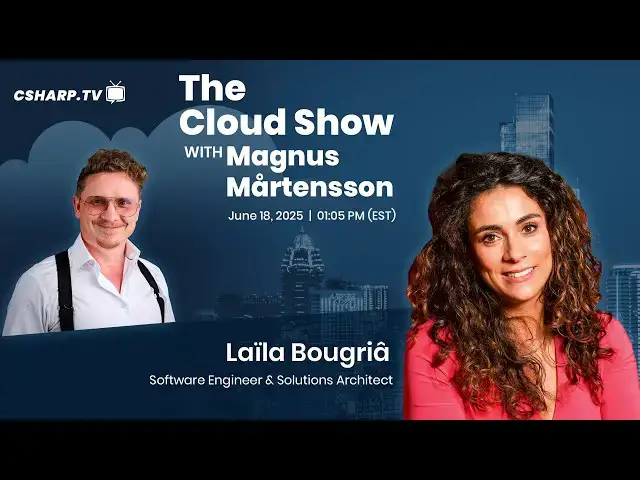
Join this live session with Magnus Mårtenssonft. Laïla Bougriâ for the next episode of The Cloud Show with Magnus Mårtensson on June 18, at 01:05 PM (EST).
The show is about cloud leadership and all the important questions relating to cloud projects. Certainly, many matters when a company is going to and wants to be successful in the cloud, are about technology. However, there are many additional matters, adjacent to technology, that we also need to tend to regarding business strategy, human resources, organizational change, planning for a technical cloud approach, and many more questions. These conversations are critical for a healthy cloud and for a swift and accurate cloud approach.
GUEST SPEAKER
Laïla Bougriâ is Solutions Architect with nearly 20 years of experience in the software industry. I'm passionate about software, focusing on distributed systems with messaging 📩. I'm a keynote speaker 🎙️ and frequently share my knowledge and insights at conferences worldwide. I’m a Microsoft MVP in Azure and Developer Technologies 🏆. Currently, I'm busy building NServiceBus at Particular Software, solving distributed riddles.
📺 CSharp TV - Dev Streaming Destination http://csharp.tv
🌎 C# Corner - Community of Software and Data Developers https://www.c-sharpcorner.com
#CSharpTV #csharpcorner #TheCloudShow #CSharp #interview
Show More Show Less View Video Transcript
0:01
hello everyone welcome to another
0:03
episode of the cloud show today we're
0:05
going to talk about distributed systems
0:08
and we're going to talk about it in the
0:09
in the terms of figuring out the most
0:13
sort of underrated and hard things about
0:16
building distributed systems and for
0:19
that the star of the show is the
0:21
distributed systems expert Leila
0:25
[Music]
0:34
hello hello he would have called you
0:38
there the distributed systems expert
0:39
yeah i'm like "Oh my god he's overdoing
0:41
it again." No no that's true it's true
0:45
thanks hey it's good to see you welcome
0:47
back to the show this is your second
0:49
appearance yes thank you for having me
0:52
again it's good to see you absolutely
0:53
you didn't have enough for the show last
0:55
time that's good apparently you keep
0:57
convincing me so here I am here you are
1:01
all right that's great and and um I know
1:04
that you know uh distributed systems is
1:06
a is a big deal uh for a lot of people
1:09
um and and they're trying to build
1:12
something really great and it's hard um
1:14
there are some problems and some
1:16
challenges to tackle in this space so
1:19
tell us first
1:21
like who are you why why do you know
1:23
anything about distributed systems if
1:24
you will
1:26
yeah great so my name's Laya uh I work
1:29
for a company called Particular Software
1:31
where we build in service bus and I'm
1:33
basically uh mostly focused and
1:35
specialized in messagebased systems
1:37
event- driven systems if you will and
1:39
I've been building these systems for
1:41
over a decade now so there's one or two
1:44
things that I picked up along the way i
1:46
guess just a little bit just a little
1:49
bit and but you're based out of you're
1:51
from Belgium right yes absolutely
1:54
waffles and fries and ice cream and
1:57
lovely things all good things all right
1:59
now actually I was I was there just
2:01
recently right for the for the
2:03
conference it's a really good conference
2:04
down there at the um um Techama yeah
2:08
yeah yeah that was absolutely one of my
2:10
favorites in fact we had already
2:12
scheduled this uh this session at that
2:15
time so we didn't schedule it then we
2:17
had we had we had this on the books for
2:19
a couple of months right yes you're
2:21
you're a busy person and you you're like
2:22
"Can I schedule you in oh June
2:27
sorry but I'm here i'm here that's all."
2:30
Now you're here and that's it's all our
2:32
to our benefit so So let's dive into it
2:35
let's go into distributed systems some
2:38
underrated hard things about building
2:41
distributed systems i mean it's all the
2:43
floor is yours take it away what are we
2:44
talking about thank you well one of the
2:47
things that um I like to bring up is
2:49
that we spend so much time uh especially
2:52
in event- driven systems talking about
2:54
oh should this be a command or should
2:56
this be an event and what are our
2:58
service boundaries and which service is
3:00
going to communicate with what and no
3:01
that service should call that service we
3:04
don't want that type of coupling should
3:05
we do orchestration or choreography and
3:08
it's like so many discussions and I mean
3:12
they're valuable discussions right um
3:14
they're important discussions They shape
3:16
how the system is going to look like but
3:18
there's this one thing that is like an
3:20
oversight over and over and over again
3:23
and it's basically how are we going to
3:26
version this system like you know the
3:28
system is going to evolve over time
3:30
right it's not going to be perfect from
3:33
day one business requirements change our
3:36
understanding of the domain changes and
3:38
then things are going to have to change
3:40
so how do we do that in a way that
3:42
doesn't break the rest of the system oh
3:45
that's interesting so so the the the
3:47
over focus is on the shape of the thing
3:50
uh but they're not understanding or
3:52
maybe not putting enough emphasis on the
3:55
fact that there is an evolution here you
3:57
will you will have revisions of this
3:59
thing yes so I think it's really
4:02
important to think about it that way
4:04
from the start like how are we going to
4:06
prepare ourselves for that type of So
4:08
there's a version you know 01 or version
4:10
one like you have to have a version from
4:12
the beginning right not as an add-on
4:15
later yes so to start some of those
4:18
things also tie into how do you design
4:20
the system because I think we have to
4:22
design for evolvability as well and one
4:25
of the things that I um like to
4:27
emphasize uh whenever I can is to say
4:30
it's important to start thinking about
4:32
public facing events and private facing
4:34
events from the beginning because when
4:37
private when you have private events
4:39
then basically the subscribers are
4:41
within the boundaries of that service
4:43
right yes they're not going to be
4:44
outside of that hence the word private
4:46
clearly
4:48
but the thing is that when you have
4:50
private events they're more easily
4:53
changed in the sense that you control
4:55
the subscribers right you can just
4:57
change them because you know who's going
4:59
to use them and you can Yeah yeah yeah
5:03
makes sense exactly but with public
5:05
events well then as a publisher the
5:08
whole idea of popups is that you're
5:09
unaware of your consumers that you don't
5:11
care who is subscribed and why they are
5:13
subscribed and what they're doing with
5:15
that information and
5:17
One of the biggest mistakes is putting a
5:20
lot of information into that payload and
5:22
then you're like "Ah that's probably not
5:24
a good idea oh these teams are doing
5:26
what with that data and
5:29
and then it's kind of like really tricky
5:31
to take something away because that
5:33
breaks your consumers and it's
5:35
especially tricky in these large
5:36
distributed systems where you don't even
5:39
know who the consumers are right that's
5:42
true so you kind of have to think about
5:44
these things up front so you don't don't
5:46
just like expose everything and now
5:48
they're taking all and you're like what
5:51
did are you taking all you weren't
5:53
supposed to take all why are you doing
5:54
this exactly so one of the things that I
5:58
always like to compare this to is
6:00
whenever you think about public facing
6:02
events think about it's like it's like
6:05
posting a picture on social media like
6:08
are you going to regret it later like
6:10
how much do you want to give away
6:13
basically fair enough i may have had a
6:16
couple of couple or two of those in
6:18
incidents myself maybe
6:21
yeah it's it's a good way to get people
6:23
to think about it but of course that's
6:25
just the first step is right just how do
6:27
you design it um I think a good way to
6:30
also think about it is uh you know
6:32
something for the audience to dig a
6:33
little bit deeper into summer events for
6:36
example you could have multiple private
6:38
events but then your consumers don't
6:40
necessarily care about super granular
6:43
level of events those may be very
6:45
helpful and meaningful inside your
6:47
service boundary but it might be helpful
6:49
to basically summarize them into a more
6:52
overarching event so let's say that
6:54
stuff is added to your shopping basket
6:56
all the time and you could be publishing
6:58
item added item removed item increased
7:01
whatever it is right so um the thing is
7:05
that most of your consumers don't care
7:07
about that and at checkout you just want
7:09
to know like okay what's in the basket
7:11
now i don't necessarily want to have all
7:13
of that information all of that traffic
7:16
and all of that complexity of
7:17
understanding what happened before and
7:19
all of that and ordering issues and
7:21
things like that so then it can be
7:23
useful to have that service publish a
7:25
summary event of this is the shopping
7:27
basket at checkout right and then that
7:29
would give you like the view that you
7:32
want from a consumer perspective oh man
7:35
so that's one way to go about it yeah
7:37
but then of course that's not all right
7:39
things are going to change whether we
7:40
want it or not like I always say change
7:42
is inevitable right um so then we have
7:46
to prepare ourselves in in terms of how
7:49
are we going to version these events and
7:52
like a lot of attention is paid to that
7:54
in terms of APIs but I don't see that
7:56
same attention being spent on on our
7:59
events but events are are the API right
8:03
in terms of of event driven systems so
8:06
how do you prepare yourselves for that
8:08
and and the first thing to do is
8:10
basically to have a schema to have a
8:13
schema Now for that data how is that
8:15
going to look like how is that
8:16
structured that can also already provide
8:19
like additional insights into how your
8:22
consumers are even supposed to treat
8:24
that data consume that data like a good
8:26
example is temperature right okay you
8:29
have a field in there that's temperature
8:31
okay what does that mean like is it
8:33
Celsius or is it Fahrenheit or is it
8:36
Kelvin and is it the temperature of
8:38
light right like it it could be anything
8:41
if it's science then it could be Kelvin
8:44
right and and a schema allows you to add
8:47
that information to add that sort of
8:48
what we call metadata so that it's
8:50
easier on the consumer side to
8:52
understand how that data should be
8:54
interpreted but what's especially
8:56
helpful about schemas is that they
8:58
enable versioning
9:01
ah and then then we can start to talk
9:04
about okay how is this schema going to
9:07
evolve and what type of compatibility
9:09
strategies do we want to have for this
9:12
schema
9:13
okay
9:14
so um there are a couple of different
9:17
strategies you could have forward
9:18
compatibility backward compatibility
9:21
full compatibility and you can even make
9:23
that transitive can apply to any of the
9:26
previous back uh compatibility
9:28
strategies forward backward and full and
9:30
transitive basically means that um for
9:33
example let's say that you want to use
9:35
forward compatibility which would make
9:37
sense probably if you're using Azure
9:40
service bus for example as a broker then
9:42
it allows you to delete optional fields
9:44
and to add fields whether they're
9:46
required or not and consumers can still
9:49
use the previous version of the schema
9:52
to basically receive messages that were
9:55
constructed with a newer version of the
9:56
schema i see yep yep right so when you
10:00
use backward compatibility it's kind of
10:02
reversed and you can delete fields and
10:04
add optional fields and then consumers
10:06
can use the next version of the schema
10:08
to still be able to process messages
10:10
that were constructed with the previous
10:12
version right now when you make that
10:14
transitive it doesn't only apply to the
10:17
previous or the next version but to all
10:19
of the versions of that schema that you
10:21
have so it becomes a lot more
10:22
restrictive
10:24
um and the thing is that that basically
10:26
allows you to communicate to your
10:29
consumers how can this change like how
10:32
can I expect this thing to evolve and
10:35
how my and it allows consumers to make
10:38
better decisions on how to write their
10:40
code and how to uh basically prepare
10:43
themselves better and gives you a lot
10:45
more flexibility from a producer
10:46
perspective because as long as you
10:49
fulfill the compatibility promise that
10:52
you set out to to basically a dear to
10:55
like you can keep upgrading to new
10:57
versions of the schema without breaking
11:00
consumers
11:02
now I also want to caveat that right
11:05
because if you add something to a schema
11:08
well your consumers will still have to
11:10
upgrade to use that thing makes sense
11:12
right yes but at least it won't break
11:15
them
11:17
they're not going to fail because oh
11:19
something new was added and they don't
11:21
know what to do with that right and the
11:23
reverse could also be true if you delete
11:25
an opt let's say an optional field well
11:28
if your consumers were aware that that
11:30
thing was optional which is indicated by
11:32
the schema then they would have been
11:34
prepared to deal with that being removed
11:36
because it will just not be there and
11:39
they can deal with that yeah yeah yeah
11:41
yeah it does make sense because I can
11:43
see how the client side or the
11:45
integrator or whomever like the the
11:48
who's calling um can can have code
11:52
dependent on the exact nature of the of
11:54
the API or the the schema from before
11:57
right uh if they've done it right then
12:00
they can they can survive if you have
12:01
declared how you are how you are revving
12:04
this
12:06
exactly so by setting up that what I
12:10
always tend to say is that a
12:11
compatibility um strategy that you set
12:14
up it's basically a policy decision
12:17
right it's it's communicating how is the
12:20
system going to evolve for also from the
12:22
producer side but what can our consumers
12:25
also expect from that and and and and
12:28
this is definitely one of the choices
12:30
that need to be made earlier when
12:32
building the system it's not like this
12:34
afterthought oh yes and now we need to
12:36
version
12:37
No this is something that needs to be
12:39
discussed up front you need to agree on
12:41
the strategy uh how we're going to apply
12:44
this how do we see everything evolve so
12:47
that you can make as little breaking
12:49
changes as possible basically yeah yeah
12:52
so one place where I encounter a lot of
12:56
um a lot of API schemas and a lot of
12:58
versions is or API versions is in um in
13:03
the Azure management uh endpoint uh
13:06
there's a you know there's a hundreds of
13:08
services right and they all have they
13:10
all have a version and then you can
13:14
query you can ask okay which versions
13:16
are you supporting still if you will
13:19
right and and sometimes there has been
13:21
there has been some warnings come up as
13:24
oh this is going to this is going to be
13:25
changed by so and so date this is not
13:28
going to be compatible anymore
13:30
that sort of thing so how do you how do
13:33
you go about like can can even is that
13:35
even a thing you can do how do you go
13:37
about removing an old version like okay
13:40
we can't support this old anymore
13:42
what are we going to do that's a really
13:44
good question so that's for me like the
13:47
next step right so first we need to try
13:49
to set up a system that allows you to
13:51
make some evolution that is not breaking
13:54
okay um and then the next step would be
13:56
okay like really there's nothing we can
13:58
do about this we really need to break
14:00
this you have a breaking change well
14:03
then it then it kind of becomes a
14:05
completely new thing because the schema
14:07
has changed so basically the the meaning
14:10
of that event has now changed and now
14:12
needs to be re-evaluated by your
14:15
consumers and the best strategy to deal
14:17
with that is to basically first notify
14:20
your consumers like you know this this
14:22
is not going to be supported but to also
14:25
not go and delete it immediately to
14:27
basically work with a deprecation uh
14:30
warning is like like we do with public
14:32
APIs right um so basically to say okay
14:36
this will be supported for the next
14:38
three months and throughout that sort of
14:41
deprecation period what is important
14:43
from a producer perspective is let's say
14:46
that you have an old order placed event
14:48
and a new one right is that throughout
14:51
the deprecation period you continue to
14:54
publish both both of those events of
14:57
course and that that allows your
14:59
consumers to gradually start basically
15:02
upgrading to that new order placed event
15:05
in in in favor of the old one but even
15:08
that is quite complicated right because
15:10
the thing is that especially in an
15:11
event- driven system well let's say that
15:14
you're using Azure Service Bus okay so
15:17
you're subscribed to this topic and now
15:19
there's a completely new topic because
15:21
it's a completely new event it has
15:23
semantically changed therefore it goes
15:25
to a different topic at least if you
15:28
chose to use a a topic per event type of
15:30
topology of course assuming that for a
15:32
moment now the problem is that there's
15:35
inflight messages right how do you not
15:38
lose anything when you're trying to do
15:40
that yeah exactly and that that requires
15:43
a really sort of step-by-step type of
15:45
upgrade strategy so the whole idea is
15:48
that during this dual publishing period
15:52
when when the producer is publishing
15:54
both of the versions of the event you
15:56
basically as a subscriber have to go and
16:00
subscribe to that new type of an event
16:03
and as close to that as possible
16:05
unsubscribe from the old one yes now
16:09
unsubscribing does not mean that your
16:11
inflight messages are lost like in Azure
16:13
service bus when you subscribe to topic
16:15
you get a virtual queue or subq whatever
16:17
you want to call it right so your
16:19
messages are still there so you need to
16:21
keep the handling code in place so that
16:24
you can consume all of those inflight
16:26
messages and you don't lose them
16:31
right and so you then you'll have to
16:33
check is there any is there any more
16:36
data in this for me at all or can I stop
16:39
using it and then on the other side if
16:41
you're if you're the publisher you you
16:43
you probably want to check I have this
16:46
break here uh how many are still using
16:48
the old one and then how many are now
16:51
using the new one is do we see a trend
16:53
of that's the tricky part that's the
16:55
tricky part is as a producer you can't
16:57
really do that because like we mentioned
16:59
in the beginning sometimes you don't
17:01
know who your consumers are and that's
17:03
why purely from the producer perspective
17:06
I think we need to be a little bit
17:08
flexible with the deprecation period
17:10
like don't make it a week don't make it
17:12
three years right
17:15
but maybe like three months five months
17:17
depending on how quickly your system can
17:20
evolve right but but what I al also
17:23
always say from a producer perspective
17:25
is that if you have a way that your
17:28
subscribers can get notified of this
17:31
change right and you have set a
17:34
deprecation time well for you it's not
17:38
your responsibility to then go and check
17:40
the consumers right this is one of the
17:41
agreements that you can make within the
17:43
system is like okay when the deprecation
17:46
time has basically been elapsed and
17:49
we're done we've given it six months
17:51
we're done then you can basically stop
17:53
publishing that old version of the event
17:56
and at that point assume that all of
17:58
your consumers have upgraded if they're
18:00
good citizens of the system landscape
18:02
right
18:05
yeah this is hard of course well this is
18:08
all brilliant and I guess we could be
18:10
talking about this for a long time still
18:12
but we don't have any more time to talk
18:14
about this so we have to stop doing that
18:16
which is a shame but it's it's been a
18:19
real pleasure having you on the show to
18:21
talk about these very complicated
18:22
matters of of versioning and and
18:25
handling distributed systems thank you
18:27
for being on the show thank you for
18:29
having me good to chat with you yeah
18:32
totally my pleasure and audience see you
18:34
next time on the cloud show bye-bye
18:41
[Music]
#Business & Industrial
#Computers & Electronics