Up next in 10



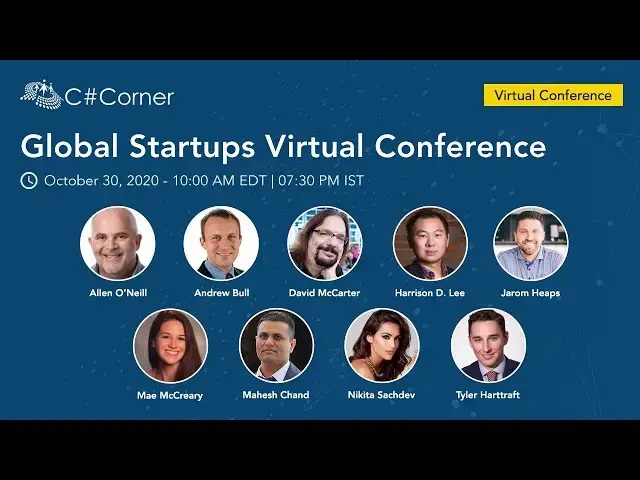
This Friday October 30th at 10 AM EST, C# Corner and 2020Twenty present the Global Startups Virtual Conference, sponsored by Mindcracker Inc.
The conference will commence at 10 AM with a welcome note by hosts Mahesh Chand and Mae McCreary.
Starting at 10:15 there will be several startup related topics presented by experts in the field.
Topics include:
How to Validate your Idea, Presented by Mahesh Chand 10:15-10:45 AM EST
How to Protect your Startup, Presented by Tyler Harttraft and Andrew Bull 10:45-11:30 AM EST
How to Build Your MVP and Test Drive it, Presented by Allen O'Neill and David McCarter 11;30 AM EST- 12:15 PM EST
Types of Investments and How to Get Funding, Presented by Jarom Heaps and Allen O'Neill 12:15- 12:45 PM EST
How to Build a Successful Go-To Market Strategy, Presented by Nikita Sachdev and Allen O'Neill 12:45-1:15 PM EST
These topics will be followed by a Panel from 1:15-1:45 PM EST.
Show More Show Less View Video Transcript
0:00
Thank you
0:29
Thank you
0:59
Thank you
1:29
Hi, Amy. Good morning
1:53
Good morning, Simon. How are you today? I'm doing good, good. It looks like we have an amazing conference coming up, right
2:02
Yeah, I'm excited. I have been learning so much about startups the past few weeks, preparing for this, and I'm really excited to learn from the professionals, really
2:14
All right. And just in case everyone is wondering that there's a change in people, right
2:20
So right now, everyone's watching. We are at the backstage, right? We're going to chat about what's coming in the conference
2:27
We're going to talk about speakers. We're going to talk about how things are going on. So, Mayra, you're joining us from today
2:33
I'm joining from a northern suburb of Philadelphia. And we have been hit by some hurricane rain the past few weeks
2:41
So, it's been a dreary week on the northeast. And we have not seen the sun
2:47
So, this conference is, I've been looking forward to it a lot
2:53
the most exciting part of my week. All right. So, Anne, I'm joining from India
2:58
where we get to see sun almost the entire day. We have not hit by storm
3:02
Winter is coming here. Not like the way you have in the United States
3:06
but it's 7.30 p.m. at my place. So everyone who is joining us today
3:10
let us know which location you are joining and drop your location in the comments
3:15
and let's join the conversation. And it looks like we have been doing
3:19
a lot of conferences and live shows in the past. I remember the recent one that we did was a .NET virtual conference, right
3:27
We had almost like 18, 20 speakers. That was amazing. And we have an amazing conference and speakers lineup for this conference too
3:34
What are your thoughts, Anne? When you say startups, do you ever plan to build your own startup
3:40
You know, I'd be lying if I said I've never thought of like having a great idea or like, oh, wouldn't this be cool
3:47
but like you know the stats show so many startups don't work out because people
3:54
just don't know where to start or where to go so yeah I've definitely
3:58
definitely had some great ideas so how about you Simon? I mean I did
4:04
a lot of them but none of them worked out some of them I quit very soon and
4:10
sometimes you are quite immature to do that so I'm really looking forward
4:14
for this conference we have amazing speakers lined up we're going to talk about how to protect your idea and all that stuff so uh
4:22
let's see uh pascar is excited and he's looking forward to it so thank you everyone who is joining
4:28
us today this is the conference backstage me and me will be joining after every session right this
4:34
is how it's gonna go we're gonna have mahesh next who's gonna do the keynote right and after every
4:39
session ends me and me will walk into the to the live broadcast conference and we're gonna talk
4:46
about how are things going on how the session went and uh just keep the chat really interactive
4:51
let us know if you have any questions coming put it into the comment section and uh hi john welcome
4:57
to the good to the conference uh thanks for joining us again he's a uh someone who regularly
5:02
attends our live shows thank you so much so may i think it's time to go ahead and invite our first
5:08
speaker who is none other than Maeshan. All right. Yes. It looks like you guys are gone. Simon and May, you both are gone
6:12
We can drop in anytime you want. How's it going, guys? How's everybody
6:17
Good. How are you today, Mahesh? Good, good. How's everything there, Simon
6:23
Looks like COVID cases are growing again in India, same here in the US. Yeah, and the fun fact is there's no lockdown
6:31
At the earlier time, we had lockdowns. government were very serious about it. Now there is no lockdown. It's all up to the citizens
6:39
Put up a mask, maintain social distance. That's all we can say. We're kind of in the same boat here
6:45
We are pretty tough. Like cases, yesterday we hit the highest cases, right? 80 some thousand
6:51
And in the US, it's like still we have like thousand people, close to thousand people dying
6:56
every day, which is pretty sad. And we don't know how the winter is going to look like
7:03
and now we have election coming up election should be done in at least few and you know this four or five days at least one thing will be done
7:13
so just go and vote right yeah yeah in the meantime you know we need to keep ourselves busy we need
7:20
to keep everybody else busy and see how you know we can even continue people to you know motivate during this time Is my sound low We see a VCA comment My volume is low It okay I mean it a low and high is a comparative term right So it my because
7:38
they're comparing with our voices, but it's okay. All right. I can turn it up a little bit
7:44
All right, guys. So let's get this going. I want to start this conference
7:51
I think you guys should get out of here. I put up your presentation and see you soon
8:03
All right, let's get this going. Good morning, everybody. Good morning. Good afternoon
8:09
Good evening. Depending on where you're joining us from, my name is Mahesh Chan and today we are here
8:17
at Global Startup Virtual Conference presented by C Sharp Corner 2020 and Mindcracker
8:24
If you are new to our conferences, C Sharp Corner is a global community of millions of developers
8:31
We do these conferences almost every month. And today, all we are going to talk about is my most favorite topic, startups
8:41
Who is this conference for? If you are someone who wants to start your own startup or you have been a part of startup
8:50
or you are a founder, co-founder or even a team member in a startup or you are a student
8:59
and you know your entrepreneurship, you're doing your course in entrepreneurship, this conference is for you
9:05
In this, again, one thing I really want to explain here is that during these times like
9:12
where you COVID for example even I know we are all stuck at home during COVID times and you know
9:19
we're not traveling we're not going out eating we are not celebrating you know birthday parties or
9:25
other you know celebrations so what happens is now all of us has more time in our hands
9:31
and you know as a growth mindset or you're always thinking how you can you best utilize your time
9:37
And this is maybe some time you want to spend some time thinking about
9:41
which you are thinking maybe have your own startup. This may be the right time for that. And if you look at the history, most, you know, a lot of successful startups
9:50
they started during bad times. So maybe this is some time, you know, something to think about
9:56
Now, let me go to my next screen. What we are going to do today in this conference with Simon in May
10:03
I'm going to be your host for the conference today after the keynote
10:07
you can see from this agenda you know at in the 15 minutes we're going to talk
10:12
about the big idea big idea means really what is your idea and how do you
10:16
actually validate it make sure that what you know I know it's there's no
10:21
guarantee that any startup is going to be successful but at least at least
10:25
before you go all in before you put all your time and money and energy in it you
10:31
need to at least somehow a little bit validate your idea that is there something you're already planning to do does make sense. Is it really has some
10:41
legs to it? Do people believe in it or sometimes you know you
10:47
think your idea is the unique idea. Some people may already have it. There may be
10:50
already several startups already doing or companies already doing what you're trying to do. Then we're going to talk about we're going to bring to experts in
11:01
how to protect your startup in that we are going to you know talk about you know registration of
11:06
your companies your trademarks, NDA's, you know intellectual protection of intellectual properties
11:13
and so on so forth. So let me emphasize one more time guys this conference is for you
11:21
this conference is for anybody who's interested in starting your own startup so goal really is
11:26
to make sure we answer your questions. So any questions you have any time
11:32
feel free to post in comment section. And we are going to take those questions
11:37
based on the topic we are covering in each session. But feel free, don't be shy about asking any questions
11:44
Can be any questions. Questions can be about your company, your legal
11:50
your startup, raising funds, and about building a team, about the product and launch and marketing. So then after our 10-45 session we are going to
12:04
you know talk about how to build a product and build most like most well you know minimum viable
12:10
product which is the one product you want to launch to certain number of people and then how
12:16
do you take a test drive to make sure it's working before you really go and launch it publicly
12:21
then we have afternoon you know afternoon we have two sessions on you know how do you raise funds
12:27
so we have experts going to join us talk about investments and then then we have in the last
12:34
session we're going to talk about marketing how do you build a successful go-to-market strategy
12:39
and the end we will do is there's going to be a panel discussion again in the end we're going to
12:44
have experts there on the panel and that's where we are going to talk about different parts of
12:49
startups how to make a success make it success and failure and so on so forth and also you can ask any
12:57
kind of questions again this conference is for you it's not for me it's not for speakers right
13:03
we are here just to support you and so make sure your make sure you ask your question so at least
13:10
by the time you've done and after these four hours next four hours you should at least feel
13:15
like you learned something today not only learn something the questions you
13:19
had on your mind they got answered. So guys welcome again, welcome to the
13:24
Global Startup Virtual Conference presented by C Sharp Corner. So we just
13:31
cover our little bit background if you are new to C Sharp Corner my name is
13:36
Mahesh Chang I'm founder of C Sharp Corner I also run a company called
13:40
called Mindcracker. Mindcracker Inc is a local Philadelphia based software consulting firm
13:46
you know, and I'm a former Microsoft regional director, 14 times Microsoft MVP and so on and so
13:51
forth. You can always find me on C Sharp Corner. I am frequent writer, contributor on C Sharp Corner
13:59
If you don't know much about me, I have been involved in a startup for many years
14:05
As a matter of fact when I just graduated a year later or two I started a couple of my own startups
14:12
So these are some of the companies I've been involved but there's 20 more companies I've been involved
14:17
This is just a list of companies. So point I'm making is that I have been in last 20 years I have been going through
14:26
a ton of startups, ton of startup work. I've started my own startups and then I am advisor
14:34
on several startups. I have been partner in several startups. I also have invested in
14:40
some startups. So if you think of, I've been help marketing startups as a matter of fact
14:45
So if you look at the whole, you know, life cycle of a startup from an idea to launch
14:51
I have been involved all part of these the all phases of a startup if you look at from you know life cycle of the startup so what I learned during these startups is like I also learned so many things and which is
15:05
very important that you know as you can see from a screen that 9 out of 10
15:11
startups fail and that's a fact and even more right some even you know if you
15:17
look at some of the data that says that if you look at the really successful
15:21
startup there's only three percent forget even you know nine out of ten I'm
15:26
saying three percent so if there are hundred startups starting only three are
15:30
really successful so it's very challenging to start taking an idea and
15:35
build into a very successful profitable business right so and that's what really
15:42
we are here to talk about today is really going to bring all these topics
15:47
like when you are you know building a product and you have an idea and you want you to build a
15:53
product you how do you make sure at least that it's going to be successful and that's exactly
15:58
what we're going to talk about today. Other fact is really is that startups with two founders are
16:05
more successful than single founder and the reason for that is very simple right. When I say
16:11
startups are like startup is not just a something where you just do it right it's a long journey it
16:20
could be a multi-month if you look at the history of any startup you can look at the facebook google
16:25
twitter and or even go back like microsoft apple and so on all these companies when they were
16:31
they started it took a while them to become successful they were not successful overnight
16:37
and now but things in the past five years have been changed so fast that you have to really move
16:45
fast you don't even have that kind of time these days because there's so many companies so many
16:51
startups are starting and they all have same idea they all have same idea because they're trying to
16:57
solve almost same problem now the idea could be a little bit unique here and there but pretty much
17:03
and there is a fact scientific fact is that anything you are thinking right now there are
17:09
six people in this world maybe from different countries different places different languages
17:14
are thinking exactly same okay so that's forget about startups and I'll give you some one idea
17:22
right and I have so many stories to tell you during this you know my startup world is I have
17:28
friend and his son plays you know with me my son's you know we play we hang out his son is the same
17:35
as my son and you know we go to basketball game and so on i know this friend for me you know many
17:41
years maybe 10 plus years uh he keeps saying for several years my hey i have an idea i have an idea
17:47
i have an idea like but i don't want to share my idea with anybody because i know somebody's gonna
17:51
steal my idea. This happens often right people think that they have this unique
17:57
idea they have the greatest idea and somebody is going to just go and steal
18:02
it. And then so let me tell you one thing here first of all your idea is pretty
18:11
much like your baby if you are a parent then you will you can probably relate it
18:15
more if you're not a parent I will try to explain you. Your idea is like you know
18:21
your car, your baby, right? Which means you are fully, you know, this is your idea
18:27
You believe in it. You 100% really believe in it. But when it comes to other people
18:32
most cases they don't care. Okay? People don't care. It's your idea, right
18:38
They have their own ideas. Everybody has their own ideas. Okay? So if you're thinking that you're going to share your idea with somebody
18:46
and they're going to steal it, that's not going to work. Nobody cares. Even, you know, I'm in New York one time, I'm in New York and I'm in a cab. The cab guy said he has six ideas, right? So point I'm making is that if you have an idea, you want to really discuss with somebody, don't take like six years to discuss it
19:06
you know I have another friend, he had this great idea which was similar to some of the most popular
19:14
companies now it was you know 10 years ago he started talking about this idea talking about
19:19
this idea but he never did anything. So another point I'm making here is if you have an idea
19:25
don't just talk about it if you're really vested in it you really believe in it and you really want
19:31
to do your own startup you gotta just do something with it okay and there'll be time where you say you
19:37
know what i don't have resource i don't have time i don't even know how to do it that's where you
19:42
can find more people you can find partners you can find companies you can find consultants depends
19:47
on where you are in your life if you don't have any money try to find a co-founder right co-founder
19:53
then can even help you try to find and that's what we're going to talk about more in this this
19:58
conference, throughout the conference and when you're looking for a co-founder try to find somebody who can compliment and when I say compliment I often see
20:08
that a startup is started by three friends, four friends, they all write code
20:14
Startup is more than just writing code, startup is more than just building an
20:19
app, startup is more than just building a product, startup needs more than that
20:24
startup needs, you know, somebody who can build the product, somebody who can market the product
20:30
somebody who can sell the product, somebody who can do operations, somebody can even also think
20:36
about how to grow it. So it's more than just building a product. So if you are somebody new
20:44
young and want to start your own company or you say, you know what, I have this great idea
20:49
I know how can go to the customers, but I don't know who can build it for me
20:54
So maybe that's where you want to go and find a co-founder who can build the product
21:00
If your background is technical, if you are a programmer, you know how to build an ad, it's a great idea, you believe in it
21:07
Then maybe you need to find a co-founder who can help you from marketing and sales side
21:12
Somebody who has done business before, somebody knows how to take from A to B, somebody who can really take what you build to the market
21:22
So you need to think about in those terms. So that's what I really mean is that people startups who have more co-founders are likely to be more successful
21:34
The one thing you want to be careful is when you are picking those co-founders make sure you complement each other rather than everybody having same skill set
21:42
Other problem I note, you know, during my experience working with the startups or me being also part of a startup, if more than one person has same skill set, for example, there are four guys building product
21:55
In most cases, there's conflicts because all of us have different, we want to build a product different ways
22:02
So if you, which is good and bad sometimes. So you have to be careful with that
22:09
But point I'm making is you definitely want to compliment. If you're trying to just start with a few friends, make sure they have different skill sets
22:19
And in the beginning, if you look at my numbers here, most of the successful startups are self-funded in the beginning
22:24
82 startups you know they are self It means money comes from the founders or their own money or somehow they get from family That how really they start So I know I talk to sometimes people in this young guy they have a startup
22:40
They'll come up and they'll say, you know what? I have this great idea. I have built a little bit here, but I'm really looking for somebody to fund my startup
22:47
okay then we have totally you know nobody's really going to fund your idea right away so you have to
22:54
get to the next level and that's where in our investment session today we are going to all
22:59
about funding what kind of types of funding how to get funding how the valuation works and so on
23:04
so forth all right i see we have more people joining us welcome to the show guys everybody
23:13
who's joining us my name is Mahesh Champ today you are joining us at the Startup Virtual Conference
23:21
what we're talking about today is all about startups who this conference is for somebody
23:27
who wants to start his own startup who wants to do his own company or somebody who already
23:34
has a startup they want to just go to the next level they want to raise money they want to
23:38
to figure out how to build a growth market, how to build a go-to-market strategy and so
23:47
on and so forth. So it's going to be a total four hours conference. So any questions, comments
23:58
you guys have feel free to post in the comment section. Again, this conference is for you
24:03
we want to make sure you learn today a lot you learn any questions you have
24:07
about startups so let me go back to my point I made on the previous screen is
24:15
that nine out of ten startups fail and why do they fail this is some of the
24:20
research it's not me saying here it's some of the research as done by companies
24:25
and that's what they're saying one of the biggest reason is that there's no
24:30
the reason startups fail is there's no market need. Means you think it's a great
24:35
idea, you think everybody wants it but in fact this market doesn't want it
24:40
People don't want it. So that's why it's very important to validate your idea
24:45
before you go and spend a lot of time and money and energy in it. Don't just go
24:51
jump around say you know what okay I have money I'm gonna hire a team, I'm
24:55
gonna start building product, I'm gonna start marketing it. Don't even start
25:00
that first you need to make sure that you validate your idea and that's where
25:05
my next session is I'm going to talk about is how do you validate your idea
25:10
then second problem startups really they fail is that they run out of cash they
25:15
are unable to raise money and this is one of the biggest reason I've seen
25:20
again and again and again let me tell you first in you know some fact here I've
25:27
been part of probably 30 startups in past 15-20 years. Out of 30, I would say 25 have
25:35
clearly failed. If not 25, 22 definitely shut down in first their first one to two
25:43
years. And one of the major reason was we were unable to raise cash, funds for the
25:49
company. You are unable to get investment. So this is not just a point here. This is
25:57
very important point here is that when you are trying to build your team or trying to find a
26:05
co-founder, it's not a bad idea to get somebody on board as a co-founder or a team member
26:12
you know, that who has experience with raising funds, finances, and so on and so forth
26:18
Sometimes you may also want to need an advisor. Advisors play a major role in startups
26:23
You know, there are some companies and some people who are successful, they know startups in different capacity, right
26:30
Some of them help you with marketing, some do with fundraising, some with your finances, so on and so forth
26:36
So it's not a bad idea to have a founder, I mean co-founder or an advisor on your startup who can help you raise money
26:47
That's the important part. Without money, you can do nothing pretty much
26:52
You cannot hire more people, you cannot build a product, you cannot go to market, all those things, all those parts of startup, they need money
27:03
Then, not the right team is another point. You may have a team, but in the beginning it's great, but then it doesn't work out
27:11
That's another reason startups fail. As I mentioned again, team is very important, right
27:17
When you say startup is a journey, as I said, startup is not just a, it's not a project where you know exactly what you're doing
27:24
Startup sometimes you think it's a great idea, but you don't know
27:28
You have to move it. You have to pivot. You have to change things. So during that time, you need a team who can support you, not only you, each other, right
27:38
So startup is journey. You are going through a long ride here. It's not just a one month or two months
27:43
It's usually years, you know, minimum one year, minimum two years. and then even more
27:49
So having the right team is a big, big, you know, big reason startups fail or they're successful
27:58
You know, some people are more motivated, some are less motivated. They just make sure the guys you have in the team
28:05
they are at least have similar mindset. They have energy and passion you do that will help you take your startup to the next stage
28:12
And then after that, let's say you have a you know you have validated you have a marketing need you
28:19
also raise fund or you will be able to raise fund when you need them you also
28:23
have a right team then startups next point is they're not innovative enough
28:27
and what does that mean is if you look at the history of any company look at the
28:33
Apple right Apple was you know failed company until they started iPod and
28:39
music service music business when they started iPod that was really when they
28:43
became more innovative but before that and if you compare now Apple with other
28:48
companies like Microsoft and you know Nokia and so many other companies a lot
28:53
of these companies had the similar products right they they had their own
28:58
phones they had their own touchscreen they had music services and so on so
29:03
forth they were just not innovative enough somewhere as a matter of fact
29:09
We were way ahead of Apple to be you know frankly. I remember when Microsoft
29:15
launched their touchscreen laptop which was similar to iPad. It was like I
29:22
remember 2001 I had it. 2000 I had it. I own a laptop called tablet. Microsoft
29:29
call it the Microsoft tablet. It was a touchscreen. It was an ink and pen. It was
29:35
but they were not innovative enough. iPad was totally different. When Apple launched iPad, it was innovative
29:43
It was designed for customers who can just carry it around wherever they need it
29:48
It was for moms or dads who are going to soccer or basketball games. They can carry it with themselves
29:54
So innovation is again a big part of that. Innovation is very important
29:59
for a startup because if there's other similar startups doing it and when it comes to competition
30:05
innovation then helps to basically lead the way you are ahead of everybody then that you know
30:12
if you even look at today there's so many companies building almost same thing same similar products
30:19
same services only few of them are successful because they are ahead of everybody so think of
30:26
that's when you are still thinking up. Welcome everybody. I see a lot more people joining us
30:31
Dave has joined us from California. Naveen, Stephen is already part of the team here
30:37
Welcome everybody to this startup conference. Today we are going through the keynote. It's a
30:44
welcome note and we're talking about startups before you even start your own company
30:49
spend too much. What are some things you need to think about? Other reason startup can fail is you have a poor product and lack of business model
30:59
That often happens. In this, I had personally worked with a couple of startups in early days where they had this fantastic idea
31:08
But the product they built was not good enough to when we gave it
31:15
working fine for few customers but it was launched to public and when thousands
31:20
people joined product crashed their website crashed their app crashed so these days if your product is not good it's not doing what it's supposed to do
31:31
it's not modern it's not innovative it's not simple people don't have patience
31:36
okay they don't have patience unless you have this unique idea where nobody has
31:43
and companies and businesses really need it or people really need it that's different story but you cannot have a poor product in today's world. Make sure
31:52
your product is done right and then you have to have a business model. Some
31:58
guys they start the company but they don't have business model or they are unable to change to the business model that works. And then last point I'm making
32:07
here is the poor marketing is another reason companies fail and this I have
32:12
Again, a lot of these points I'm talking about, even also my personal experience
32:19
We have this awesome product. We had a marketing need. We just were unable to do the right marketing
32:25
If we were doing marketing, we spent a lot of money. We were even doing it in different areas where customers weren't even there
32:33
So that could again lead to a failure of your startup. And then all these points we are going to cover in more details
32:41
when we have our expert panels come in and join us. I think I'm still good
32:48
on time we still have a few more minutes to go. So let's talk about my I think
32:56
this is a this is my last slide for this and then I have one more after this
33:01
These are some of the top five reasons they're my favorite and that they are my
33:07
favorite because these are the one I see all the time again and again and again
33:13
and keep in mind I'm still working with startups I'm still part of several you
33:20
know new startups each year I get involved in startups I help them in
33:26
different reason different capacity so these are the some of the points are my
33:34
you know hand-picked points where I see this again and again so let's talk about
33:38
this startups founders making their startup as a second priority this is my
33:45
number one point when you have a startup it has to be your first priority
33:52
otherwise chances are it's not going to go far think of that startup and I my
33:57
favorite point I make with when I speak at conferences about a startup is that
34:01
startup is like your baby. If you are a parent, you would understand that
34:06
If you're not a parent, then I understand it's like your pet. It's like you have to give it 24-7 attention
34:14
Okay, startup needs your 24-7 time. It cannot be that when you are free or you are available
34:21
then you are doing work you want to start. It doesn't work that way. I see a lot of founders
34:27
They start the company, but they're still doing their own job. they're still going
34:32
taking vacation they're still doing all the things they do I mean
34:36
it's very rare if a startup is going to be successful that way
34:40
if you are one of the founders that's just more like a hobby
34:44
it's just side hobby for you don't call it a startup don't just make it like
34:48
oh I'm building this awesome company this becomes your hobby personally that's what I think so
34:54
if you really want to do something and build something big you have to be really
34:59
100% into it Ok. This one second point is choosing the wrong technology. That could also be a major reason. I've seen companies fail, I've seen a startup fail because they built an app and app was done in the wrong technology and now things change and the startup was unable to quickly pivot from that
35:19
This happens all the time that you build on a technology that's not scalable and you go live in public, then your website starts crashing
35:29
It almost happened to actually Facebook when Facebook built their app and it was unable to scale
35:36
They ran into big challenges at that time, but they were able to fix problems and they were quickly able to rebuild their website and launch it, app launch it
35:47
But that happens a lot. So you gotta be careful what technology you pick before, you know, you really go all in there as a startup
35:58
And then definitely we talked about this point that when you're unable to raise funds, we ran through a lot of problems because either, you know, investors, if they were interested in, first of all, some of the ideas they were not interested in
36:12
Some of the startups were not up there, but they wanted to see
36:16
Some said simply the valuation is too high. I'm still an advisor on companies where one company's valuation is just too high
36:25
It's a great idea, it's a great product. They have business model working, but the founders are saying our company is worth 500 million
36:33
And investors, any investor you mean, we cannot invest in this valuation
36:39
We want your, you know, it should be under 10 million or 100 million, whatever it is, but that could be another reason
36:46
But these days, if you want to raise money, I remember 10 years ago, it was different
36:53
10 years ago, if you have an idea and you could get money, say, I want to build this app for this, you could raise money
37:02
But now most investors, they want to see that not only you have an idea, but you have built some kind of product
37:09
You have launched it. And some people are actually, you have few customers actually using it
37:14
That kind of becomes a proven model that your idea is working
37:20
So today, that's where you want to be before you go and talk to investors
37:26
Again we going to have more of this discussion in our detail in our investment session as well Then as we talked about if you are unable to build and execute a successful marketing strategy that another reason we ran through these startups where we were unable to market and go to our audience and customers and sell them
37:50
unable to do that. Sometimes companies they you know they are if they are unable
37:58
to pivot or change their business model what they do they may fail and if you
38:03
look at any successful company today they pivot they change they evolve over
38:10
time. Look at Amazon. Amazon started as a selling old used books that's how Amazon
38:18
started where you have an old book you have used book you want to sell it to
38:23
you know you just go put it online that's how they started look at that
38:26
today today they are the number one cloud company so you have to pivot most
38:31
startups they are successful they pivot there I have seen some startup founder
38:37
they're so stubborn they're like no I don't want to change my model was guess what sometimes you have to pivot to make it successful so alright we have five
38:47
more minutes to go before our next session so if you guys have any questions let them come post
38:53
them in comments we are going to take these questions within between sessions between two
38:57
sessions or after one session is done so any kind of any kind of questions you have make sure you
39:05
ask your post doesn't come in because that's why we are here make sure during this pandemic you know
39:11
while we are doing all these conferences, we want to make sure you get some benefit out of it
39:15
So, oops, on the wrong slide. Let me go back to my last slide and we are almost done. Supposed to
39:27
be break, but it's okay, we are running out of time. So we'll spend five minutes on this slide
39:32
And then we have our next session coming up from its own, how to protect your startup. That's very
39:39
important topic I advise everybody everybody who wants to start their own
39:44
companies should attend that session it's very important so back to this
39:50
how do you validate your idea our first point is if you have an idea of a
39:54
startup or you're planning to start a startup or you already started it you
39:58
know maybe you are in early very early stage first thing I highly recommend is
40:03
you kind of need to validate your big idea you know how and validate is very
40:07
important first of all is your ideas unique no and I can say it doesn't have
40:14
to be unique unique means it's certain at least at some point a certain test to
40:18
have some more than what's already out there okay so when you are building
40:24
something I'll give you again let me go back to my discussion I was talking about
40:27
my friend he said Mahesh you know the friend I was talking about who has been
40:32
telling me this idea for ten eight ten years he said I have this idea I want to
40:37
build this app where you know if you are alone you're going out you need a wingman so how do you
40:43
find the wingman then I just showed him right there and you know I went to my iPhone I went to
40:48
the app store I searched it there like tons of tons of apps are already there doing it okay so
40:55
if you think you have a great idea and it's very unique and it's better than others what you need
41:00
to do is first you need to go and search what's already out there and for example if you're building
41:07
an app. I don't know, maybe whatever, you're building a game. Go check it out there. It's
41:12
already there. If it is there, who is doing it? If there is a company that's a really big company
41:18
that's doing the same thing what you're doing, chances are, guess what? They have more money
41:22
They have more resources. They have more customers already. So you have to look at that
41:28
You cannot just say, you know, oh, I have this great idea. You have to do research that. And
41:33
chances are in today's date whatever you're thinking it's probably already done okay now
41:40
doesn't mean that i'm demotivating you you still have to go and see if you still want to do that
41:46
why your idea is better than others or how can you move ahead of them or how can you be you know
41:56
better market this or how is your your app or your product people why if that's
42:02
it today I want to start my own Facebook why would people who are already on
42:07
Facebook for years would jump to my newest new con new app or website that's
42:12
how you have to think what is that reason where one person will move from
42:17
this place to this place you have to give them a very compelling reason that's
42:21
how you to think you have to do next is feasibility ysis feasibility means
42:25
you have to look at all aspects like time, money, team, resources, are you just
42:32
feasible to even do that. Sometimes you may have this great idea this could be
42:35
the greatest idea but building this idea will take you more than how much money
42:40
you'll make it so you have to look at the feasibility there right now then you
42:44
validate it so you see you did all the research you did feasibility ysis
42:48
you think you know what looks good I have a better idea than others I'm
42:52
I'm going to still go with it. Now you need to go is validated
42:56
Again, don't be afraid of sharing your idea. You can validate with friends
43:00
Talk to close friends, the one first you can trust. So if you're afraid that somebody's going to go and steal your idea
43:07
talk to your close friends. Like, hey, I want to build this app. Hey, I want to build this product
43:11
What do you think? They'll give you the right advice. Talk to family. Talk to coworkers
43:16
try to find people who can really give you a true advice who can criticize you who can even tell you
43:24
that's a great idea but this is why i should know it will not work because of me don't just listen
43:30
to only people who are always supportive to you because there are people like if i go talk to you
43:35
say you go talk to your best friend talk to your mom they're always going to support you because
43:40
that's what they do so they they're okay but they are not the right people you want to validate your
43:45
idea with you want to validate with some people who can really give you right advice who can
43:50
criticize you and who could also be your future potential customers that's how you validate talk
43:57
to them before you go there so that's all it is my time is running out so now I'm going to take a
44:03
break here and let's invite Simon and May back for our session thank you so much I'll be seeing
44:11
you all day through our next four hours all right did you learn something yes
44:17
thank you Mahesh that was wonderful I do think we have some questions for you if
44:24
we have questions we can take this maybe after first session of course we are kind
44:30
of running time so what we should do is when session is done early we will take some questions awesome I think maybe it's time to go ahead even invite our
44:38
next speakers because I think we are very exactly on time. Wonderful. All right. So
44:45
let's have our next speaker, Andrew and Tyler. Thank you
45:24
Hey, Andrew, how are you
45:35
Hey, Mahesh, doing well. How about yourself? All good, all good. Welcome to the show. Welcome to the conference
45:42
Thank you very much. Thank you for being available. Hey, Tyler, how are you
45:46
Hey, doing well, Mahesh. Thanks for having us. Definitely, definitely. No, thank you for, you know, helping us and being part of this
45:54
How's everything going? I know you both are in Philadelphia. I'm not far from there
45:59
That's right. Yeah, for sure. We're both like right down in the city. So, you know, lots of
46:04
spots here for sure. All right, guys. So what I will do is, you know, as you probably heard already
46:11
you guys go ahead with your sessions, start sharing the screen and go ahead and jump in
46:15
And then if there is time is to, you know, in the end, we will do question and answers
46:20
Perfect. Great. All right. Sounds good. All right. So I'm going to start the presentation that we have. And I just wanted to maybe give a quick brief overview. Tyler and myself, we both work for our law firm that we started a couple of years back. And we're basically fintech lawyers that have a couple of different specialties
46:45
And realistically, we've not only been a part of several startups, we've ran our own startups in the past
46:51
And we also do a lot of legal consulting for startups in a lot of different industries
46:56
And so the main objective here for this presentation is really to provide some insight and information to those who are taking on this leap into the startup space
47:07
And really considering how to properly protect your startup as well as how to structure it
47:13
and we're going to cover a lot of different topics. And so I'm going to kind of jump right into it
47:18
I'm going to do the first half and then Tyler will do the second half and then we'll open it up and we'll kind of have a panel
47:23
and maybe a conversation and we'll be open to questions and things along those lines
47:28
So first and foremost, just thinking about the startup in of itself
47:33
is let's conceptualize that you already have your idea, you know what your business is going to do in terms of functionality
47:40
but then what do you do? The very, very first consideration a lot of times is trying to figure out how to take that idea and really create a legitimate business
47:50
And so the first step is definitely entity formation. So choosing an entity for your business is extremely important and will also dictate not only the functionality of the business, but also the roles and responsibilities of the members within it
48:05
Mahesh made a great point about choosing your members and the individuals who are going to be a part of the business
48:11
And entity formation is really building up a large kind of robot structure around the relationship that you create with those individuals
48:19
So there are many different types of entity structures and there's a lot of considerations
48:25
And especially early on, you want to make sure that you're properly considering the right entities because it could potentially come back and be very important in terms of not only taking your business to either another level in terms of expansion
48:39
but also taking on other individuals and employees and investors and things along those lines
48:45
So the very, very high level overview of entities, especially here in the United States
48:52
is the sole proprietorship, the limited liability company, most common, the corporation, the partnership, and then the S corporation
49:01
So I'm going to kind of break down each one of these and talk about the considerations in terms of the perspective of the founder of the startup
49:09
And then really kind of just explain a couple key points from a legal standpoint and provide that legal advice that is so crucial in terms of considering which entity to go with
49:20
So the first one is a sole partnership. And this one is at the very, very base level of entity formation because it technically in a lot of states doesn't even require you to provide any filings to the state
49:32
It's one of the only entities that this is not a requirement
49:36
and so as a result there's really no formal action but there are specific considerations
49:42
the most important being that it can only be operated and owned by one individual and so
49:48
there's no distinction between you as the individual and the business and a lot of
49:53
businesses will start off as a sole partnership and it'll be the individual who owns it and started
49:59
it and maybe you're trying to get off the ground maybe you're just fleshing out your
50:02
business plan or you're trying to develop a website or whatever it is in the early development
50:09
of the process that you feel that you don't want to take that leap to one of the more legitimate
50:14
entity structures. Also, it kind of depends on what business you're in, because there are examples
50:20
of sole partnerships where it makes sense, say, if you're a freelancer or if somebody is going to be
50:27
hired as like an at-will employee or something along those lines, the person, they can kind of
50:33
have this sole partnership. It's easy. There's really no expense. And also you have complete
50:40
control over everything. And that's kind of one of the very, very like basic parts of it
50:46
One of the legal considerations and why maybe Tyler and myself aren't huge fans of sole
50:51
partnerships is mostly because of liability. So if you conduct operations and you move forward
50:58
with your business and you're maybe providing some service, let's just say you have a customer base
51:03
and one of the customers is dissatisfied or feels that they were taken advantage of by your
51:09
services. If they want to sue or bring a case against you or say you don't pay your taxes for
51:16
the company, your personal liabilities are at risk. And so the sole partnership doesn't really
51:22
absolve you from liability for the risks that are accompanied by a business. And that's kind of why
51:28
Tyler and myself aren't huge fans of this, because at the end of the day, you really want to take
51:33
advantage of a lot of the entity structures that provide that liability protection. And as a result
51:39
you can conduct business in a manner that allows you to not constantly worry about your personal
51:45
assets being potentially subject to risk. So very, very basic stuff about the tax consideration for
51:53
sole partnership. And realistically, you basically just kind of follow a very, very standard report
52:00
income and losses and expenses to the IRS, standard form 1040 and Schedule C. So I'm going to move on
52:08
to the next one. And in my opinion, this is the most commonly used in our experience, not only in
52:14
startups, but also early on developing businesses. And it's the limited liability company. Now
52:21
the limited liability company as I indicating in this slide it kind of this hybrid legal structure where what I was talking about before in terms of your protection of your liability it provides that and it also has some features of the larger corporation
52:35
entity structure. So there's some tax efficiencies and operations and things along those lines
52:42
and you're a member of the LLC and you're not limited like you are in the sole partnership
52:47
in that you can take on multiple members. Now, LLCs, again, they're flexible. They're used for
52:53
many different operations. And a lot of times startups will actually create an LLC with the
53:00
idea that at a later date, they are going to then convert into a corporation, which I'll get into
53:06
in a minute. The LLC provides this flexibility and provides a protection of your assets and your
53:13
personal liabilities. But however, unlike in a corporation, they're not taxed as a separate
53:19
business entity. So from a tax perspective, it's different from a corporation and actually pretty
53:25
similar to a sole partnership in that you are going to have these individual taxes. Now, sometimes
53:33
depending on where you operate, like for example, say you operate in the city of Philadelphia
53:38
and there's a city tax that is levied against the company, that's a consideration that you need to
53:43
take on as a business. And ultimately, the partner, the members of the LLC will be filing
53:49
their personal income taxes, and there will most likely be taxes that they owe on behalf of the
53:54
LLC that they'll be paying through their personal income taxes. So instead, but all profits and
54:01
losses are passed through. And that's basically kind of like a summarization of what I just said
54:05
It's passing through the entity into you and the other members of the LLC. Again, Tyler and myself
54:12
really feel that the LLC is extremely flexible. We find that it can be very useful and easy to set
54:18
up early on. And for example, I have this kind of like quick breakdown of how to form one
54:24
And really you're choosing your business name. You're checking the state to make sure that
54:28
someone else already doesn't have that entity name. And if it's available, then you can move
54:33
forward with filing your articles of organization, which a lot of times lawyers do. We do this on
54:39
behalf of startups. It's very easy. We've done it plenty of times. Also, some startups do it
54:43
themselves. It's something that can be learned. It's just whether you have the time and whether
54:49
you want to take on the individual risk. We are obviously self-serving in that we always advise
54:54
people to use attorneys in terms of creating their entities, but that doesn't necessarily mean that
54:58
it's going to be a blanket statement and that everyone should do it for the articles of
55:03
organization. A lot of times it's simply filling out a form and submitting it to the state department
55:08
So creating an operating agreement once you have the Articles of Organization submitted
55:14
which is kind of the stamp of approval from the state, is really important. The operating agreement is going to detail the roles and responsibilities of all the members
55:22
functionality of the business, and then it's going to talk about very important aspects of the business
55:26
For example, if the business were to get sold or if the business were to dissolve
55:32
these are all considerations that really need to be codified in the Articles of Organization
55:37
So they're going to map out kind of the procedures of the business
55:42
Now, creating an operating agreement, there's plenty of templates on the Internet, and I've had plenty of companies and startups that have come to me that have already created an operating agreement
55:52
And they took from that template and nine times out of 10 when it's very, very early on in development
55:57
That's not that big of a deal. However, once you start conducting operations and potentially expanding or taking on employees, that operating agreement needs to be more robust
56:07
because it needs to account for the liabilities of the company, as well as those roles and
56:11
responsibilities of any incoming employees and or investors that are potentially investing in the
56:16
business. Obtaining licensing and permits. This is something that's going to be industry specific
56:23
and kind of depends on whatever your business is. So for example, if I am a fintech business that
56:29
is going to launch a payment app similar to PayPal, I am going to need to get what's called
56:35
money transmitter license in the state that I offer services in. That is a state license that
56:40
I have to apply for and ensure that my entity has before I can conduct operations. That's a high
56:45
level example of a license. And there are other ones that apply for other industries, but it just
56:51
serves as an example of once you structure your entity, have the operating agreement in place
56:56
your articles or organization are filed, you may need to consider whether you have licensing or
57:01
permanent obligations, which is obviously something that your attorney will do for you
57:05
but it's also something you should definitely be cognizant of as the founder of the startup
57:12
So let's talk about positives and negatives. So I kind of cover the positives. And again
57:16
there's a lot of ability and flexibility for the business. And I just want to talk about two of the
57:22
negative examples, which is the limited life. So if a member leaves, the business is dissolved and
57:27
the members must fulfill all remaining the legal obligations to close the business. This means that
57:32
if there's debt or there's any obligations for a contract or finishing a contract that you can't
57:38
get out of or can't cancel, you're going to need to make sure that you fulfill those obligations
57:43
And that's a little different from a corporation structure. Self-employment taxes are important as
57:48
well, which is kind of a negative component to the LLC because everyone's considered self-employed
57:53
for the members. And so they're paying their taxes towards Medicare and Social Security
57:58
You don't have a robust payment plan or really have an ability to offer a lot of benefits to
58:04
employees. And so there's less of an incentive for an employee to come on from that perspective
58:10
However, again, from a developmental standpoint, it's really important to understand that an LLC
58:16
could really serve in the early stage of development because you might not necessarily
58:20
be taking on employees during that stage. And the conversion to a corporation might be beneficial
58:26
at a later date when you're ready to make that next step. Corporations. So corporations from a
58:33
high level are more respected by investors and VCs. That's just kind of a flat out understanding
58:40
in the industry. And they also are used for more robust, complicated, for lack of a better term
58:47
businesses. So we're talking about a entity that is going to most likely have a board of directors
58:53
that will make decisions, and then it'll have the lower level employees as well. And then obviously
58:59
your CEO, CFO, COO, things like that, like the members, of course, those exist in the LLC. But
59:06
this is a much more robust structure in terms of not only the ability to create different classes
59:12
of shares. So for example, if you want to allow investors to come in and invest in the company
59:18
early on, the ability of a corporation to issue shares is a much more important consideration
59:24
early on than it is in the LLC context. So the corporations really are reserved for kind of
59:31
these more complex scenarios. And also the ability to really go public is another important
59:39
consideration. Now that may be way off in the future and maybe you're still early on in your startup development, but it is a consideration, something you want to factor in because at the end of the day, if your long term goal is to really get to the public listing stage of a business, then a corporation, a C-corp specifically might be the perfect entity
59:59
for you early on. But again, there's funding considerations. It's typically more expensive
1:00:05
to create a C-corp. There's more documentation that is affiliated with it. Also tracking minutes
1:00:10
and making sure that you're carrying out the procedures of the business are more important
1:00:15
than in the LLC context. So we have some positive attributes here. Limited liability for sure. I
1:00:22
mean, corporations, there's a concept called piercing the corporate veil, which is when somebody
1:00:27
basically uses their own personal assets, for example, to conduct business operations
1:00:32
then they might be potentially personally liable. But for the most part, when you have a corporation
1:00:38
you are keeping those things separate. And as a result, you are shielded from liability of the
1:00:42
business itself. The ability to generate capital, and this is the one that we really harp on for
1:00:47
startups as much as possible. C-Corps, again, going back to what I said, I'm just going to repeat it
1:00:52
They are just considered more legitimate from an investor standpoint. So you're going to be able
1:00:56
to attract investors more, most likely. Again, it's industry specific, but VCs, for example
1:01:02
are very much going to give larger consideration to a C-Corp than they would an LLC
1:01:08
The corporate tax treatment is important as well. Corporations, they file taxes separately from
1:01:13
their owners. And so it's separated, unlike in the LLC context where it's going to be a pass
1:01:19
through. And so that's one of the considerations as well in terms of structuring the entity
1:01:23
And then I mentioned this before, but attracting potential employees because you can get those benefits
1:01:31
S-corporation is a specific type of corporation that's not the general C-corporation
1:01:37
And again, this one is a little bit different because you just need to make sure that you can pass through the profits and losses through the personal tax return
1:01:46
But it's an additional application with the State Department that needs to be approved
1:01:51
And so it's not simply a filing in that you're creating an entity. It's more of a review process in that the State Department needs to review this and then approve it
1:02:03
And so, again, my second bullet point, the IRS, S-corks are considered by law to be a unique entity separate in terms of the apart from the individuals
1:02:14
But at the same time, the liability and responsibility for the owners or shareholders is going to be more limited than the C-corp
1:02:21
And so this S-corp a lot of times can be reserved for something that is more of an altruistic business that might not fully be a nonprofit, but also has something in regards to a portion of the business that is really trying to do good rather than having a purely capital focused entity
1:02:43
So positive attributes, again, there's not the double taxation that I was referencing before in the C-corp
1:02:48
And so there's tax savings in that context. and then the business expense tax credits are really important
1:02:55
And we're obviously going to share this presentation, so you'll be able to have all this information
1:02:59
Also, the independent life component. If the members leave and there are additional members that can come in
1:03:05
the business can continue to operate. And this happens a lot in the corporate context
1:03:11
Negative attributes, strict operational procedures and processes. Basically, in an LLC, you really have the flexibility to go out
1:03:19
and maybe pivot and do different things. In the corporation context, you're going to have limitations
1:03:25
in terms of making sure that everyone's on board or maybe you need approval from the board of directors
1:03:31
depending on how the policies and procedures of the business are set up. So that's a component of the business
1:03:38
that really has to kind of make sure that you're considering how flexible you want to be
1:03:42
in terms of whatever your idea and industry is that you're entering into. Shareholder compensation requirements
1:03:48
So this is a really important one as well. LLCs have a lot of deference in terms of how they can issue profits
1:03:57
And in the corporate context, especially with S corporations and C corporations, you have these very specific requirements and they must receive reasonable compensation
1:04:07
So the IRS looks at that with a very intent eye rather than they would with an LLC
1:04:12
A partnership is a single business where it's just two or more people
1:04:19
So the partnership is different from the LLC because the partners are contributing to all of the business
1:04:24
And they encompass kind of like multiple individuals, but it's not the sole partnership
1:04:31
And so it's a little different from the sole partnership as well as the LLC in terms of liability
1:04:37
Positives, it's super easy. Shared financial commitment means everyone's kind of on the same page
1:04:42
in terms of development and progress, some of the negatives are again the liability component
1:04:49
You're going to really want to focus in on LLCs and corporations if you're entering a startup that
1:04:54
is going to potentially operate in a legitimate industry. You really want to stray away from
1:04:59
sole partnerships and partnerships in general because of this joint individual liability
1:05:06
So I'm going to talk about NDAs and confidentiality and protection. I'm not going to spend too much
1:05:10
time on this because a lot of times the way that this op functions is you'll have all of these
1:05:16
documents in place for a startup and it's extremely important to make sure that you're preserving your
1:05:21
ideas and information especially as you start to conduct operations so an NDA is a non-disclosure
1:05:28
agreement you are basically granting somebody the ability to receive your proprietary information
1:05:34
about your business and then they don't have the ability to then disseminate or distribute that
1:05:40
information subsequently to anybody else. Basically, you can share with them and then they
1:05:45
can't go share with anybody else. A really important stage in a startup's process and
1:05:53
timeline and lifecycle is not only entering into contracts with third-party service providers
1:05:59
as well as communicating with investors. Those two scenarios are extremely important for a
1:06:05
non-disclosure agreement. If you're entering into a potential contract with a third-party service
1:06:10
provider that is going to do something in regards to whatever your platform is or business is
1:06:15
you're going to want to make sure that you have them signing this type of agreement beforehand
1:06:19
This can be baked into a contract as well because if you're agreeing to a contract and maybe you
1:06:24
have a software developer that's going to build out your website or you have an online service
1:06:28
provider or something along those lines, it's going to be really important to make sure that
1:06:32
you have this NDA in place, either initially or in the contract where you're going to start giving
1:06:38
them proprietary information about your business. It's also extremely important to provide this to
1:06:44
investors, definitely with VCs as well as funds that are potentially investing. Because if you're
1:06:50
not using this type of protection, then that information can potentially get out. Now, this
1:06:56
isn't necessarily important, like Mahesh pointed out early on, when you're talking to other people
1:07:00
about your business. It's very unlikely, like you said, that people are going to go off and just take
1:07:05
that information. But when you're entering into this investor context and you're having presentations
1:07:10
with potential investors or communicating them with information about the business, maybe you're
1:07:16
providing your prior financial history or operating expenses. That is all information that you just
1:07:21
want to make sure that you protecting And the NDA really serves as a flexible document that protects that early on Confidentiality comes in multiple different forms from a legal context Again this is a similar scenario to non in that
1:07:36
the confidentiality is protecting that information. And so these aren't full-on agreements. It
1:07:43
typically either is a provision within your NDA or it's a provision within your contract that
1:07:48
you're entering into with whomever the third-party business or entity or individual is
1:07:53
So you want to make sure that whoever your attorney is or whatever agreements you have in place, that they have these confidentiality provisions within them, especially in the IP context, which Tyler's going to get into in a little bit
1:08:10
Insurance. So this is going to be very industry dependent. For example, when I started my law firm, it's extremely important for lawyers to have insurance and liability insurance
1:08:23
So that was very much a priority from that perspective. However, that is going to be a different consideration depending on what your business is operating in
1:08:34
So a really good example is if you are a FinTech payment application and you want to allow for users and businesses to be able to use your payment application
1:08:46
it's going to be extremely important for you to have insurance because you're dealing with flow of funds
1:08:51
If a merchant goes out and uses your service and they end up losing a significant amount of money, they're going to try to hold you responsible and most likely will file a case against you
1:09:02
Having insurance for that or as well as potentially you having suffering losses of funds in the startup is extremely important as well
1:09:11
So, again, it's going to be very industry dependent. But even if you're running your startup at an early stage, it's something that you should definitely consider and potentially talk to an attorney about
1:09:21
Because that insurance component could potentially make or break your business, especially early on
1:09:26
There have been so many entities and startups early on in their development that have never been able to get off the ground because they were just bombarded with legal cases or they were threatened with legal lawsuits
1:09:38
And you definitely don't want to take that on early on because it's going to not only be bad for the business, you're going to struggle to raise funds because VCs are pretty conservative in the way that they evaluate information
1:09:50
and they're going to make this decision just from that very basis that, oh, there's an inherent risk with this business
1:09:56
I'm not going to come in and risk funding it. So that's a really large consideration for sure
1:10:03
And something that this is after creating the entity, getting all of your operating and corporate governance documents in line
1:10:10
and then going out and making sure that you want to consider, oh, do I have hardware, for example, that I need to have insured
1:10:18
Or do I conduct operations that need specific insurance in some type of specific industry, professional industries
1:10:26
So doctors, dentists, lawyers, psychologists, all of these individuals and businesses very much are at the focal point of insurance
1:10:35
But don't think that it's just categorically limited to those industries. It's very important for you to consider what your startup is doing and see if you need insurance early on
1:10:48
Cyber insurance. So I kind of alluded to this earlier, but if you're conducting operations and if you're a fintech or if you're just like a technology based startup and there's a lot of accessibility from an Internet perspective, you're going to want to definitely take into consideration whether you need cyber insurance
1:11:07
I mean, there's computer forensics, privacy, security considerations, crisis management, your data loss
1:11:14
If you're taking on personal information of individuals and or businesses and you're needing to protect them, you're most likely going to want to have cyber insurance
1:11:23
Because if you lose that information, then you're liable for that. And that can really make or break a business as well
1:11:29
So in terms of coverage, again, it is going to be industry specific
1:11:33
but there are a lot of policies out there and third-party insurance providers that provide
1:11:39
these types of different plans. A lot of times it ultimately becomes a negotiation. This is
1:11:44
something you should talk with your representation about because it's going to be that consideration
1:11:49
of, okay, what industry am I in? What is my exact platform? How many jurisdictions is my website or
1:11:57
internet service accessible in, which is another large consideration because if you're just
1:12:03
operating in one state or you're operating in 13 countries, you're going to have a much different
1:12:08
consideration in terms of your cyber insurance. A lot of startups obviously aren't operating in the
1:12:13
latter context and that many jurisdictions, but they ostensibly want to grow to get to that point
1:12:19
And as a result, they really want to make sure that they're considering insurance from that perspective. So, and I listed a couple of examples at the bottom, which are really important. The
1:12:28
cybercrime component, theft or loss of hardware, also software as well, hacking, regulatory actions
1:12:35
things along those lines are all definitely extremely important in terms of insurance
1:12:40
So that is the end of my portion of the presentation. I'm going to let Tyler take on
1:12:45
the rest of it, and then we're going to open it up and have a discussion about some of the
1:12:50
services that we really think are important for startups, as well as just general questions about
1:12:55
these topics that we're covering. Alright thanks Andrew. Hey guys gonna talk about intellectual property here
1:13:03
We're gonna go until about 1130 and we're gonna leave some times for questions. So this topic I think it's kind of this about the product we're talking about
1:13:15
your services and I have this image here of some trade. This is all to say that
1:13:24
that intellectual property big brands it's I get to be a big brand in the early stages of your
1:13:34
business this is instead you're on down the road so we're gonna talk about the right trade secrets
1:13:44
trademark. They could overlap as far as confusing as far as what type of intellectual property
1:14:03
and what you need to do to protect each type of intellectual property
1:14:08
And we'll talk about the roles of your intellectual property council. All right, he's breaking up wait, please that out. Can you click me through? Yeah, so
1:14:47
Tyler you're just breaking up if you want to check that out Which I can just cover the patent component right now
1:14:54
So that fine Yeah yeah and then we figure that out and hop on on So patents are a really important consideration for certain types of startups And I think that patents should always be heavily weighed in terms of consideration before actually making the plunge into filing a patent application
1:15:14
Because it's a robust process that requires a lot of information. Now, there are different types of patents that I've detailed here and I'll get into in a second
1:15:23
But really, from a legal perspective, you want to make sure that whatever you're going to patent, one, can actually be patented
1:15:32
And then two, what is the likelihood that you're going to get granted a patent
1:15:36
There are too many times where businesses have come in and they don't provide enough information or they don't allow for the proper evaluation of what it is they're trying to patent
1:15:47
And as a result, it gets denied. And then they've wasted all of these legal costs and time to try to get something protected that they actually couldn't have gotten protected in the first place
1:15:58
So that's a really, really strong consideration from early on. And the types of patents is really going to give us some insight into whether your information and business needs to have some element of patent or whatever it is that you're developing
1:16:14
So what is a patent, right? What is it protecting? It's just protecting the information around the invention, or maybe it's a discovery or prime examples, obviously, are machines and computer components and things along those lines
1:16:30
Medical devices is a really popular area that gets patented a lot
1:16:35
And then obviously it covers a lot of different technological areas. But ultimately, you are protecting the ability to use whatever it is that you've created
1:16:46
And so by creating and filing a patent, you are allowing yourself to make sure that someone isn't going out and taking your idea and the same exact concept and implementing it without you at least getting compensated or even allowing them to do it in the first place
1:17:05
So when we talk about patents, the most important and most popular one is a utility patent
1:17:11
This is an invention patent, essentially. you're developing some type of process machine composition matter or something along those lines
1:17:21
that allows the owner so you as the startup to exclude these other individuals or businesses
1:17:28
from doing the same thing and creating that same invention so a really good example of this is
1:17:35
the there's i actually met a guy and helped him out with some legal work one time he
1:17:41
created a device for jet skis that doesn't allow jet skis to go above a certain speed
1:17:49
This was perfect in terms of a utility patent because he was creating an actual device that
1:17:57
was going to be inserted into the manufacturing process of jet skis. And as a result, he wanted
1:18:04
to file a patent that was going to protect that invention. So that is a really good kind of
1:18:10
hardware example and design or utility patents are really kind of primed for that. I want to
1:18:17
take a moment and talk about just a side note is that a provisional patent is essentially a one-year
1:18:25
patent light is what we like to call it and basically at the end of the day it's your ability
1:18:32
to file not nearly as much information that is required for a full patent and then it's reserved
1:18:38
in the USPTO office and database for one year. When that one year expires
1:18:44
you have the ability to file a full patent application or you can just let it expire and then that's it
1:18:51
The protection's no longer there. Provisional patents are great for startups who are going to patent some type of invention
1:18:59
or process that they've created. And there are a lot of considerations there
1:19:03
One is in what stage of development are you in terms of creating the invention
1:19:09
If you are halfway through and it's not fully fleshed out, a provisional patent gives you that year time period
1:19:15
to not only take the time to finish it out, create the invention
1:19:20
but also make sure that you have all the information for when you file the full patent application
1:19:25
So for example, he thinks this is a great idea. It was
1:19:31
And he wants to make sure that, oh, the timing of the market
1:19:35
like someone might come along and create this in this period of time that is going to allow me to
1:19:40
finish out the invention. Provisional patent is perfect for that and really kind of puts it on
1:19:45
reserve in terms of allowing for the protection component of what a patent is. So a lot of times
1:19:53
startups will do provisional patents and then do the full patent application because patents can be
1:19:58
costly from a legal perspective. They can cost a good amount of money depending on what type of
1:20:02
invention and mechanism that you're actually creating. Let's talk about design patents. So
1:20:07
this is a new original and ornamental design embodied in an article of manufacturing and then
1:20:13
allows you to really sell this design. So a lot of times there's software designs that can be
1:20:20
really good examples for a design patent that maybe it's creating some type of new design in
1:20:28
an application or maybe it is some type of new software coding development, like take
1:20:35
Ruby on Rails or something like that or something along those lines in terms of coding
1:20:42
And a design patent can be really helpful in terms of preserving that mechanism or design
1:20:48
that you're creating and then allowing, obviously, people to go out and access it
1:20:52
Because at the end of the day, you want to be able to monetize, especially as a business
1:20:57
the creation that you've put in place. And as a result, you want to make sure
1:21:02
that you're properly designing this patent that reflects whatever design that you've created
1:21:09
Plant patents are by far the least common. And it's basically a new and distinct
1:21:15
invented or discovered, reproduced plant. So this is a very unique scenario
1:21:22
And I can't imagine we have too many people during this presentation
1:21:26
that would even consider this type of patent. But if you do, it's available
1:21:31
And obviously a very, very specific type of patent. I think there's only been 12 or 15 issued ever
1:21:37
Yeah. Tyler, you're coming in clear. You want to take over? Perfect
1:21:42
Yeah, just a little relocation. You want to go ahead to the next slide
1:21:47
I think I need you to click through. Yeah. All right, guys
1:21:51
So we got some examples of each type of patent. So as you'll see, the design patent is purely the application that you file is really going to be focused on the characteristics of the object that you're designing
1:22:04
And then the utility patent is going to lay out a process more so than the design patent
1:22:11
And then your plant patent, as we said, those are very rare. I think this is the original plant patent or the first plant patent ever filed
1:22:19
It was for a rose variety back in the 80s I think it was And so we don have too many of them but these are just some examples so you can visualize what these patent applications look like when they filed They very technical There a lot that goes into drafting these
1:22:36
So I wouldn't recommend doing it without help of an experienced patent counselor
1:22:41
It's very important to get it right because, as Andrew mentioned, it can be very expensive to go through the process
1:22:47
And you don't want to get all the way through the application process only to be denied. So we'll dive into copyright. Copyright is when you protect work of authorship. And the thing about copyright is you need it to you need what you're protecting to be in a form or medium of expression
1:23:10
So that means we're not protecting ideas. We're protecting actual expression of ideas. So art, music, literature, books, movies, anything you can think of that is actually expressed in medium
1:23:23
A website is copyrightable. And you'll see that often, 99% of the times, websites do have copyright, the copyright logo at the bottom of the site
1:23:36
And we're looking at, so generally it must be original. So it's independently created by one or more persons
1:23:43
What can happen is when two people work on a book or a movie, you're going to have a situation where there's co-authorship
1:23:51
And sometimes you can get into trouble with those situations if one person thinks that he or she owns more of the work than the other
1:23:59
So that's why it's important to have certain agreements in place, like a co-authorship agreement
1:24:03
so that you can determine from the outset who is entitled to what when you're working on something like this
1:24:11
It's a very collaborative process, usually when you're creating things that are protected by copyright
1:24:16
Right. And then we have we can have issues arise pertaining to authorship when we're dealing with works made for hire
1:24:24
So if you're an employer or if you're a consultant hired by by someone, then you're going to have a contract that usually addresses
1:24:32
There's a section titled works made for hire. And so this section is going to address the employer's rights as far as commissioning the work and stipulate that the employer or the person hiring the consultant is actually the owner of the work
1:24:48
So these are all types of things that issues that can arise or that are baked into contracts when we're dealing with copyright issues
1:24:59
All right. That's great. Thanks, Tyler. So I think that what we're going to do is we want to make sure we open it up and give everyone an opportunity to kind of ask us some questions
1:25:08
So I'm actually going to get out. I think we've got five more minutes now for the
1:25:18
Should we go? No, we have five minutes just for questions now
1:25:24
OK, we'll be done this at 1130. Sorry, that was a little confusion there
1:25:29
No problem. Great presentation. I think guys you covered pretty much what we were looking for from
1:25:35
keep in mind this most users who are watching this are from software background so that's great
1:25:42
Some are actually contributors. So I have a question about this last point you had about
1:25:51
the trade, about the copyright. A lot of guys who are joining us this conference, they work for a
1:25:57
company either as a full-time employee and i have seen some conflicts so you want to explain a little
1:26:04
bit if i'm working as a full-time employee and i'm writing a code who owns that code and they are what
1:26:10
they can do or cannot do sure yeah absolutely so oftentimes we see or we advocate for our clients
1:26:17
to enter into employment contracts or consulting agreements with their personnel which state that
1:26:24
Anything made by the employee or the consultant is actually ownership of the company
1:26:30
There's obviously sections that we provide in those documents that can exclude certain works
1:26:35
So if the company wants to allow the employee or consultant to moonlight and work on their own projects, that can certainly be dealt with in those agreements
1:26:44
So it's really going to be largely dictated by the agreement in place between the employer and the employee
1:26:50
If there is no agreement in place, then you're going to look at the law of the jurisdiction in which you're operating to determine what the rights of the employee are there for developing software
1:27:02
And oftentimes that employee developing software is going to have an authorship right to that work that's being created
1:27:09
Okay, so it looks like if you are a startup founder and you hire somebody to write your
1:27:16
code, it's probably better to make sure you have that contract and say that the startup
1:27:23
will own all the rights to that code and the employee cannot go and take a new code somewhere else. Exactly
1:27:31
And one of the basic things that we do for our startup clients when they're just getting
1:27:35
and operating with new employees or consultants, we have them sign a confidentiality and assignment of inventions agreement
1:27:43
which essentially protects the company's intellectual property and anything developed by the consultant or employee
1:27:49
in the process of working for the company. So that's another good point, right
1:27:54
Confidentiality. What I have seen is also some, you know, some guys, they work for me or some companies
1:27:59
and they left and they started their own same thing. Can you spend a little bit of time on maybe a minute just to explaining that there's a period of time you cannot just go and start your own same idea or company
1:28:16
Sure. Andrew, do you want to take that? For sure. Yeah, absolutely
1:28:20
I mean, a lot of times courts in the States are reluctant to uphold kind of a prohibition against going off and doing your own thing if it's beyond one or two years
1:28:32
And so that's kind of like a blanket statement in terms of your limitations of going off and doing something else
1:28:38
And a lot of times it's going to be codified in whatever the contract is between the individual and the business itself
1:28:44
And so when people go out and create a similar business, you really want to make sure that you're relying back on whatever the documentation was that was solidified for you to even be in the relationship in the first place
1:28:56
So, and again, time and scope are the biggest considerations because the time, the one, two years, if it's beyond that, most likely won't be upheld
1:29:05
And then scope from a geographical standpoint is another very large consideration, especially in the technology world, right
1:29:12
Because if your scope of your business is accessible in a lot of different jurisdictions, then it's going to be difficult for a court to uphold a protection against the scope of any type of non-compete agreement
1:29:26
So that's really the largest consideration as well. If you're geographically based, say you're only in Pennsylvania and you're saying, okay, this individual can't go off for one year and compete in Pennsylvania, that most likely will be upheld depending on the business and things along those lines. But if it's beyond that element of scope and time, then it's most likely not going to be upheld
1:29:48
Okay. And then we have a last, let's take last question here from Alan. Is software patentable in the US different than EU or other countries
1:29:56
Amen. Sure, yeah. So, I mean, you are going to need to prepare two applications, one for the EU and one for the U.S
1:30:06
They are going to be different applications. The law is going to be applied differently
1:30:10
There are overlaps and similarities, but you would certainly need to seek out counsel in each jurisdiction who's familiar with that jurisdiction's law
1:30:19
So if we're talking U.S., you want your U.S. counsel. If we're talking to you, you want to be sure to hire someone who's dealt with maybe global patent practice
1:30:27
or someone who's specifically in the EU who handles patent practice. All right
1:30:33
That is all for us. And thank you, Andrew and Tyler. I think we learned, I learned myself a lot here
1:30:39
I'm sure you just learned a lot. Thank you so much for your time
1:30:44
And hopefully talk to you soon. Absolutely. Our pleasure, Mahesh. Thanks for having us
1:30:49
If anyone needs our contact information, Mahesh obviously has it, and I think we'll post it if anyone needs to reach out and ask questions
1:30:57
Anybody in the union trying to start your own startup or company need attorney or legal advice, connect with me
1:31:04
I'll pass you with Andrew. I talk to him all the time, so just let me know
1:31:09
Sounds good. All right, guys. All right, thank you. All right. Hey, Mahesh
1:31:17
was going did you learn something may oh definitely i think the most interesting
1:31:23
part of that presentation was uh for me plant patents i had no idea that you could patent a
1:31:30
living plant i did not i did not know that i have a plant right here maybe i should
1:31:37
maybe yeah that's so interesting yeah all right so let's uh let's talk about our next session
1:31:46
what we're talking about and invite our guests there. Yes. So next up, we are going to learn all about how to build an MVP
1:31:54
and how to test drive it with Alan O'Neill and David McCarter
1:32:16
Thank you
1:32:46
Hello, hello, and good morning. Good evening, good afternoon
1:32:57
Hey, how's everybody? I'm still woke up. Welcome. Sorry, I don't think I have the best connection
1:33:08
I think I was frozen for a second, but hello and welcome. Yeah, I couldn't figure out if it was my computer or your guys' computer that keeps freezing
1:33:19
Yeah, I think I was telling Mahesh and Simon earlier that we've been hit with part of a hurricane in Philadelphia
1:33:26
So I think my connection is a little shaky from all of the rain this week
1:33:30
But welcome. We are so excited to have you guys back. Your connection is flaky because the water got into the internet lines, right
1:33:40
Exactly. preventing it from working correctly I think that's how it works yeah the
1:33:47
Internet's just a series of tubes right remember that guy saying that right
1:33:54
all right thank you mate that's guys welcome to the show so today in this
1:34:09
part I guess you know session we are going to talk about building your MVP if you are a internet or
1:34:17
software startup founder entrepreneur starting your own you know idea turning into reality
1:34:25
you know in previous session we learned about first thing you want to do is make sure you are
1:34:30
protected at least do trademark and register your company depending on all those company type but the
1:34:35
The next part in the startup journey is building your MVP. What does your idea look like
1:34:41
How do you really first build the MVP? How do you test drive it
1:34:47
How do you take it to a few people? So, Ellen, I want to start with you
1:34:52
This session is not a presentation. It's going to be more like a panel and Q&A and discussions
1:34:58
I've been part of startups for the past several years. I'm sure same thing with you
1:35:05
So you want to start a little bit more? I want you to start with what does MVP really mean and why it plays a major role in the startup world
1:35:14
Sure. So I went away and years ago, a number of times I made the mistake of thinking that I had this great idea
1:35:27
and I knew exactly what the customer wanted and I knew better than them
1:35:33
and they were going to pay me like so much money that it would be sick
1:35:37
and I would have to have a backhoe at my front door just to push the money away
1:35:43
I knew stuff and they knew nothing. And you very quickly realize that when you go off and spend a huge amount of time
1:35:52
building a product and you put money and time and effort and everything else
1:35:57
and you bring it to the customer and they say, what's this
1:36:01
this is no use to me right you you realize that actually the old concept of building a huge huge
1:36:11
big thing and a big monolith and bring it to a customer and saying hey this is awesome buy it
1:36:17
it doesn't work okay because um there's an old saying that says that a business plan will never
1:36:26
survive first contact with your market or with your customer and this is the same with a product
1:36:32
and years ago we had to go out we had to buy huge big servers and we had to have um thousands of
1:36:39
hundreds and thousands of um hours of programmer time and everything else to get products built
1:36:44
and now we can go we can go you know file a new website inside and we got a new website up and
1:36:50
built. There's many companies that are successful today who have gone and they've started their
1:36:58
software product without any software. What they have done is they have put up a mock page on their
1:37:05
website and they've advertised it and they have seen what people come to the page, what buttons
1:37:13
they click on, and depending on this, they build the products that the people click on and that
1:37:18
they looking for The message here is that in this day and age it is too expensive and a waste of our time to throw money and energy behind what you think is what the customer wants You need to start off with the very very very smallest possible idea and you need to bring it to the customer and say what do you think
1:37:44
And this is the minimal part. And then the MVP is the viable
1:37:49
So what's viable? So you'll go to a load of different small ideas to a customer and those small ideas make up one starting point and that one starting point is your viable product
1:38:00
So it's incredibly important not to think that you know everything, but to go and talk to your customers and that's where MVP starts
1:38:08
You say, what's your pain? What do you want? And I don't want to hear like all of the huge whist lists
1:38:14
I just want to know what's the bare minimum that we can get away with
1:38:19
And that's where it starts. Yeah, that's a great point. And that's a great point
1:38:23
And I think I want to add more to that is that when, and I made these mistakes same too, like same mistakes many, many times
1:38:31
It's just not one time. Is that when we sit down with, you know, some of my own ideas
1:38:36
some of our different founders, when we start building this, they just keep adding one idea, other idea, right
1:38:42
So we entrepreneur or most of the entrepreneurs are like we are like full of ideas
1:38:47
Okay, we want to bring everything into this one product, but point is not about us
1:38:53
It's all about the customers, right? Even in C-sharp corner, I'll give you an idea
1:38:59
When I launched, you know, we launched this in 99 and we start building it in 2000 was launched
1:39:05
We had the features what LinkedIn has today. we had interviews we had jobs we have training we had everything you can
1:39:13
imagine but point was as a user you cannot just give them so much it's like
1:39:20
going to a you know if I make customer and you go to this big shop a million
1:39:25
things and you were just confusing the customer right so that's first thing if
1:39:30
you are a startup you know founder first thing you need to come up with as
1:39:34
Alan said is come up that one one minimum minimum viable feature that you can give it to users and
1:39:41
let them just learn it use it and come back to you and then slowly you can sneak in one more new
1:39:49
feature and leave look at the Facebook right Facebook started simply by sharing photos and
1:39:55
just feed and now look at them today uh 20 years later and 15 years later it's like now there are
1:40:01
millions of features. Well, Amazon, I mean, I don't know, you know, I don't think the millennials
1:40:10
will remember, but Amazon started just selling books. You know, that's not even new books
1:40:16
Yeah. Yeah. That's all they did. You know, they didn't do what they do now, which is kind of crazy
1:40:21
but from what they started, but that's all they did. And they were so successful because they
1:40:27
were able to sell books you know even when they got to the new books you know they were able to
1:40:33
sell them cheaper than the bookstore because you know when you go to the bookstore you basically
1:40:38
pay the price on the back of the book right but amazon was always selling them cheaper than the
1:40:44
bookstore and that's why there's not many bookstores left anymore you know correct so right
1:40:50
Yeah, it's one simple idea. Yeah, so that's it. So now, once you have your MVP, you know, first feature launch
1:40:59
would you say, Alan and David, that it should be more like iterative process
1:41:04
So when you start doing it, not just keep building and giving them
1:41:08
maybe talk to your customers, right? Maybe first learn, okay, what they like, what they didn't like
1:41:14
Let's spend some time on this. How do you interact with customer? and I know you know during our discussions you know and I'll talk more about what kind of
1:41:22
customers you want to engage with so let's just talk about the whole iterative process and how do
1:41:27
you take that feedback and go back to your team and rather than you know build build build build
1:41:34
should you also have a smaller team should it be like a lean approach if you are a software
1:41:40
developer or do you just want to go ahead and hire a bunch of people and start building a bunch
1:41:45
of things can i wind back just a little bit before that because um a question in my head always and i
1:41:56
bet it's the same when someone says mvp say that's cool well how do i know what to build first
1:42:02
what's that first feature dude okay like before i even get my lean team together and everything else
1:42:08
How do I know what to build? And I've come up with a very simple way, and I use it now every single time
1:42:18
And what I do is I put down a list of what I think are the features that people want on one side
1:42:26
And then I have two columns. And one of them is how easy or difficult this thing is to build
1:42:33
And I call that the cost of building. and then on the other column I put down a list of what's the value of this to the customer
1:42:41
right and when I say value I mean either a um uh what's it going to add um to them is it going to
1:42:50
save them money um or is it going to make the money because that's what it's all about with
1:42:54
a product because it's going to make you money or save you money okay and what I do is um I then go
1:42:59
through the first column which is the cost of producing this thing the cost of generating this
1:43:06
thing and i put down numbers from one to ten or how many items i have but the trick is you can
1:43:13
never repeat the same number twice that's the trick right so if i've got ten items i've got
1:43:19
to classify them one to three four five you'd always say oh but this is like that's like so
1:43:25
much priority the same as this thing? Well, they're not. You've got to make a decision, right
1:43:29
One or two. And then you do exactly the same thing with the other column, which is the benefit
1:43:36
or the pain to the customer. Then when you're finished, you've got a list of features. You've
1:43:41
got a list of ranking, you know, 10 down to one of what it's going to cost you in time or complexity
1:43:48
to develop. And then you have another column of one to 10 of what it's worth to the customer
1:43:55
either benefit to them or profit back to you, payment back to you. And you simply then make
1:44:01
your decision based on what's the one that has the biggest impact to the customer with the biggest
1:44:07
payback to you with the smallest development cost to you. And that's how you decide what your first
1:44:14
number of functions are going to be or functionality in your minimal viable product
1:44:21
Okay. So that's the very important. You call this as a more like a 10-90 or 80-20 rule
1:44:26
Not even. No. Yeah. It's even different to that. I know we said we wouldn't do this, but I'm going to do it if I'm allowed to
1:44:34
I'm going to do a 30-second share. Have you got my screen there
1:44:41
Yep. Okay. Right. So this is the thing. When I'm talking about this stuff, I talk about this here
1:44:46
And I just have just two slides on it, right? So there's this one here. I going to talk about I developing this awesome new alarm clock app And here my grid I put down on the side the proposed features It got to have a basic alarm a ringtone maybe choose something to wake me up for my Spotify list snooze voice
1:45:06
wake-up reminder and then I've got the difficulty of the effort required and the impact of my
1:45:11
revenue, what the customer wants. And I just put them down and I have to give them, you know
1:45:16
numbers one to seven because there's seven items in this and I can never repeat the same number
1:45:20
twice and then I do exactly the same thing on my impact on revenue on my my uh the benefit of the
1:45:27
customer and then what I simply do is I go across and I say what is the biggest impact on my my
1:45:33
income or my customer and what is the lowest effort required or the lowest difficulty for me
1:45:38
and that's how I decide and that's how I do it well that's great that's great David you want to
1:45:45
Spence, a little bit, what's your thought on this? I know you work with different software companies, you manage teams, and then, you know, when
1:45:54
you're managing this, building in new features in the software, do you agree with that
1:45:58
What's your take on that? Well, you know, I'd like to talk more about, I mean, you know, with this subject, I'd like
1:46:09
to talk about, you know, talking to the customers, which I think is, you know, the number one
1:46:15
most important thing to do, right? And the other thing, I didn't hear a lot at the beginning of
1:46:21
the conference, but Mahesh, you said that, you know, make sure you have an original idea. You
1:46:26
know, I want to make sure that everybody hears that, you know, because, you know, just my big
1:46:31
thing with starting a company, and I've even, you know, mentored people about this, is, you know
1:46:38
don't do something, something's something somebody's already done, right? You got to do
1:46:44
something unique and, and to get your foot in the door. But, but I'd like to talk about talking to
1:46:51
the customers, right? Because I, I've been part of lots of startups, you know, I've wanted to start
1:46:57
a lot of startups and, you know, the lot of, most of those startups don't exist anymore, you know
1:47:02
And actually, all the startups I worked at when I was a beginner don't exist anymore
1:47:09
And but for me, I was most successful when I was able to talk to the customers, right, to provide something they really want
1:47:19
And I've got lots of stories about that, but I'll tell you a quick one
1:47:24
I was hired by a very small startup company here in San Diego
1:47:29
There was me and two other developers. I was the lead of the two other developers, and there was the owner
1:47:35
That was it. Oh, and I think his wife. You know, so that was basically it
1:47:40
And so he basically made a contract with Edwards Theaters. And, you know, do you have Edwards Theaters mass back there
1:47:51
We do and we don't. Yeah, so at least on the West Coast, Edwards Movie Theaters is really, really big
1:47:56
It's one of the biggest, you know, movie theaters, you know, on the West Coast, I guess
1:48:01
And they needed a new ticketing system. And so somehow this guy convinced Edward Sitters that, you know, he was the right company, you know, the right guy to write this ticketing system
1:48:15
So when he hired me, you know, he basically told me all the requirements
1:48:20
And I would say, you know, have you talked to the customers
1:48:25
What do the customers want? And he goes, I know what the customers want. Just listen to me, you know
1:48:29
And he kept saying that over and over and over again. you know, and what could I do really? Yeah. I said, okay. And so, so, so when I had a prototype
1:48:39
ready that worked, not fully worked, but at least got through the whole workflow of, you know
1:48:45
creating tickets and doing reports and things like that, I finally convinced my boss to let me go
1:48:52
down to one of the local Edwards theaters. And he was pretty reluctant, but I pushed hard enough
1:48:58
and he finally let me go. And so I spent an entire afternoon down in the ticketing booth at Edwards
1:49:07
Theaters. I didn't talk to the manager. I talked to the people that, you know, took the money and
1:49:13
gave the tickets. Right. And what I did was I set up my system right next to the girl doing the
1:49:20
tickets and everything she did, I mimicked on my system. Right. Just to make sure that, you know
1:49:28
we were, you know, meeting their needs and things like that. And then during, you know, and when
1:49:33
you know, when they have movies, there's always, you know, there's always this up and down with
1:49:38
the ticket sales, you know, all, you know, they sell a bunch of tickets, and then they don't do
1:49:42
anything for 20 minutes, and then they start selling tickets again. So in these lulls, in
1:49:48
these 20 minute lulls, I would talk to the ticket person, and just talk to them about, you know
1:49:52
the frustrations they have with current system, you know, what would they like to see
1:49:58
you know, in a ticketing system. And what I found out by this is my boss was completely wrong
1:50:05
Yeah. You know, everything he told me was wrong, you know, and I basically had to
1:50:12
I didn't have to rewrite the whole system, but I basically had to do a lot of work for the
1:50:17
you know, the user, you know, the, the application that they were going to use. Right. And so I had
1:50:24
to go back and change everything because my boss obviously didn't talk to the ticket people
1:50:29
right? Because the ticket people are the ones using the software, you know, not the managers
1:50:34
you know, not, you know, corporate people, it's the ticketing people, right? And so
1:50:40
and I've, you know, I have more stories like this, but, you know, my personality is that
1:50:46
you know, when I go into, especially a startup like company, you know, I want to be part of the
1:50:53
entire system from I mean, the tired flow from talking to the customers to delivering the software
1:51:00
Right. Because I believe, you know, especially as an architect level, that if I'm part of the whole
1:51:07
system, you know, the whole thing, then I have a better view on how to deliver, you know
1:51:15
software that meets the customer's needs. And that's, and that's one of the biggest problems
1:51:20
Like even like, you know, right after this conference, I have to bolt and go to the dentist
1:51:24
Right. And whenever I go to, you know, my doctors and things like that, they're using computer systems, you know, to do the patient information
1:51:33
And I always ask them, so how do you like your system? And almost every single one says we hate it
1:51:39
No. And I'm going, OK, well, then, you know, whatever company your your doctor bought this from obviously didn't talk to you
1:51:48
So it's interesting, Dave, that you were talking there about going out and talk to the customer and brings us right back to the question that Mahesh had when he kind of started us off, which is the need for small teams and iterative working
1:52:06
And one of the things that it's critically important to do when you're building your
1:52:11
MVP is to ensure that you have a representative of the different stakeholders in your team
1:52:19
This doesn't mean they work with you side by side, but it means they're involved in every decision
1:52:24
So when you have your you know be it your one or your 10 developers in a team you always must have a representative of the customer And that doesn mean the manager It means who going to be using the software on your team
1:52:37
And I think when you when you do that, it brings the thing to the next level
1:52:46
And that then leads into another point, Mahesh, which you had been talking about earlier, which is the mindset of doing this
1:52:54
Do you want to maybe talk about the mindset of this and the importance of it? Yeah, yeah. So I want to go back a little bit more because I want to talk more about the customers, right
1:53:02
But before we go to customers, so the way, you know, when I build these systems, apps or websites, whatever
1:53:11
obviously in the beginning, when you're building this MVP, you don't really have a customer, right
1:53:16
You just have some users they are going to use. And first thing that they've said, you need to understand what their problems are, right
1:53:23
What is the main problem we are solving and how you are solving by making it very simple and easy, right
1:53:30
You cannot just solve a problem by, you know, you cannot say, oh, I want to just climb on a roof and build like a plane to just climb
1:53:37
You know, it has to be a ladder. So obviously you have to come up with a, you know, simplest solution possible, fastest solution possible, cheapest solution possible for the problem
1:53:50
That's number one we learned from the discussion. Number two, obviously you're not going to talk to customers right away
1:53:56
So the way we work with the startups is when we will select a group of beta users, beta testers and users
1:54:04
And these are the people who some of us we know, which we know that these could be the guys who are potential users of the final product
1:54:12
Right. So we can call them early adopters or beta testers. Right. So early adopters are the people
1:54:17
So they give us like a real critical feedback and they have time for us
1:54:23
So as a startup founder, you need to find that few people
1:54:27
And when I'm working with a startup, I put four to ten people. These are early adapters
1:54:33
Not only they test the system, but they're also part of our discussions while we are building these features
1:54:40
And we will do weekly meetings that, oh, this is the first three features we are going to launch
1:54:45
So we are going to, let's say, if I'm building an app, right? say social media app we will say this is our login screen look like this is our
1:54:53
feed look like and this is how we are going to upload these photos and share
1:54:58
and like and then we create and present these screens to the users and sometimes
1:55:04
we also watch them how they are using it it's again same those 10 guys so see
1:55:10
what they are clicking what they're poking around and get their feedback so
1:55:15
So we're good here. Now let's step back to your, now we can start with your
1:55:20
Alan, your point here, second point. Just even before you do, I just want to say
1:55:26
yeah, yeah, yeah, just before you, I just want to say, again, these things are so interesting
1:55:31
because when you say, you know, we start with maybe nothing or some users
1:55:37
and then we start with maybe hopefully a customer who decides maybe
1:55:41
they want some, pay some money or something. And another important thing is to make sure that you don't end up building minimum features or a minimum product that is only useful to that one company or that one user
1:55:55
Make sure that you always question, is this just useful for that person or is it good for my entire proposed user base
1:56:03
And that's a critical question to ask. Correct. That's very important. Yeah. So going on then to the next item that Mahesh had put into the agenda was mindset for the team and growth mindset
1:56:19
You know, it's often said that one bad apple will kill the rest of the basket
1:56:26
OK, you've got one bad apple and one person who is not right for the team and they can kill the team
1:56:33
team, they won't only kill the team, they'll kill the entire project, they can kill the startup
1:56:39
So it's incredibly important that when you are pulling together a team, if there's anybody at
1:56:45
all that you don't get on with, don't have them on the team. If there are people who are constantly
1:56:54
negative, don't have them on the team. You only want positivity on your team. You only want people
1:57:01
who can see the big picture. You don't have to have everybody
1:57:06
who has the genius architect mind that sees the vision that you see
1:57:11
but you want people that will buy into your vision, that they will see the growth that you have
1:57:16
and they will say, I want part of that. I want to learn as a person
1:57:20
I want to learn as a technologist. I want to learn as a business person
1:57:27
and I want to have fun. and that's a huge part of the growth mindset that if you if you if you cannot have a team
1:57:36
that can work well together and if your team would not be happy to go out to eat an evening meal
1:57:44
together or would not be happy to invite each other to each other's homes they're not a team
1:57:48
that should be working together it's really important and everybody has to you know commit
1:57:54
100% and they have to know also part of the growth mindset is actually not about growing
1:58:03
It's about knowing when to walk away. It's about knowing when to say, actually, I'm not able for
1:58:08
this. I'm not capable of doing this. I'm good enough to get it to this point. But beyond this
1:58:13
I need somebody else or I need to call for help. And that's part of the growth mindset
1:58:18
Yeah. And just to add that, right. So a startup is like a growing a baby. I always call that
1:58:24
That's my very big reference because I grew my son from baby to he's now 18
1:58:30
So when you see your kid is growing, you just need to make sure your parents, your coaches, everybody's kind of involved for the growth
1:58:38
So startup is same way. As you said, Alan, your team needs to be not only highly vested in, 100% vested in it, but they need to be highly motivated, energetic, and they need to believe in the idea
1:58:52
That's the biggest thing. and frankly speaking, I advise everybody I tell
1:58:56
and some people are probably watching this, I say if this guy does not have startup mindset
1:59:02
don't put that in the team. Startup mindset is not like, oh it's my 8 to 5
1:59:08
and I'm done, I'm going home. Startup is a 24 hour job, 7 days
1:59:14
a week for everybody. Yeah, that's true. You're watching go ahead David. No, I
1:59:22
You remind me of basically why I live where I am right now
1:59:28
I moved here because I was working for a startup about three blocks away from me
1:59:33
And I hate commuting. And so I said, I want to live right next to where I'm working
1:59:38
And so I could walk to work, which I did. But you're right
1:59:43
I remember that company. And that company is one of the best teams I ever worked at
1:59:50
And unfortunately, I can't say that very much, you know. But, you know, one of the one of the reasons I'm I think is
2:00:00
Where I am is because of that team. You know, we worked so well together
2:00:06
You know, we were a really good, well-oiled machine. You know, everybody from the developers to the QA people
2:00:15
you know, everybody that's involved in writing the software. We were friends
2:00:19
We were friends after the company ended. You know, we had every Friday afternoon
2:00:26
we would go out to happy hour together. You know, we did so many things together. We we even played music together because, you know, there is another guy in there who I still know that plays drums, you know
2:00:37
And so we worked really well together. And that's that's really, really important for a startup is
2:00:44
And I totally agree with Alan. There's one bad apple can really ruin it
2:00:49
And luckily, you know, the startups that I've worked at, even this company I was just talking about is we did hire bad apples
2:00:57
And luckily, you know, they they were gone pretty quick one way or the other
2:01:02
You know, so we could keep, you know, so we could keep going with, you know, our vision of the product
2:01:07
You know, we let the bad apples go. Right. Yeah. And then, yeah, one next. So anybody who are watching again, guys, looks like a few people join
2:01:16
Again, you guys, welcome to the startup conference. We are right now in the session talking about building your MVP and how to launch it to, you know, very limited customer base
2:01:28
If you have any, again, this conference is for you. We want to make sure you learn something today
2:01:34
Any questions you have about anything related to startups, just feel free to post those questions
2:01:40
And we are here to answer those. So, Alan and David, next, my next question, which I go, you know, I work with the startups and I was like that
2:01:50
keep in mind our background is programming so some of us we are entrepreneurs we are founders
2:01:56
and all that we are also very stubborn in our way we think that we know the best and we are the best
2:02:02
and all that so as a you know startup mindset and you know I learned the hard way and you know that
2:02:10
it's not really about us it's all about our startup right so look at Steve Jobs look at you
2:02:17
know bill gates steve jobs left the company came back and so on so forth so when you are building
2:02:23
this startup it has to be more about the startup if you really want to make it successful and not
2:02:29
about you me or other people unless what do you think on that you want to shed some light on this Dobby
2:02:37
Yeah. At the end of the day, as you said, this thing is like a baby
2:02:48
It's like bringing up a child. And when you start off, you have got to pay attention to every single little detail
2:02:57
And you've got to be very detail orientated. And you micromanage the way you nurse it along and you feed it when you need to feed it
2:03:04
and you change its nappy and you spend time teaching it how to talk and to walk
2:03:08
and you're watching and everything else. But you need then to let the child grow
2:03:14
You need to let the business start to grow on its own. You need to step back. And then it'll happen is at some stage you'll find out that you start losing control
2:03:24
And that's natural. That's normal. And like a teenager, it'll start fighting against you
2:03:30
You'll say, oh, my God, if I was, you know, if I was doing the code myself, I would do it this way
2:03:35
I would do it that way. I would have it done so much faster, you know. But this is the thing
2:03:40
Like a child, you've got to let it grow and you've got to let it find its own feet. It's got to morph and it's got to transform into that adult and it grows up
2:03:48
So to use that very same ogy, it absolutely, it takes on a life of its own and you've got to let it grow
2:03:56
But your job as a founder is to always make sure that you keep listening to your customers
2:04:06
you keep listening to the market, you look at your competition, you look at the trends in the market, you look at what's changing
2:04:14
and you constantly ask yourself, are we still on the right track
2:04:18
Are we still on the right track? And one of the things that Amazon and Bezos constantly says is, I don't care how good we are
2:04:30
I don't care how big we are. How can we make things better for the customer
2:04:37
Because that's what it's all about. It's not about how fancy your gear is
2:04:42
It's not about how clever it is or how smart it is. It's about, does it help the customer
2:04:47
and then to go back to Dave's thing earlier on of every time he encounters somebody with
2:04:51
using some software he says hey how do you like your software you don't want to be the guy who
2:04:56
goes in there and says how do you like the software and they say hey your software sucks man
2:05:00
I wrote that software you don't want that you've got to always strive to make sure that at the end
2:05:08
of the day the customer is king and you focus on making them happy at the end of the day all being
2:05:15
equal, if you've got two products that are exactly the same, exactly the same, the one that the
2:05:21
customer will use is the one that they're happy with. So keep your customer happy in everything
2:05:28
And it's not just about your product. Your product is also your company. It's also your team. It's
2:05:34
your QA. It's your support. It's your website. It's how people perceive you. It's your Twitter
2:05:39
account. It's your Facebook account. So your company is not just your technology. Your company
2:05:44
is everything. It's everything. Yeah, that's one thing I talk about a lot is perception
2:05:53
You know, perception is very, very, very important, you know. And the other thing that
2:05:58
I kind of thought of when Alan was talking there was one thing I also
2:06:04
kind of warn people about is, you know, you get one shot, you know
2:06:08
And if you screw it up the first time, people won't come back, you know
2:06:14
So they'll go find another software that's like that because, you know, everybody copies ideas and there's always somebody out there in competition
2:06:25
And if you screw up the first time, if you screw up the first time the customer sees your app, that's it
2:06:33
You know, you've lost them forever, pretty much, you know, and that's exactly the way it works for me
2:06:38
You know, I use an app and it certainly doesn't meet my needs
2:06:42
And I can tell that they didn't really talk to the customers. I'm out
2:06:46
I go find something else. You know, it's a big software world out there
2:06:51
Yeah, in today's world, as you know, there's so many options, right
2:06:56
It's not back to 1990s where there was only one software, okay
2:07:00
There was only one. They say there's so many options. It's like a whole buffet of everything
2:07:05
So if you are first time is very important and that's where challenge comes for founders
2:07:11
like okay should we go there should we not go there because what if users don't like
2:07:16
it what they like it this always we've been through that with several startups
2:07:20
and they're like no what if they don't like it what they don't come back so that when you really engage some of those people very early and get the real real real feedback not the one that is always supporting you You want the critics like you want the people who say you know what
2:07:36
this is great, but I don't really care about it, as you said earlier. And, you know, my focus is to solve me about this problem, right
2:07:43
Yeah. And one thing I want to just put out there really quick before we end is
2:07:49
you know, I, when I was a beginner, I specifically targeted startups, right? And I mainly did it
2:07:58
because, you know, back then, you know, there's a lot of startups, a lot of cash, you know
2:08:03
flowing around. And, you know, there were a lot of startups back then. And I believed in
2:08:10
you know, you know, being part of the startup company, so they'll sell it and I'll make lots
2:08:14
of money. Well, you know, that never happened, you know, unfortunately, but it's really important
2:08:22
to, I think, I keep coming back to the customer, you know, and you have to meet their needs
2:08:30
you have to understand their issue, and you have to solve their issue, right? And, oh
2:08:38
The other thing I was going to say is the other reason I targeted startups is because that's where I learned a lot
2:08:47
Right. Because when you are in the startup and I even, you know, suggest to my beginner students, you know, go find a startup because at a startup, you wear many, many different hats
2:08:59
Right. And you have to because there's only a few of you. Right
2:09:03
And that's why I can, you know, do DevOps and I can do software engineering and I can write database systems. Right. It's because I was part of startups. Right. And that's a really great way to get a lot of experience. Just make sure there's at least one really good person there that can be your mentor. Right. If you hire a bunch of beginners for a startup, I'm not sure that's going to work very well. Right
2:09:28
yeah I agree so now let's move to our last topic we have five more minutes and that's when we talk
2:09:35
about pivot right for any startup it's very important to change things around and very quickly
2:09:41
and also cost efficiently like I you cannot just go and you know things don't work out first time
2:09:48
and you can just go and redo the whole thing and take six more months because everything changes in
2:09:54
six months these days. So, Alan, you want to lead to that way
2:09:59
And again, I'll give you an idea. Right now, we are actually in one of our startups
2:10:04
It's been three, four years, three years old. We have spent millions of dollars already on that
2:10:10
It's going nowhere. So, we are right now in a big pivot mode
2:10:14
We are actually even moving out from the segment and going to a different customer base
2:10:21
Yep, that's really interesting. and I think it's a nice segue to end up on
2:10:27
when we've just talked about listening to the customer and you've talked Mahesh
2:10:32
about listening to the hard customer, the difficult customer, right? We don't learn an awful lot from customers
2:10:37
who say, yes, you're awesome. We learn most from customers who say
2:10:41
you're getting it wrong, okay? And if you discover that you're getting it wrong
2:10:47
actually here's what we call the acid test, right? how do you know if the product that you're producing as your MVP, how do you know if it is
2:10:58
good or not good? How do you know this? And the simple test is this. You go to your customer and
2:11:05
you say, if I took this product away from you in the morning, you can't have it anymore. Will this
2:11:12
cause you pain? And they say, it's okay. You don't have a business and you don't have a product
2:11:20
That's when you need to ask the customer, why? What do I need to do to take away your pain so that if I say in the morning I'm taking away my product, you say, please don't take it away
2:11:34
I love it so much. I will pay you money, money, money, money. That's what you want
2:11:38
And that's the acid test. That's the key. If you do not get that feedback from your customer, you need to adapt
2:11:46
You need to pivot. You need to see where is the money
2:11:50
You need to chase the money. The thing about startups is you always go to solve a problem of one degree or the other
2:11:58
On one hand, you have what we call a nice to have
2:12:02
This is an aspirin. You've got a headache. Sorry, this is a vitamin tablet
2:12:10
Okay. So you think, well, I know if I take a vitamin C tablet every day, I'm less likely to have a head cold in the winter
2:12:19
And then on the other hand, you have a painkiller, you have an aspirin
2:12:23
You say, I've got a damn headache. It's incredibly sore. I need to take this painkiller
2:12:29
When you're doing a business, steer away from vitamins and always go towards painkillers
2:12:36
Because painkillers are where the money is and painkillers are where the customers are more willing to give you money and to allow you to solve their problem
2:12:45
So whenever you find that the customers are saying, not sure, right
2:12:53
That's when you say to yourself, I have a vitamin pill and I need to pull out my aspirin
2:12:58
I need to pull out my paracetamol. I need to give these guys some bismol, whatever it is
2:13:04
But you want those guys to be so much in pain that you're like this raging professor, medical doctor coming over the hills saying, I will take away your pain
2:13:15
I will take away your pain. And you pivot to wherever the pain is
2:13:20
Pivot to the pain. Pivot to the pain. Say it with me, guys. Pivot to the pain
2:13:24
Pivot to the pain. Pivot to the pain. That's a nice way to put it, guys
2:13:31
So, yeah, I think anybody who's watching, you know, I think think about customers, as David said and Alan said, think about the pain
2:13:42
Think about how important it is for them for your product to use and how it's going to impact their lives
2:13:49
Right. If you build something like that, chances are your MVP is going to turn into probably a fully functional, successful product one day
2:13:58
Yeah. And I, you know, I'd like to close on, you know, you know, I became a patent inventor because of kind of this what we've all been talking about. Right. And and the biggest reason I became that inventor was because I listened to the customers
2:14:19
I spent a day with the customers. I saw their pain, like Alan was talking about. Right
2:14:25
I saw their pain with their current whatever they're doing and I fixed it. Right
2:14:32
And I became a patent inventor, you know, and I think that's pretty cool. But, you know, being an inventor, I don't really care about
2:14:39
What I cared about was I solved the customer's problem. I took away their pain, you know, basically, like Alan was saying, you know
2:14:48
and they were so happy with that system. Right. And that's how you succeed is doing that
2:14:55
Very well guys Well said Thank you so much for this you know coming on Alan I will see you in
2:15:05
next session as well but David thank you so much and if you are available for the panel at the last
2:15:13
panel please feel free to stop by sure if I'm back from the dentist hopefully but I'm back with your
2:15:19
dentist. Hopefully everything's good. And make sure you ask them about their
2:15:23
software, Dave. I will, I will. But I'd also like to plug my
2:15:27
show tomorrow. So tomorrow on Rocking the Code World with Donet Dave
2:15:32
I have the man for Cosmos DB, Mark Brown, is going to be my guest. I'm going to interview
2:15:37
him. So if you have any burning questions about Cosmos DB or you need to understand Cosmos DB
2:15:44
this is the man. So tune in tomorrow 10 a.m. Pacific Standard Time
2:15:51
All right. Thank you. Thanks. Hello. Thank you, Alan and Mahesh
2:16:00
That was awesome. I'm joined here by my pup, Leon. He was on last conference and he wanted to say hello again
2:16:09
He loves startups. How are you, Leon? What's up? Good. I hope he's learning something
2:16:13
Oh, yeah. He wants to know if dogs can learn how to code. He's got a few ideas
2:16:20
Definitely. Great idea. All right. Let's invite our next guest to the next show
2:16:28
Yes. So our next topic will be exploring types of investments and how to get funding
2:16:34
And we welcome and welcome our new speaker to the stage, Jerome Heaps
2:16:43
Hello. How's it going, everyone? Hello. Welcome. Thank you for joining us today
2:16:49
Hey, Jerome. How are you? Simon, we don't have a video. All right. So where are you joining us from today, Jerome
2:16:59
So I'm joining from South Carolina. Okay. Wonderful. I am very jealous of your weather right now
2:17:07
we I'm talking about it but we've been having some horrible weather up here so I'm sure you
2:17:16
guys have a lot more sun and warm weather down there in South Carolina than we do in Philadelphia
2:17:20
yeah yeah it's pretty nice up here I mean I grew up in Utah and by Halloween I remember
2:17:27
going trick-or-treating wearing a coat so it's nice to be in South Carolina it's a little bit
2:17:32
warmer and yeah yeah all right so Jerome welcome to the show this session we are going to talk
2:17:41
about you know biggest problem biggest challenge biggest you know work biggest worry for any
2:17:47
startup is how to get that money so yeah and Alan welcome back I think your video is a little bit
2:17:57
flaky, you are turning into Santa Claus. You used to be DJ
2:18:06
Alan, now you're Santa Claus Alan. Yeah, well, I've just kind of
2:18:10
it's just hitting, it's starting to hit the hour of darkness outside
2:18:17
So it's like a dramatic change in the backlight. Now that should be slightly different now
2:18:25
okay okay you have any presentation um no presentation um right awesome that's great so
2:18:34
that's perfect so what we'll do is lead into the investment so anybody who's joining us
2:18:40
and just joined recently welcome to the show um today this session we're going to talk about
2:18:46
we have jerome heaps here he's going to introduce himself uh if we don't have a video but uh we'll
2:18:52
talk about investment, right? How to raise funds for a startup. What are the different types of
2:18:57
investments and, you know, investor types? How does the company valuation work and the fees and
2:19:04
so on and so forth? So, Jerome, why don't you start with your introduction? Tell people about
2:19:12
what you do and from the startup world, what's your role in companies and so on. Go ahead
2:19:18
Yeah. Yeah. So I've been working with startups, small businesses for over five years now. I personally, when I was in college, I started a business and I love working with small early stage companies
2:19:38
So that kind of transitioned into a role in helping companies find money because, I mean, there are a lot of good ideas out there
2:19:47
There are patents. There are great ideas. People are really smart. They find unique solutions to a lot of problems
2:19:56
But getting that off the ground is a whole different task, right
2:20:02
Creating a business around an idea is a whole different task. can. So, so yeah, so fundraising is, is key to, to, to every business, whether it's putting in
2:20:14
your own money on day one to be able to kind of test the concept and prove something out to
2:20:20
to, to later on when you need to bring in larger dollars and give up a larger piece to your
2:20:26
business to really grow the business and pour gas on the fire
2:20:36
So yeah, you know, that's a good point to start with is so as a, you know, entrepreneur
2:20:41
or founder of a company, just brand new company, imagine, you know, just brand new company
2:20:46
started and we hear these terms like, okay, angel investment, VCs, versus which is good
2:20:52
which is bad. Before that, we also, it's like self-funded. so maybe you want to spend some time on talking about you know there's a self-funded then you can
2:21:02
go get money from friends and family then angel and then vcs and what are the major differences
2:21:07
and what is your recommendation even going forward for the first time startup founders
2:21:13
yeah yeah you have so um so so what you'll find is um that the best money you can put in is is um
2:21:25
is the cheapest money, right? So as you, as you move through the funding cycles, money becomes a
2:21:32
little bit more expensive, right? Um, I would say, especially when you're starting out in kind of
2:21:39
proof of concept seed stage, using your own capital is, is probably the best. Um, maybe starting to
2:21:47
use some friends and family money is all right, but you really need to prove out the idea or
2:21:57
the business model prior to seeking larger dollars. So if you can, I mean, this is why a lot of people
2:22:07
will save money and maybe work one job while starting out and incubating a startup
2:22:15
up because they need the capital to be able to start the business
2:22:20
So kind of first off, the best capital day one, the least expensive is going to be money you can put in from yourself And if you kind of tapped out there the next is to go and start raising from friends and family because at this point typically you
2:22:37
haven't really proven the concept. And so when you're asking friends and family to invest in
2:22:43
your business, what they're essentially doing is they're investing in you, right? They're investing
2:22:48
in you as a person because they believe in you. They believe that you're smart, you're capable
2:22:54
And then maybe they can see some sort of potential in the idea. Typically, those are going to be smaller dollars, depending on who you're connected to
2:23:03
I mean, you may be able to you may have a family member that can fund you the whole time
2:23:07
But typically, friends and family checks are going to be smaller checks. And it's kind of just as a level of comfort because they may or may not be accredited
2:23:16
And then after that, once you move to kind of institutions or family offices or angel investors, those type of investors are, I mean, their principal concern in either lending you money or investing in the company is how are they going to get a return on the money that they're putting into your business
2:23:38
so once you're using maybe the next step is an angel investor it's going to be kind of a mid
2:23:46
mid-sized dollar amount but they want to see if I invest now what is this business going to become
2:23:53
what is the potential do you have any traction do you have any users do you have any revenue
2:24:00
they want to see that there's a little more of a substantiated business before they're going to
2:24:06
put some dollars behind it. And that funding can come in in a variety of ways. It can come in
2:24:13
through a pure equity investment. It can come in as a convertible note
2:24:21
But that's kind of the next step above self-funding and friends and family. And then
2:24:26
once you're going out to kind of the larger institutions, the family offices, which for those
2:24:33
that don't know, a family office is essentially a wealthy family or group of families that have
2:24:38
decided to invest in maybe one niche or one section of investment. It's kind of like a VC
2:24:47
where a VC is a fund typically where they've raised money around a certain niche. So it could
2:24:54
be technology, it could be healthcare. So a VC would also be targeting a specific niche there
2:25:02
but once you're moving to a VC they definitely want to see a path to an exit
2:25:09
it doesn't have to be an immediate exit but they want to see how either one they're going to get paid back
2:25:14
but two they also want to know how they're going to be able to make a profit on the investment
2:25:19
it's interesting what you said there about the different levels and starting off with your own dollar
2:25:31
if you have it, we talk about friends and family. And certainly over in the EU, we call that the 3F
2:25:42
The last one we haven't talked about, which is the friends, families, and fools
2:25:48
And what I find interesting is that you talk about, you go off on your own dollar and you build something up
2:25:55
And then you need a bit more. So you ask your friends and family to give you some more money
2:26:01
um you're right in that it's going to be a smaller amount than the higher level um and and they're
2:26:08
going to give you that money because they're they they know you they trust you they love you all
2:26:12
these different things um but generally they're not professional investors um you you move on then
2:26:19
to as you said the um uh more professional angels family funds up to vcs and you mentioned the word
2:26:27
traction. Now, we know that at the very early stage for yourself, like you just have this idea
2:26:34
So the traction is your own brain and your own desire. And then your family, well, you just
2:26:40
they know you and maybe they don't want to not give you some money, right? So you just
2:26:43
you get that. But once you go beyond your local sphere, right? Once you go beyond your own
2:26:50
comfort zone of friends, families, and fools, and you get to people you don't know
2:26:55
What are the different levels of traction that they want to see
2:26:59
What does traction mean at those levels? Could you maybe talk through those
2:27:04
Yeah, you bet. So, I mean, one of them is users, right
2:27:11
How many people are using your technology, using your device? Users is one level of traction
2:27:21
A second level would be revenue. Again, that kind of falls within users, right
2:27:27
But who are you selling to? Like, do you have anybody who's actually paying for your good or service or product or technology
2:27:38
So revenue is another marker there. And then kind of another measure would be earnings, right
2:27:45
So not only are you able to sell your product, but are you able to make money selling your product
2:27:50
um so that those would be kind of the most i would say that probably the biggest
2:27:56
levels of traction would be would be that so um so a little uh little uh background alan um jerome has helped uh raise you know funds for
2:28:12
some of my friends and also so that's a little background on that and then so you just mentioned
2:28:21
one more thing here equity versus convertible notes right so if I'm a startup founder I don't
2:28:29
know much difference what should I choose what's the very you know good versus bad bad among those
2:28:34
two you want to spend some time on that yeah yeah so um so there's a lot of different ways you can
2:28:42
take money from people. Equity, and it kind of depends on risk level. That's a good way to look
2:28:51
at the way you're taking investment. So if you're taking equity, like a pure equity investment
2:28:57
so someone says, I'll give you a million dollars to invest in your business. I'm going to want
2:29:02
maybe 50% of your business for a million dollars. You're giving up half of your business for those
2:29:09
funds, they now hold 50% of the risk. So for example, say your idea doesn't turn into anything
2:29:19
They're just out the money, right? It's pure equity. They're completely out. But they also
2:29:24
hold 50% of the risk of the success, right? The positive side of things. So you've given out 50
2:29:32
of the success of the business. If you do something else like a convertible note
2:29:40
they may, what initially they hold is they hold debt. So they hold a claim on all assets of the business
2:29:48
all IP, so say the business were to fail, they would still walk away with whatever tangible
2:29:53
or intangible assets were there. And the convertible note gives them the option
2:29:58
to convert into XM. at a future date at a future price. So a convertible note is most typical
2:30:07
There are other things similar to a convertible note called a safe
2:30:13
Basically, that gives the investor an option. So that protects them from some of the downside
2:30:19
risks, but still gives them the upside risk once they have the ability to convert
2:30:26
So that's a convertible note. There's also just pure debt. So pure debt doesn't have that option, but they're up. I mean, that's just borrowing money. So you could borrow money from somebody and then you just have the obligation to pay it back with some fixed interest rate over time
2:30:43
um so those are kind of the there are quite a few options um but when you look at it it is all about
2:30:51
what you're willing to give up for the investment um and the more sophisticated of an investor you're
2:30:57
working with they may be asking for a little bit more a little more security a little more
2:31:01
upside so um anyway that kind of goes back to the friends family and fools right that that that type
2:31:10
of money is going to be the least expensive for you because you may be able to negotiate
2:31:13
kind of a better deal early on. It's interesting what you said there, Jerome, about, you know, I think that a lot of founders
2:31:30
when they're starting off, they don't realize that there's these layers of complexity as
2:31:37
you move up the food chain um in investment and the only thing they generally have in their head is
2:31:42
what percentage do i give away yes that's all they have in their head is it's what percent
2:31:47
um and i think there's there's two things that um you have said that are important to
2:31:53
to point out and to maybe talk about because it's i think where a lot of founders trip up
2:31:58
is to know the difference between dilution and preemption so that you can say, okay, well, I've given away X percent of my company
2:32:12
and I still own 80%, so it's awesome. It's really cool. But if you've signed a deal that says you may own 80%
2:32:19
but that's only after somebody else gets all of their money back plus another 10X on top of that
2:32:25
and then your 80% is actually worth about 2%. So could you maybe just give a little bit of clarity
2:32:32
around what that means for the founder? Yeah, so there are a lot of ways
2:32:42
Deals can get complicated, right? So, I mean, as a founder, I mean, you may be wondering how you can quit your day job
2:32:51
and do your startup full time, right? That may be something that's going through your mind
2:32:55
I mean, if there's a payback, that may make that a little bit harder for you to do, right
2:33:02
If you have some sort of fixed obligation that you have to pay them back, whatever, two times their money before
2:33:09
It can just make things a little more expensive, right? It can make it harder to kind of gives you a little more headwind
2:33:15
It might be a good way to look at it that not only do they get a piece of the company, but, I mean, they get to be paid back as well
2:33:24
So it just makes it more expensive. So you just have to consider the cost of capital. And I'm a firm believer that there's an investor for every single type of deal. A lot of it is just finding that person or finding that group
2:33:39
but I mean that being said you just need to be a little I mean it's worth taking the time to be
2:33:48
choosy on on what dollars you take and how you take them because just because you're you may
2:33:54
really need the money that may not be the best partner for your business and you could be hurting
2:33:59
yourself long term if you would have been patient and waited another month or two you may have been
2:34:04
able to pick a deal that was half as expensive, right? So it's being smart about the money you
2:34:10
take because, I mean, this is a partner, right? Whether you like it or not, if you take money
2:34:15
from 10 family members, you better believe at Christmas, those 10 family members are going to
2:34:20
ask you how the investment's coming, right? If you take money from a family office, you better
2:34:27
believe they're going to be following up with you every other week, asking how their investment's
2:34:33
coming so there's external costs it's not just how much money how what percentage of your business
2:34:38
you're giving up i mean this is somebody you're committing to for a long time it's almost like a
2:34:42
marriage right i mean you're going to be with this person for a long time or group that's that's the
2:34:47
key isn't it you know this is like a marriage and um one of the things i think that a lot of people
2:34:53
don't understand when they they start off this um this journey is that um uh first of all things
2:35:01
are never going to go as planned, right? Every plan fails. You've got to pivot and twist every other week, right
2:35:06
And secondly, in the same ways we talked earlier on there, Mahesh and I and David
2:35:12
about the importance of having the right team to start off with
2:35:16
The team isn't just about the people who are there writing your code or selling your product
2:35:21
The team is the people on your board. The team is the people who are on your network
2:35:25
The team is the people who are getting you that money and pulling it in together. And at the end of the day
2:35:30
it is about a marriage. And it's insanely hard. It's awful easy to fall in love
2:35:37
but it's insanely hard to get divorced, right? A hell of a lot more than a marriage. So
2:35:43
you know, you need to think long and hard about this. And I know that there is the conversation
2:35:52
about smart money versus dumb money, right? But leaving that bit aside for a second
2:35:56
and maybe you could talk to us a bit about you said there you know maybe at the end of the year
2:36:03
you got to talk to your friends and family about um oh it's going well and you can bluff a bit and
2:36:08
everything else versus you have a family fund or you got a vc no matter what size it happens to be
2:36:13
who's going to be coming back to you and saying you showed me a business plan you had these metrics
2:36:18
you had this roadmap i want to see those check boxes and are you meeting them and um if you're
2:36:23
not um is your ass on the line right so if you have committed to do these things and is that
2:36:30
partner that you've um uh joined up with for this money um are they going to be turning around to
2:36:36
you and putting pressure on you personally to say do what you say that you're delivered to get our
2:36:42
money and if you don't we actually have the right according to the shareholder agreement or the
2:36:47
letter of terms that we put in place to kick you out and you suddenly lose your own company so maybe
2:36:51
you could talk around um uh you know the that journey of um losing control when stuff starts
2:37:02
going wrong and how to um uh maybe guard against that early in the journey and how to set the
2:37:10
expectations correctly both for yourself and for your investment partners yep yeah that's great
2:37:17
Great, great area, great topic. So it important when you initially going out to fundraise that you setting expectations I mean you can lose your company right I mean it comes down to probably deal specifics I mean if you maintain
2:37:37
control, but I mean, there may be some measures within those documents where they can take you
2:37:44
out as CEO. You may still be an owner in the company, but they may be able to replace you as
2:37:49
CEO. They may be able to put a board of directors in place that dictates what you do. And essentially
2:37:56
you may be an owner, but you may have to follow kind of the rules of the business now versus your
2:38:02
own personal rules. So some of that is structure. Some of it also is setting clear expectations
2:38:09
right? So in the beginning, you want to paint a picture how your business can go from small to
2:38:15
really big, right? I mean, it's exciting to say, I have this solution, it fits its niche
2:38:20
and it's going to become the best in the world, I'm going to do millions or billions, right
2:38:25
But as you set those, those become the yardstick with which you're measured, right? So when you're
2:38:31
setting up some sort of financial projection in the beginning, you definitely want to be
2:38:36
optimistic, but you definitely need to be realistic. Optimism is great. But
2:38:44
realistic is going to be better for you in the long term, right
2:38:48
So optimistic to bring somebody in, but realistic for finding a real partner
2:38:54
It's also careful to note there because you guys are sitting at the moment stateside
2:39:01
I'm over in Europe. Some of our listeners, we've got listeners all over the world and certainly afterwards
2:39:06
that I'll be looking at this from around the globe. people's perceptions of what it is to be successful and investment returns
2:39:17
I think very much vary on culture and where you come from. So stateside, people will think, oh, we're going to go and get some seed funding
2:39:26
and seed funding is like $5 million or $25 million, right? Whereas someplace else they might say seed funding, oh, my God, I got $5,000
2:39:36
Woo, we're on the road. So when you're talking about, you know, expectations of sales, I presume that you're putting that in the context of the market that you're in, the background of the investors, the product that you're developing, all of that stuff
2:39:52
yeah yeah definitely i mean typically in in the u.s i mean if you're going out to uh to a vc for
2:40:02
for an a stage or later i mean you're looking for one two three million dollars right or more right
2:40:08
so um in the united states friends and family i mean if you're going for for a couple hundred
2:40:14
thousand i mean that's probably best found within your own personal network um um angel investors
2:40:22
is maybe a couple hundred thousand up to maybe a million dollars. I mean, that would be a good range for an angel
2:40:27
But if you're looking for more than that, you're probably looking for a family office or VC
2:40:33
But again, that's dependent on stage as well. I mean, if you're in seed stage
2:40:38
you may be able to find a VC that would, I mean, all they do is seed investments
2:40:44
So they would put $25,000 to an idea. Again, I mean, I said this a little bit earlier
2:40:50
but I believe there are investors for every deal. I mean, I've seen crazy deals get funded
2:40:56
deals that I never thought should have got funded get funded. And I've seen companies that are really great companies
2:41:01
not be able to close on funding. So it's just taking longer than you thought
2:41:07
An idea you thought was a slam dunk is maybe not a slam dunk, but it's about finding the match, right
2:41:13
I mean, there are thousands of investors, tens of thousands, hundreds of thousands of investors
2:41:18
it's all about helping them understand what what your idea is and kind of bridging the gap between
2:41:25
what it what it is today and what it can be um it's casting a wide enough net i mean that's why
2:41:31
you hear stories of founders pitching their idea 300 times before finding somebody who would invest
2:41:37
it it was because they were going through this process of finding a match so um absolutely yeah
2:41:43
And then there's one more question to lead to that, Alan. Just exactly, you know, so we are not off the topic
2:41:51
You know, you hear sometimes that, oh, you only want to raise minimum amount of money you need
2:41:57
Can you spend a little time on that? Like when you say minimum amount, is that you're looking for a year out, two years out or a smaller window
2:42:06
Or rather than saying, oh, I want the, you know, 10 million versus, oh, I only need 1 million
2:42:11
Yeah, I think sometimes founders get caught up in ideal situations. They're like, well, ideally, I would have $10 million in the bank and I would be able to build this tomorrow, right
2:42:26
But, I mean, there is a little bit more realism, right? Depending on the stage of the business, money is more expensive, right
2:42:33
You're definitely better off taking fewer dollars today, as few dollars as you can take, right
2:42:40
Because in the life of a startup, especially early on, that's where the most risk is
2:42:46
So you're going to pay the price for the risk early on. So if you can afford to take smaller dollars early on, I would take smaller dollars early on, right
2:42:55
So if you can say, I can get by with whatever it is, $50,000
2:43:01
I can get by with half a million dollars for the next six months
2:43:06
that's what I would target in your fundraising is it's kind of that minimum amount you feel like
2:43:11
you can get by with with maybe a little buffer um instead of chasing chasing those large checks
2:43:16
because I mean they're going to be expensive right um depending on the stage of the business
2:43:21
so they're expensive they're more complex um but the other thing not to forget I know you
2:43:29
everybody in this conversation has seen it is um you're going to run out of money sooner than you
2:43:33
think. It's always going to happen, so be very careful about that. There's two areas on the
2:43:39
fundraising side. We've talked about the FFF, we've talked about the angels, we've talked about the VCs
2:43:44
and there's two areas that we haven't touched on as sources of money. One of them is a reasonably
2:43:52
recent phenomenon, which is the whole idea of crowd source funding, and we've seen that
2:44:02
certainly i'm not sure about the states but certainly in europe it's it's um a very very
2:44:06
strong option and and there's a couple of um uh crowd companies that do this and it's a
2:44:12
it's denting a lot of the angel groups and stuff quite heavily um to a degree and it's where um
2:44:20
uh it's like an amalgamation of friends family and and the rest whereby i'll come along and i'll say
2:44:27
I don't have 50,000 to give you, but I have maybe two and a half thousand that I've saved up over the past year
2:44:34
And I'll put it into a fund. And that fund then is just like a separate trust fund
2:44:40
And then it's all amalgamated and you get 250 from 25 people type of thing
2:44:46
That's one thing. And the other one to not let people forget about is your customers
2:44:53
You go off to your minimum viable product and you talk to customers In my current startup I was out just doing standard consulting
2:45:05
and it's in a very specialist area. I had a particular customer, and they said, look
2:45:11
you're telling us how to do this. We can't do this. We haven't got the experience. We haven't
2:45:15
got the skills. Can you just not go and do it and sell it to us, right? So I went ahead and I did
2:45:21
that and then they turned around and they said hey this is like so awesome and can we invest in
2:45:27
this please right so sometimes you'll actually get your customer who will love what you're doing so
2:45:35
much that they'll say and we actually need to invest in you to ensure the success of what
2:45:42
you're doing because it is so important to the success of our business and that's that's an
2:45:46
incredibly strong signal. So I don't know if you've got experience of that or experience of the
2:45:53
sort of the crowdfunding side. Could you talk about those if you do? Yeah, yeah, you bet. And I know we
2:45:59
may be short on time here at the end of the session, but I mean, crowdfunding is a great option
2:46:04
I would just be careful when you're looking for a platform to help you with crowdfunding
2:46:08
They can kind of be expensive. So just make sure you do your due diligence on platforms
2:46:13
It may not make sense to pay $40,000 or $50,000 to try and raise money through crowdfunding
2:46:22
So just be wise about that. But yeah, there are a lot of individuals that would love to put their money towards interesting ideas
2:46:30
Typically, when I'm talking about crowdfunding, I'm talking about an idea that may be exciting or have some sort of mass appeal versus more of like an industrial or business to business type solution
2:46:41
typically those aren't exciting enough to be able to get crowdfunding. So, I mean, I would just think about that as, does this have mass appeal
2:46:51
Do I happen to have a lot of customers that would be, I mean
2:46:56
say you have a platform and you have 100,000 users. Would my users be interested in investing in my business, right
2:47:04
There's a perfect crowd that you can market to that may be interested in
2:47:07
investing in your business. So that's interesting. I mean, nobody said you can't do a joint venture with your biggest customer and have them invest money into your business
2:47:19
I mean, it's okay to be creative. I don't want you to be afraid of raising money in any of the ways
2:47:27
I mean, it's an exciting thing to do. It's exciting to go out there and look for a match and be able to get the capital you need to grow your business
2:47:34
And it can come in a lot of different forms. I mean, it's okay to be creative, right
2:47:40
So whether that is taking money from a customer, a user, I mean, it's all about how do I grow this business and how do I get the money I need to grow it
2:47:55
All right. I mean, that was great. I think we're running out of time
2:47:59
We don't have any more time left, guys. Those were great questions, great discussions
2:48:04
I think we learned a lot. And good thing is we have this whole recording
2:48:08
Perfect. to share more to our millions of users. Say hi to our new guest
2:48:12
and I'll see you in a little bit. Thank you. Hi. She just
2:48:17
once in a while, she just comes and runs around, breaks everything. Thank you, Jerome, for coming
2:48:23
That was awesome. And we'll keep in touch. Thanks, Alan. Thank you
2:48:31
All right. So let's back to our next session. And Alan, we're going to stick around
2:48:35
yeah that was a wonderful segment lots of uh learning as the day goes on i feel prepared to
2:48:44
start my own startup now well almost that's great that's great almost we still have one topic to
2:48:51
cover so then i'll be ready to start my own startup um so let's go ahead and introduce our
2:48:58
next segment of how to build a successful go-to market strategy we will have alan sticking around
2:49:05
and we are now introducing Nikita Sakhtev. I hope I pronounced that right
2:49:11
Nikita is not going to join us, so I think it will be just me and Alan taking over this thing
2:49:16
Oh, well, wonderful. I can't wait to hear what you have to say. Let's take a two-minute break up. All right
2:49:24
Here at Mindcracker, we create artificial, virtual, and mixed reality games and apps
2:49:31
voice-enabled skills and apps, and intelligent apps and integrate AI with IoT products
2:49:38
We offer advisory services for innovations and startups. We provide cloud and code security and performance services
2:49:48
We also offer AI-ML blockchain development, consulting, and training. Just visit www.mindcracker.us to make your dreams into a reality
2:50:03
All right. We are back. Let's get Alan back. Let's find him where he is
2:50:10
Hello. Welcome back, Alan. You're back, Alan. I'm starting to think you two are the most expert on startups since you have been so frequently joining us today in almost every segment
2:50:23
So I'm excited to hear from the ultimate experts in our last segment today
2:50:28
We've had the pain. right pivot for the pain exactly all right so everybody joining us this session today we in
2:50:40
this we're going to talk about marketing right that's the one of the another important part
2:50:45
of of a startup um so and i have some you know we're not going to do decks but in this what we're
2:50:55
going to talk about is there are different kind of you know marketing strategies different pathways
2:51:02
and you know as a team marketing team you want to hire somebody you want to do your own you want
2:51:08
to build your own team all that combined so let's start with you know you want to share something
2:51:15
about any startup you have done in marketing then I'll share one which we did and then we'll go
2:51:21
break down this into separate topics? Sure. So I think you really have two types of customers
2:51:35
And depending on the type of customer that you have, it determines what type of marketing you do
2:51:41
You're either going out to consumers, so you're like you're a B2C
2:51:46
or you're going to a business, you're a B2B. and um uh if you're maybe selling uh some kind of add-on to visual studio jet brains type thing well
2:51:58
you're not a b2b you're a b2c because you're you're going out mostly to the consumer the the
2:52:03
user of that piece of software and maybe if you're a twitter or facebook you're again you're you're
2:52:09
you're a b2c um and a b2b business to business and you're selling something directly to an
2:52:14
enterprise. So if we're trying to, they always say that if you want to find out
2:52:20
where your customer is it the same as if you out in the Serengeti desert you out in the jungle or something and you want to find out where all those animals gone where are the beasts right
2:52:35
So you go and find out where they drink. You go to the watering hole and you find out where these people congregate and where do they hang around
2:52:42
But in the case of consumers, nowadays, it's reasonably easy to reach out to them on the social media, on Facebook and Twitter and those things and to do some of that hyper-targeting to get in
2:52:55
It's also important when you're going into both consumer and to B2B to ensure that you're hyper-focused
2:53:08
So you're not just going there with a shotgun and saying, bang, we want to hit everybody
2:53:12
but you very, very tightly define down what your niche is. So your niche is not anybody who could use your product
2:53:19
Your niche is, and that you want to target is, the people who have the pain
2:53:24
who are looking for solutions to that pain, and who have the ability to influence the decision to make a purchase
2:53:32
You're not necessarily going out to target the people who are paying the money
2:53:36
You're going to target the people who can get you noticed within the company
2:53:39
to the people who actually go and pay the money. So when we talk about early adopters and beta testers
2:53:50
you have different types of buyers. You have the type of buyer who is only interested in a product
2:53:57
if it is solid and it's perfect and it's mature. And then you have other buyers who are early adopters
2:54:05
So they're happy to come in and to influence the direction of the product
2:54:11
And you'll generally find that in the IT industry, you'll have a lot of people who are more inclined to be early adopters and sort of early geek users and everything else
2:54:21
And you should try and find where is their watering hole? Where do they virtually drink
2:54:25
I don't mean where they get on and have a pint in the bar. I mean, where do they hang out
2:54:30
Where do they hang out online? Because everybody hangs out online. It could be the case that they even follow a certain influencer online
2:54:37
It could be the case that they read a certain journal or a certain magazine that's still actually sent physically
2:54:43
These things still happen in this world. Or it could be the case that they listen to their friends
2:54:48
And actually, the best recommendation, the best marketing you can do is to get one person word of mouth to recommend something to somebody else
2:54:56
So some of the tricks and things that you can do is you can learn tricks of psychological persuasion
2:55:07
So you're not only doing the broadcast, here's an advert, I hope people will buy it, but you're doing things like positioning
2:55:15
So you go off and you say, okay, I am going to put myself out there as an expert in a particular thing
2:55:21
So I'm selling these cool glasses. These are for my electronics, so I can look at stuff in extreme detail. So I zoom down in here with these. Yeah. And it's got a light that turns on, you see, and I can, you know, look at circuit boards and things
2:55:40
So what you want to be able to do is you want to be able to identify that you're
2:55:48
I'm sorry, to make people identify you as an expert. And one way you can do that is to go out there, you write blog posts
2:55:55
you go to your good old community site like C Sharp Community, you write articles, you talk, you speak, and you let people know your name
2:56:04
Because if somebody hears you talking about something, if somebody sees you writing a blog about something and someone hears somebody else
2:56:11
interviewing you about something, you are automatically in their head an expert
2:56:16
You know more than they do with that particular subject. And if you then go to sell them something and they trust you as an expert
2:56:25
they will more likely purchase that thing from you. So when you're marketing, no matter whether it's small or big
2:56:30
one of the most important things to remember is you should always be building trust. Yep. So back to that, right
2:56:36
So just let's hold on there. Let's say I want to spend a little more time on this, right
2:56:41
So if you're a startup or you have a product and you have your early customers or beta test or some people, they believe in you
2:56:48
So I think as you said, word of mouth is the best marketing, right
2:56:55
Means these people already believe in your product. And if your product is good enough, and that's where again, Apple comes in, right
2:57:04
the way apple build their products is that people who start using apple product they were so proud of
2:57:10
owning the product they were telling their friends they were showing off like look i'm cool
2:57:16
so that cool factor came in whatever that's the reason they like the product so mark apple doesn't
2:57:23
really have to really go and market a lot because those cool people became their uh de facto brand
2:57:31
investors absolutely they were their number one fan yeah there's number fan and they become their
2:57:38
you know look at example of i'll take this example of microsoft right microsoft has this group of
2:57:44
mvps and there are a few thousand of those and all they are is really early adopters so these are
2:57:51
the guys they love microsoft they love microsoft products and microsoft throws everything at them
2:57:57
like hey check this out check this out see what this starts what is and they spend a lot of time
2:58:03
and provide feedback back to Microsoft and which is really a big program and that's where they make
2:58:08
their products better and now when that product is launched these MVPs are now talking about it
2:58:15
they're writing about it they're selling to the customers their customers so that's kind of
2:58:22
includes everything. It includes your good product. It includes your brand investorship. It includes your selling. And Microsoft is not really even
2:58:32
selling direct. So this kind of combines all of those marketing strategies
2:58:39
which you just talked about. Absolutely. And if you want to put a word on that
2:58:44
I think we could put a banner over that that simply says two words, social proof
2:58:48
there you go so social proof is important part of your marketing strategy if you're a startup
2:58:54
try to get those you know and again we are focusing on a startup right now here if you're
2:58:59
a startup you want to take your product out there try to find and it's hard it's hard trust me we
2:59:05
have done that finding those early adapters who love your product is not that easy you know forget
2:59:12
Microsoft and Apple because they're already well-established companies but you're out there nobody it's going to take you probably a hundred times effort
2:59:24
to find those hundred people than anybody else so okay that's great so
2:59:29
that should be one of the strategies in startups is that find those early
2:59:36
influencers right go ahead let's talk about more other things when you do if
2:59:42
If you're a startup, how do you market your product? How you go to the people
2:59:47
What else next we have? So one of the things that you can do as well is, you said, how do you get to the people
2:59:54
And we always go to the watering hole, go to where they're drinking and go to where they're reading
3:00:00
you say to yourself, okay, but you know, there's that guy, there's that girl, and they have this
3:00:04
great blog. And we know that like thousands of people read them every week. And, you know
3:00:10
the best that I can do is maybe go and I can start engaging with them. Because if I engage with them
3:00:16
and they engage back with me, that gives me social proof. And that raises my profile in
3:00:22
their eyes. And then I can leverage that and I can start to use that and hopefully partner with
3:00:26
them. So I can go in, I can start commenting on their blog posts, I can start, if I'm following
3:00:32
them on the LinkedIn, or if I'm following them on the Twitter, I can ask them questions, I can send
3:00:37
replies back in, I can offer to go and interview them, I can offer to give them some free content
3:00:46
I can go in and I can say, hey, what can I do to help you in something, you know, free of charge
3:00:54
and I've even seen people do some pretty weird stuff um like for example uh there was a company
3:01:01
and uh they wanted to get some journalists to write a story about them some influencers and
3:01:08
bloggers um and what they did was they had this is ridiculous they had giant lobsters delivered
3:01:15
to their house right now I'm not talking about live lobsters I'm talking about like big blow-up
3:01:20
toys right so they had these um uh like sort of a you know a singagram or something and they arrived
3:01:29
up to wherever they knew that their place of work was or if the influencer said hey everybody won't
3:01:34
be around tonight i'm going down to joe's bar or to the pizza place or whatever they would pay for
3:01:40
a uh uh you know a singagram or something to go along with this massive big huge blow-up lobster
3:01:47
or a big giant fish. Anything, anything, just to get attention. And that broke the ice
3:01:54
That had a bit of fun of an element. And then the two connected and bang, they were off
3:01:58
So there was a guy, an old story I heard, and it was about salesmen
3:02:05
And this particular salesman, he wore a huge big fur coat all the time, right
3:02:10
Now, he wasn't like selling up in Eskimo land and up in Alaska or anything
3:02:15
He was selling in California. And my God, if you were wearing a fur coat in California, you either must be, you know, like the world's most frozen person or you must be like psychologically damaged
3:02:27
Right. So someone said to this guy, why do you always wear this like ridiculous big fur coat and you're sweating and sweltering and everything else
3:02:37
You know, and he said, it's really simple. When I go into my customers and I want to sell my product, I'm the same as everybody else
3:02:45
I'm just another salesman. That's all I am. And that's all the customer sees. They just see this
3:02:50
annoying person coming in to sell them stuff. However, when they see me coming, they remember me
3:02:56
They know that I'm different. And even if it's just something visual, something different
3:03:01
they've got to do something to make themselves stand out. And that's part of the key with
3:03:06
marketing. No matter whether you're doing it on a macro level or a micro level, you must do
3:03:11
something to stand out and position yourself as something that people want to remember and want to
3:03:18
engage with so that's a that's a good point uh be different right come up with something because
3:03:24
there's so much out there already there right um one uh and i think we did i want to spend a little
3:03:31
more time on thing you covered the writing blogs being influencers and all that that kind of comes
3:03:38
as a I would say content marketing right it's not it's not a paid because it's written by
3:03:44
the people who love your product but as a company you can also build a paid marketing campaign for
3:03:51
you know content marketing you can pretty much hire these influencers and all these days we call
3:03:58
them you know insta insta models or whatever in instagram you can go and find the people who have
3:04:05
thousands, hundreds of thousands or millions of followers. For example, if you have a sunscreen, you can find a model in California, she has 3 million followers
3:04:19
What they do is they, in their live videos on Instagram or other social media platforms
3:04:27
they will show what product they are using. using they don't really need to promote the product where your camera is on the
3:04:34
product what they are using so that's probably also best because if they are
3:04:40
using it and I'm a follower I would probably want to use that as well so
3:04:45
that part of that exclusivity and also kind of indirect message hidden
3:04:52
message there is that you don't have to blast the message right so you kind of
3:04:57
have to prove your audience that I believe in this product, and that's all you got to do
3:05:07
And that's really interesting as well, because that leads us then to market positioning, right
3:05:15
So, you know, when you go out and you try and directly sell to somebody
3:05:23
they know you're selling, and people don't like being sold to, right? Um, whereas if you go out with the attitude of, um, actually I don't need to sell to you
3:05:33
I don't even want to sell to you. In fact, my product is so exclusive
3:05:38
You probably couldn't afford my product. Right. And anyway, I only sell one product every week and I've already promised now for the
3:05:46
next five weeks to somebody else. So you can't have it. Okay. So you're out of luck. Right
3:05:50
So when you introduce this, this concept of exclusivity, like a club, if you remember
3:05:57
Remember when a lot of products, when they're starting off, they'll say, put your name on the waiting list, right
3:06:05
Now, it's not that they're blocked because they can't hold any more people
3:06:10
They're using the law of marketing scarcity. And they're saying, well, if we say to you there's a waiting list, you say, I want to join that
3:06:18
I want to join that list. If other people want on, I want on, right
3:06:22
So there's different strategies and tricks that you can use to get to market
3:06:27
And such as, for example, saying, yeah, you know, if you want to be on this, well, you have to wait because my thing is so exclusive
3:06:36
Everybody wants it. Use a countdown. So you want to, you know, you're trying to sell your thing and you say, well, I'm only going to sell it at this price for the next three hours
3:06:47
But if you say something, you must stick to it. You can't say in three hours, oh, it's going to go for another three hours
3:06:53
Yes. So back to this exclusivity, right? Look at the Facebook, right? Facebook was perfect example that initially they launched their platform. It was invitations only. You could not just go and register on Facebook. I remember that. And I was like, wow, that's the stupidest thing ever. I want to register, but they won't let me because the invitation has to come from a college. It was designed for colleges only in the beginning
3:07:20
that made it so wanted like oh I really want it and another example now you know fast so many years my son he into these basketball gear and there a company I forgot three ball or whatever
3:07:35
They only have exclusive product and they will only set it for 24 hours
3:07:41
and i remember they start doing for a few products and yesterday or this week he said
3:07:47
they are gonna drop they're gonna airdrop or whatever that term is they call it only 1.5
3:07:54
million product that's it and they are all sold out in advance and they're like double
3:08:01
the cost of regular prior product price out there yeah and and and it's absolutely crazy
3:08:09
And then you have that particular industry, like the sneaker bot industry, where people write bots to just go on
3:08:16
It's like going out to buy, you know, Ticketmaster ticket stuff. And it's actually the same
3:08:23
It's all about creating an image of scarcity. And if something is scarce, well, people want more of it
3:08:30
And if people want more of it, well, then you can charge more. Right. And you can build up more of a community of people who have your product versus people who want your product
3:08:44
And then what you do is you have this very strange thing that Apple are extremely good at
3:08:51
And Steve Jobs was the master of it, which was teasing something
3:08:57
So you have a product tease. So you're about to release a product, you want to market it, but you don't want to say, hey, I've got these really bizarre electronics glasses I want you to buy
3:09:09
What you do instead is you just go out and you maybe say, it's coming
3:09:16
Yeah. And that's all you do, right? And then maybe the next week or the following day, you do a little reveal and you go, it's done the way or whatever
3:09:25
You know, so that what you do is over time, you build up an element of want, of need, of what's the word there I'm searching for
3:09:37
It's the expectation, you know, of something big to coming in. And people want this
3:09:42
You're building excitement and you're building a community of people who desire your product
3:09:49
Yeah. And that's really interesting. Yeah, in between, they would do a lead
3:09:54
they would leak something yes so when you leak something people desire it just becomes a bigger
3:10:00
news then just go and announce it yeah i mean look that awful person trump is a classic example of
3:10:07
this um you you don't even have to uh say something that is true you can you can just prime the truth
3:10:15
which is what it's called you say for example i heard somebody told me that this is an amazing
3:10:21
product that you have to do you have to go and get i don't know i've never seen this product but i've
3:10:26
heard about it yeah that's right that's right yeah as long as you have the influencers right
3:10:33
that's the important part if the influencers who are saying that that's the key that's it
3:10:42
And years ago, there was always certain things that marketer used years ago that can't be used anymore
3:10:53
And they would tell lies blatantly and they would create this air of uncertainty and fear and doubt
3:11:00
Remember the FUD thing they used to talk about, fear, uncertainty and doubt. and because of the fact that the internet has now spread so wide
3:11:09
and it's so deeply ingrained in everybody's lives, we can go and we can search for information
3:11:16
and we can find one thing that says something is black and another thing that says something is white
3:11:20
but there's always information and there's always no opinion out there. The thing is that if you're going to make a claim about your product
3:11:29
if you're going to market yourself based on something, don't pretend that you are something that you are not because one of the big things that has
3:11:37
been found about marketing um over the past sort of seven to ten or so years especially in the
3:11:44
the internet world um is that it is incredibly easy to damage your brand incredibly easy and
3:11:52
it takes it it takes so much resources and money and effort to build a brand and to get a new
3:12:01
customer, whereas to keep a customer is much cheaper and much easier. So never damage your
3:12:07
brand by telling an untruth. And on the other hand, don't apologize for what you do either
3:12:16
You don't have to be all things to all men. You don't have to solve everybody's problems
3:12:23
Sometimes going out and saying and acknowledging, actually, my competitor over there is absolutely
3:12:31
awesome at what they do. We really respect them and we never want to do what they do because we
3:12:37
couldn't do it because it's too big. But sometimes you don't need that level of bigness. You just
3:12:44
need something that little bit smaller. And that's what we do. We do this one thing really, really
3:12:50
well. We don't do what they do, but we can give you that two or 3% that you need and you're our
3:12:56
customer so truthfulness is an incredibly important um a thing to remember when you're
3:13:03
doing your marketing yep yep and then yeah i agree that's that's changed a lot um so what looks like
3:13:10
we're almost done with time there's one more point i want to bring here is the partnerships right
3:13:15
so i think partnerships play a major role when it comes to marketing especially if you are ahead
3:13:21
already in your product and your kind of scaling. So let's talk a little bit, one more, two minutes on partnership
3:13:27
Sure. I think it used to be the case that everybody thought that they had to stand on their own
3:13:34
and they had to be the best and they had to be the biggest. In fact, the most successful companies, the most successful rock stars
3:13:41
the most successful movie stars, the most successful media influencers are all people who cooperate with others in partnership
3:13:51
If you look at Apple, they are not the biggest and best because they have the best phone
3:13:57
They happen to have the biggest and best partnership with people who make apps to go onto their phone
3:14:03
They've got this massive partnership and ecosystem. It's exactly the same with Microsoft
3:14:07
They're not the biggest and the best because they have the biggest, best of everything. It's because they have the biggest and best partnership of sellers and partners and integrators across the world to help this move
3:14:20
If you look at different singers, you'll find it became popular probably 12 years ago to see singers coming out and saying, well, here is Mahesh singing his new song, I Have a Cat With a Red Head, featuring the famous rapper Alan
3:14:39
So this featuring stuff became very, very important. And this is where partnering with people is incredibly important, not only for visibility and marketing, but also for the overall success of your organization
3:14:54
Because if you can go and you can say my company doesn just stand on its own it stands in a community of other products that supported by all of these different people
3:15:09
Not only can you leverage the power of the partnership in your business, but also then in your marketing
3:15:19
And we see this time and time again where Microsoft products, for example, are continuously co-branded and co-marketed with other people
3:15:30
Standing together is much stronger than standing alone because not only do you promote your own business, but you are improving your own brand by standing with somebody else's brand
3:15:46
and together you're stronger. Any community is the same. Together you're stronger
3:15:51
Well said. Together you're stronger. Very good point here. I think we are good with the timing now
3:15:58
I think, thank you so much everybody for joining. Now we have one last more session to go in this conference
3:16:06
and that will be followed by panel. So May, you want to jump in
3:16:14
and then bring everybody to the panel. Hey, guys. Hey. We're back
3:16:24
How was your dentist appointment? Quick and easy. They were just taking a scan to make a mouth guard
3:16:33
And it's really cool because my dentist was the first dentist in San Diego
3:16:38
to get this machine that they stick this thing in your mouth
3:16:43
and it takes a 3D picture of your teeth. Wow. It's awesome
3:16:48
They don't do impressions anymore. They just do a 3D picture of your mouth
3:16:52
They send it off to a computer and they make it right there at the dentist, right
3:16:58
Sounds like whoever. They know who they have. They have a rock star there. They better have all those
3:17:04
So the next thing is going to be some kind of hollow lens
3:17:08
where I can be here in Ireland and somebody can put this wand in your mouth
3:17:13
and I can be like, you know, like inside your mouth looking around
3:17:17
like a giant universe. Yeah, yeah. That's coming. That's next. But my dentist does everything in-house now
3:17:25
because of that machine. He does all the crowns and all that kind of stuff there
3:17:31
you know, because of that. Let me throw in this here because it's very relevant
3:17:36
It's interesting because what you're basically saying is that your dentist does everything in-house
3:17:40
and they 3D print stuff, okay? Those of us who are geeks will remember, you know
3:17:45
there's types of Star Trek and stuff, and you had the replicator when everything was printed, right
3:17:50
I want to go back to something that one of the best entrepreneurs
3:17:56
the world has ever seen, which is Bill Gates said many, many years ago
3:18:02
and it's very, very, very, very relevant to startups. And he said, never forget that it is very, very easy to overestimate what you can do in one month or one year, but underestimate what you can achieve in five
3:18:25
And that's very, very, very important. It's very easy to try and cram too much into now
3:18:34
but not to envisage what you can actually do over three or five years. So always think about the long game, not just about the now
3:18:42
Yeah, I agree. Good point. That's a good point. All right, so guys, this is the panel
3:18:47
Let's do, welcome everybody who's joining us. This panel will take some questions
3:18:52
If you have any questions about startups, feel free to post in the comments
3:18:58
May you going to leave the questions? Sure. So our first question here from John Peters is, how do you price the product
3:19:08
All right. So, yeah, go ahead. You want to take Alan on that? Sure
3:19:14
Product pricing is both a science and an art. and I will actually
3:19:24
I will think of it as I go on and I'll post it. When somebody else is talking
3:19:28
I'll go to my bookshelf and get it. There's an ebook that you can download for free that was written by
3:19:34
I think some of the guys in Redgate and it talks about this. And the bottom line is this
3:19:41
If you're doing a B2B, right? If you're doing some kind of software thing and you want to sell to a company
3:19:47
You basically want to say to yourself, what is the value to the company of this product
3:19:52
Is it saving somebody time? Is it allowing somebody to be replaced and for their job to be moved off elsewhere
3:19:59
Are you allowing them to make additional savings or to make some extra profit
3:20:06
And you must quantify what that is. And then you sell your product in it slightly less than that
3:20:13
And that's the bottom line, right? There's a science to it, but that's the bottom line
3:20:17
The most important thing to realize is that you do not forget never to undersell your product
3:20:23
Okay. Everything has value. If you sell your product too low, well, then people will lose respect for you and for your product
3:20:30
Your product has value. I remember somebody saying one time, we went into a meeting and the customer said, wow, but your product is so expensive
3:20:40
and he said yes well you can think of me as the rolls royce of whatever product it was okay so he
3:20:48
was positioning himself instantly as the premier product in that league and he was making zero
3:20:55
apologies for the price he was charging yes so what what you do is go off and i want you to either
3:21:01
bing or google or whatever your search engine of choice is for a book called don't roll the dice
3:21:09
and it's a free book. You can download it. It's an e-book
3:21:13
So don't roll the dice. I'll put a link up here that the guys can read later on
3:21:19
To add to that, when you say you are a premium product
3:21:25
you've got to also make sure you kind of back that up with your product quality
3:21:30
That's kind of important, right? If you're selling Rolls Royce, make sure it drives like that
3:21:37
It has luxury like that. you can't be repackaging Hyundai or Tata into Rolls-Royce
3:21:44
Yeah, yeah. Stephen, I've put the link in there to get that free PDF
3:21:49
It was written by Neil Davidson, one of the founders of that great company in the UK, Redgate
3:21:55
They make such amazing products. So if you want to share that, you can go and you can download a free PDF
3:22:01
and it gives you excellent, excellent insight in how to price your product
3:22:07
Wonderful. Thank you so much. I actually have a question that's a little sort of similar, I mean, sort of related to
3:22:16
startups, but a little bit just for the upcoming holiday of Halloween, if you're in the United States
3:22:24
If each of you had to dress up as a Halloween costume that was related to startups what would you be All right David you want to start
3:22:35
Oh, I need some time to think about that one. I'm going to be the yoga guy
3:22:40
That's what I want to be. I would be a cat. And the reason I would be a cat is that nobody wants to harm a cat
3:22:50
and I look soft and gentle and attractive and I'm not threatening and everybody wants to hug a
3:22:57
cat okay whereas if I was coming in as a drag and everybody would run away from you and
3:23:02
everything else so my my kind of thinking behind it is um is make yourself and your company and
3:23:09
your product and your team attractive not necessarily just because I'm so handsome I know
3:23:15
So that, I mean, make it that it is attractive to you
3:23:19
is it is attractive to people want to engage with you and they want to engage with your product
3:23:24
So that's what I mean. Make yourself attractive. Be a cat. Right
3:23:28
That's a great ogy. To add to that, I want to be the skeleton means
3:23:32
you've got to, as a startup, you've got to have as low fat as you can
3:23:38
Fat doesn't work with the startups. You've got to have a team. Brilliant
3:23:43
Yeah, that skeleton needs more meat on the bones there. I think I'm going to fall back to what I wear when I speak at C Sharp Corner
3:23:54
is my rock star outfit. So I get, well, not this year, but every other year
3:24:01
I get to dress up multiple times a year for Halloween because of my rock star outfit
3:24:07
It's good that you say that because, again, just drawing it back to the whole startup thing, right
3:24:12
a very important thing and everybody's heard it but it's really true in startups is fake it until
3:24:17
you make it yeah if you if you portray that you're successful people will perceive it and people want
3:24:24
to be with successful people and successful companies and successful products so dave rock
3:24:30
star away yeah and to add to dave your point right dave is like you know one of the key with the
3:24:35
startups is when you're selling you gotta separate yourself right you gotta look different you gotta
3:24:41
brand different so everybody knows Dave because if there's a one rock star speaker in tech that's
3:24:47
Dave well nobody knows everybody else like whatever well that that actually reminds me of a
3:24:53
a story that I haven't thought about in a long time where I was working for this startup arm of
3:25:00
a different company um north of me a little bit and uh what I built was I think I built the very
3:25:07
first horse wagering application ever. Right. And I was, you know, connected to the New York
3:25:18
betting thing and I was betting thousands of dollars, fake dollars, you know, to test the
3:25:24
program and everything. But anyway, we there's this big show that we needed to attend in Tucson
3:25:32
Arizona, which is not too far from here. It's about six, seven hours away. And before that
3:25:40
I worked 40 straight days, even through Thanksgiving. I worked on Thanksgiving
3:25:47
to get the product ready for this demo at the show in Tucson. So I was the only developer
3:25:57
It was so me and the boss, my boss went to Tucson in a van with all of our computer gear
3:26:03
And I actually took my computer gear and set it up in my hotel room because I still had to do some coding before the show started
3:26:10
Right. But anyway, because I worked for 40 straight days, I was horribly ill
3:26:17
I got I was really, really sick, you know, with some terrible flu because my immunity was down
3:26:22
so I was just hiding in my hotel room coding while my boss was downstairs you know showing
3:26:28
the product and my boss calls it up to me and says Dave we want you to come down to the you
3:26:34
know the floor and I go no no I'm sick I you know you don't want me down there I'm sick I have long
3:26:41
hair and a ponytail and you know I might scare away some customers he goes no that's exactly why
3:26:46
we want you here because you have long hair and a ponytail you look like a developer you know
3:26:52
And so I had to go down there and, you know, talk to the customers and things like that
3:27:00
But, you know, that was a pretty big thing for me to realize that, you know, me growing my hair actually helps
3:27:11
Yeah, that's very interesting. And I really like all of your takes on how you would turn a startup into a Halloween costume
3:27:17
One thing I was thinking of is someone mentioned the pivot towards the pain throughout the conference
3:27:25
And I think, you know, with Halloween, there's a lot of fear associated
3:27:29
And I was expecting answers like, oh, I'd be someone in pain or, you know, something like that related to startups
3:27:37
But I really liked all of your interpretations. so the next question I have is related to startups that aren't kind of internet-based
3:27:50
are there modern startups these days that aren't centered around software development
3:27:57
or are those the most successful startups that have been seen as of late
3:28:02
I think the bottom line is that code and software IT-based startups are the cheapest to start
3:28:19
And as somebody said there a while ago, they're the cheapest to fail, right
3:28:23
So it's never been as cheap to fail a business. In other words, to test an idea
3:28:28
you can't go out and get tools and dyes and molds and everything else made of
3:28:33
some kind of manufacturing product for less than hundreds of thousands of dollars even if you've
3:28:38
got some fancy 3d printer you just can't do it you can't start a biomedical startup cheaply it's
3:28:44
going to cost you millions and millions and millions and but startups you know go to azure
3:28:49
and you just go like file your website bang you're done and you can do that in your free 25
3:28:54
turkey so you know um i think that the ones that have visibility are the ones that are software
3:29:00
because you can fail them so fast and they can scale so fast it's incredibly difficult to scale
3:29:07
other types of businesses and the margins in other types of businesses are nothing like
3:29:13
um you get in software so you know it's it's it's it's a different game yeah to add to to add to that
3:29:20
software startups have access to the entire world so means you don't have just your city as a
3:29:29
customer you have 7.2 billion people as your potential customers and even now there's three
3:29:36
of us from different continents and sitting here talking in real time to the world and
3:29:42
like how are you going to do that if you're trying to sell a huge big mri machine it's difficult Yeah
3:29:50
And, you know, I'd like to piggyback a little bit on what Alan said is, just a couple of kilometers away
3:29:58
from me is a really big area. in San Diego. San Diego has a lot of biotech startups. You know, we have a lot. And I actually
3:30:06
worked for one. I was in charge of all software development worldwide. And yeah, I mean, they
3:30:15
work years before their product comes out, right? And so like Alan said, that's many, many millions
3:30:21
of dollars because, you know, especially at a biotech company, you know, the people, the scientists
3:30:26
are not cheap. They're really expensive. They're a lot more expensive than software developers
3:30:33
Right. So, yeah, it seems like the software startups are the easiest
3:30:40
most cost-effective and most successful. Simon, do you have anything to add
3:30:47
No, I don't have anything to add. I'm just going through my Twitter and as Alan said that
3:30:51
we are sitting from three different continents. I got a picture where me, Mahesh
3:30:55
and Alan, And we all are sitting on a couch right back on 2016
3:31:00
I'll just go ahead and pull it up. And I won't. Alan is just relaxing there
3:31:05
You see over there at the bottom. I've been there. Yeah, you came the other day, I remember, right
3:31:13
It was 2016. And this is my very first event at C Sharp Corner
3:31:17
And that's where I met Mahir Saran and you guys for the very first time
3:31:21
I am so handsome. I remember you said the same thing. bad day too look if if if if
3:31:30
if I don't say it nobody else will so I have to keep saying it yeah
3:31:34
there you go that's one way to sell it yeah yeah yeah
3:31:39
repeat it until you know okay we have a question and I
3:31:42
this is my favorite question is there's a question from PU said how important
3:31:47
is networking for stuff and I think startups networking really I think he means
3:31:52
going meeting people partnerships all that go ahead I mean I can just add it's very important obviously depending on what kind of startup you
3:32:03
have but for me and David will be agree or we all will agree networking is probably one of the
3:32:09
things that made us successful yes I that's almost every job I've ever gotten you know
3:32:16
has come from networking one way or the other just about and you know when I when I've done my
3:32:23
you know like uh surviving the technical interview uh session at a c-sharp corner
3:32:28
you know that's one of the things i i tell people is the number one way
3:32:32
you know to meet people you know get jobs you know make contacts is networking you know yeah
3:32:39
you've got to do it it's and some of these guys can help you sell your product promote it if you
3:32:45
like them you become friend it's all about you know having more and more friends in your circle
3:32:51
Let me add a word of warning to this particular thing, right
3:32:57
And it's simply this. I have seen too many entrepreneurs who are in love with the idea of being an entrepreneur
3:33:07
And they are in love with the idea of having a startup
3:33:11
And they spend all of their time reading the recommended books and looking at the recommended TED Talks
3:33:18
and going to all of the startup meetups and groups and everything else
3:33:22
and never producing a first minimal viable product. There's a time for networking
3:33:28
There's a time for marketing. There's a time for business. There's a time for finance
3:33:33
But there's a time for getting started as well. And what you need to do if you want to get into the startup
3:33:40
and to see if you can make it go is you need to put your foot down
3:33:44
and take your first step. Stop talking. Get doing. Yeah, agree. 100%. Yeah. You got to do it. And networking is more like part of, I would say, biz dev. It's not a part of the product team or this is part of marketing team, right? You got to figure out how to network, meet people, get on board, sign up. End of the day, you can network, but you also have to close the deal. Don't just do networking because you can network with thousand people if nobody's helping you grow the business useless
3:34:15
Yeah, true. Never forget at the end of the day, go to your customer and say, if I took away the product, would it cause you a problem
3:34:25
Right. No, no. So I have a question to kind of piggyback off of that
3:34:32
What advice would you each give to someone who's early in the startup process who maybe doesn't know where to start networking
3:34:45
I mean, first thing is I would say if they don't know where to start. Go and ask
3:34:49
Yeah. I mean, I would say there are some groups where startups, people do hang out
3:34:55
There's a speaker usually come. And usually speakers are somebody who's successful
3:35:00
You look at who's speaking there. If somebody say, I know in Philadelphia sometimes, you know, CEO of some famous startup, they
3:35:08
sold for a billion dollars, they go there as you speak. So try to meet them
3:35:13
And first thing I would say is get somebody who is, you know, who kind of mentor to you
3:35:21
That's kind of key. The key message from me on this one here is simply ask Because people strangely very strangely people actually want to help right right and the start community is awesome for people uh who will help so if you
3:35:41
don't know where to network if you don't know where to start go on twitter go on facebook go
3:35:45
on c sharp corner community go on the forum go to a local whatever and just say hey guys i'm new to
3:35:51
this i don't know where to start where should i start what should i do and guess what people will
3:35:56
give you advice. It's awesome. That's true. People are willing to help. I was talking to someone
3:36:01
yesterday about this and, you know, it kind of stemmed from, you know, I've gotten a comment
3:36:07
many, many times in the 27 years I've been doing this is, you know, Dave, how do you get so much
3:36:14
free stuff? You know, like when I, when I ran the user group, I was in charge of getting free stuff
3:36:19
so we could, you know, raffle it off at the, at each meeting so we could raise money for the group
3:36:25
That's how we raise money. We didn't have dues. You know, we gave away stuff
3:36:29
You know, people bought tickets and then, you know, we would give it away
3:36:33
And people would say, well, how do you get all this stuff, Dave? And I go, I ask
3:36:39
That's it. I have a riddle. Riddle to ask to all of you guys, four of you
3:36:46
What is that thing everybody wants to give, nobody wants to take
3:36:53
Advice. Advice. Yeah, that's true. So maybe that was a bad question, but I think all of your unwarranted advice, I'm sure will help somebody out there
3:37:12
Hope so. Getting started. um another question i have and i know this is probably dependent on you know situation like
3:37:21
it's very situational but what industries have you guys seen the most success with startups
3:37:27
well that's a good question that's a really good question and i think industries kind of
3:37:32
change every five years or so so if i have to add right now and everybody can chime in
3:37:39
Right now I'm seeing obviously in tech world, that's where I know the most, is cloud is big, AI machine learning is growing, and then speakers, you know, smart speakers are growing and smart phones, smart cars, that all comes in right to IOTs
3:37:55
So those are two, three big things are growing big time. And they're going to continue to grow more for years
3:38:02
Yeah, I would I would you know, the thing that always comes to my mind when people say that to me and I've even talked about this and, you know, the classes I've taught at the university is medical
3:38:14
Right. Medical industry is exploding just like the software industry is exploding
3:38:20
You know, to me, you know, these are the two biggest growth areas to look at
3:38:25
You know, if you want to be a software engineer, you're golden. If you want to go into medical career, you're golden
3:38:30
So if you're going to start a startup, you know, a software startup, I would look at medical, you know, because there's a huge need and I'm sure it's not being met right now
3:38:42
Yeah. Yeah, for sure. And like I said earlier in my talk that, you know, the medical software I do see, like at my dentist's office, they don't like
3:38:52
Right. Alan? interestingly if i were to put money on something right now and i would put it on e-commerce because
3:39:06
of our unfortunate current situation with the pandemic worldwide we've seen an absolute explosion
3:39:13
of everything to do with e-commerce in all facets of it from the online selling to the ytics to
3:39:21
the routing of delivery to the end-to-end delivery chain to the optimization of
3:39:34
customer personalization, yada, yada, yada, yada, yada. Anything to do with e-commerce right now
3:39:44
like Dave said about medical, is again absolutely golden. And actually, if you want to just step
3:39:49
back a bit further and look at what Dave said and what I'm saying, actually anything that helps to
3:39:57
bridge the gap that we previously had whereby we had to physically do things and now to assist
3:40:04
remote, not only remote working, remote health care, remote mental health, remote communities
3:40:13
and all of these things are absolutely exploding. And one of the interesting outcomes of the pandemic is the realization for companies
3:40:25
that they don't actually have to have these huge physical presences anymore
3:40:29
They don't need all of their people congregate into a city. So another place that if I had I had a lot of money right now to invest
3:40:39
We probably in sort of a satellite hot desk type places where people could co-mingle in small groups
3:40:47
but still come together as a company now and again, if they needed to, et cetera, et cetera
3:40:52
So that's perfect to segue to this answer to this question right here
3:40:57
Can you suggest me the most what will be the most popular startup coming in year So guess what If you build a e platform for healthcare industry
3:41:09
and that uses, that's hosted on cloud and uses machine learning and AI
3:41:16
Well, wait, you're giving away our idea. Come on. That's it. We shouldn't have done this publicly
3:41:22
This is it. It's all done. It's gone. But like Mahesh said earlier on
3:41:27
No one's going to steal your idea. No. Bottom line, okay, here's one thing that I really want to tell you guys, right
3:41:34
And it's something that I learned a long time ago, and it's so important
3:41:40
Ideas are cheap. Ideas are ten a penny. They're common, common, common
3:41:45
What is not common is execution. If you want to have a startup that is going to be successful
3:41:52
and people think of success at different levels, success can be something that just literally
3:41:57
pays your bills every week or it can be multi-millions it doesn't matter, it's whatever success means to you
3:42:03
talk is cheap ideas are cheap execution is what matters so if you want to get yourself
3:42:11
into a startup and do all the things that we talk about shut up and start doing yeah
3:42:17
so you're telling people to stop watching this show we better go down soon
3:42:23
Go code. Feel the pain. Go code. They're all going to leave and they're all going to go and start working
3:42:29
Yeah. Well, you know, Alan, you know, what you said kind of reminded me of something that I invented in my head Saturday, you know, and while I was playing guitar
3:42:43
and I discovered something I'm not going to say publicly, but I almost instantly came up with a
3:42:53
new guitar product, right? And I've already researched it. It doesn't exist. You know
3:42:59
that's the first thing I tell people when they have an idea like for a startup and stuff. I say
3:43:04
go see if it's already done, right? Because if it's already done and especially done by multiple
3:43:09
people, it might not be a great thing to start, right? Because people have, you know, are ahead
3:43:14
of you. But anyway, I invented in my head a brand new type of guitar sustainer. And Alan knows what
3:43:22
that means, right? And what a guitar sustainer basically is, you know, when you pluck a string
3:43:29
on a guitar, that vibration lasts about a minute if you don't pluck it again, right? What a sustainer
3:43:36
does is make that last longer, right? And many great guitarists use that, you know, even Grammy
3:43:44
winning guitars use these kind of things. So I actually have one, I have a handheld one that I
3:43:51
use on a couple songs, but I came up with a new one that is even better. And I actually went in
3:43:58
my attic, I mean, my loft yesterday looking for things I could use to build the prototype
3:44:03
you know and this is why i was trying to say what alan was saying i'm already looking at
3:44:08
building the prototype i already have folks the kickstarter next yeah but i have the whole
3:44:14
i i i designed the whole thing in my head i know exactly what i need i just need to go buy the parts
3:44:21
and put it together to see if my idea is really going to work right and if it and if it does
3:44:29
then yeah maybe kickstarter something like that we'll see but you know
3:44:34
build the mvp first i'm gonna build it for me first and then
3:44:42
we'll see you know all right we have more questions i think we could
3:44:48
from the comments all right guys looks like we have covered everything
3:44:53
this was great i know simon is like guys can we heck get the heck out of here i want to see what's going on 11 11 11 11 yeah so um i think it was
3:45:08
amazing great uh work guys everybody thank you so much for coming um we are going to plan more
3:45:16
conferences i would say at sometime in february starting february i'll just let you guys know
3:45:23
one will be around consulting that should be pretty good topic for all of us because we all
3:45:28
have done consulting for so long that's all i do just focused on just focused on consulting how to
3:45:33
build your own consulting business what do you look for what not to look for how to protect
3:45:38
yourself and say so many other things um anything go ahead you guys want to say last word about the
3:45:44
this thing last thing and then may you can close in the end yeah the last thing that i want to say
3:45:50
is i said earlier on um uh you know people are willing to help and ask for help and people will
3:45:57
help you. And the flip side of that is go help yourself, right? So when somebody is asking for
3:46:05
help, you know something, go tell them. It doesn't matter how stupid you think it is. They may think
3:46:11
it's absolute gold. So help others. It's always important. Yeah. My thing is just come up with
3:46:19
the original idea and do it, you know, and something you're really passionate about. I think
3:46:24
you know, everything is better when you're really passionate about it, you know
3:46:28
and that kind of makes me think back a little bit to what Alan was saying a little bit ago about you know people that start startups just because they want to be famous I kind of call them cheerleaders They really don do anything but go around
3:46:41
cheerleading. So don't do that. Come up with something you're really passionate about and do
3:46:49
it and find other people that have the same passion. That's what happened when I was working
3:46:55
for startups. We all had the same passion for what we were doing. The one last thing I'm going
3:47:02
to say on this is that you don't need to reinvent the wheel. You just need to have something
3:47:08
completely and utterly unique. Sometimes, a lot of times, what you hear as first mover advantage
3:47:14
is actually a disadvantage because you have to do all the work to figure out exactly what the
3:47:21
route is to get that thing to market. Somebody comes behind you, they learn from your pain
3:47:26
they actually take your pain and they improve on it, and they get second mover advantage
3:47:31
which is far more valuable than first mover advantage. So a lot of times you don't have
3:47:36
to come up with a new idea, you just have to do something better than somebody else
3:47:41
Right. Yeah. Yeah. Don't do it the same thing. That's... No. You're just wasting your time
3:47:47
Whatever you want to do, just make sure that you're the best at it. That's all
3:47:50
Right. We don't need another Facebook, right? We need something different. Maybe Facebook for guitarists who come up with ideas that like stay notes longer
3:48:03
The build sustainers, right? Yeah. Okay. Are we done? Yeah. Simon, you want to add
3:48:12
Last words and then maybe we'll end it. For my last one would be, as you said, go and ask for help
3:48:18
Thank you. Thank you so much for joining in the last moment. Right. It was on a very short notice
3:48:23
So we reached out for the help. So thank you for the help. Really appreciate it. You both are the guys we always look up for
3:48:30
Right. And thank you. Thank you so much. And looking forward to meet you next year, both in person and in Europe
3:48:38
Yeah. In Europe. Yeah. Yeah. It would be great to go ahead to Europe and London and Ireland too
3:48:45
That would be great. you don't forget i'm not going to do rsq
3:48:49
oh my goodness i just googled it right and don't forget to uh watch my show tomorrow
3:48:56
oh sorry yeah everybody don't forget to watch my show tomorrow rockin the cold world with donat day yeah and we're coming with alan's show too that that's
3:49:08
about non-tech non-code guys that's interesting too oh yeah we're going to do it we're doing a
3:49:13
We're getting together a show as well. It's called Aftercode, and it's going to talk to folk about stuff they do when they're finished coding
3:49:21
So Mahesh is going to talk about what relaxes him with cuisine
3:49:27
I'm going to talk about woodworking and some robotics and stuff. I've got a guy who's going to come on
3:49:34
He's an IT pro. He's going to talk about beekeeping and how not to get stung by a thousand angry bees
3:49:40
and then we've got an amazing guy as well who's going to come on and he's going to talk to us all
3:49:45
about eco house building and he's a very impressive architect so it'll be interesting to see his
3:49:51
skills transfer from the IT side to the physical side so if you guys watching guys and girls have
3:49:59
an interesting hobby on the side something you'd like to talk about please reach out to any of us
3:50:04
here and we'd love to have you on and start talking to you about on that as well so Alan did you see
3:50:10
my new art project that I've launched? I didn't, but I'm sure you'll show it to me later
3:50:17
Yeah. It's going to be a new sustainer. Yeah, other things, and I'm creating art
3:50:22
And so I showed the first one, I think, last week. And so that's kind of my passion right now
3:50:29
besides guitar playing, is I'm getting back into doing art, which I've been doing ever since grade school
3:50:35
Get in the line. Get in the line, definitely. Yeah. Well, thank you all for being here and speaking and sharing your wisdom with us about startups
3:50:47
I definitely learned a lot, and I'm sure our audience members did as well
3:50:52
Thank you to Simon for doing all of the backstage stuff. Me and my team, yeah
3:50:59
You and your team. Yeah, keeping the conference going. and thank you to Mahesh for hosting and sharing as well
3:51:10
So I look forward to seeing you guys next year, hopefully in person
3:51:14
Thank you all. And thank you, marketing team, the guys who are posting on social media
3:51:18
There's a few guys still awake. They're working nonstop and doing all the social media work, marketing work
3:51:26
Thank you all. Have a nice weekend. Thank you. Happy Halloween. TGIF
3:51:35
Thank you
3:52:05
Thank you
#Business Education
#Education