Up next in 10

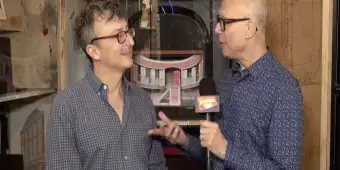
Video: How Beowulf Boritt Found Grover's Corners to Bring Back OUR TOWN
Sep 13, 2024


Bringing Our Town back to Broadway is personal for Beowulf Boritt. The two-time Tony-winning scenic designer played the Stage Manager in Thornton Wilder's iconic play when he was a just a freshman in high school. Now, he's bringing the story to life again onstage at the Ethel Barrymore Theatre. Watch in this video as he chats about his inspiration for the design and so much more.
Show More Show Less View Video Transcript
0:00
It's just such a gorgeous play
0:01
It is the way it reminds us to recognize the moments in our life that are magic
0:09
and to try not to just kind of breeze through and ignore them is the thing that brings me to tears
0:24
Bear Wolf, I'm thrilled to be standing with you here in the making of a Broadway show exhibit here at the Museum of Broadway
0:30
some of your set designs are here. They sure are. There's a picture of Act 1 up there
0:33
and I guess the model is out in the lobby. I haven't even seen it yet. This will be my first time seeing it in the museum
0:38
so I'm excited for that. Now, you've been to the museum before. Of course, of course
0:41
What was it like the first time you walked through the museum? What kind of emotions did you feel
0:45
I was moved, like, to tears, literally. I don't know what I was expecting exactly
0:50
but it's done so beautifully. It feels like it's the Smithsonian for our industry
0:55
And I don't say that lightly. I think they really have done a beautiful job
0:59
of it. But what moved me is there so many of my friends are here. I mean, I kept finding my own
1:04
name, which I hadn't expected. But so many of my friends and friends who were gone to see like
1:08
the Hal Prince stuff and the Steve Sontime stuff, people that I kind of grew up worshipping and then
1:13
was able to work with and now have left us. To see them recognized and remembered here is really
1:20
beautiful. Martin Sharnan is a lot of people. And then, of course, a lot of people who are still alive
1:24
were also recognized, which is really beautiful. But I found it incredibly moving. But you know
1:29
What's great about is people who come through here, some people will be like, oh my gosh, I may not want to be an actor. I may want to be a set designer, a lighting designer, a costume designer
1:36
Yeah, no, and in this room that we're in is great for that. There's all these set models around, and it reminded me of when I was a teenager
1:43
I lived in England briefly with my family, and there used to be a theater museum in Lester Square
1:49
and what I remember as a teenager is seeing all the set models they had on display there
1:52
And I think I sort of already knew I wanted to be a set designer at that point
1:56
but I remember it quite vividly. So if this gives somebody a window into what they might do with their lives, it's fantastic
2:03
Well, this is a busy season for you. You're about to return to Broadway. with this glorious new production of Our Town
2:10
Portland Wilders, Pulitzer Prize winning classic, directed by Kenny Leon. How excited are you
2:15
I'm super excited. When Kenny asked me to do this, I was thrilled. I was in our town in high school, as was practically everybody
2:22
Who'd you play? I played the stage manager in ninth grade at my junior high
2:26
And it is, it's the first time, I think, my mother said she had an inkling I was going to do this with my life
2:33
I think, honestly, it was that she sort of saw me being someone different than myself. on stage and it maybe shocked her, but I, it's when she says she sort of knew I was going to do this
2:42
So it's meaningful for me for personal reasons. But also, it's just such a gorgeous play
2:48
It is the way it reminds us to to recognize the moments in our life that are magic and to try not to just kind of breeze through and ignore them is the thing that brings me to tears
3:01
really almost every time I see a good production of the show. So Our Town takes place in Grover's Corners
3:08
What does your Grover's Corners look like? Well, the entire company of Our Town took a field trip to Peterborough, New Hampshire
3:16
which is Grover's Corners, which was kind of amazing. It's, you know
3:20
ours doesn't look anything like that. Obviously, that's a real town. The thing that struck me is I didn't realize
3:26
it's in the mountains, and I'm not sure I ever imagined that when I read the play
3:30
So you're kind of down in this valley with mountains all around you. And, you know, there's references in the play to the mountain
3:35
but I didn't think of it as quite such hilly terrain. So that's what really struck me about it
3:41
Our Grover's Corners is very simple. I mean, the show is written to be done kind of with no scenery
3:46
So the challenge is how do you do something that feels like it has some resonance for Broadway, but also doesn't get in the way of the play. And that's what I hope we've achieved. It's a very, very simple kind of wood plank set. You'll walk in and there's kind of a wall with a door in it. We're going to have some audience sitting on stage. Kenny talked to me early on. His vision was to start the show with church music. There's a lot of references. So this church is here. This church is there. And because the production is very much about, you know, all of America is our town. All of the world is our town
4:16
We all live in our town. He wanted to start with different music from kind of different religions and different branches of religion
4:24
Not competing, but sort of hearing those different sounds, hearing that kind of crazy quilt of American life
4:32
And so I said, well, what if we put audience on stage in church pews? And he said, I love that as long as they're comfortable
4:38
So I think he must have sat in a lot of uncomfortable church pews in his life. So hopefully we've succeeded
4:43
and there are 15 audience members on stage right, 15 on stage left that are sort of part of the action in a way
4:50
And then on the stage we have a very, very simple staging, some tables and chairs, but most of the props are mimed in a traditional hour town way
4:59
And there's this kind of old weathered plank wall upstage that's, again, it's trying to get at the sort of the age of the country and that this is an old play, but it's also a current play and sort of the history of it all
5:13
And then the other gesture we've made is there are 218 lanterns that hang around the stage, out over the audience
5:21
And their old antique lanterns, my prop supervisor, Lauren, has been, for the past three months driving around the tri-state area to everybody's garage and yard sale and antique shop and buying up every old lantern she can find
5:34
And then it's not just buying them. We've got to take all of them. We've got to wire them to put a light bulb in them, make them safe to hang over the audience
5:40
So it been quite an involved project I think when I cooked up the idea I thought oh this is beautiful They be like the souls of people and stars hanging over the stage And my assistants and everybody else who had to deal with the nitty gritty of it is ready to
5:53
hit me at this point because it's very fussy. Every one of these things has to be individually hung
5:57
We've got to figure it how high it is. So it doesn't block sight lines. It doesn't get in the way of the lights
6:02
But it's made this kind of, I keep calling it a cloud sort of that floats over the stage
6:07
and over the audience of these little twinkling lights. and they are as I said they're they're sort of meant to be stars they're sort of meant to be human souls
6:16
Kenny you know one of the things we talked about early on is he said he thinks of the stage manager as is kind of like an eternal soul who is you know usuring us into to this world
6:26
and that all of the actors are in a way portraying human souls that they're they're neither alive nor dead they're there are our souls there are hearts
6:34
and so the lanterns is trying to to sort of help with that
6:39
a little bit in a very, very subtle way. And the set is very much trying to kind of span the difference, the membrane between life and death
6:49
that we are all alive for a brief moment. And hopefully we pay a little bit of attention while we're alive and don't just rush through life
6:57
But, you know, notice the smell of the bacon and notice, you know, the joy of a sunrise
7:02
the joy of being with a loved one while they're still with us. I think that's to me what the show is
7:09
about and what we're trying to express. And the set in its way is trying to express that is sort of the paper thin line between life
7:17
and death. And I don't want to talk too much because the set does a thing during the show that I don't
7:22
want to give away, but that is trying to help illuminate that
7:26
So when you all went up to the Real Grover's Corners, you took your set design up there
7:30
Now, normally you present that at the first day of rehearsal, but you got to show it to the
7:34
entire company there in the Real Grover's Corners. did things change for you after you went up there
7:40
you're like, oh, I'd like to add this, or something like that? It's, I sort of, I don't know that I would have changed anything
7:46
had I seen it first. The way this, the realities of Broadway work
7:50
is the set was half built by then. So they, you know, because it takes us a few weeks to install these things in the theater
7:58
the set has to be designed probably three, six months before we do the show
8:02
And so it, for all of us, it's an exercise in thinking ahead, what are we going to want, making our kind of best education
8:07
educated guesses and leaving some flexibility too so that oh you know we suddenly have this idea
8:12
you know can we can we do something with that but but the set was largely built by the time we
8:17
visited grover's corners what you know the things that struck me like I said were were the terrain
8:23
the sort of the ruralness of it and the smell honestly the smell of the pine trees um and the smell
8:29
of kind of being out in the in the deep country um it another thing that we trying to do in the show and we see how it works out Kenny and I talked early on about like is there a way to get smell as part of this And I think a lot of people now have thought oh we going to fry bacon in the third act so you smell that a little bit
8:45
So we're going to try to do a version of that. But we also bought some machines that they use in Vegas
8:50
to sort of pump scent out into the casinos, and we're trying some different scents
8:54
to see if we can fill the theater at different moments with something that smells like wildflowers or coffee or whatever
8:59
The challenge is those scents often make it smell like you're in a candle shop
9:03
and we don't want that. So we're playing with how that's going to work out still
9:08
It's exciting, though. It's fun. It's not, you know, how it became part of the set
9:11
I'm not entirely clear. I keep joking, my union's going to call up and say, you need to hire a smell designer for this
9:16
It's collaboration. That's what we call this. So right now, you're at the theater loading the sets in
9:22
Stressful. What is that like for you that time? You know, it's not stressful because we really have like the best team on Broadway doing it
9:30
Neil Mozilla and Hudson Sienic had built the set, and I know they always have my back
9:34
So even when something's wrong, we're like, well, that's wrong, we're going to fix it. So that part of it's been lovely
9:39
The things that are stressful about it are, I've made this small model, like what's around us
9:45
And if I do that right, probably the set's going to come out okay
9:49
But when the real thing starts going, and I honestly am in terror for the first couple of weeks
9:52
every time I'm sure I've screwed it up and that it's not going to come together. And when I start to see pieces of it
9:58
that are suddenly reacting and looking and feeling the way I wanted them to
10:01
then I calm down a little bit. And so I'm feeling cautiously optimistic right now
10:05
Every set designer has been that way from day one. I think so. I'm not constantly sure I'm going to be exposed as a fraud
10:10
with every show that goes in. But so far, so good. Now, this is a huge company that's on stage
10:15
It was very exciting. Led by Jim Parsons as the stage manager. Yeah, no, it's very... Katie Holmes. What a great cast
10:20
No, it's an exciting group. And it's, again, part of why we wanted to put audience on stage as well
10:26
that it's just, it's all of us. That's what it's trying to express. It's the population of human
10:31
is what the show is trying to be about. There's no better director than Kenny Leon
10:36
This is the perfect time to bring back Thornton Wilder's Our Town. What do you hope people take away after seeing this production of Our Town
10:43
You know, when I, again, when Kenny asked me to do this, I was excited because I thought this is like the most Kenny Leon play I've ever touched
10:50
What I love about Kenny's work, whether I'm doing it with him or not, is he has this deep sense of humanity
10:56
It really, it's like an MLK kind of love of humanity, and we're all in this together
11:01
He really believes it, and it comes across in his work. When I walked out of Pearlie Victorious, which I didn't do, I just saw it as an audience member
11:09
that was the thing that it left me with, is this is Kenny's deep and abiding sense that we are all human beings
11:14
and we all need to learn to love each other and not hate each other
11:18
And our town is so much about that. That's what I'm looking forward to is I hope and believe that Kenny's spirit
11:24
and that thing that he sort of brings to every show will really shine through in this one
11:29
because the show is so inherently about that
#Events & Listings
#Movies
#Music & Audio
#Performing Arts
#Acting & Theater
#Musical Films
#Vocals & Show Tunes
#Broadway & Musical Theater