Up next in 10

Exclusive: Tour Backstage at THE GREAT GATSBY with Paul Tate dePoo III
Jan 15, 2025


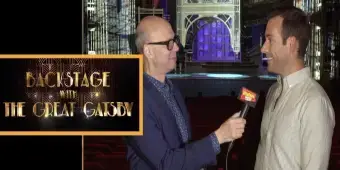
BroadwayWorld is taking you backstage at The Great Gatsby with a four-part video series spotlighting its incredible creators. Watch in this video as dePoo tells us more about the musical's extravagant sets.
Show More Show Less View Video Transcript
0:00
Hello, I'm Richard Ridge for Broadway World
0:02
We're at the Broadway theater, which is the home to the hit musical, The Great Gatsby, and I am standing here with the show's set designer and projection designer, Paul Tatea Pooh, the third, to chat right before a matinee
0:27
So you know that I fell in love with this show at Paper Mill. So how much of the show changed from a set and projection design between Paper Mill and New York
0:35
When we started Paper Mill, we had a running hit list of like, here's what we wanted to do if this ever were to happen again
0:42
And we loaded out of November 16th from Paper Mill, and we were told November 17th that we were moving here
0:50
And then opened the end of March. So the turnaround was insane, but we nearly doubled the physical set from what we saw at Paper Mill
1:00
And then, you know, refurbished everything, repainted, just because we learned a lot from paper mill, but 50% new things
1:06
So we got twice as much here. You design the sets and the projections
1:11
At what point during the design, do you decide will use projections here or will add them to a set
1:17
Yeah. As the set designer, you're usually the first to talk of the creatives with the director
1:22
So Mark, Bruni, and I sat down. And as the conversation started rolling, and once I realized that videos started to become
1:29
a word that we were using often, then what I'll do is I'll sort of yze, are we doing video
1:36
to be an extension of the scenery? And as soon as I noticed that is a conversation, then I start
1:41
to say let start to consider both So it usually a little process of me figuring out psychologically where we going with it Because if it something that graphic and like you know camera work and video that not really what I do but an extension of the world that what I love to do
1:58
So when you were designing this show, is it like a puzzle of where you start
2:02
Did you start from the top of the show? Did you work on other parts first? How did you design it
2:07
We got the first script. We basically color-blocked everything. So Wilson's was in orange
2:11
Buchanan's was in purple. And it was like a big puzzle piece that we laid out on a table. And I asked to do this design
2:18
I asked Mark Bruny and approached him. And then when I got it, I was like, I think we can make it pretty
2:23
Let's just figure out how it works and how it moves, which then lends itself to actually what it looked like
2:27
which is sort of backwards. Usually you start with how it should look. And what's the design
2:32
And this was all about the puzzle piece because it's nonstop. It changes 53 times
2:37
And once we started figuring out, here was the flow, and here's how it can be layered
2:41
and here's how it can be malleable to a new script that's changing constantly. then we started to apply aesthetics
2:47
Okay, so you mentioned the number 53. Yeah. Of your 53 sets or like how many designs
2:52
53 times that the stage manager is saying go, that the audience will recognize something is visually changing is 53 times
2:59
Okay, so how long did it take you to design this show? We started in November of 2022
3:05
and we opened the beginning of October of 23, so less than a year
3:11
So it was a pretty fast turnaround. And famously, we sort of started
3:15
scrapped the ideas that we had created for months. And about the end of July, I woke up a morning and was like, this is how it should be done
3:24
And so Mark Bruny came, he's like, what do you mean we were starting over? And I was like, let's just start over
3:29
And somehow we did it. And because we realized that, like, as I said, the writers are changing naturally
3:35
It the beast of a new musical And so things had to be able to be used in different places and like different locations but still all cater to the different worlds that we going to throughout the evening
3:47
But end of July. To put a set like this on Broadway, how many shops are involved, scenic shops
3:53
For Paper Mill, we had 12 different shops in the Tri-State area. So we basically had a full-time job for two months driving around all these shops non-stop
4:03
And they basically built it. with the time ticking, and we loaded it into paper mill at the beginning of September
4:11
and the 12 was the magic number that made this happen. And then once we went to Broadway, show motion up in Connecticut
4:18
really sort of took all of the built entities, brought it together, made it uniform
4:25
just as far as engineering and certificates of safety, and then built everything new that was coming along
4:31
So they had their hands full and forever grateful. We're downstage left and this is basically where all of our scene furniture and where the car
4:42
a ton of stuff comes and fits back here, which you can see is relatively very, very small
4:47
Because once we're in show mode, you know, it's basically all walled off here and they have to do what they have to do with all the furniture
4:55
which gets stored up in the air. The car has to be shuttled all around the stage and it's just sort of a miracle how somehow we can fit all this stuff in this little downstage left area
5:04
So everything gets brought down, and then once it's down, everything gets locked into the computerized tracks
5:11
So the tracking is talking to everything that's flying in the air and everything that's going on with the deck
5:16
But it's a nonstop show. Our champagne tower, which we use for 30 seconds
5:21
30 seconds. Our stage manager lives up there which some people don know that the production stage manager actually is not seeing a stage live And they seeing a ton of monitors So they never seeing the real thing with their eyes But we trusting a ton of computers and monitors and communications for people on deck
5:40
people behind the computers to make this thing run. So there's a whole backstage show going on at the same time
5:45
The show's going on. It's a simultaneous show that is ran by some incredible wizards
5:51
That when you see the whole show in its entirety, you don't understand
5:55
how or where it's coming from, and that's because everyone back here that's doing it. All right, so these are our video gates
6:01
which we are using throughout. We put a bunch of architecture in front of LED screens
6:05
so that it's blurring the eye, so they're not just constantly seeing an exposed TV screen per se
6:10
But once this is in show mode, it doesn't look so technological
6:15
But these are also computerized and automated to track on and off
6:19
and it also sort of allows us to open up backstage so that the car can get, and the casks can get
6:25
around backstage, but this is sort of a variable that tells the story throughout the night
6:30
And now we can start to see, you know, some of the water. Now we see Long Island. Here we are
6:35
So who designs where everything lives backstage when you hand everything over? No, we have to
6:41
I mean, our studio, that's going until the day that we freeze, where we're updating and constantly
6:46
and we had to know where things were going so that it was a possible, B, that we didn't waste time
6:52
in the theater, and C, so that we could prove that. that some of it was all able to be done
6:58
Because when you see all of this stuff in a room or laid out on paper, it's daunting
7:03
And you don't know how it's all going to shift, but the engineering is like 50% of the passion
7:08
that I love for this. Well, I want to thank you, because I know the show's getting ready to begin here for the matinee
7:12
by thank you for taking the time to visit with us and just creating the magic that you create on stage
7:17
It's really spectacular. Come see us
#Entertainment Industry
#Performing Arts
#Vocals & Show Tunes
#Broadway & Musical Theater