0:00
What's the fastest way to make a cake
0:02
What temperature cake layers? Spreading or piping filling and frosting? And what kind of cake comb
0:07
Let's find out. First, the basics of assembling a cake. Use a bit of frosting on the cake board
0:16
to attach your first layer of cake and then alternate between filling and cake layers
0:21
Cover it in a thin layer of frosting called a crumb coat before you do the final coat and add decorations
0:27
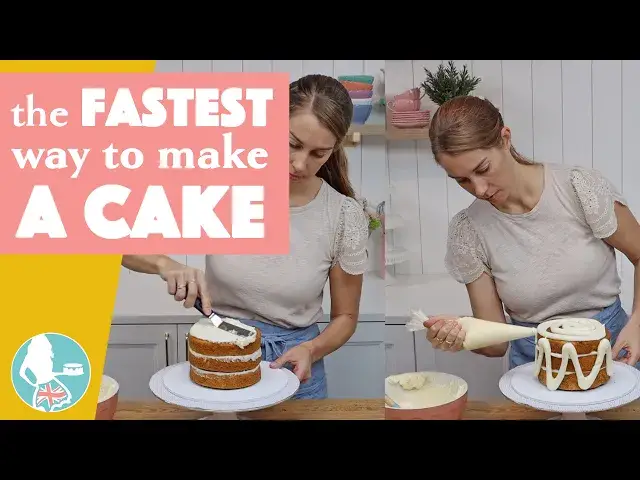
Let's rewind. Should you spread or pipe? the filling onto each layer. This is my four-minute butter cream. To spread it as the filling on a cake
0:35
spoon it onto the cake and then use an offset spatula to cover the whole top of the cake layer
0:40
and to smooth it so it's flat and level. Ready for the next cake layer. To pipe it
0:45
spoon it into a piping bag with the end cut off or fitted with a round piping tip
0:51
Pipe a spiral onto the cake and then optionally spread that to flatten and level it
0:56
Which is faster. Take a look. Piping the filling gives it a neater edge than spreading it, and piping it also takes less time than spreading it
1:04
But after piping the filling, if you choose to spread that piped filling, you'll add some time
1:09
to the process making it just a tiny bit faster than spreading the filling straight on Pro tip However you get the filling onto the cake get down to eye level several times as you assemble the cake to make sure you place each layer of cake
1:22
directly over the layer below it so that the cake has straight sides
1:26
and doesn't lean to one side. What about the frosting? Should you spread or pipe that on
1:32
If you spread it on, the top of the cake is the same process as the filling
1:36
spreading it to cover the cake and then smoothing it. For the sides, these side-to-side motions
1:41
are the quickest way to spread the frosting all over the cake. To pipe the frosting on, again, the process for the top of the cake is the same as for the filling
1:50
But for the sides of the cake, I like to pipe these zigzags to evenly spread the frosting over the cake
1:55
without ending up with too much frosting. I like to pipe a ring around the bottom of the cake too
2:01
since that's the trickiest part to get an offset spatula down to. Then spread the piped frosting all over the cake
2:07
Which way is faster, spreading or piping? Definitely pipe. Although it's an extra step to fill a piping bag with frosting and clean it later
2:16
you'll see that it takes a lot less time to spread it when it's already piped evenly over the cake
2:21
compared to scooping up dollop after dollop of frosting from a bowl and spreading that straight onto the cake
2:27
What key with either method spreading or piping is to completely cover the cake with frosting This first layer of frosting is called a crumb coat and its purpose is to trap any crumbs that come off the cake
2:40
so that they don't get into the final layer of frosting, so you don't want to leave any cake exposed
2:45
To smooth this frosting, what kind of cake comb is the fastest to use
2:50
Let's compare the two most common materials, plastic and acrylic. You can see that plastic is quicker to clean off after each scrape around the cake
2:59
compared to acrylic which is much thicker, so you have two surfaces to wipe off each time
3:04
which takes longer. I should mention that I do find that the frosting is much smoother if I use
3:10
an acrylic comb rather than a plastic comb. But for the crumb coat, I use a plastic cake comb because
3:16
speed is my goal, rather than making it pretty, since the crumb coat is going to be covered up with
3:21
a final layer of frosting, so it doesn't matter what it looks like. But for the final coat of frosting
3:26
I would choose acrylic over plastic because I want that frosting to be as smooth as possible
3:32
Now, what temperature should the cake layers be? Probably the most important factor in assembling a cake
3:37
is the temperature of the cake layers. These ones have cooled after baking
3:42
so they're at room temperature, and this is the most difficult and time-consuming way to do it
3:47
because even the light pressure from my offset bachelor and cake comb will cause the cake to wobble The cake started off in the middle of the cakeboard but while I spreading the frosting onto it the cake slides sideways so it off centre and I have to push it back into the middle
4:02
Also, even though I lined the layers up straight on top of each other, as I spread and then smoothed
4:07
the frosting, the layers start to slip sideways and the cake starts to lean
4:12
These cake layers have been in the freezer for an hour, so they're cold and firm, which makes
4:16
the cake much sturdier. The dot of buttercream on the cake board sets after about a minute
4:22
because the cold cake chills the buttercream and it attaches the cake very securely to the cake board
4:27
Then I can spread the frosting with my offset spatula without making the cake wobble or slide or lean
4:33
You can see that with the room temperature cake layers, I have to stop and start several times
4:38
as I adjust the cake when it moves. But with the cold cake layers, the cake stays still as I spread
4:44
and smooth the frosting. So the process is much quicker. So now you know the fastest way to decorate a
4:50
cake. Learn all of my tips for cake decorating on my online cake school with hundreds of decorating
4:55
techniques and designs. Go to British Girlbakes.com or click the link in the top of the screen
5:00
or in the video description. Thanks for watching