Up next in 10


Understanding Diffusion Movement, Types, and Everyday Examples
Study Note: https://biologynotesonline.com/diffusion-definition-causes-significance-examples/
In this enlightening video, we delve into the concept of diffusion movement, exploring its fundamental principles and various types. From the basic mechanics of how particles spread in different mediums to real-world applications, we provide a comprehensive overview that enhances your understanding of this essential scientific phenomenon. Join us as we illustrate everyday examples of diffusion, such as the dispersal of fragrance in a room or the mixing of sugar in water, to highlight its significance in both nature and technology. Whether you're a student, educator, or simply curious about science, this video is designed to enrich your knowledge of diffusion. #Diffusion #ScienceExplained #EverydayScience
Website: https://biologynotesonline.com/
Facebook: https://www.facebook.com/biologynotesonline
Instagram: https://www.instagram.com/biologynotesonline/?hl=en
diffusion,diffusion and osmosis,examples of diffusion,simple diffusion,definition of diffusion and osmosis with examples,diffusion and active transport in plants,daily life examples of diffusion,facilitated diffusion,diffusion and active transport,what is diffusion,simple diffusion and facilitated diffusion,facilitated diffusion and simple diffusion,difference between diffusion and osmosis,types of diffusion,osmosis and diffusion
Show More Show Less View Video Transcript
0:00
simple diffusion is the movement of molecules directly across a semi-permeable membrane without the help
0:06
of transport proteins the cell membrane is composed of a phospholipid billayer
0:11
that acts as a selective barrier small non-polar molecules like
0:17
oxygen and carbon dioxide can pass through the membrane directly through a process called simple diffusion
0:23
these small molecules can slip between the phospholipids in the membrane without requiring any additional
0:30
proteins however larger molecules like glucose cannot pass through the membrane
0:35
via simple diffusion several factors affect simple diffusion including molecule size and
0:41
polarity concentration gradient strength membrane properties and temperature
0:47
remember simple diffusion is a passive process that requires no energy input
0:52
molecules naturally move from areas of high concentration to areas of low
0:57
concentration facilitated diffusion is a process that allows molecules to cross
1:02
cell membranes with the help of transport proteins the cell membrane consists of a phospholipid billayer
1:09
which creates a barrier that some molecules cannot easily cross transport proteins embedded in the membrane create
1:16
channels that allow specific molecules to pass through small uncharged molecules can often diffuse directly
1:23
through the phosphoipid billayer however larger molecules or charged particles cannot pass directly
1:29
through the membrane they require transport
1:38
proteins charged molecules also use these protein channels to cross the membrane following their concentration
1:46
gradient
1:51
importantly facilitated diffusion does not require energy input molecules still
1:57
move down their concentration gradient from high to low concentration transport proteins are highly selective allowing
2:04
only specific molecules to pass this process is generally faster than simple
2:09
diffusion for the molecules that need assistance in summary facilitated diffusion allows
2:15
molecules that cannot cross the membrane directly to move across with the help of transport proteins all without using
2:23
energy osmosis is a special type of diffusion that specifically involves the movement of water molecules across a
2:30
semi-permeable membrane in osmosis water moves from areas of lower solute
2:35
concentration to areas of higher solute concentration
2:41
this movement continues until the concentration of water molecules reaches equilibrium on both sides of the
2:47
membrane the solute particles cannot cross the semi-permeable
2:52
membrane we can demonstrate osmosis using a YouTube separated by a semi-permeable membrane when pure water
3:00
is placed on one side and a sugar solution on the other water molecules move toward the sugar solution
3:07
osmosis is crucial for cells to maintain proper water balance it prevents cells from shrinking or bursting and controls
3:14
tur pressure in plant cells dialysis is a specialized type of
3:20
diffusion where a semi-permeable membrane allows some solutes to pass through while blocking others the
3:26
membrane contains tiny pores that act as molecular filters allowing small waste molecules to pass while blocking larger
3:34
essential molecules small waste molecules can freely diffuse through the membrane pores while larger essential
3:41
molecules are too big to pass through this selective diffusion principle is the foundation of kidney dialysis a
3:48
life-saving medical treatment for patients with kidney failure in a dialysis machine blood flows through
3:54
semi-permeable tubes inside a dializer a special fluid called dialysate surrounds
4:00
these tubes waste molecules like ura and creatinine diffuse from the blood into the dialysate due to concentration
4:07
gradients while essential proteins and cells remain in the bloodstream this process essentially performs the
4:14
filtering function of healthy kidneys the cleaned blood is then returned to the patient while the
4:20
waste-filled dialysate is discarded dialysis demonstrates selective diffusion through a semi-permeable
4:26
membrane allowing small waste molecules to pass while retaining essential components this principle saves
4:33
countless lives every year diffusion occurs because of the
4:40
random movement of molecules at the molecular level all particles possess kinetic energy causing them to be in
4:47
constant motion let's visualize a chamber with a high concentration of molecules on one side and a low
4:53
concentration on the other the random motion of molecules causes them to move in unpredictable directions continuously
5:01
colliding with each other and their surroundings as molecules move they
5:06
naturally spread from areas of high concentration to areas of low concentration this doesn't mean
5:12
molecules move in only one direction rather the net movement of molecules is from high to low concentration areas due
5:20
to statistical probability eventually the random motion leads to an even distribution of molecules throughout the
5:26
container a state of equilibrium it's important to understand that diffusion is driven by this random motion
5:34
molecules don't know where to go they simply move randomly and the concentration gradient results in the
5:40
net movement we observe thus the random movement of molecules due to their kinetic energy is the
5:47
fundamental mechanism driving the process of diffusion molecular collisions play a key role in the
5:53
diffusion process let's examine a system with a higher concentration of particles on the left side and fewer particles on
6:00
the right as particles move randomly they collide with each other and change
6:06
direction these collisions are fundamental to understanding how diffusion works
6:12
in areas of higher concentration particles are closer together leading to more frequent collisions these
6:18
collisions push particles toward less crowded areas creating a net movement down the concentration gradient when
6:26
particles collide several effects occur they change direction transfer energy
6:31
and contribute to the overall movement from high to low concentration this molecular level understanding of
6:37
collisions helps explain why substances naturally diffuse from areas of high
6:42
concentration to areas of low concentration temperature plays a
6:48
crucial role in how quickly molecules diffuse let's compare how diffusion
6:53
happens at different temperatures higher temperatures increase the kinetic energy of molecules
7:01
molecules at higher temperatures move at lower
7:06
temperatures as a result diffusion happens much more quickly at higher
7:12
temperatures the relationship between temperature and diffusion rate is not linear as temperature increases
7:19
diffusion rate increases more rapidly temperature change is one of the most effective ways to control diffusion
7:25
rates in scientific applications and natural processes
7:31
particle size has a significant impact on how quickly substances diffuse through a medium to understand this
7:37
relationship let's observe how particles of different sizes move through the same medium here we have small particles like
7:45
oxygen molecules which are crucial for cellular respiration and here are larger particles such as glucose molecules
7:52
which provide energy for cells when diffusion begins we can observe a clear difference in how quickly these
7:58
particles move smaller particles diffuse faster
8:04
because they encounter less resistance when moving through the medium they also have higher mobility
8:11
allowing them to navigate more easily between molecules in the medium as a result smaller particles consistently
8:18
diffuse faster than larger ones in the same environment at the molecular level the
8:24
medium itself consists of particles that create resistance larger particles like glucose experience more frequent
8:31
collisions with medium molecules slowing their movement smaller particles like oxygen can navigate through the spaces
8:38
between medium molecules more easily allowing for faster diffusion this
8:43
fundamental principle explains why gases like oxygen diffuse rapidly in tissues while larger molecules like proteins
8:50
diffuse very slowly the properties of the medium through which diffusion occurs significantly
8:56
affect how quickly particles move let's first examine viscosity which measures a fluid's resistance to flow we can
9:04
compare diffusion in a low viscosity medium like water with a high viscosity medium like honey let's observe how the
9:11
same particles diffuse through these different media in water with its low viscosity
9:16
particles move rapidly and freely but in honey the high viscosity restricts movement causing particles to diffuse
9:23
much more slowly this demonstrates an important principle as viscosity increases the rate of diffusion
9:30
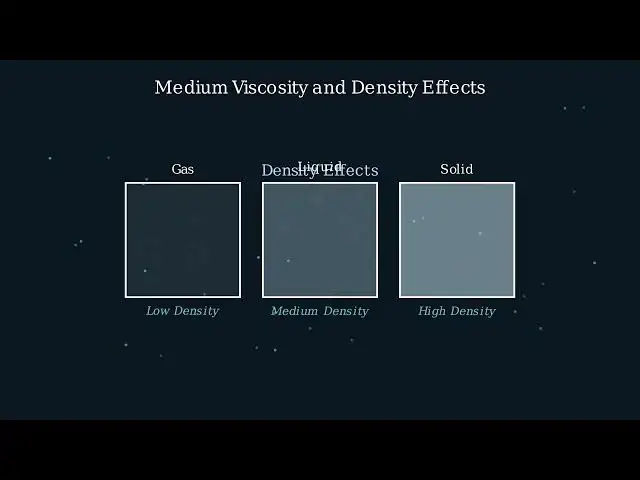
decreases now let's examine how density affects diffusion density is the mass
9:36
per unit volume of a substance diffusion occurs at different rates in gases liquids and solids due to their
9:42
different densities let's participle
10:12
as density decreases the rate of diffusion increases to summarize what we've
10:18
learned the properties of the medium have a significant impact on diffusion rates higher viscosity slows diffusion
10:25
by increasing resistance to movement lower density diffusion by allowing for
10:31
greater molecular movement the same substance will diffuse at different rates depending on the medium it's
10:37
traveling through
11:44
the distance molecules need to travel has a profound impact on diffusion time let's visualize how diffusion time
11:52
changes as the distance increases we'll start with molecules on one side of each container and observe how they diffuse
11:59
across different distances in the small container diffusion happens quickly as molecules need to travel a short
12:05
distance with twice the distance diffusion takes approximately four times
12:13
longer and with four times the distance diffusion takes 16 times longer showing
12:19
a squared relationship between distance and time
12:48
the mathematical relationship between diffusion time and distance follows a square law this means diffusion time is
12:55
proportional to the square of distance for example if diffusion takes 1 second
13:00
across 1 millimeter it will take a 100 seconds nearly 2 minutes to diffuse
13:05
across 10 millime small organisms like amiebas can
13:11
rely entirely on diffusion because molecules only need to travel short however large organisms like
13:18
humans cannot rely solely on diffusion due to the time it would take they've evolved circulatory systems to transport
13:26
substances quickly over long distances to summarize what we've
13:32
learned about distance and diffusion time diffusion time is proportional to the square of distance it works
13:38
efficiently over short distances like micrometers to millime but becomes impractical over longer distances this
13:45
is why cells remain small and large organisms have evolved circulatory systems to overcome the limitations of
13:51
diffusion when perfume is sprayed in one corner of
13:58
a room the scent molecules begin their journey through the air initially
14:03
there's a high concentration of perfume molecules near the source of the spray these molecules move randomly in all
14:10
directions but their overall movement follows the principle of diffusion from high concentration to low concentration
14:17
areas over time the perfume molecules distribute more evenly throughout the room reducing the concentration gradient
14:24
while each individual molecule moves randomly due to its kinetic energy the collective behavior results in the scent
14:31
spreading throughout the entire room eventually the perfume reaches an equilibrium distribution although the
14:37
molecules continue their random motion the diffusion of tea and water is
14:43
a perfect example of how compounds move from areas of high to low concentration
14:49
we start with a cup of water and a tea bag containing dried tea leaves the tea leaves contain color and flavor
14:55
compounds at high concentration while the water initially has none when we place the tea bag in hot water the
15:02
compounds begin to diffuse from the tea bag into the surrounding water
16:16
as time passes the concentration of tea compounds in the water increases the process continues until the tea reaches
16:23
a uniform color and flavor throughout the water temperature plays a crucial role in this process higher temperatures
16:30
increase the kinetic energy of molecules making them move faster in hot water tea
16:36
diffuses much more quickly than in cold water which is why we typically use hot water for brewing tea this diffusion
16:43
process follows the universal principle of molecules moving from areas of high concentration to low concentration until
16:50
equilibrium is reached when sugar is added to coffee it
16:55
dissolves and diffuses throughout the liquid initially the sugar concentration is highest at the bottom where the
17:02
crystals are added at the molecular level sugar molecules start to disperse from areas of high concentration to
17:09
areas of low concentration without stirring sugar molecules slowly diffuse through random molecular movement this
17:16
process can take several minutes to reach an even distribution throughout the coffee when we stir the coffee the
17:23
diffusion process is drastically accelerated stirring creates currents that rapidly carry sugar molecules
17:30
throughout the liquid achieving an even distribution in seconds rather than minutes whether through natural
17:36
diffusion or with the help of stirring sugar molecules ultimately reach equilibrium and distribute evenly
17:43
throughout the coffee understanding this process helps explain why your coffee eventually
17:48
tastes sweet throughout even if you don't stir it cellular respiration depends heavily on
17:55
diffusion for gas exchange between cells and the bloodstream cells are surrounded by blood vessels that carry oxygen and
18:02
remove carbon dioxide in this gas exchange system diffusion drives the
18:07
movement of molecules across the cell membrane inside cells mitochondria are the primary sites of cellular
18:13
respiration the bloodstream maintains a high concentration of oxygen molecules around the cell meanwhile cellular
18:21
respiration within the cell produces carbon dioxide following the concentration
18:26
gradient oxygen diffuses from high concentration in the bloodstream to low concentration inside the cell the
18:33
mitochondria use this oxygen in cellular respiration to produce ATP the energy currency of the
18:40
cell as cellular respiration produces carbon dioxide it builds up inside the
18:45
cell creating a concentration gradient carbon dioxide then diffuses from high
18:50
concentration inside the cell to low concentration in the bloodstream the bloodstream carries away this carbon
18:57
dioxide which is eventually exhaled through the lungs this continuous exchange of oxygen
19:04
and carbon dioxide through diffusion is essential for sustaining cellular energy production without this diffusion-driven
19:11
gas exchange cellular respiration would cease and cells would rapidly die from energy depletion and waste
19:19
buildup plants obtain essential nutrients from the soil through their root
19:25
systems let's look at a cross-section of a plant root the epidermis is the
19:30
outermost layer with root hairs that increase surface area for absorption inside we find the cortex where much of
19:38
the diffusion occurs and the central steelely that contains vascular tissues for transporting nutrients throughout
19:44
the plant nutrient uptake depends on concentration gradients the soil solution typically has a higher
19:50
concentration of mineral ions than root cells this concentration gradient drives
19:55
diffusion mineral ions naturally move from an area of higher concentration in the soil to an area of lower
20:02
concentration inside the root cells root hair cells actively maintain this gradient by quickly moving absorbed
20:09
nutrients into the inner tissues allowing continuous diffusion to occur
20:14
this passive diffusion of minerals from soil to roots is essential for plant nutrition providing elements like
20:20
nitrogen phosphorus and potassium needed for growth and development
20:26
neurons communicate with each other across a tiny gap called the synaptic
20:35
cleft neurotransmitters are stored in vesicles within the presinaptic neuron
20:40
the postsaptic neuron has specialized receptor proteins that can bind to these
20:45
neurotransmitters when an action potential reaches the end of the presinaptic neuron it triggers the
20:51
release of neurotransmitters these neurotransmitters are released into the synaptic cleft where they
20:57
diffuse randomly across the gap the neurotransmitters bind to specific receptors on the postsaptic
21:04
neuron this binding triggers a response in the post synaptic neuron allowing the
21:09
signal to continue diffusion is crucial for neural communication as it allows
21:14
neurotransmitters to travel across the synaptic cleft through random molecular movement
23:49
diffusion plays a vital role in chemical reactions by bringing reactant molecules into contact with each other in a
23:57
chemical reaction molecules must first come into contact before they can react
24:02
through random thermal motion molecules diffuse throughout the solution or gas
24:07
eventually coming into contact with other reactants when reactants meet chemical bonds can form creating new
24:14
products the rate of these reactions is often limited by how quickly the molecules can diffuse to the reaction
24:21
site in many reactions the diffusion of reactants is the rate limiting step this
24:27
means the overall speed of the reaction depends on how quickly molecules can diffuse to each other factors like
24:34
temperature molecular size and medium viscosity affect diffusion rates in environments with faster
24:41
diffusion reactions proceed more rapidly as reactants meet more
24:46
frequently understanding diffusion is crucial in both industrial processes and laboratory settings engineers design
24:54
reactors to optimize diffusion by controlling temperature increasing surface area and reducing diffusion
25:00
distances in laboratories techniques like stirring accelerate reactions by enhancing molecular
25:07
encounters to summarize diffusion is often the key limiting factor in chemical reaction rates by understanding
25:15
and controlling diffusion scientists and engineers can optimize reaction efficiency in both laboratory and
25:22
industrial settings
26:25
let's compare diffusion and active transport two fundamental transport mechanisms in cells these two processes
26:32
have fundamental differences in how they function and the energy they require diffusion is a passive process that
26:38
requires no energy while active transport requires ATP the cell's energy currency diffusion moves molecules down
26:46
their concentration gradient from high to low concentration active transport
26:51
does the opposite it moves molecules against their concentration gradient from low to high concentration diffusion
26:58
is generally faster and more energyefficient but is limited by the existing concentration gradient active
27:05
transport is more controlled and can maintain specific concentrations regardless of the existing
27:12
gradient let's look at how cells use these transport mechanisms in practice
27:17
oxygen diffuses from the bloodstream into cells down its concentration gradient this requires no energy input
27:24
from the cell the sodium potassium pump is a classic example of active transport it
27:30
uses ATP energy to pump sodium ions out of the cell and potassium ions into the
27:36
cell both against their concentration gradients cells use both transport
27:41
mechanisms strategically diffusion is preferred when possible because it's energy efficient active transport is
27:48
essential when cells need to maintain specific internal concentrations different from their surroundings many
27:54
cellular processes rely on a balance of both methods working together
28:01
in this classic diffusion experiment we'll observe how a drop of food coloring spreads in still water let's
28:08
follow these steps to observe diffusion in
28:13
action we start by adding a single drop of food coloring to the top of the water at first the color remains concentrated
28:20
in one area creating a region of high concentration after 30 seconds we can
28:25
observe the color beginning to spread out slightly after 2 minutes the diffusion continues as more molecules
28:32
move throughout the water if we observe the experiment from multiple angles we
28:38
can see how the food coloring spreads in three dimensions this simple experiment clearly demonstrates how molecules
28:45
naturally move from areas of high concentration to areas of low concentration without requiring any
28:51
external energy this random molecular movement resulting
28:57
in the even distribution of particles is the essence of
29:03
diffusion medical dialysis uses diffusion principles to clean the blood of kidney patients waste products
29:11
diffuse across a semi-permeable membrane while blood cells and proteins remain in the bloodstream controlled release
29:18
medications use diffusion to gradually release drug molecules through specially designed polymer matrices this provides
29:26
consistent dosing over extended periods improving treatment efficacy food preservation techniques
29:33
like salting and smoking rely on diffusion salt and smoke molecules penetrate food creating environments
29:40
where harmful bacteria cannot thrive gas masks use activated carbon with
29:46
millions of microscopic pores when air passes through toxic molecules diffuse
29:51
into these pores and become trapped while clean air passes through to the wearer in semiconductor manufacturing
29:59
diffusion introduces precise amounts of dopen atoms into silicon wafers this
30:04
controlled process creates the electrical properties needed for modern electronic devices
30:10
understanding diffusion principles has enabled countless innovations that improve our lives from life-saving
30:17
medical treatments to the devices that power our digital world
#Biological Sciences