Up next in 10

Ticks Explained - Anatomy, Life Cycles, and Diseases
Website: https://biologynotesonline.com/
Facebook: https://www.facebook.com/biologynotesonline
Instagram: https://www.instagram.com/biologynotesonline/?hl=en
Show More Show Less View Video Transcript
0:00
Hey everyone. Today we're diving into
0:02
the fascinating yet concerning world of
0:05
ticks. These tiny creatures may seem
0:07
insignificant, but they pose serious
0:09
health risks that everyone should
0:11
understand. First, let's clarify what
0:13
ticks actually are. Ticks are arachnids,
0:16
which means they're more closely related
0:18
to spiders, scorpions, and mites than to
0:20
insects. This spider anatomy diagram
0:23
shows the internal structure typical of
0:25
arachnids. Ticks are obligate
0:27
hematophagus ectoparasites.
0:29
Let me break that down. Obligate means
0:32
they absolutely must have blood to
0:33
survive. Hematophagus means blood
0:35
feeding. And ectoparasites means they
0:38
live on the outside of their hosts. As
0:40
you can see in this image of a tick
0:42
embedded in human skin. Ticks go through
0:45
four distinct life stages. Egg, larvae,
0:48
nymph, and adult. This diagram shows the
0:51
complete life cycle. What's important to
0:53
know is that each stage after the egg
0:55
requires a blood meal to develop to the
0:57
next stage, making them persistent
0:59
parasites throughout their lives.
1:02
Despite their tiny size of just 3 to 5
1:04
mm, ticks cause major health problems.
1:08
They transmit numerous diseases
1:09
including Lyme disease, Rocky Mountain
1:11
spotted fever, and anoplasmosis. Their
1:14
geographic range is expanding and
1:16
disease rates are increasing, making
1:18
them a growing public health concern.
1:21
Throughout this series, we'll explore
1:23
tick anatomy and identification, their
1:25
life cycles and behavior, how they
1:27
transmit diseases, and most importantly,
1:30
how to protect yourself. We'll cover
1:32
control methods and current research
1:34
trends. Remember, knowledge is your best
1:37
defense against these tiny but
1:39
troublesome parasites. Ticks are
1:41
fascinating yet troublesome creatures
1:43
that belong to a specific group of
1:45
animals. Understanding what they are
1:48
helps us better protect ourselves from
1:50
them. Ticks belong to the order exoda,
1:53
which makes them arachnids. This means
1:55
they're actually more closely related to
1:57
spiders and scorpions than to insects.
2:00
Adult ticks are quite small, typically
2:03
measuring just 3 to 5 mm in length.
2:06
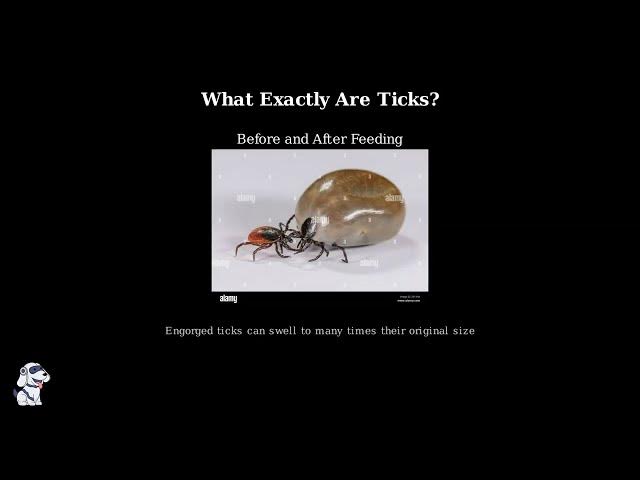
That's a pencil eraser. However, ticks
2:09
can swell dramatically after feeding on
2:12
blood. An engorged tick can become
2:14
several times larger than its original
2:16
size, sometimes appearing like a small
2:18
grape. The tick's body structure is
2:20
quite unique. Unlike insects, which have
2:23
three distinct body segments, ticks have
2:25
a fused head and abdomen, creating a
2:28
streamlined design perfect for their
2:30
parasitic lifestyle. Everything about a
2:32
tick's anatomy is designed for one
2:34
primary purpose, finding a suitable host
2:37
and feeding on their blood. This
2:40
specialized design makes them incredibly
2:42
effective parasites, but also helps us
2:44
understand how to protect ourselves from
2:47
them. Ticks are broadly classified into
2:49
two main families that look quite
2:51
different from each other. Understanding
2:54
these differences is crucial for proper
2:56
tick identification.
2:58
Hard ticks from the exodate family are
3:01
the most commonly encountered ticks.
3:04
They get their name from a distinctive
3:06
hard shield called a skutum. The skutum
3:08
is the key identifying feature of hard
3:10
ticks. This hard shield-like structure
3:14
covers part of their back and gives them
3:16
their characteristic appearance. Soft
3:18
ticks from the Argaday family look
3:20
completely different. They lack the hard
3:22
scum and have a more rounded leathery
3:25
appearance. Notice the key difference.
3:27
Hard ticks have a prominent skutum that
3:30
acts like armor while soft ticks have a
3:32
completely smooth rounded body without
3:35
any hard shield. Beyond the skutum,
3:38
there are other important differences.
3:40
Hard ticks have their mouth parts
3:42
visible at the front, while soft ticks
3:45
have mouth parts located underneath
3:47
their body. Hard ticks tend to be more
3:49
oval-shaped, while soft ticks are more
3:51
perfectly rounded. This difference in
3:54
body structure is crucial for
3:55
identification. Most ticks you encounter
3:58
outdoors will be hard ticks, as they are
4:00
more common and spend longer periods
4:02
attached to hosts. Soft ticks are less
4:06
frequently encountered but are important
4:08
vectors for certain diseases.
4:10
The key takeaway is simple. If you see a
4:13
hard shield or skew, it's a hard tick.
4:15
If the body is completely rounded and
4:17
leathery without any hard parts, it's a
4:19
soft tick. This fundamental difference
4:22
will help you identify which type of
4:24
tick you're dealing with.
4:27
Now, we'll examine the remarkable
4:28
anatomy of ticks, focusing on their
4:30
specialized feeding structures. Despite
4:33
their tiny size, ticks possess
4:35
incredibly sophisticated mouth parts
4:37
designed for one purpose, finding and
4:40
feeding on blood. The tick's feeding
4:42
apparatus is located in a structure
4:44
called the capitulum or head region.
4:47
This isn't actually a true head like we
4:49
might think of it, but rather a
4:51
specialized feeding structure that
4:53
contains all the ticks mouth parts and
4:55
sensory organs.
4:57
The hypos is perhaps the most important
4:59
feeding structure. This needle-like
5:01
appendage is covered with
5:03
backward-facing barbs that work like
5:05
tiny fish hooks. Once the hypos
5:08
penetrates the host's skin, these barbs
5:10
lock the tick firmly in place, making
5:12
removal difficult.
5:14
The chellisser are paired cutting
5:16
structures that work like microscopic
5:18
scissors. These sharp appendages slice
5:21
through the host's skin and underlying
5:23
tissue, creating the wound through which
5:26
the tick will feed.
5:28
They're essential for breaking through
5:29
the skin barrier.
5:32
The sensory palps are the tick's
5:33
detection system. These structures can
5:36
sense heat, carbon dioxide, and chemical
5:38
signals from potential hosts. They help
5:41
the tick locate blood vessels beneath
5:42
the skin and guide the precise placement
5:45
of the feeding apparatus.
5:47
Ticks are remarkably sophisticated at
5:50
finding hosts. They don't just randomly
5:52
attach to whatever passes by. Instead,
5:55
they use a combination of sensory
5:57
methods to identify and target suitable
5:59
blood meals. Ticks can detect the heat
6:02
signature of warm-blooded animals from
6:04
several feet away. They sense carbon
6:07
dioxide in exhaled breath, pick up
6:09
chemical signals like body odors and
6:11
pherommones, and even feel vibrations
6:14
from footsteps or movement through
6:15
specialized sensory organs.
6:19
The most remarkable sensory structure is
6:21
Holler's organ located on the tick's
6:23
front legs. This specialized organ can
6:26
detect minute changes in odor, humidity,
6:29
and temperature. It's so sensitive that
6:32
it can detect a potential host from much
6:34
greater distances than you might expect
6:36
from such a tiny creature.
6:38
The tick's feeding apparatus represents
6:41
millions of years of evolution,
6:42
perfecting a blood feeding strategy. The
6:45
chelliser cut through skin. The hypostom
6:48
anchors the tick securely and the
6:50
sensory palps guide the entire process.
6:53
This sophisticated system explains why
6:55
ticks are such successful parasites and
6:57
why they can be so difficult to remove
6:59
once attached.
7:01
Understanding the tick life cycle is
7:03
crucial for effective tick control and
7:05
disease prevention. Ticks undergo a
7:08
complete metamorphosis with four
7:10
distinct life stages and their feeding
7:12
patterns vary significantly between
7:14
species. All ticks go through four life
7:17
stages: egg, larvae, nymph, and adult.
7:20
This process is called complete
7:22
metamorphosis and each stage has
7:24
different characteristics and feeding
7:26
requirements.
7:28
Here we see the complete tick life
7:30
cycle. Female ticks lay eggs on the
7:32
ground which hatch into tiny six-legged
7:35
larae. After feeding and molting, larae
7:38
become eight-legged nymphs, which then
7:40
mature into adults after another feeding
7:42
and molting cycle.
7:44
The egg stage begins when a female tick
7:46
lays hundreds to thousands of eggs in a
7:48
protected area on the ground. The
7:51
incubation period varies depending on
7:53
species and environmental conditions,
7:56
typically ranging from a few weeks to
7:58
several months.
8:00
Larae are tiny, six-legged creatures
8:02
about 1 millm in size. They're often
8:05
called seed ticks because of their small
8:07
size. Larae must find a host for their
8:10
first blood meal, which they need to mol
8:13
into the next stage.
8:15
Nymphs are eight-legged and larger than
8:17
larve, typically 2 to 3 millime in size.
8:20
They're most active in spring and early
8:22
summer, and can transmit diseases to
8:25
humans. Like larve, they need a blood
8:27
meal to mol to the adult stage.
8:31
Adult ticks are the largest stage,
8:33
measuring 3 to 5 mm when unfed. Males
8:36
and females have different feeding
8:38
patterns with females capable of
8:40
expanding dramatically when taking a
8:42
blood meal. Adults are most active in
8:45
fall and early spring.
8:47
This diagram shows the dramatic size
8:49
differences between tick life stages.
8:52
Notice how the larvae is tiny compared
8:54
to the adult and how a fed female tick
8:56
becomes significantly larger than an
8:58
unfed one.
9:00
Hard ticks can follow different host
9:02
patterns. The most common is the three
9:05
host life cycle where ticks find a new
9:07
host for each life stage. This cycle
9:10
typically takes two years to complete
9:12
with ticks spending most of their time
9:14
off the host.
9:16
Hard ticks can follow one of three host
9:19
patterns. One host ticks stay on the
9:21
same animal for all stages, which is
9:23
less common. Two host ticks use one host
9:26
for larvae and nymph stages, then find a
9:29
new host as adults. Three-host ticks,
9:31
which include most medically important
9:33
species, find a new host for each life
9:36
stage. Soft ticks follow a different
9:38
strategy. They have multiple nymph
9:41
stages with each stage requiring a blood
9:43
meal. Unlike hard ticks, soft ticks feed
9:46
quickly, usually within 30 minutes to 2
9:49
hours, then return to their hiding
9:51
places in host nests and burrows.
9:53
Understanding
9:55
tick life cycles is essential for
9:57
effective control. Remember that each
9:59
active stage requires a blood meal. Life
10:03
cycles can take months to years to
10:05
complete and different tick species
10:07
follow different host patterns. This
10:10
knowledge helps us target control
10:11
efforts at the most vulnerable stages.
10:15
Ticks use different strategies for
10:16
finding hosts during their life cycle.
10:19
Understanding these host patterns helps
10:22
us predict where we might encounter
10:23
ticks and assess our risk of tickborn
10:26
diseases. A one-host tick stays on the
10:29
same animal throughout its entire
10:30
parasitic life cycle. The larvae
10:33
attaches to a host, molts to become a
10:35
nymph on that same host, then molts
10:38
again to become an adult, all without
10:40
leaving the original animal. A two-host
10:42
tick uses a different strategy. The
10:44
larvae attaches to one host and molts to
10:47
become a nymph while still on that first
10:49
animal. However, the nymph then drops
10:52
off and must find a completely different
10:54
host to continue as an adult. Three host
10:57
ticks are the most common and medically
10:59
important type. Each life stage requires
11:01
a completely different host. The larvae
11:04
feeds on one animal, drops off to mol,
11:07
then the nymph must find a second host.
11:10
After feeding and molting again, the
11:12
adult tick must locate a third host to
11:14
complete its life cycle. Understanding
11:16
these host strategies is crucial for
11:18
tick prevention and control. Three host
11:21
ticks are more likely to encounter
11:23
humans because they actively seek new
11:26
hosts multiple times. This also means
11:29
they have more opportunities to pick up
11:31
and transmit disease-causing pathogens
11:33
between different animals. Now, we'll
11:35
explore three of the most important tick
11:37
genre that affect human health.
11:40
Each genus has distinct characteristics
11:42
and transmits different diseases. First,
11:45
let's meet the Exod genus. These are
11:47
commonly called blacklegg ticks or deer
11:50
ticks. They're the primary vectors of
11:52
Lyme disease in North America. Exod
11:54
ticks are responsible for transmitting
11:56
several serious diseases including Lyme
11:58
disease, anoplasmosis, babyiosis, and
12:01
Pawasan virus disease. Next is the
12:04
dermacenter genus commonly known as
12:06
American dog ticks or wood ticks. These
12:09
ticks are the main carriers of Rocky
12:11
Mountain spotted fever. Dermacenter
12:13
ticks transmit Rocky Mountain spotted
12:15
fever, Colorado tick fever, and tuleria.
12:18
They're found throughout much of the
12:20
United States. Finally, we have the
12:22
amloma genus, which includes the
12:24
notorious lonear tick. This genus is
12:27
known for transmitting ericchiosis and
12:30
causing alpha gal syndrome. Alpha gal
12:32
syndrome is particularly concerning
12:34
because it causes people to develop an
12:36
allergic reaction to red meat after
12:38
being bitten by a lone star tick.
12:41
Remember these three key genera
12:44
for Lyme disease, dermma center for
12:46
rocky mountain spotted fever, and amloma
12:48
for illechiosis and alpha gal syndrome.
12:51
Knowing which ticks are in your area
12:53
helps you understand your disease risk.
12:55
Ticks are not just annoying parasites
12:57
that feed on blood. They are dangerous
13:00
disease vectors capable of transmitting
13:02
serious pathogens to both humans and
13:05
animals. Ticks can carry three main
13:08
types of disease-causing pathogens.
13:10
First, bacteria such as borellia which
13:12
causes Lyme disease and rakettia which
13:15
causes Rocky Mountain spotted fever.
13:17
Second, viruses including poison virus
13:20
and Colorado tick fever virus which can
13:22
cause severe neurological symptoms. and
13:25
third prozzoa like besia which are
13:27
single-sellled parasites that can cause
13:29
besiosis a malari-like illness. The
13:33
transmission of pathogens occurs during
13:35
the tick's blood feeding process. When a
13:37
tick bites, it injects saliva into the
13:40
host to prevent blood clotting and aid
13:42
in feeding. This saliva can contain
13:44
pathogens that the tick picked up from
13:47
previous hosts. As the saliva enters the
13:49
host's bloodstream, these pathogens are
13:52
transmitted, potentially causing
13:54
infection.
13:55
Different tick species carry different
13:57
pathogens leading to various diseases.
14:00
Each tick species shown here can
14:02
transmit specific diseases to humans and
14:05
animals. The major tickborn diseases
14:07
include Lyme disease, Rocky Mountain
14:09
spotted fever, anoplasmosis, besiosis,
14:12
ericchiosis, poasan virus disease, and
14:15
tulermia. Each of these can cause
14:17
serious health problems if left
14:19
untreated.
14:20
Tick born diseases pose a serious threat
14:23
for several reasons. First, tick bites
14:26
are often difficult to detect because
14:28
ticks are small and their bites are
14:30
usually painless. Second, symptoms of
14:32
tickborn diseases may not appear for
14:35
days or even weeks after the bite,
14:37
making it difficult to connect the
14:39
illness to the tick exposure. Third, if
14:42
left untreated, these diseases can cause
14:44
serious complications affecting the
14:46
heart, joints, and nervous system,
14:48
sometimes leading to chronic health
14:50
problems. Finally, the number of
14:52
tickborn disease cases continues to
14:55
increase each year, making this a
14:57
growing public health concern that
14:59
affects thousands of people annually.
15:02
Understanding that ticks are serious
15:04
disease vectors is the first step in
15:06
protecting yourself and your family from
15:08
these potentially dangerous infections.
15:12
Lyme disease is the most common tickborn
15:15
illness in North America and Europe.
15:17
Understanding this disease is crucial
15:19
for protecting yourself and your family
15:21
from serious health complications. Lyme
15:24
disease is caused by a spiral-shaped
15:26
bacteria called burilia burgdorfery.
15:29
These microscopic organisms live in the
15:31
gut of infected ticks and are
15:33
transmitted to humans through tick
15:35
bites. Lyme disease is transmitted
15:38
exclusively by exod ticks, also known as
15:41
blacklegg ticks or deer ticks. The tiny
15:44
nymphs are particularly dangerous
15:46
because they're hard to spot and most
15:48
active during spring and summer when
15:50
people spend more time outdoors. The
15:52
transmission cycle involves ticks
15:54
feeding on infected animals like mice
15:57
and deer, picking up the bacteria, then
15:59
transmitting it to humans during their
16:01
next blood meal. The tick must be
16:03
attached for 36 to 48 hours to transmit
16:06
the disease.
16:08
The most recognizable symptom of Lyme
16:10
disease is the characteristic bullseye
16:13
rash, which appears in 70 to 80% of
16:16
cases. This expanding red rash often has
16:18
a clear center and can grow quite large.
16:21
Early symptoms also include fever,
16:23
fatigue, headache, and muscle aches. If
16:26
left untreated, Lyme disease can
16:28
progress to more serious symptoms,
16:30
including severe joint pain,
16:32
neurological problems, heart issues, and
16:34
memory difficulties. This is why early
16:37
detection and treatment are absolutely
16:39
critical.
16:40
The good news is that Lyme disease is
16:43
highly treatable with antibiotics when
16:45
caught early. Doxycycan is the most
16:48
commonly prescribed antibiotic,
16:50
typically taken for 10 to 21 days. Early
16:54
treatment prevents the disease from
16:56
progressing to more serious
16:57
complications. If you find a tick
17:00
attached to your skin, proper removal is
17:02
crucial. Use fine tip tweezers to grasp
17:05
the tick as close to the skin surface as
17:07
possible. Pull upward with steady, even
17:10
pressure, then clean the bite area with
17:12
rubbing alcohol. Perform daily tick
17:15
checks after spending time outdoors.
17:17
Check your entire body, paying special
17:19
attention to areas where ticks commonly
17:21
attach, like behind ears, armpits, and
17:24
between toes. Showering within 2 hours
17:27
can help wash off unattached ticks.
17:30
Remember these key points about Lyme
17:31
disease. It's caused by bacteria
17:34
transmitted by Exod's ticks. The
17:36
bullseye rash is a telltale sign. Early
17:39
antibiotic treatment is highly effective
17:41
and prevention through regular tick
17:43
checks is your best defense against this
17:46
serious disease. Rocky Mountain spotted
17:48
fever or RMSF is one of the most serious
17:51
tickborne diseases in North America.
17:54
Despite its name, this disease occurs
17:56
throughout the United States, not just
17:58
in the Rocky Mountain region. RMSF is
18:01
caused by a bacterium called Rkettzia
18:03
Rakettzi. This microscopic organism
18:06
specifically targets and infects the
18:08
cells that line our blood vessels
18:10
causing inflammation and damage
18:12
throughout the body. The disease is
18:14
transmitted to humans through the bite
18:16
of infected ticks primarily dermacenter
18:18
species also known as dog ticks and
18:21
ripephilis ticks commonly called brown
18:24
dog ticks. These ticks pick up the
18:26
bacteria when they feed on infected
18:28
animals. RMSF typically begins with
18:31
flu-l like symptoms including high
18:33
fever, severe headache, and muscle
18:35
aches. However, the most distinctive
18:38
feature is a characteristic rash that
18:40
usually appears 2 to 5 days after the
18:42
fever begins. The RMSF rash consists of
18:45
small red or purple spots called petiki.
18:49
Unlike many other rashes, the RMSF rash
18:51
typically starts on the wrists and
18:53
ankles, then spreads toward the center
18:55
of the body. This image shows examples
18:57
of the peticial rash on different parts
18:59
of the body. This comprehensive
19:01
infographic shows the complete picture
19:03
of Rocky Mountain spotted fever. You can
19:07
see the geographic distribution across
19:09
the United States, the tick vector, the
19:12
characteristic centripal rash pattern
19:14
that moves from extremities toward the
19:16
center and the clinical presentations
19:18
that doctors look for. RMSF is a medical
19:21
emergency. Without prompt treatment, the
19:24
mortality rate can be as high as 20 to
19:26
30%. However, when diagnosed early and
19:29
treated with appropriate antibiotics
19:30
like doxycycline, the prognosis is
19:33
excellent. The key is seeking medical
19:35
attention immediately if RMSF is
19:38
suspected.
19:39
Remember these key points about Rocky
19:41
Mountain spotted fever. It's caused by
19:44
rakettzia bacteria transmitted by
19:46
specific tick species. Symptoms include
19:48
fever, headache, and a distinctive rash.
19:51
And most importantly, early antibiotic
19:54
treatment is lifesaving. Never hesitate
19:56
to seek medical attention if you suspect
19:58
RMSF. A new threat has emerged in the
20:01
world of tickborn diseases. The Asian
20:04
longhorn tick represents one of the most
20:06
concerning developments in recent tick
20:08
surveillance.
20:10
The Asian longhorn tick, scientifically
20:12
known as hemaphosalis longicornis, is an
20:14
invasive species that has recently
20:17
established populations in the United
20:19
States. Originally native to East Asia,
20:22
this tick was first discovered in New
20:23
Jersey in 2017.
20:26
Since its initial discovery, the Asian
20:28
longhorn tick has spread rapidly across
20:31
the eastern United States. It has now
20:33
been confirmed in over a dozen states
20:36
from New England down to the southeast.
20:38
What makes this expansion particularly
20:40
concerning is the tick's ability to
20:42
reproduce without mating through a
20:45
process called parthnogenesis.
20:47
The Asian longhorn ticks life cycle
20:49
follows the typical pattern of egg,
20:51
larvae, nymph, and adult stages.
20:54
However, what sets this species apart is
20:57
its remarkable reproductive capability.
21:00
Female ticks can reproduce through
21:01
parthnogenesis,
21:03
meaning a single female can establish an
21:05
entire population without needing to
21:07
mate.
21:08
In its native range in Asia, the Asian
21:11
longhorn tick is known to transmit
21:13
several serious pathogens, including the
21:16
virus that causes severe fever with
21:18
thrombocytoenia syndrome. While no
21:20
disease transmission has been confirmed
21:22
in US populations yet, researchers are
21:25
actively monitoring this potential
21:27
threat. Public health agencies are
21:29
taking this emerging threat seriously.
21:32
The CDC and state health departments are
21:34
conducting extensive surveillance
21:36
programs to track the tick spread and
21:39
monitor for potential disease
21:41
transmission. Research is ongoing to
21:43
better understand the species behavior,
21:46
host preferences, and pathogen
21:48
transmission capabilities.
21:50
The Asian Longhorn tick represents a
21:53
significant emerging threat in tickborne
21:55
disease surveillance. Its unique
21:58
reproductive capabilities, rapid spread,
22:00
and potential for pathogen transmission
22:03
make it a priority for ongoing research
22:05
and monitoring efforts. Understanding
22:08
this emerging threat is crucial for
22:10
protecting public health. Personal
22:12
protection is your most important
22:14
defense against tick bites and tickorn
22:16
diseases. There are four key strategies
22:19
that work together to keep you safe.
22:21
using effective repellents, wearing
22:24
protective clothing, treating gear with
22:26
peromethine, and conducting thorough
22:28
tick checks. DE is the gold standard for
22:31
tick protection. Look for repellents
22:34
with 20 to 30% DE concentration. This
22:38
provides 6 to 8 hours of protection and
22:41
is the most effective ingredient against
22:42
ticks. Picaridin is an excellent
22:45
alternative to DE. It's odorless,
22:48
non-greasy, and less likely to irritate
22:50
skin. Some formulations provide up to 12
22:53
hours of protection against mosquitoes
22:55
and ticks. For those preferring natural
22:58
options, oil of lemon eucalyptus and
23:00
IR3535
23:02
are EPA registered alternatives.
23:04
However, they typically provide shorter
23:06
protection periods and may need more
23:08
frequent reapplication.
23:11
Proper clothing creates a physical
23:12
barrier against ticks. Wear long sleeves
23:15
and long pants, and always tuck your
23:17
pants into your socks or boots. This
23:20
prevents ticks from crawling up your
23:22
legs. Light colored clothing makes it
23:24
easier to spot ticks before they attach.
23:28
Peromethine is a synthetic insecticide
23:30
that kills ticks on contact. You can
23:33
treat your clothing and gear with
23:35
peromethine spray or buy pre-treated
23:37
clothing. The treatment lasts through
23:39
multiple washes and provides excellent
23:42
protection. Never apply peromethine
23:44
directly to skin, only to clothing and
23:46
gear. Conduct thorough tick checks
23:49
immediately after spending time
23:50
outdoors. Ticks prefer warm, moist areas
23:54
of the body. Check behind ears, in hair,
23:56
under arms, around the waist, between
23:58
legs, behind knees, and around ankles.
24:01
Don't forget to check children and pets
24:03
as well. Learn to recognize the
24:05
difference between a normal tickbite
24:07
reaction and signs of tickorn disease. A
24:10
small red bump is normal, but expanding
24:13
rashes like athemma migraines require
24:15
immediate medical attention.
24:18
Remember these five essential protection
24:20
strategies. Use effective repellents.
24:23
Wear protective clothing with pants
24:25
tucked into socks. Treat your gear with
24:27
peromethine. Conduct thorough tick
24:29
checks. And shower within 2 hours of
24:32
coming indoors. These simple steps
24:34
dramatically reduce your risk of tick
24:36
bites and tickorn diseases. One of the
24:39
most effective ways to protect your
24:41
family from ticks is to modify your
24:43
outdoor environment. By managing your
24:46
yard's habitat, you can significantly
24:48
reduce tick populations and create safer
24:51
spaces for outdoor activities. The first
24:54
step in habitat management is removing
24:56
leaf litter and debris. Ticks thrive in
24:59
moist, shaded areas where fallen leaves
25:02
accumulate. These piles provide perfect
25:04
hiding spots and breeding grounds for
25:06
ticks. Tall grasses and overgrown brush
25:10
create ideal tick habitat. Regular
25:12
mowing and vegetation management are
25:14
essential. Keep grass short and clear
25:16
away dense vegetation where ticks can
25:19
wait for hosts.
25:21
Creating physical barriers between your
25:23
lawn and wooded areas is highly
25:25
effective. A 3 to 9 ft wide barrier of
25:28
wood chips, gravel, or mulch can prevent
25:31
ticks from migrating into your yard from
25:33
surrounding vegetation.
25:36
The barrier should be at least 3 ft
25:38
wide, though 9 ft is even more
25:40
effective. Use materials like wood
25:42
chips, gravel, or decorative stones.
25:45
Place these barriers around decks,
25:47
patios, play areas, and between your
25:49
lawn and any wooded or brushy areas.
25:52
Additional habitat modifications can
25:54
further reduce tick populations.
25:57
Increase sunlight by pruning trees and
25:59
shrubs, as ticks prefer shaded areas.
26:02
Keep wood piles away from the house and
26:04
elevate them off the ground. Remember,
26:07
habitat management is an ongoing
26:09
process. Regular maintenance of your
26:11
yard creates an environment that is less
26:13
attractive to ticks and safer for your
26:16
family. These simple modifications can
26:19
dramatically reduce your risk of tick
26:21
encounters. Chemical control using
26:23
aerasides represents one of the most
26:25
effective methods for managing tick
26:27
populations.
26:29
Aarasides are specialized chemicals
26:31
specifically designed to target and
26:33
eliminate ticks. Unlike general
26:35
insecticides, aerasides are formulated
26:38
to target the unique biology of ticks
26:41
and related arachnids. They work by
26:43
disrupting tick nervous systems and
26:45
metabolic processes making them highly
26:48
effective when applied correctly.
26:50
Several types of aerasides are available
26:52
for tick control. Each type works
26:55
through different mechanisms including
26:57
organo phosphates, pythroidids,
26:59
carbonates, and amines.
27:02
Professional-grade products often
27:03
combine multiple active ingredients for
27:05
enhanced effectiveness.
27:08
Effective aaraside application requires
27:10
strategic planning. Rather than blanket
27:12
spraying, focus on targeted habitat
27:15
areas where ticks are most likely to be
27:17
found. This includes vegetation
27:19
barriers, property perimeters, and areas
27:22
with high tick activity during peak
27:24
seasons.
27:26
Safety is paramount when using aides.
27:29
Always read and follow label
27:30
instructions completely. Use appropriate
27:33
protective equipment, including gloves,
27:35
masks, and protective clothing. Avoid
27:38
application during windy conditions and
27:40
ensure children and pets are kept away
27:42
from treated areas until dry. When
27:45
considering a keraside application,
27:47
weigh the benefits of professional
27:50
versus do-it-yourself approaches.
27:52
Professional applicators bring expert
27:54
knowledge, proper equipment, and access
27:57
to more effective products. They're also
27:59
licensed and insured for your
28:01
protection. DIY application may be
28:03
suitable for small areas and can be more
28:06
cost effective, but requires careful
28:08
research and carries higher safety
28:10
risks. Limited access to
28:13
professional-grade products may also
28:15
reduce effectiveness compared to
28:16
professional treatment.
28:18
Chemical control with aerasides can be
28:21
highly effective for tick management
28:23
when used strategically and safely.
28:26
Remember that proper application
28:27
technique, safety precautions, and often
28:30
professional expertise are key to
28:32
successful tick control while protecting
28:35
your family and environment.
28:38
Biological control represents one of the
28:40
most promising and environmentally
28:42
friendly approaches to managing tick
28:44
populations.
28:46
Instead of relying solely on chemical
28:48
pesticides, we can harness the power of
28:50
nature's own tick enemies. Biological
28:53
control means using living organisms to
28:55
naturally reduce pest populations. This
28:58
approach works with nature rather than
29:00
against it, creating sustainable
29:02
long-term solutions. Entomopathogenic
29:05
fungi are specialized microorganisms
29:07
that naturally infect and kill insects
29:10
and arachnids including ticks. These
29:12
fungi have evolved specifically to
29:14
target arthropod pests. The infection
29:17
process begins when fungal spores come
29:19
into contact with a tick. The spores
29:22
attach to the tick's outer surface and
29:24
begin to penetrate through the
29:26
exoskeleton.
29:28
The fungal infection process follows a
29:30
predictable sequence. First, spores
29:32
attach to the tick's outer shell. Then,
29:35
the fungi penetrate through the
29:36
protective cuticle and begin growing
29:39
inside the tick's body. The infected
29:41
tick typically dies within 1 to two
29:43
weeks. As the fungus completes its life
29:45
cycle, new spores are produced and
29:48
released, creating a natural cycle that
29:50
can continue to control tick
29:52
populations.
29:54
Biological control offers significant
29:56
environmental advantages over chemical
29:58
pesticides. These fungi are completely
30:01
eco-friendly, breaking down naturally
30:04
without leaving harmful residues in the
30:06
environment. Unlike chemical pesticides,
30:09
ticks cannot develop resistance to these
30:11
biological agents. The fungi also target
30:14
specific pests without harming
30:16
beneficial insects or other wildlife.
30:19
Several species of entomopathogenic
30:21
fungi have shown excellent results
30:23
against ticks. Metarisium anosopia and
30:26
Bavaria basana are the most widely
30:28
studied and commercially available
30:30
options. Laboratory studies demonstrate
30:33
mortality rates of 80 to 95% while field
30:37
trials typically achieve 60 to 80% tick
30:40
population reduction. These fungi work
30:42
best in humid conditions where spores
30:44
can survive longer.
30:47
Biological control works best as part of
30:50
an integrated pest management approach.
30:53
When combined with habitat management
30:55
and personal protection measures, it
30:57
creates a comprehensive strategy for
30:59
long-term tick control. Biological
31:02
control using entomopathogenic fungi
31:05
represents a promising environmentally
31:07
sustainable approach to tick management.
31:10
These natural enemies offer high
31:12
effectiveness without the environmental
31:13
concerns of chemical pesticides, making
31:16
them an essential component of modern
31:18
integrated pest management strategies.
31:22
Host reduction is a strategic approach
31:24
to tick control that focuses on managing
31:26
the wildlife populations that ticks
31:29
depend on survival. By reducing or
31:32
treating the animals that serve as tick
31:34
hosts, we can significantly decrease
31:36
tick numbers in an area.
31:38
Ticks require blood meals from various
31:40
wildlife hosts throughout their life
31:42
cycle. Small mammals like mice and
31:44
squirrels are particularly important
31:46
hosts for juvenile ticks, while larger
31:49
animals like deer serve as hosts for
31:52
adult ticks.
31:54
Bait boxes and tubes are specialized
31:57
designed to deliver ticking chemicals
32:00
called aides directly to small mammals.
32:03
These devices contain attractive food
32:05
that draws animals like mice and
32:07
squirrels along with materials treated
32:09
with aides.
32:11
The process works in four key steps.
32:14
First, small mammals are attracted to
32:16
and enter the bait boxes. Second, as
32:18
they feed, they come into contact with
32:20
the treated materials like cotton or
32:23
foam. Third, these chemicals kill any
32:26
ticks that are feeding on the animals.
32:28
Finally, this reduces the overall tick
32:31
population in the surrounding area. Host
32:34
reduction through bait boxes can be
32:36
highly effective. Studies have shown
32:38
that properly implemented bait box
32:40
programs can reduce tick populations by
32:43
70 to 90% in treated areas. This
32:47
dramatic reduction significantly lowers
32:49
the risk of tickborn disease
32:50
transmission.
32:52
Host reduction is a powerful tick
32:54
control strategy that works by treating
32:56
the animals ticks depend on for
32:58
survival.
33:00
When implemented properly with bait
33:02
boxes and tubes, it can dramatically
33:04
reduce tick populations and is most
33:06
effective when combined with other
33:08
integrated pest management approaches.
33:11
While current prevention methods focus
33:13
on avoiding tick bites, scientists are
33:15
developing a revolutionary approach.
33:18
vaccines that could prevent tick born
33:20
diseases before they start.
33:23
Unlike traditional vaccines that target
33:26
disease-causing pathogens, tick antigen
33:28
vaccines take a different approach. They
33:30
target specific proteins in the tick
33:32
itself, disrupting the tick's ability to
33:35
feed successfully and reproduce.
33:38
Current research focuses on proteins
33:40
like BM86 found in tick gut cells. In
33:43
laboratory trials, cattle vaccinated
33:45
with these antigens showed remarkable
33:47
results, a 92% reduction in tick
33:50
offspring, demonstrating the vaccine's
33:53
potential to break the tick life cycle.
33:57
The most promising development is a Lyme
33:59
disease vaccine currently in latestage
34:01
clinical trials. This vaccine targets
34:04
multiple strains of the Lyme bacteria
34:06
and could prevent the most common
34:08
tickborn disease in North America and
34:11
Europe.
34:12
The urgency for tickborn disease
34:14
vaccines is clear. Lyme disease cases
34:17
have increased by over 300% in rural
34:20
areas since 2007 with significant
34:23
increases in urban areas as well. This
34:25
dramatic rise makes vaccine development
34:28
a critical public health priority.
34:32
Effective vaccines could break the
34:34
disease transmission cycle shown here.
34:36
By preventing successful tick feeding
34:38
and reproduction, vaccines would reduce
34:41
tick populations and interrupt the cycle
34:43
that spreads Lyme disease from infected
34:45
animals to humans.
34:48
The future of tickborn disease
34:50
prevention looks promising. With
34:52
multiple vaccine candidates in
34:54
development and Lyme disease vaccines
34:56
nearing approval, we may soon have
34:59
powerful new tools to protect ourselves
35:01
and our communities from these dangerous
35:03
diseases.
35:05
Keep watching for updates on vaccine
35:07
development progress. The breakthrough
35:09
we've been waiting for in tickborn
35:11
disease prevention may be closer than we
35:14
think. Tick populations are no longer
35:16
confined to their traditional habitats.
35:20
Climate change and human activities are
35:22
dramatically expanding where ticks can
35:24
survive and thrive, creating new public
35:27
health challenges.
35:29
Warmer temperatures are the primary
35:31
driver of tick range expansion. As
35:33
global temperatures rise, areas that
35:36
were once too cold for ticks to survive
35:38
are becoming suitable habitats.
35:41
Habitat fragmentation plays a crucial
35:43
role in tick expansion. When forests are
35:45
broken up by development, it creates
35:47
edge habitats where ticks, wildlife
35:50
hosts, and humans are more likely to
35:52
interact.
35:54
The geographic expansion of tick ranges
35:56
is clearly visible across the United
35:58
States. This map shows how tick
36:01
populations have spread into new
36:03
counties over nearly two decades.
36:06
Climate change also alters the timing of
36:09
tick life cycles. Warmer temperatures
36:11
extend the questing season, meaning
36:14
ticks are active for longer periods
36:16
throughout the year.
36:17
The combination of expanding ranges and
36:20
longer active seasons means more
36:22
opportunities for tick human encounters.
36:25
This creates significant public health
36:27
challenges as tickborne diseases spread
36:29
to new areas. Understanding these
36:31
expanding tick ranges is crucial for
36:34
public health planning. Communities in
36:36
newly affected areas need to be educated
36:39
about tick prevention and the diseases
36:41
they can transmit.
36:44
Tick born diseases are becoming an
36:46
increasingly serious public health
36:48
concern across the United States and
36:50
around the world. The number of reported
36:53
cases continues to rise each year,
36:56
creating new challenges for health care
36:58
systems and communities. Looking at Lyme
37:00
disease alone, we can see a clear upward
37:02
trend. Reported cases have more than
37:05
doubled from 30,000 in 2010 to over
37:08
65,000 in 2023. This represents just one
37:13
tickorn disease and the pattern is
37:15
similar for other tick transmitted
37:17
illnesses.
37:19
This map shows the distribution of major
37:21
tickborn diseases across the United
37:23
States in 2010. Notice how Lyme disease
37:26
shown in blue is concentrated in the
37:28
Northeast and upper Midwest. Rocky
37:31
Mountain spotted fever in red affects
37:33
the South Central region. The geographic
37:36
spread has only expanded since then.
37:39
Early detection and prompt treatment are
37:42
absolutely crucial for managing tickborn
37:44
diseases. Understanding the tick life
37:47
cycle helps us recognize when exposure
37:49
might have occurred. The key is
37:52
recognizing early symptoms, seeking
37:54
medical attention quickly, and informing
37:57
healthcare providers about any recent
37:58
tick exposure.
38:00
This shows the progression of athemma
38:03
migraines, the characteristic rash of
38:05
Lyme disease over two weeks. Starting as
38:07
a small red spot, it gradually expands
38:10
into the classic bullseye pattern.
38:12
Recognizing this progression can lead to
38:14
early treatment and prevent
38:15
complications.
38:18
When tickorn diseases go untreated, they
38:20
can lead to serious long-term
38:22
complications. Untreated Lyme disease
38:25
can cause joint problems, neurological
38:27
issues, and heart complications.
38:30
Other tickborn diseases can result in
38:32
organ damage and even be
38:34
life-threatening. This is why early
38:36
recognition and treatment are so
38:38
important.
38:40
Addressing this growing public health
38:42
concern requires a comprehensive
38:44
response.
38:46
Healthcare providers need better
38:47
training to recognize tickborn diseases.
38:50
Public awareness campaigns must educate
38:52
people about prevention and early
38:54
symptoms. Continued surveillance helps
38:56
us track trends and respond effectively
38:59
to this expanding threat. The increasing
39:01
incidence of tickborne diseases
39:03
represents a significant and growing
39:05
public health challenge. Early
39:07
detection, accurate diagnosis, and
39:09
prompt treatment remain our best
39:11
defenses against these expanding
39:13
threats. Staying informed and vigilant
39:16
is essential for protecting ourselves
39:18
and our communities. Climate change is
39:21
dramatically altering tick behavior
39:23
patterns across the globe. As
39:25
temperatures rise, these tiny parasites
39:28
are becoming active for longer periods,
39:30
creating new challenges for public
39:31
health. Warmer temperatures are the key
39:33
driver of increased tick activity. As
39:36
global temperatures rise, ticks can
39:38
remain active much longer throughout the
39:40
year. The questing season, when ticks
39:44
actively search for hosts, has
39:45
dramatically extended. What used to be a
39:48
seven-month season from April to October
39:51
has now stretched to 9 months from March
39:53
through November in many regions.
39:57
Warmer temperatures don't just extend
39:59
the active season, they also accelerate
40:01
the tick life cycle itself. Each stage
40:04
from egg to larvae to nymph to adult
40:07
develops faster in warmer conditions.
40:09
This acceleration means more generations
40:11
of ticks can complete their life cycles
40:13
in a single year, leading to larger tick
40:16
populations and increase disease
40:18
transmission opportunities.
40:21
Warmer temperatures allow ticks to
40:23
survive in regions that were previously
40:25
too cold. This geographic expansion
40:28
brings tickborn diseases to new areas
40:30
where populations may have little
40:32
immunity or awareness.
40:35
The combined effect of these
40:37
climat-driven changes significantly
40:39
increases the risk of tickborn disease
40:41
transmission. Longer seasons, larger
40:44
populations, and expanded ranges all
40:46
contribute to greater human exposure to
40:48
infected ticks. As climate change
40:51
continues to alter tick behavior, it's
40:54
more important than ever to remain
40:55
vigilant throughout extended seasons and
40:58
in new geographic areas where ticks are
41:00
expanding their range. Scientists and
41:03
researchers around the world are working
41:05
tirelessly to understand and combat the
41:07
growing threat of tickborn diseases.
41:10
Their efforts focus on four key areas.
41:13
Surveillance, pathogen detection,
41:15
vaccine development, and innovative
41:17
control methods.
41:19
Tick surveillance programs are the
41:21
foundation of our understanding.
41:23
Researchers monitor tick populations,
41:25
map their geographic distribution, and
41:28
study how environmental factors affect
41:30
their behavior and survival.
41:33
Detecting pathogens in ticks requires
41:35
sophisticated laboratory techniques.
41:37
Scientists use both conventional methods
41:39
like PCR and antibbody tests as well as
41:42
emerging technologies like DNA
41:44
microarrays and crisperbased detection
41:47
systems. These advanced detection
41:49
methods allow researchers to identify
41:51
multiple pathogens quickly and
41:53
accurately, helping us understand which
41:55
ticks carry dangerous diseases.
41:59
Vaccine development follows a rigorous
42:01
process from exploratory research
42:03
through clinical trials to regulatory
42:05
approval. Scientists are working on
42:07
vaccines that could prevent Lyme disease
42:10
and other tickborne illnesses. Current
42:12
vaccine research includes a promising
42:14
Lyme disease vaccine in clinical trials,
42:17
anti-tick vaccines that target tick
42:19
feeding mechanisms, and multipathogen
42:22
vaccines that could protect against
42:23
several diseases at once.
42:26
Researchers are developing innovative
42:28
control methods, including autonomous
42:31
tickbot robots that can patrol areas and
42:33
eliminate ticks, smart bait boxes that
42:36
deliver treatments to wildlife, and
42:38
biological control using fungi that
42:41
naturally kill ticks. The future of tick
42:44
research focuses on real time pathogen
42:46
detection, personalized risk assessment
42:49
tools, integrated surveillance networks,
42:52
and climate adaptive control strategies.
42:55
These advances will help us stay ahead
42:57
of the evolving tickborn disease threat.
42:59
Through continued research and
43:01
development, scientists are building the
43:03
tools and knowledge we need to protect
43:05
public health from tickborn diseases.
43:08
These efforts represent our best hope
43:10
for reducing the impact of these tiny
43:12
but dangerous parasites.
43:15
Citizen science programs are
43:17
revolutionizing how we monitor tick
43:19
populations and track disease
43:21
prevalence.
43:23
These initiatives allow everyday people
43:25
to contribute valuable data that helps
43:27
researchers understand tickborne
43:29
diseases in communities across the
43:31
country. Citizen science in tick
43:34
research involves ordinary people
43:36
collecting and submitting ticks they
43:38
encounter. Participants find ticks on
43:41
themselves, their pets or in their
43:43
environment, then send these samples to
43:45
research laboratories for scientific
43:47
analysis.
43:49
This map shows the distribution of major
43:51
tickborn diseases across the United
43:53
States in 2010.
43:56
Citizen science data helps researchers
43:59
create and update these disease
44:01
distribution maps, showing where
44:03
different tickborn illnesses are most
44:05
prevalent.
44:06
Participating in citizen science is
44:08
straightforward. When you find a tick,
44:11
safely remove and preserve it. Take
44:13
photos, record the location, and submit
44:16
it to a program like Tick Spotters or I
44:18
Naturalist. Many universities and state
44:21
health departments also run their own
44:23
tick submission programs. Your
44:26
participation in citizen science creates
44:28
significant impact. Researchers benefit
44:31
from expanded geographic coverage and
44:33
dramatically increased sample sizes,
44:36
while participants learn about local
44:38
tick species and receive disease testing
44:40
results. Together, these programs
44:42
collect thousands of tick submissions
44:44
annually from all 50 states.
44:47
Getting involved in citizen science is
44:50
easy and rewarding. Search for tick
44:52
citizen science programs in your area.
44:55
Download apps like I naturalist or tick
44:57
spotters or contact your local
44:59
university or health department. Your
45:02
participation helps researchers track
45:04
tickborne diseases and protect public
45:06
health in your community. After learning
45:08
about ticks throughout this series,
45:10
let's review the most important
45:11
takeaways to keep you and your family
45:14
safe from these tiny but dangerous
45:16
parasites.
45:17
First, remember that ticks are parasitic
45:19
arachnids, not insects. They go through
45:22
a complex life cycle from egg to larvae
45:24
to nymph to adult and they need blood
45:27
meals at each stage to survive and
45:29
develop. Second, ticks can transmit
45:32
serious diseases like Lyme disease,
45:34
Rocky Mountain spotted fever, and many
45:36
others. Early recognition of symptoms
45:39
and prompt medical attention are crucial
45:41
for successful treatment. Third,
45:43
personal protection is your first line
45:45
of defense. Use EPA approved repellents,
45:48
wear protective clothing, and always
45:50
perform thorough tick checks after
45:52
spending time outdoors. Fourth, treat
45:55
your clothing and gear with peromethine.
45:57
This insecticide kills ticks on contact
45:59
and provides long-asting protection even
46:02
through multiple washes. Fifth, if you
46:05
find a tick attached, remove it properly
46:07
using fine tipped tweezers. Grasp close
46:10
to the skin and pull straight up with
46:11
steady pressure. Never twist or squeeze
46:14
the tick's body. Sixth, manage your
46:16
environment to reduce tick populations.
46:19
Keep grass short, remove leaf litter and
46:22
brush piles, and create barriers between
46:24
your lawn and wooded areas. Finally,
46:26
stay vigilant and informed. Tick
46:29
populations are expanding due to climate
46:31
change and new diseases are emerging. By
46:33
following these protection strategies
46:35
and staying aware of tick activity in
46:38
your area, you can significantly reduce
46:40
your risk. Remember, a few simple
46:42
precautions can make all the difference.
46:45
Check yourself and your loved ones
46:46
regularly. Use proper protection and
46:49
don't hesitate to seek medical attention
46:52
if you develop symptoms after a tick
46:54
bite. Stay safe out there.
#Infectious Diseases
#Public Health