Up next in 10

The Old World Hookworm
Website: https://biologynotesonline.com/
Facebook: https://www.facebook.com/biologynotesonline
Instagram: https://www.instagram.com/biologynotesonline/?hl=en
Show More Show Less View Video Transcript
0:00
Hey everyone, welcome to our
0:02
comprehensive exploration of
0:03
paracettology. Today we're focusing on a
0:05
tiny but incredibly impactful organism
0:08
that affects hundreds of millions of
0:10
people worldwide. Ancelostoma duadinale
0:14
commonly known as the oldworld hookworm
0:16
is a parasitic nematode. That's a type
0:18
of roundorm. This microscopic creature
0:21
primarily makes its home in the small
0:23
intestines of humans. Now you might be
0:25
wondering why we need to study such a
0:27
small organism. The answer lies in its
0:30
massive global impact. Current estimates
0:32
suggest that between 576 and 740 million
0:36
individuals are infected with hookworms
0:38
worldwide. The health consequences are
0:40
staggering. Hookworm associated
0:42
malnutrition and anemia account for the
0:45
loss of up to 4.1 million disability
0:48
adjusted life years annually. This makes
0:50
hookworm infections a major public
0:52
health concern, especially in developing
0:55
regions. Understanding this parasite is
0:57
crucial because hookworm infections
0:59
remain a significant problem in areas
1:01
with lower socioeconomic conditions. By
1:05
studying ancillosoma duad nail, we can
1:07
better combat malnutrition, anemia, and
1:10
developmental issues that affect
1:11
vulnerable communities around the world.
1:14
Throughout this series, we'll explore
1:16
everything from the hookworm structure
1:18
and life cycle to its global
1:20
distribution, health impacts, and the
1:22
latest advances in diagnosis, treatment,
1:25
and prevention. Let's begin this
1:28
fascinating journey into the world of
1:29
parasettology. Let's explore what anclo
1:32
dad actually is. Understanding this
1:35
parasitic worm is the first step in
1:37
learning about its impact on human
1:39
health. Ancelostoma duadnail is a
1:41
parasitic round worm which means it
1:44
belongs to a group of worms called
1:45
nematodes. These are cylindrical worms
1:48
that live inside other organisms. Here
1:50
we can see what the worm looks like at
1:52
different stages of its life. The adult
1:55
worm is elongated and curved with
1:58
specialized structures for attachment
1:59
and feeding. What makes this worm
2:02
particularly dangerous is its ability to
2:04
latch onto the walls of the small
2:06
intestine. It has specialized structures
2:08
that allow it to attach firmly to the
2:11
intestinal lining. Once attached, the
2:14
hookworm feeds on blood from the
2:16
intestinal wall. This bloodfeeding
2:18
behavior is what causes the most serious
2:20
health problems, particularly iron
2:22
deficiency anemia. Think of it like a
2:25
tiny vampire, but instead of sparkling
2:27
in sunlight, this parasite causes
2:29
serious health problems by stealing iron
2:32
from your blood, leading to anemia and
2:34
weakness. The key takeaway is that
2:37
ancillostoma douadinale is not just any
2:39
worm. It's a specialized bloodfeeding
2:41
parasite that can cause significant
2:43
health problems particularly in areas
2:46
with poor sanitation. Now let's examine
2:48
the physical structure and key
2:50
characteristics of ancillostoma
2:52
datadale. Understanding what this
2:54
parasite looks like helps us recognize
2:56
how it functions and causes disease.
2:59
Adult ancillostoma dadale worms are
3:02
quite small measuring only 8 to 13 mm in
3:05
length. To put this in perspective,
3:07
that's about the width of a pencil lead.
3:09
They have a cylindrical tube-like shape
3:12
that's characteristic of round worms.
3:14
Here we can see the actual structure of
3:16
adult male and female hookworms. Notice
3:19
the cylindrical body shape and the size
3:22
differences between males and females.
3:24
One of the most important features of
3:26
hookworms is their specialized mouth
3:28
structure called a buckle cavity. The
3:31
buckle cavity contains sharp cutting
3:33
teeth that allow the hookworm to attach
3:35
firmly to the intestinal wall. These
3:38
teeth are what make hookworms so
3:40
effective at staying attached and
3:41
feeding on their host's blood. Another
3:44
important characteristic is sexual
3:46
dimmorphism, which means males and
3:48
females look different from each other.
3:51
Males are typically smaller, measuring 8
3:53
to 11 mm, and have a curved posterior
3:56
end. Females are larger, 10 to 13 mm,
4:01
with a straight posterior end and an
4:03
egg-filled uterus for reproduction.
4:05
Finally, let's look at the eggs that
4:07
female hookworms produce. Hookworm eggs
4:10
are ovalshaped and extremely small,
4:13
measuring about 60 microme.
4:16
They have a thin colorless shell and
4:18
contain a morula with four to eight
4:20
cells. These eggs are what we look for
4:23
when diagnosing hookworm infections. Let
4:25
me summarize the key structural
4:27
characteristics we've learned about.
4:28
These structural features, the small
4:30
cylindrical body, specialized cutting
4:33
teeth, sexual dimmorphism, and
4:35
characteristic eggs are what make
4:37
ancelast such an effective parasite and
4:40
help us identify it in medical
4:41
diagnosis.
4:43
Now that we understand what ancillastoma
4:45
douadin looks like, where exactly do we
4:48
find this hookworm around the world?
4:51
This world map shows us the global
4:53
distribution of hookworm infections.
4:56
Notice how the darkest areas indicating
4:58
the highest prevalence are concentrated
5:00
in specific regions of the world.
5:02
Ancelosa douadinale is primarily found
5:05
in six key regions. The Mediterranean
5:07
basin, the Middle East, subsaharan
5:09
Africa, northern India, China, and
5:11
Japan.
5:13
The hookworm thrives in warm, moist
5:15
tropical climates. This map of India
5:17
shows the various climate zones with the
5:20
tropical and monsoon regions being ideal
5:22
for hookworm survival. Temperature is
5:25
crucial for hookworm survival. This
5:28
temperature map of China shows how the
5:30
warmer southern regions provide ideal
5:32
conditions while the cooler northern
5:34
areas are less suitable.
5:37
Poor sanitation practices create perfect
5:40
conditions for hookworm transmission.
5:42
When people defecate in soil and walk
5:45
barefoot, they create a cycle that
5:47
allows the parasite to thrive and
5:49
spread. To summarize, ancillosoma
5:52
douadinale is found in warm tropical
5:55
regions around the world, particularly
5:57
where sanitation is poor. Understanding
6:00
its geographical distribution helps us
6:02
target prevention and treatment efforts
6:04
where they're needed most.
6:06
The hookworm life cycle is crucial for
6:09
understanding how this parasite spreads
6:11
and infects humans. By learning each
6:14
stage, we can better protect ourselves
6:16
and break the cycle of infection. The
6:18
cycle begins when adult hookworms in the
6:21
small intestine produce eggs. These eggs
6:23
are passed out of the body through human
6:25
feces and deposited in soil. In warm,
6:29
moist soil conditions, the eggs hatch
6:31
and develop into larve. First they
6:33
become rabditapform larve, then mature
6:35
into infective ferapform larve that can
6:38
penetrate human skin. The infective
6:40
larve penetrate human skin, most
6:42
commonly through bare feet when people
6:45
walk on contaminated soil. The larve use
6:48
their sharp mouth parts to burrow
6:49
through the skin. Once inside the body,
6:51
the larae begin an incredible journey.
6:54
They enter the bloodstream and travel to
6:56
the lungs where they break into the air
6:58
sacks. From there, they crawl up the
7:00
trachea to the throat. The final stage
7:03
occurs when larae are coughed up and
7:05
swallowed reaching the small intestine.
7:08
Here they mature into adult hookworms
7:10
attached to the intestinal wall and
7:12
begin feeding on blood completing the
7:14
cycle. Understanding this complete life
7:17
cycle is essential for prevention. The
7:19
cycle can be broken at multiple points.
7:22
Proper sanitation prevents egg
7:24
contamination. Wearing shoes prevents
7:26
skin penetration and treatment
7:28
eliminates adult worms. Understanding
7:30
how hookworm infection occurs is crucial
7:33
for prevention. There are two main ways
7:36
these parasites can enter your body with
7:38
skin penetration being by far the most
7:41
common route. The primary way hookworm
7:44
infection occurs is through skin
7:46
penetration. When you walk barefoot on
7:48
contaminated soil, microscopic larve can
7:51
actually burrow directly through your
7:53
skin, typically through your feet. These
7:56
larve are incredibly small but
7:58
remarkably effective at penetrating
8:00
human skin. They use specialized enzymes
8:02
to break down skin barriers and burrow
8:05
into your tissue, often without you even
8:07
feeling it happen. This diagram shows
8:10
the complete process.
8:13
After penetrating your skin, the larve
8:15
don't stay there. They begin an
8:17
incredible journey through your body,
8:19
traveling through your bloodstream to
8:21
your lungs, then up to your throat,
8:23
where they're swallowed and finally
8:24
reach your small intestine.
8:27
The second route of infection is through
8:29
oral ingestion, though this is much less
8:32
common. This can happen when you
8:34
accidentally consume contaminated food
8:37
or water that contains hookworm larve.
8:39
When larae are ingested this way, they
8:42
skip the skin penetration step, but
8:44
still need to travel through your
8:45
digestive system to reach their final
8:48
destination in the small intestine.
8:51
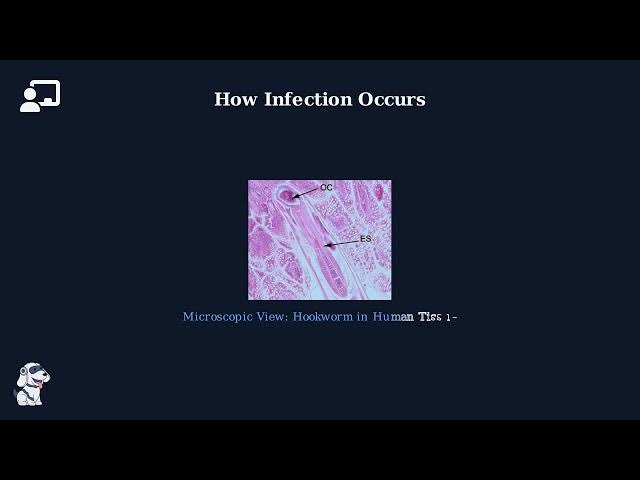
This microscopic image shows what a
8:54
hookworm looks like once it has
8:55
established itself in human tissue. You
8:58
can see the worm's distinctive oral
9:00
cavity and esophagus structure embedded
9:02
within the tissue.
9:05
Remember these key points about hookworm
9:07
infection.
9:08
Skin penetration through bare feet is
9:10
the main risk. Larve can enter without
9:13
you feeling anything. And regardless of
9:15
how they enter, they all end up in your
9:18
small intestine where they cause the
9:19
most damage. Now we need to understand
9:22
what makes ancelos douadel so harmful to
9:25
human health. The pathogenicity of this
9:28
hookworm stems from its feeding behavior
9:30
and the cascading health effects it
9:32
creates.
9:34
The primary way hookworms cause harm is
9:36
through their feeding behavior. Adult
9:39
hookworms attach to the intestinal wall
9:41
using their specialized mouth parts with
9:43
teeth, and they feed directly on the
9:46
host's blood. The constant blood feeding
9:49
leads to iron deficiency anemia, which
9:51
is the most significant health impact of
9:54
hookworm infection. As you can see in
9:56
this blood smear, the red blood cells
9:59
become abnormally shaped and reduced in
10:01
number.
10:03
Beyond iron loss, hookworms cause
10:05
significant protein malnutrition. The
10:07
host loses red blood cells and plasma
10:09
proteins leading to malabsorption and a
10:12
weakened immune system. The impact on
10:15
children is particularly devastating.
10:17
Heavy hookworm infections can lead to
10:19
heart failure, quashior, as shown in
10:21
this image, and significant delays in
10:24
mental, physical, and sexual
10:26
development.
10:28
Understanding the pathogenicity of
10:29
hookworms helps us appreciate why
10:32
prevention and treatment are so
10:34
critical. The cascade of health effects
10:36
from simple blood feeding can have
10:38
profound lifealtering consequences,
10:41
especially for children in affected
10:43
communities.
10:45
Iron deficiency anemia is one of the
10:47
most serious consequences of hookworm
10:49
infection. Understanding how these
10:52
parasites cause this condition is
10:54
crucial for recognizing the health
10:55
impact of ancillosoma douadinol.
10:58
Adult hookworms live in the small
11:00
intestine where they attach firmly to
11:02
the intestinal wall. Using their
11:04
specialized teeth, they create wounds
11:07
and continuously feed on the host's
11:09
blood. The hookworm uses its buckle
11:12
cavity with cutting teeth to create a
11:15
wound in the intestinal wall. It then
11:17
feeds continuously on blood from the
11:19
damaged tissue and blood vessels. Each
11:23
adult hookworm consumes approximately
11:25
0.2 to 0.3 milll of blood daily. This
11:29
blood contains iron which is essential
11:32
for oxygen transport in red blood cells.
11:34
When hookworms feed, this iron is
11:36
permanently lost from the host's body.
11:39
Here we can see the dramatic difference
11:41
between normal blood and blood affected
11:43
by iron deficiency anemia. The anemic
11:46
blood has significantly fewer red blood
11:48
cells, which means less oxygen can be
11:50
transported throughout the body.
11:54
Iron deficiency anemia from hookworm
11:56
infection particularly affects women of
11:59
reproductive age and children. Women
12:02
need additional iron due to
12:03
menstruation. While children require
12:05
iron for proper growth and development,
12:08
studies show that hookworm infections
12:10
account for 30 to 54% of moderate to
12:13
severe anemia cases among women in
12:15
Africa and Asia. To summarize, hookworms
12:19
cause iron deficiency anemia through
12:21
continuous blood feeding with each worm
12:23
consuming up to 0.3 milliliters of blood
12:26
daily. This iron loss reduces red blood
12:29
cell production, particularly affecting
12:32
women and children who have higher iron
12:33
requirements. In some regions, hookworm
12:36
infections are responsible for over half
12:38
of all anemia cases. Hookworm infection
12:41
symptoms can range dramatically from
12:43
barely noticeable to life-threatening
12:46
depending on how many worms are present
12:48
in the body and how long the infection
12:51
has persisted.
12:53
In mild infections with just a few
12:55
worms, people might experience only
12:57
minor symptoms. These include slight
12:59
abdominal discomfort, itching at the
13:01
site where larve first penetrated the
13:03
skin, and occasional digestive upset.
13:07
Severe infections with many worms cause
13:09
much more serious symptoms. The
13:11
hookworms attach to the intestinal wall
13:13
and feed on blood, leading to iron
13:16
deficiency anemia. This causes extreme
13:18
fatigue, weakness, pale skin, shortness
13:21
of breath, and rapid heartbeat. Children
13:24
are particularly vulnerable to hookworm
13:26
infection. The chronic blood loss and
13:28
malnutrition can severely impact their
13:31
development, causing stunted growth,
13:33
delayed cognitive development, learning
13:36
difficulties, and behavioral changes.
13:39
This is especially concerning because
13:40
children's growing bodies need adequate
13:43
iron and nutrients. Remember these key
13:46
points about hookworm symptoms. They can
13:48
range from barely noticeable to
13:50
life-threatening. Severe cases cause
13:52
dangerous anemia. Children face
13:54
additional developmental risks. And
13:56
early detection with proper treatment
13:58
can prevent serious complications.
14:02
Detecting hookworm infections requires
14:04
several diagnostic approaches. As your
14:07
friendly guide through medical
14:08
diagnostics, I'll show you the main
14:10
methods doctors use to identify
14:12
ancillostoma datadinale infections.
14:16
The primary diagnostic method is direct
14:18
microscopic examination of feces.
14:21
Doctors collect a stool sample and
14:23
examine it under a microscope to look
14:25
for characteristic hookworm eggs which
14:28
are ovalshaped and measure about 60
14:30
micrometers by 40 microme.
14:33
Blood tests provide important supporting
14:35
evidence. They can reveal iron
14:37
deficiency anemia, which occurs because
14:40
hookworms feed on blood in the
14:42
intestines. Blood tests also show
14:44
eocinophilia, an increase in
14:46
eocinophils, which are white blood cells
14:48
that respond to parasitic infections.
14:52
Advanced diagnostic methods include
14:54
real-time PCR, which is increasingly
14:57
recognized in research for accurate
14:59
species identification. Immunological
15:02
assays can also detect specific
15:03
antibodies or antigens related to
15:06
hookworm infection. These modern
15:08
techniques provide more precise
15:10
diagnosis than traditional methods.
15:13
Remember these key diagnostic points.
15:15
Microscopic examination of feces remains
15:17
the primary detection method. Blood
15:20
tests reveal important signs like anemia
15:22
and increased white blood cells. And
15:24
modern techniques like PCR provide the
15:27
most accurate species identification.
15:29
Using multiple diagnostic approaches
15:31
ensures the most reliable results.
15:35
The most common method for diagnosing
15:37
hookworm infection is microscopic
15:39
examination of feces. This
15:41
straightforward technique involves
15:43
examining a stool sample under a
15:45
microscope to identify the
15:46
characteristic eggs of ancillosoma
15:48
douadin.
15:50
Under the microscope, technicians look
15:52
for the distinctive oval-shaped eggs
15:55
that are characteristic of hookworm
15:56
infections. These eggs have specific
15:59
features that help identify them. Here
16:02
we can see a typical hookworm egg under
16:04
microscopic examination. Notice the
16:06
characteristic oval shape with a clear
16:08
outer shell and granular interior. These
16:11
eggs measure approximately 60
16:13
micrometers by 40 microme.
16:16
However, identifying these eggs requires
16:19
considerable expertise. Technicians must
16:22
be able to differentiate hookworm eggs
16:24
from those of other parasites that may
16:26
be present in the same sample. This
16:28
image shows a more complex sample
16:30
containing various cellular structures
16:32
and debris. You can see different types
16:35
of eggs and particles, demonstrating why
16:37
expert knowledge is essential for
16:39
accurate identification. While
16:41
microscopic examination is the most
16:43
widely used diagnostic method, it does
16:46
have important limitations that medical
16:48
professionals must consider. The main
16:51
limitations include reduced sensitivity
16:53
in cases of light infection where fewer
16:55
eggs are present. It also requires
16:58
skilled technicians who can accurately
17:00
differentiate between different parasite
17:02
species. Additionally, the method may
17:05
miss eggs if the sample size is too
17:07
small or if the examination is not
17:09
thorough enough. Despite these
17:11
limitations, microscopic examination
17:14
remains the primary diagnostic tool for
17:16
hookworm detection due to its
17:18
accessibility and cost effectiveness,
17:20
especially in resource limited settings
17:22
where hookworm infections are most
17:24
common.
17:26
When someone is infected with hookworms,
17:28
doctors have several effective treatment
17:30
options available. The primary weapons
17:33
against these parasites are anthalic
17:36
drugs, medications specifically designed
17:38
to eliminate worm infections. There are
17:41
three main anthalic drugs used to treat
17:43
hookworm infections. First is alendazol
17:46
given as a single 400 mgram dose. Second
17:49
is meendazole taken as 100 mg twice
17:52
daily for 3 days. Third is pyel pamoate
17:56
given as a single dose of 11 mg per
17:59
kilogram of body weight. These
18:01
medications work by paralyzing and
18:03
killing the hookworms in the intestine.
18:06
The drugs interfere with the worm's
18:08
nervous system and cellular processes,
18:10
making it impossible for them to survive
18:12
and reproduce. Let me show you more
18:14
details about one of these medications.
18:17
Purel pamoate is particularly effective
18:19
against hookworms and several other
18:21
intestinal parasites. This slide shows
18:24
detailed information about Pyel Pamo. As
18:27
you can see, it's effective against
18:29
hookworms, pinw worms, and round worms.
18:31
The medication targets the neuromuscular
18:34
system of these parasites, causing
18:36
paralysis and eventual elimination from
18:38
the body. The effectiveness of these
18:40
drugs comes from their specific
18:42
molecular structure. Here's what an
18:44
anthemic drug molecule looks like at the
18:47
atomic level.
18:49
It's absolutely crucial to follow the
18:51
prescribed dosage and complete the full
18:53
course of treatment. Taking the
18:55
medication exactly as directed ensures
18:58
that all worms are eliminated and
19:00
prevents the development of drug
19:01
resistance. Remember these anthic drugs
19:05
are highly effective when used properly.
19:08
The key to successful treatment is
19:09
patient compliance. Taking the
19:11
medication as prescribed and completing
19:14
the entire course, even if symptoms
19:16
improve before finishing the treatment.
19:19
When hookworm infection causes anemia
19:21
through blood loss, iron supplementation
19:24
becomes a critical part of treatment.
19:26
Iron supplements help restore the body's
19:28
iron stores and alleviate anemia
19:30
symptoms. First, let's understand what
19:33
symptoms iron supplementation helps
19:35
treat. Anemia from hookworm infection
19:38
causes several debilitating symptoms
19:40
that significantly impact quality of
19:42
life. Iron supplements work by providing
19:45
the body with readily available iron
19:47
that can be absorbed in the small
19:49
intestine. Let's see how this absorption
19:52
process works at the cellular level.
19:54
Iron supplements come in various forms
19:57
with slowrelease formulations being
19:59
particularly effective. These
20:01
supplements are designed to minimize
20:03
stomach upset while maximizing iron
20:06
absorption. The appropriate dosage and
20:08
duration of iron supplementation depends
20:10
on several factors. Your doctor will
20:12
consider the severity of anemia, your
20:15
body weight, and other individual health
20:17
factors. With proper iron
20:18
supplementation, the blood gradually
20:20
returns to normal. This comparison shows
20:23
the difference between anemic blood with
20:25
fewer red blood cells and healthy blood
20:28
with normal red blood cell density.
20:30
While supplements are the primary
20:32
treatment, iron rich foods can provide
20:34
additional support. Combining
20:36
supplements with dietary sources helps
20:39
optimize iron absorption and overall
20:41
recovery. Here are the key takeaways
20:43
about iron supplementation for hookworm
20:45
related anemia. Remember, medical
20:48
supervision is essential for safe and
20:50
effective treatment. Always consult with
20:53
your health care provider before
20:54
starting iron supplementation.
20:57
They will create a personalized
20:59
treatment plan based on your specific
21:01
needs and monitor your progress
21:03
throughout recovery. Prevention is
21:05
always better than cure when it comes to
21:07
hookworm infections. Today we'll explore
21:10
the three main pillars of prevention
21:13
that can protect communities from
21:15
ancillostoma datadil. Effective hookworm
21:18
prevention relies on three essential
21:20
pillars. First, proper sanitation
21:23
ensures human waste is safely disposed
21:25
of. Second, protective footwear prevents
21:28
larve from entering through bare skin.
21:31
Third, public health education teaches
21:33
communities about prevention methods.
21:35
Proper sanitation is the foundation of
21:37
hookworm prevention. This includes safe
21:40
waste disposal systems, access to clean
21:42
water, proper sewage treatment, and
21:44
community latrines. When human waste is
21:47
properly managed, hookworm eggs cannot
21:50
contaminate the soil where people live
21:52
and work. Protective footwear is crucial
21:55
because hookworm larae enter the body
21:57
through bare skin, especially the feet.
22:00
Simply wearing shoes when walking
22:02
outdoors can prevent most infections.
22:05
This is particularly important in areas
22:07
where human waste may contaminate the
22:09
soil. Personal hygiene, especially
22:12
proper handashing, is essential for
22:14
preventing hookworm transmission.
22:16
Regular handashing with soap removes any
22:19
larve that might be present and prevents
22:21
accidental ingestion. This simple
22:24
practice can significantly reduce
22:26
infection risk. Communitywide prevention
22:29
is most effective when it combines
22:31
improved living conditions, health
22:33
education programs, community
22:35
cooperation, and regular health
22:37
monitoring. When entire communities work
22:40
together to implement these prevention
22:42
strategies, hookworm transmission can be
22:45
dramatically reduced. Remember, these
22:48
simple prevention measures, proper
22:49
sanitation, protective footwear, and
22:52
good hygiene are highly effective at
22:54
stopping hookworm infections before they
22:56
start.
22:57
Prevention truly is better than cure.
23:00
One of the simplest yet most effective
23:02
ways to prevent hookworm infection is
23:04
wearing protective footwear. Let's
23:07
explore why shoes are so important in
23:09
breaking the cycle of infection.
23:11
Hookworm larve live in contaminated
23:13
soil, especially in warm, moist
23:16
environments. These microscopic
23:17
parasites actively seek out human skin
23:20
contact and can penetrate through bare
23:22
feet in just seconds.
23:25
When bare skin comes into contact with
23:27
contaminated soil, hookworm larve can
23:29
penetrate through the skin within
23:31
minutes. They use specialized enzymes to
23:34
break through the skin barrier and enter
23:36
the bloodstream.
23:38
Shoes create a simple but effective
23:40
physical barrier between your skin and
23:43
contaminated soil. The sole of the shoe
23:45
prevents larve from making direct
23:47
contact with your feet, completely
23:49
blocking their ability to penetrate your
23:51
skin.
23:53
Children are particularly vulnerable to
23:55
hookworm infection because they spend
23:57
more time playing outdoors and often go
24:00
barefoot. Infections in children can be
24:03
especially serious, affecting their
24:05
growth, development, and ability to
24:07
learn.
24:08
Different types of footwear offer
24:10
varying levels of protection. Closed
24:13
shoes and boots provide the best
24:14
protection, while even basic sandals
24:16
with thick soles offer significant
24:18
protection compared to going barefoot.
24:21
The key message is that any footwear is
24:24
better than none.
24:26
Remember these key takeaways. Shoes
24:28
create a physical barrier against
24:30
hookworm larve. They're essential
24:32
protection in areas where hookworm is
24:35
common. They're particularly important
24:37
for children and they represent a simple
24:40
cost-effective prevention method.
24:42
Prevention is always better than
24:44
treatment. Public health education is
24:46
the cornerstone of preventing hookworm
24:48
infections in communities worldwide.
24:51
When people understand the risks and
24:53
know how to protect themselves,
24:55
infection rates drop dramatically.
24:58
Education empowers communities to take
25:00
control of their health. When people
25:02
understand how hookworms spread and what
25:04
they can do to prevent infection, they
25:07
become active participants in protecting
25:09
their families and neighbors.
25:12
Effective public health campaigns focus
25:14
on three critical practices that can
25:17
dramatically reduce hookworm
25:19
transmission in communities. First,
25:22
proper handwashing technique. This
25:24
seven-step process removes hookworm eggs
25:27
and larve that might be on contaminated
25:29
hands, preventing oral transmission of
25:31
the parasite. Second, proper waste
25:34
disposal prevents hookworm eggs from
25:36
contaminating soil where people walk
25:38
barefoot. This breaks the transmission
25:41
cycle at its source. Third, wearing
25:44
protective footwear creates a physical
25:47
barrier that prevents hookworm larae
25:49
from penetrating through the skin of the
25:51
feet, which is the most common route of
25:53
infection. Public health education works
25:56
through multiple channels. School
25:59
programs teach children proper hygiene,
26:01
who then share this knowledge with their
26:03
families. Community health workers
26:05
provide door-to-door education and
26:08
distribute prevention materials.
26:10
The impact of public health education is
26:13
remarkable. Communities that receive
26:15
comprehensive education programs see
26:17
infection rates drop by 60 to 80%. This
26:21
dramatic improvement comes from
26:22
sustained behavior change across entire
26:25
populations.
26:27
Public health education is one of our
26:29
most powerful tools against hookworm
26:31
infection. When communities understand
26:34
the risks and know how to protect
26:36
themselves, they become partners in
26:38
prevention, creating healthier futures
26:41
for everyone.
26:43
Drug resistance is becoming a serious
26:45
challenge in treating hookworm
26:47
infections. When we repeatedly use the
26:50
same medications, some hookworms develop
26:52
the ability to survive these treatments,
26:55
making them much harder to eliminate.
26:58
To understand drug resistance, we first
27:00
need to see how antholmentic drugs
27:02
normally work. Benzyazole drugs like
27:04
alendazole and meendazole target
27:07
specific proteins in the hookworm,
27:09
disrupting their cellular functions.
27:12
Drug resistance occurs when hookworms
27:14
develop genetic changes that allow them
27:16
to survive drug treatment. This happens
27:19
through natural selection. The worms
27:21
that can resist the drugs survive and
27:23
reproduce, passing on their resistance
27:26
genes.
27:28
Scientists can measure drug resistance
27:30
by testing how much medication is needed
27:32
to kill different hookworm strains.
27:35
This graph shows a clear difference.
27:37
Resistant strains need much higher drug
27:39
concentrations to achieve the same level
27:41
of control.
27:44
Drug resistance has serious consequences
27:46
for public health. Treatment failures
27:49
become more common, infections persist
27:51
longer, and patients continue to suffer
27:54
from anemia and malnutrition. This is
27:56
especially concerning in areas where
27:58
hookworm infections are already
28:00
widespread.
28:02
Drug resistance highlights the urgent
28:04
need for new treatment strategies.
28:07
Researchers are developing new
28:08
medications, combination therapies, and
28:11
prevention methods like vaccines. We
28:13
must also use current drugs more
28:15
carefully to slow the development of
28:17
resistance. Current hookworm treatments
28:20
face a major challenge. While
28:22
antholmentic drugs can eliminate
28:24
existing infections, they don't provide
28:26
lasting protection. In endemic areas,
28:29
people often get reinfected shortly
28:31
after treatment, creating an endless
28:33
cycle. This is where vaccine development
28:36
becomes crucial. Researchers worldwide
28:38
are working on creating hookworm
28:40
vaccines that could provide long-asting
28:42
immunity and break this cycle of
28:44
reinfection.
28:46
The goal of hookworm vaccine development
28:48
is to create long-asting immunity.
28:51
Unlike current treatments that only
28:52
address existing infections, a vaccine
28:55
would train the immune system to
28:57
recognize and fight off hookworm larae
28:59
before they can establish infection.
29:02
This is especially important in endemic
29:04
regions where hookworm infections are
29:06
most common.
29:08
Let's look at where these vaccines would
29:10
have the greatest impact. Vaccine
29:12
research is progressing on multiple
29:14
fronts. Scientists are studying
29:17
different approaches from targeting
29:19
specific hookworm proteins to developing
29:22
vaccines that prevent laral development.
29:24
A successful hookworm vaccine could be a
29:26
true gamecher. It would provide
29:29
long-term protection, reduce the need
29:31
for repeated treatments, and
29:33
significantly improve health outcomes in
29:35
affected communities. While hookworm
29:38
vaccines are still in development, the
29:40
research shows promising results. The
29:43
future of hookworm prevention lies in
29:45
combining traditional control methods
29:47
with innovative vaccine technology to
29:49
create comprehensive longlasting
29:52
protection. The most effective way to
29:54
control hookworm infections isn't just
29:56
treating people who are already sick or
29:59
just improving sanitation. It's
30:01
combining both approaches into what we
30:04
call integrated control programs. Think
30:06
of integrated control programs as having
30:09
two strong pillars working together. The
30:12
first pillar is mass drug administration
30:14
which treats existing infections. The
30:17
second pillar is wash programs which
30:19
prevent new infections. Mass drug
30:21
administration involves giving
30:23
antholmentic medications to entire
30:25
communities not just people showing
30:27
symptoms. This treats current infections
30:31
and provides immediate relief from the
30:33
parasite burden. Wash programs focus on
30:35
water sanitation and hygiene
30:37
improvements. They build proper toilets,
30:40
provide clean water access, and educate
30:42
communities about hygiene practices to
30:45
prevent future infections.
30:47
Here's why combining both approaches is
30:49
so much more effective. Drug treatment
30:52
alone means people often get reinfected
30:54
because the environmental conditions
30:56
haven't changed.
30:58
Wash programs alone take time to show
31:01
results while people continue suffering
31:02
from existing infections. But when we
31:05
combine both strategies, we get
31:07
immediate relief from current infections
31:09
while simultaneously creating conditions
31:12
that prevent future infections. This
31:14
creates a powerful cycle of health
31:16
improvement. In practice, integrated
31:19
control programs follow a systematic
31:22
approach. They start with assessing
31:24
community needs, then simultaneously
31:26
implement drug treatment and
31:28
infrastructure improvements, followed by
31:30
ongoing education and monitoring.
31:34
The key takeaway is that fighting
31:35
hookworm infections requires a
31:37
comprehensive strategy. Mass drug
31:40
administration treats the immediate
31:42
problem while wash programs address the
31:44
root causes. Together they create
31:46
sustainable long-term health
31:48
improvements for entire communities.
31:51
Traditional hookworm diagnosis relies on
31:53
microscopic examination of stool
31:55
samples. But this method has
31:56
limitations. Modern molecular
31:59
diagnostics, particularly real time PCR,
32:02
are revolutionizing how we detect and
32:04
analyze hookworm infections. Realtime
32:07
PCR, also called quantitative PCR or
32:09
qPCR, is a molecular technique that
32:12
amplifies specific DNA sequences while
32:14
monitoring the process in real time.
32:16
This method is highly sensitive and can
32:18
detect even small amounts of parasite
32:20
DNA in patient samples. The PCR process
32:24
involves three main steps repeated in
32:26
cycles. Dennaturation to separate DNA
32:29
strands, annealing where primers attach
32:31
to target sequences, and extension where
32:33
new DNA is synthesized. Each cycle
32:36
doubles the amount of target DNA. Unlike
32:39
traditional PCR, real-time PCR monitors
32:41
DNA amplification as it happens. The
32:44
amplification curve shows fluoresence
32:46
increasing with each cycle. Samples that
32:49
cross the threshold line are considered
32:51
positive while those below remain
32:53
undetected.
32:55
Realtime PCR offers significant
32:57
advantages over traditional microscopy.
33:00
While microscopy cannot distinguish
33:01
between hookworm species and relies on
33:04
subjective egg counting, PCR provides
33:07
species specific identification and
33:09
precise quantification of infection
33:11
intensity.
33:12
One of the most important advantages of
33:14
real-time PCR is its ability to identify
33:17
specific hookworm species. This is
33:20
crucial because different species may
33:22
require different treatment approaches
33:25
and have varying clinical significance.
33:28
Realtime PCR enables precise
33:30
quantification of infection intensity,
33:32
helping clinicians determine the
33:34
severity of infection and make informed
33:36
treatment decisions. It also supports
33:39
research efforts in epidemiology, drug
33:42
resistance monitoring, and vaccine
33:44
development.
33:45
Molecular diagnostics, particularly
33:48
real-time PCR, represent the future of
33:50
hookworm diagnosis. These advanced tools
33:53
provide the precision and sensitivity
33:55
needed for effective disease management
33:57
and control programs. While ancillostoma
34:00
datadil primarily infects humans, we
34:03
need to understand that the hookworm
34:05
family includes other species that can
34:07
affect both animals and humans. This
34:10
creates important considerations for
34:11
public health. Ancelostoma duadnail has
34:14
evolved specifically to infect humans.
34:17
This species is perfectly adapted to our
34:19
intestinal environment and completes its
34:22
entire life cycle within the human host.
34:25
However, other ancillos species have
34:27
different host preferences. Ancelostoum
34:30
primarily infects dogs while
34:31
ancillastoanum
34:33
commonly infects cats and other animals.
34:36
The important consideration is that some
34:38
of these animal hookworm species can
34:40
also infect humans. This is called
34:42
zooonautic transmission. When diseases
34:45
jump from animals to humans,
34:47
ancillosanicum
34:48
in particular can successfully infect
34:50
humans and complete its life cycle in
34:53
our intestines. This creates a bridge
34:55
between animal and human health
34:57
concerns. This interconnection between
35:00
human and animal health leads us to an
35:02
important concept called the onehealth
35:04
approach. The onealth approach
35:06
recognizes that human health, animal
35:08
health, and environmental health are
35:10
interconnected.
35:12
Effective hookworm control must consider
35:14
all three aspects working together. Let
35:17
me share the key takeaways from
35:18
understanding zunotic transmission in
35:20
hookworm infections.
35:23
First, while aduadinel primarily infects
35:25
humans, other ancillos species infect
35:28
animals. Some of these animal species
35:31
can transmit to humans, making the
35:33
onehealth approach essential for
35:34
effective control by considering both
35:36
human and animal health together.
35:39
Understanding zooonautic transmission
35:41
helps public health officials develop
35:43
more comprehensive prevention strategies
35:45
that protect both human and animal
35:48
populations from hookworm infections.
35:51
Hookworm infections don't just affect
35:53
physical health. They have profound
35:55
impacts on children's cognitive
35:57
development and educational success.
36:00
Understanding this connection is crucial
36:02
for addressing the full scope of this
36:04
parasitic disease. The primary way
36:07
hookworms affect cognitive development
36:09
is through chronic iron deficiency
36:11
anemia. When children don't have enough
36:14
healthy red blood cells, their brains
36:16
don't receive adequate oxygen and
36:18
nutrients needed for proper development.
36:20
Children with hookworm induced anemia
36:23
experience a range of symptoms that
36:25
directly impact their ability to learn
36:27
and develop. These include fatigue,
36:29
difficulty concentrating, and behavioral
36:32
problems that interfere with educational
36:34
progress.
36:35
Research shows that children with
36:37
hookworm infections perform
36:39
significantly worse in school. They have
36:42
trouble concentrating in class, miss
36:44
more school days due to illness, and
36:46
struggle with memory and problem-solving
36:49
tasks. The cognitive impacts extend far
36:51
beyond childhood. Children who suffer
36:54
from chronic hookworm infections may
36:56
experience permanent developmental
36:57
delays, reduced educational attainment,
37:00
and limited economic opportunities
37:02
throughout their lives. This is why
37:05
treating hookworm infections is not just
37:07
a health issue. It's an educational and
37:10
economic imperative. By addressing these
37:12
parasitic infections early, we can
37:15
protect children's cognitive development
37:17
and give them the best chance for
37:19
educational success and future
37:21
prosperity. As we conclude our
37:23
comprehensive study of ancillastoma
37:25
douadinale, let's review the most
37:27
important points that every health care
37:30
professional and student should remember
37:32
about this significant parasitic threat.
37:35
First and most importantly, ancillostoma
37:37
duadnel represents a massive global
37:40
health challenge. With up to 740 million
37:43
people infected worldwide, this hookworm
37:45
causes the loss of over 4 million
37:47
disability adjusted life years annually,
37:50
making it one of the most significant
37:52
neglected tropical diseases.
37:54
Understanding the complete life cycle is
37:56
crucial for effective prevention and
37:58
control. The hookworm's journey from egg
38:01
in contaminated soil to adult parasite
38:04
in the human intestine reveals multiple
38:06
intervention points where we can break
38:08
the transmission cycle.
38:10
The health consequences extend far
38:12
beyond simple intestinal infection. Iron
38:15
deficiency anemia affects up to 54% of
38:18
women in endemic areas while children
38:20
face developmental delays, cognitive
38:22
impairment, and in severe cases, heart
38:24
failure or quashiorore.
38:27
Effective prevention requires a
38:29
multi-pronged approach. Improved
38:31
sanitation and hygiene infrastructure
38:33
combined with protective footwear and
38:36
public health education can dramatically
38:38
reduce transmission rates in endemic
38:40
communities. The future holds promise
38:43
with ongoing vaccine development,
38:45
improved molecular diagnostics, and
38:47
integrated control programs. However,
38:50
emerging drug resistance reminds us that
38:52
continued research and innovation are
38:55
essential for long-term success. In
38:57
summary, ancelostoma duadinel remains a
39:00
significant global health challenge. But
39:03
through understanding its biology,
39:05
implementing comprehensive prevention
39:07
strategies, and continuing research
39:09
efforts, we can work toward a future
39:11
where hookworm infections no longer
39:14
threaten human health and development.
39:17
Thank you for joining us in this
39:18
educational journey.
#Infectious Diseases
#Public Health