Up next in 10

Parasitic Vertebrates - Adaptations for Survival
Website: https://biologynotesonline.com/
Facebook: https://www.facebook.com/biologynotesonline
Instagram: https://www.instagram.com/biologynotesonline/?hl=en
Show More Show Less View Video Transcript
0:00
Hey everyone, welcome to an incredible
0:02
journey into the fascinating world of
0:05
parasitic vertebrates. These are some of
0:07
nature's most remarkable creatures, and
0:10
today we're going to discover just how
0:12
amazing they really are. Parasitic
0:15
vertebrates are animals with backbones
0:17
that have evolved to depend on other
0:19
organisms for survival. Unlike predators
0:22
that kill their prey, these creatures
0:24
obtain nutrients directly from living
0:26
hosts. They've developed incredible
0:29
adaptations that allow them to thrive in
0:31
this unique lifestyle.
0:34
Today, we'll explore four incredible
0:36
examples of parasitic vertebrates, each
0:38
with their own unique strategies and
0:40
adaptations. First, we have the cookie
0:43
cutter shark, a small but mighty ocean
0:45
predator that takes perfectly round
0:47
bites from much larger marine animals,
0:50
leaving distinctive cookie cutter-shaped
0:51
wounds. Next is the canderoo, a tiny
0:55
Amazonian catfish with a fearsome
0:57
reputation. This translucent parasite
1:00
feeds on the blood of other fish by
1:01
entering their gill chambers. Our third
1:04
example is the hood mocking bird from
1:06
the Gapagos Islands. This opportunistic
1:09
bird has learned to drink blood from
1:11
wounds of injured seabirds and sea
1:13
lions.
1:15
Finally, we have the vampire bat.
1:17
Perhaps the most famous bloodfeeding
1:19
vertebrate. These remarkable mammals
1:21
have evolved specialized adaptations to
1:24
feed exclusively on blood.
1:27
Each of these creatures has evolved
1:29
remarkable adaptations that allow them
1:31
to thrive as parasites. From specialized
1:33
feeding structures to unique behaviors,
1:36
we'll discover how they've mastered the
1:38
art of living off other organisms.
1:42
Get ready to discover incredible feeding
1:44
strategies, learn about amazing physical
1:47
adaptations, understand their ecological
1:50
importance, and appreciate the
1:51
incredible diversity of life on our
1:54
planet. This journey will change how you
1:56
see these remarkable creatures forever.
1:59
Let's start by understanding what
2:00
parasetism actually means. Parasetism is
2:04
a biological relationship where one
2:06
organism called the parasite benefits by
2:08
living on or in another organism called
2:10
the host. while causing harm to that
2:12
host. To better understand parasetism,
2:16
let's look at how it differs from other
2:17
biological relationships.
2:20
This flowchart shows three main types of
2:22
relationships between organisms. In
2:24
mutualism, both organisms benefit from
2:26
each other. In commensalism, one
2:29
benefits while the other is neither
2:30
helped nor harmed. But in parasetism,
2:33
the parasite always benefits while the
2:35
host is harmed.
2:37
Here's a helpful way to think about it.
2:39
Parasetism is like borrowing something
2:41
from a friend without asking, never
2:44
returning it, and maybe breaking it a
2:46
little in the process. The parasite gets
2:48
what it needs, but the host pays the
2:51
price.
2:53
Unlike predators that hunt and kill
2:54
their prey, parasites usually keep their
2:57
hosts alive. After all, a dead host
3:00
can't provide ongoing resources. This
3:03
microscopic view shows parasites living
3:05
inside a blood vessel taking what they
3:07
need while the host continues to live.
3:10
The key difference is that parasites
3:12
need their hosts to survive. They've
3:15
evolved to take just enough to benefit
3:17
themselves without killing their host.
3:20
It's a delicate balance that has
3:22
developed over millions of years of
3:23
evolution.
3:25
Understanding parasetism helps us
3:27
appreciate the complex relationships in
3:29
nature. From tiny organisms in our blood
3:33
to larger creatures that attach to
3:35
marine animals, parasites have found
3:37
countless ways to make a living at
3:39
someone else's expense. Meet the cookie
3:41
cutter shark. One of nature's most
3:43
unusual parasites. This small but
3:46
remarkable predator has developed a
3:48
feeding strategy unlike any other shark
3:50
in the ocean.
3:52
The cookie cutter shark is surprisingly
3:54
small, measuring only 42 to 56 cm in
3:58
length. That's about the size of your
4:01
forearm, much smaller than the great
4:03
white sharks most people imagine.
4:06
Cookie cutter sharks live in the deep
4:08
tropical and subtropical waters of the
4:10
world's oceans. During the day, they
4:12
stay in the depths, but at night, they
4:14
migrate upward to hunt in shallower
4:17
waters.
4:18
The cookie cutter shark gets its name
4:20
from its unique feeding method. Just
4:22
like a cookie cutter tool removes
4:24
perfect circular pieces from dough, this
4:27
shark removes round plugs of flesh from
4:29
its prey.
4:32
In the wild, cookie cutter sharks attach
4:34
themselves to larger animals like
4:36
whales, dolphins, and large fish. They
4:39
use their specialized mouth to create a
4:41
suction seal, then twist their body to
4:44
carve out a perfect circular plug of
4:46
flesh.
4:47
The cookie cutter shark proves that size
4:50
doesn't always matter in nature. This
4:53
small predator has evolved a highly
4:55
specialized feeding strategy that allows
4:57
it to take advantage of much larger
4:59
prey, leaving its distinctive circular
5:02
calling card throughout the ocean.
5:06
The cookie cutter shark has evolved
5:08
remarkable physical adaptations that
5:10
make it a highly effective parasite.
5:12
Let's explore these fascinating features
5:15
that allow this small shark to feed on
5:17
much larger prey. The first key
5:19
adaptation is bioluminescence. The
5:22
cookie cutter shark's underside glows
5:24
with a blue green light, except for a
5:26
distinctive dark collar around its neck
5:28
area. This bioluminescence serves as
5:31
camouflage from below, but the dark
5:33
collar creates a silhouette that likely
5:35
attracts larger prey swimming above,
5:38
mistaking it for a small fish. The
5:40
cookie cutter shark's mouth is perfectly
5:42
designed for its parasitic lifestyle. It
5:45
has strong sctoral lips that work like a
5:48
suction cup to attach firmly to its
5:50
prey. The teeth arrangement is crucial.
5:52
The upper teeth are designed for
5:54
anchoring. They grip and hold onto the
5:56
prey. The lower teeth are razor sharp
5:59
and designed for slicing through flesh.
6:01
Here's how it works in practice. The
6:04
shark attaches its sectoral lips to the
6:06
prey, uses its upper teeth to anchor
6:08
firmly, then rotates its body while the
6:11
lower teeth carve out a perfect circular
6:13
chunk of flesh. The result is these
6:16
distinctive circular wounds like a
6:18
biological hole punch. This feeding
6:20
method allows the cookie cutter shark to
6:22
get nutrition without killing its prey,
6:25
making it a true parasite. These
6:27
remarkable adaptations, the
6:29
bioluminescent lure, powerful suction
6:32
lips, and specialized teeth arrangement
6:34
make the cookie cutter shark one of
6:36
nature's most efficient parasites,
6:38
perfectly evolved for its unique
6:40
lifestyle.
6:41
Cookie cutter sharks have fascinating
6:43
and complex feeding habits that go far
6:46
beyond their famous parasitic bites.
6:48
These remarkable predators are what
6:50
scientists call facultative
6:52
ectoparasites. Unlike obligate parasites
6:55
that must feed on hosts to survive,
6:57
cookie cutter sharks have a varied diet.
6:59
They don't just take bites from large
7:01
marine animals. They also actively hunt
7:04
smaller prey like squid and crustaceans.
7:07
Cookie cutter sharks exhibit remarkable
7:09
vertical migration behavior. During the
7:12
day, they stay in the deep, dark waters
7:14
of the ocean depths, but as night falls,
7:17
they migrate upward to shallower waters
7:19
where their prey is more abundant.
7:22
Recent scientific research has revealed
7:24
a fascinating connection between cookie
7:26
cutter shark attacks and lunar cycles.
7:30
Studies analyzing data from 1961 to 2023
7:34
found that these sharks are
7:35
significantly more active during
7:37
moonless nights when complete darkness
7:39
provides them with optimal hunting
7:41
conditions.
7:43
Understanding these feeding habits helps
7:45
us appreciate how cookie cutter sharks
7:47
have evolved as highly adaptable
7:49
predators. Their ability to switch
7:52
between parasitic and predatory feeding,
7:55
combined with their strategic migration
7:56
patterns and optimal timing makes them
7:59
remarkably successful in the ocean
8:01
ecosystem. Deep in the Amazon and
8:03
Oronokco River basins of South America
8:06
lives one of nature's most notorious
8:07
parasitic fish, the cander.
8:11
The canderoo is a small, slender catfish
8:14
that's almost completely translucent,
8:16
making it nearly invisible in the murky
8:18
waters of the Amazon. These tiny fish
8:20
range from just 2.5 to 17 cm in length.
8:25
The kangaroo is a hematophagus parasite,
8:28
meaning it feeds on blood. It primarily
8:30
targets the gills of larger fish using
8:32
chemical and visual cues to locate its
8:34
hosts. Once it finds a suitable fish, it
8:37
enters the gill chamber and uses short
8:39
spines on its gill covers to attach
8:42
itself.
8:43
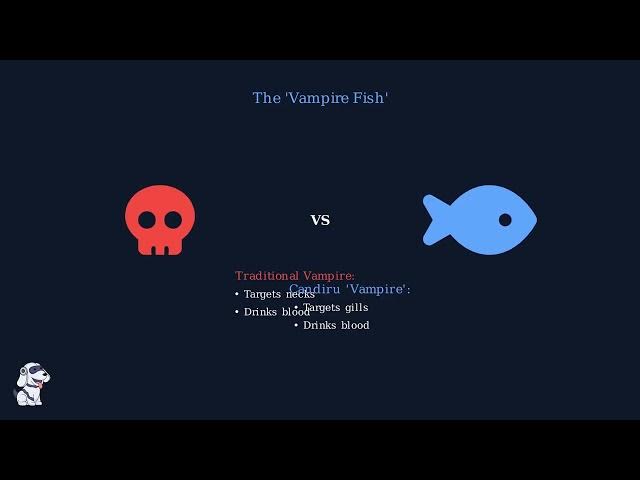
The candyoo has earned the nickname
8:45
vampire fish because like legendary
8:48
vampires that target necks, the candrew
8:50
targets gills, the breathing organs of
8:52
fish. Instead of going for necks, this
8:54
tiny parasite goes for gills, making it
8:57
a truly aquatic vampire. This remarkable
9:00
adaptation makes the kandar one of the
9:02
most specialized parasitic vertebrates
9:05
in the world, perfectly evolved for its
9:07
unique lifestyle in the Amazon's complex
9:09
aquatic ecosystem.
9:12
The cander's physical characteristics
9:15
make it one of nature's most elusive
9:17
parasites.
9:18
Understanding these features helps
9:20
explain how this tiny fish has become
9:22
such an effective bloodfeeding
9:24
specialist. Kandaroo are remarkably
9:26
small fish, typically ranging from just
9:28
2.5 to 17 cm in length. That's roughly
9:32
the size of your thumb to the length of
9:34
a pencil.
9:36
But size isn't their only advantage.
9:39
Kandaru have evolved a nearly
9:40
transparent translucent body that makes
9:43
them incredibly difficult to spot in the
9:45
murky waters of the Amazon.
9:48
Imagine trying to find a clear needle in
9:50
a muddy river. That's exactly how
9:52
difficult it is to spot a kandiru in its
9:55
natural habitat. This transparency is a
9:58
crucial survival adaptation.
10:00
The kangaroo's most important adaptation
10:02
for parasetism are the short sharp
10:04
spines located on their gill covers.
10:06
These spines act like tiny hooks,
10:09
allowing them to latch firmly onto their
10:11
host fish.
10:13
These three key physical
10:15
characteristics, small size, translucent
10:17
body, and gill spines, work together to
10:20
make the kangaroo a highly specialized
10:22
parasite perfectly adapted for its
10:24
unique lifestyle in Amazonian waters.
10:27
The kandiru has developed one of the
10:29
most sophisticated bloodfeeding
10:31
strategies in the animal kingdom. These
10:33
tiny fish are hematophagus, which means
10:36
they feed exclusively on blood from
10:38
other animals. The kangaroo's feeding
10:41
strategy involves four main steps.
10:44
First, they must locate a suitable host
10:46
fish using both chemical and visual cues
10:48
to detect potential blood sources. Once
10:50
a host is located, the kandiru enters
10:53
the gill chamber. This is a critical
10:55
moment. They must navigate into the
10:57
confined space where the gills are
10:59
located without being detected by the
11:01
host fish. Inside the gill chamber, the
11:04
kandrew attaches itself to either the
11:06
dorsal or vententral aorta arteries.
11:09
These are the main blood vessels that
11:11
supply the gills with oxygen rich blood.
11:14
Here's where the kandaroo's specialized
11:15
anatomy comes into play.
11:18
They use their needle-like teeth to make
11:20
a precise incision in the artery wall.
11:23
These teeth are perfectly designed for
11:25
this surgical precision. The genius of
11:27
this feeding strategy is that the cander
11:30
doesn't need to actively suck blood. The
11:33
host fish's own blood pressure pumps the
11:35
blood directly into the parasite's
11:37
digestive system. Talk about a free
11:39
meal. This feeding strategy makes the
11:42
candrew incredibly efficient. They can
11:44
obtain a blood meal with minimal energy
11:46
expenditure using the host's own
11:49
circulatory system as their feeding
11:51
mechanism. The kanderoo's feeding
11:53
strategy represents millions of years of
11:55
evolution, resulting in one of nature's
11:58
most efficient parasitic relationships.
12:01
This tiny fish has mastered the art of
12:03
obtaining nutrition with remarkable
12:05
precision and minimal effort. Now we
12:08
meet one of the most unusual birds in
12:10
the world, the hood mocking bird. This
12:13
fascinating creature lives only on
12:14
Espanola Island in the Galapagos
12:17
archipelago. The hood mockingb bird
12:19
looks like a typical bird at first
12:20
glance. It has modeled gray and brown
12:23
feathers, a long tail, and a distinctive
12:26
curved beak, perfect for various feeding
12:28
tasks. This bird is primarily an
12:30
omnivore, eating insects, fruits, seeds,
12:34
and small marine creatures. It's a
12:35
typical island bird making the most of
12:37
available food sources. But here's where
12:40
things get interesting and a bit
12:41
disturbing. The hood mocking bird has
12:44
developed some rather unusual
12:46
opportunistic feeding behaviors that set
12:48
it apart from other birds. This
12:50
seemingly innocent bird has a disturbing
12:53
side hustle. It drinks blood. The hood
12:55
mocking bird will opportunistically feed
12:58
on blood from wounds of injured
12:59
seabirds, sea lions, and marine iguanas.
13:02
Think of it this way. Imagine a regular
13:04
neighborhood bird that also works
13:06
part-time as a vampire. The hood mocking
13:08
bird is like nature's version of a bird
13:10
with a very unusual side job. This
13:13
opportunistic behavior helps the hood
13:15
mockingb bird survive on an isolated
13:18
island where food sources can be
13:19
limited. It's a perfect example of how
13:22
animals adapt to make the most of every
13:24
available opportunity. The hood mocking
13:27
bird has evolved remarkable physical and
13:29
behavioral adaptations that make it one
13:32
of nature's most versatile opportunists.
13:34
Let's examine the hood mockingb bird's
13:36
key features. Notice the long thin beak.
13:40
This isn't just for show. It's a
13:42
precision tool perfectly adapted for
13:44
their unique feeding behaviors.
13:47
This specialized beak serves multiple
13:49
functions. It can delicately tap into
13:52
seabird eggs to access the nutritious
13:54
contents inside.
13:56
And it's precise enough to drink blood
13:58
from the wounds of injured animals. Hood
14:01
mocking birds are incredibly
14:02
opportunistic. They've been observed
14:05
removing tissue from the tail tips of
14:07
marine iguanas, drinking blood from
14:09
wounded seabirds and sea lions. They
14:12
truly aren't picky eaters.
14:14
The hood mocking bird's success comes
14:16
from the perfect combination of
14:18
specialized physical features and highly
14:21
adaptable behavior. Their long, thin
14:23
beak paired with opportunistic feeding
14:26
strategies makes them incredibly
14:27
versatile survivors in their island
14:29
environment.
14:32
Hood mocking birds have evolved some of
14:34
the most unusual feeding habits among
14:36
birds. Living on the harsh, isolated
14:39
Espanola Island in the Galopagos, these
14:42
resourceful birds have learned to take
14:43
advantage of every available food
14:45
source, including blood.
14:48
One of their most remarkable behaviors
14:50
is drinking blood from wounds on living
14:53
sea lions. These large marine mammals
14:56
often have cuts and scrapes from
14:58
fighting or rough surfaces, and the
15:00
mocking birds have learned to take
15:01
advantage of these fresh wounds as a
15:04
proteinrich food source.
15:07
Another blood source comes from sea lion
15:09
births. When sea lion pups are born, the
15:12
mocking birds feed on the placental
15:14
material, which is extremely rich in
15:16
nutrients and blood. This opportunistic
15:19
behavior shows how these birds have
15:21
adapted to make use of every available
15:23
resource in their challenging
15:25
environment.
15:27
Hood mocking birds also target injured
15:29
seabirds, pecking at their wounds to
15:31
access blood. This behavior is
15:34
remarkably similar to that of vampire
15:36
finches found on other Galapagos
15:38
islands. The mocking birds use their
15:40
sharp beaks to carefully access blood
15:42
from cuts and injuries on other birds.
15:46
This unusual bloodfeeding behavior
15:48
evolved because life on Espanola Island
15:51
is incredibly challenging. The island
15:53
has limited freshwater, scarce
15:55
traditional food sources, and extreme
15:57
weather conditions. In such a harsh,
15:59
isolated ecosystem, hood mocking birds
16:02
had to become extremely opportunistic to
16:04
survive, leading them to exploit every
16:07
available nutrient source, including
16:09
blood.
16:10
The key takeaway is that hood mockingb
16:12
birds demonstrate remarkable
16:14
evolutionary adaptability by developing
16:17
blood feeding behaviors. They found a
16:19
way to access vital protein and
16:21
nutrients that help them survive in one
16:23
of nature's most challenging
16:25
environments. This shows how species can
16:28
evolve unexpected solutions when faced
16:30
with extreme survival pressures.
16:34
Finally, we arrive at the vampire bat,
16:36
the most famous bloodfeeding vertebrate
16:38
of all. These remarkable mammals have
16:41
captured human imagination for centuries
16:43
and represent the ultimate
16:45
specialization in blood consumption.
16:48
Unlike the other bloodfeeding
16:49
vertebrates we've explored, vampire bats
16:52
are true specialists. They feed
16:54
exclusively on blood. It's their only
16:56
source of nutrition. This makes them
16:59
unique among all mammals on Earth.
17:01
Vampire bats are found throughout the
17:03
tropical and subtropical regions of the
17:06
Americas from Mexico down to Argentina.
17:09
Let's look at their distribution on this
17:11
map. Here we can see a vampire bat in
17:13
action feeding on a taper. Notice how
17:16
the bat creates a small wound and laps
17:18
up the blood. The feeding process is
17:21
surprisingly gentle and often goes
17:23
unnoticed by the host animal. Vampire
17:25
bats have evolved incredible adaptations
17:28
for their bloodfeeding lifestyle. Look
17:30
at these razor sharp teeth perfectly
17:33
designed for making precise incisions in
17:35
their hosts skin. Vampire bats are
17:38
highly social creatures, often roosting
17:40
together in large colonies. This social
17:43
behavior helps them share information
17:45
about food sources and even share blood
17:47
meals with colony members who were
17:49
unsuccessful in feeding. Vampire bats
17:52
truly are the poster child for blood
17:54
sucking parasites. Their complete
17:56
specialization, unique adaptations, and
17:59
fascinating social behaviors make them
18:01
one of nature's most remarkable examples
18:03
of evolutionary adaptation to a highly
18:05
specialized diet. Vampire bats possess
18:09
remarkable physical adaptations that
18:11
make them perfectly suited for their
18:13
blood feeding lifestyle.
18:15
Let's examine the three most important
18:17
features that enable their unique
18:19
feeding behavior. First, vampire bats
18:22
have incredibly sharp incizers and
18:24
canines that work like tiny surgical
18:26
scalpels. These razor-sharp teeth can
18:28
make precise, clean cuts in skin without
18:31
causing pain to their sleeping victims.
18:34
Second, vampire bats have specialized
18:36
heat sensors located on their noses.
18:39
These thermal detectors can sense the
18:41
warmth of blood vessels just beneath the
18:43
skin, helping them find the perfect spot
18:45
to feed. Third, vampire bat saliva
18:48
contains powerful anti-coagulants that
18:51
prevent blood from clotting. This keeps
18:53
the blood flowing freely during feeding,
18:55
allowing the bat to consume up to half
18:57
its body weight in blood. These three
18:59
adaptations work together seamlessly.
19:02
The heat sensors locate blood vessels.
19:04
The sharp teeth make precise cuts and
19:06
the anti-coagulant saliva ensures a
19:08
steady blood flow. This combination
19:11
makes vampire bats incredibly efficient
19:13
blood feeders. Perfectly evolved for
19:15
their unique ecological niche. Vampire
19:18
bats have developed one of the most
19:20
specialized feeding strategies in the
19:22
animal kingdom. Their approach to
19:24
obtaining blood is remarkably
19:26
sophisticated and efficient. Vampire
19:29
bats are nocturnal hunters that target
19:31
sleeping animals. They use stealth and
19:33
patience, waiting for the perfect moment
19:36
when their prey is completely at rest
19:38
and unaware of their presence. Once
19:41
positioned, the vampire bat makes a
19:43
small, painless cut using its
19:45
razor-sharp teeth. The cut is so precise
19:47
and shallow that the sleeping animal
19:49
rarely wakes up during the process. The
19:52
vampire bat then uses its specially
19:54
adapted grooved tongue to lap up the
19:57
blood. This tongue works like a tiny
19:59
straw, efficiently drawing blood from
20:01
the wound through capillary action.
20:03
Here's an amazing fact. A vampire bat
20:06
can consume up to 40% of its own body
20:08
weight in a single feeding session. This
20:11
is an enormous amount relative to their
20:13
size. To put this in perspective,
20:16
imagine if you could drink almost half
20:18
your body weight in soda in one sitting.
20:21
If you weigh 150 lb, that would be like
20:24
drinking 60 lb of soda. That's about 30
20:27
large bottles. This incredible feeding
20:30
efficiency allows vampire bats to
20:32
survive on their specialized blood diet.
20:35
Their combination of stealth, precision,
20:37
and specialized anatomy makes them one
20:39
of nature's most effective parasites.
20:42
Vampire bats are not just skilled blood
20:44
feeders. They also have some of the most
20:47
fascinating social behaviors in the
20:49
animal kingdom. These remarkable
20:52
creatures have developed a complex
20:53
system of cooperation that ensures their
20:56
survival. The most remarkable aspect of
20:59
vampire bat society is their
21:00
bloodsharing behavior. When you see two
21:03
bats like this, they're not just being
21:04
affectionate. They're actually sharing a
21:07
life-saving meal through regurgitation.
21:11
Think of vampire bat colonies as having
21:14
their own blood bank system. When one
21:17
bat has a successful night of feeding,
21:19
it can share some of its blood meal with
21:21
a bat that wasn't so lucky.
21:24
What makes this behavior even more
21:25
remarkable is that vampire bats don't
21:28
just share blood with their relatives.
21:30
They form reciprocal relationships with
21:32
both family members and completely
21:34
unrelated bats in their colony.
21:38
The key takeaway is that vampire bats
21:40
have evolved one of nature's most
21:42
sophisticated social safety nets. This
21:45
bloodsharing system acts like a
21:46
community support network, ensuring that
21:49
even when individual bats fail to find
21:51
food, the colony as a whole survives and
21:54
thrives. This remarkable social behavior
21:57
shows us that even creatures we might
21:59
consider frightening have developed
22:01
incredibly sophisticated ways of caring
22:03
for one another, making vampire bats
22:05
true masters of social cooperation. The
22:09
cookie cutter shark holds a unique
22:11
position in marine ecosystems. According
22:13
to the International Union for
22:15
Conservation of Nature, or IUCN, cookie
22:18
cutter sharks are classified as least
22:20
concern on their red list of threatened
22:22
species. Several factors protect cookie
22:25
cutter sharks from over fishing. Their
22:27
small size, typically only 16 to 22 in
22:31
long, makes them less valuable to
22:33
commercial fisheries. More importantly,
22:35
they live in deep ocean waters, far from
22:38
most fishing operations. Cookie cutter
22:40
sharks are found in tropical and
22:42
subtropical waters around the world.
22:45
This global distribution map shows where
22:48
they've been documented, primarily in
22:50
deep ocean environments far from coastal
22:52
fishing areas. Cookie cutter sharks play
22:55
a fascinating dual role in marine
22:57
ecosystems. They act as both predators
22:59
and parasites depending on the size of
23:02
their target. This unique feeding
23:04
strategy makes them important players in
23:06
ocean food webs. Here we can see direct
23:09
evidence of cookie cutter shark
23:10
activity.
23:12
These distinctive circular bite marks on
23:14
larger fish show how cookie cutter
23:16
sharks remove plugs of flesh without
23:18
killing their hosts. Each bite provides
23:20
the shark with a nutritious meal while
23:23
the host typically survives. In the
23:25
marine ecosystem, cookie cutter sharks
23:27
help control populations of smaller prey
23:29
species while also affecting the
23:31
behavior and health of larger marine
23:34
animals. Their parasitic bites can
23:36
influence migration patterns and feeding
23:38
behaviors of whales, dolphins, and large
23:41
fish. The cookie cutter shark
23:43
demonstrates how even small predators
23:45
can have significant ecological
23:47
importance. Their stable population
23:49
status and unique feeding strategy make
23:52
them valuable indicators of ocean health
23:54
and important components of marine
23:56
biodiversity.
23:58
The Kanderu's ecological significance is
24:01
closely tied to its conservation status
24:03
and the unique challenges of studying
24:05
this elusive Amazonian fish. However,
24:08
the Kanderu's remote habitat in the
24:10
Amazon and Oronokco basins presents
24:13
significant challenges for researchers
24:15
trying to study these mysterious fish.
24:17
Despite limited research, we know that
24:20
kanderu play an important role in the
24:22
complex aquatic ecosystems of South
24:24
America's river systems. The lack of
24:26
specific conservation efforts for
24:28
kanderoo reflects both their stable
24:30
status and the broader challenges of
24:32
protecting biodiversity in remote
24:34
Amazonian waters.
24:36
The hood mocking bird faces significant
24:39
conservation challenges that make it one
24:41
of the most vulnerable bird species in
24:43
the Galapagos Islands. With fewer than
24:45
2500 individuals remaining in the wild,
24:48
this species is classified as vulnerable
24:50
by conservation organizations. Their
24:53
entire population exists on just one
24:56
small island. The hood mockingb bird's
24:58
vulnerability stems from its extremely
25:00
limited range. Being endemic to only
25:03
espanola island means the entire species
25:05
depends on a single small ecosystem.
25:08
This creates multiple risk factors.
25:11
There are no backup populations
25:13
elsewhere making them completely
25:15
dependent on weather conditions and
25:17
environmental changes on their single
25:19
island home.
25:21
Hood mockingb birds face several
25:23
environmental threats that could
25:24
devastate their small population.
25:27
Climate change is altering rainfall
25:29
patterns on Espanola Island. Extreme
25:32
weather events like severe storms or
25:34
prolonged droughts can quickly impact
25:36
their food sources and nesting success.
25:39
Changes in vegetation patterns affect
25:41
the insects and fruits they depend on
25:43
for survival, creating a cascade of
25:46
ecological challenges. Protecting hood
25:49
mockingb birds is crucial for multiple
25:51
reasons. They play an important role in
25:53
maintaining ecosystem balance by
25:55
controlling insect populations on
25:57
Espanola Island. Their unique
25:59
evolutionary adaptations, including
26:02
bloodfeeding behavior, represent
26:04
millions of years of specialized
26:05
evolution that cannot be replaced if
26:08
lost. As part of the Galopagos ecosystem
26:10
that inspired Darwin's theory of
26:12
evolution, they represent an
26:14
irreplaceable piece of our planet's
26:16
natural heritage that must be preserved
26:19
for future generations. Vampire bats
26:21
have a complex ecological role that goes
26:24
far beyond their reputation as blood
26:26
suckers. They're both agricultural pests
26:28
and important ecosystem contributors.
26:31
Vampire bats are considered significant
26:33
agricultural pests because they
26:35
regularly feed on livestock. Cattle,
26:38
horses, and other farm animals become
26:40
targets for their nightly blood meals.
26:42
This feeding behavior causes direct
26:44
economic losses to farmers. The bats
26:47
weaken animals, reduce milk production,
26:49
and create wounds that can become
26:51
infected with bacteria.
26:53
The most serious concern with vampire
26:55
bats is their role in disease
26:57
transmission, particularly rabies. This
27:00
viral disease can be fatal to both
27:02
animals and humans. The rabies virus is
27:05
transmitted through the bat's saliva
27:06
when they bite. This creates a
27:08
transmission cycle that can affect
27:10
livestock, pets, and even humans in
27:13
rural areas. Despite their pest status,
27:16
vampire bats also provide important
27:19
ecological benefits. They help control
27:21
populations of other animals and
27:23
contribute to nutrient cycling in their
27:25
ecosystems.
27:26
Like other bats, they consume insects
27:28
and help control pest populations. Their
27:31
guano also acts as a natural fertilizer,
27:34
enriching soil and supporting plant
27:36
growth in their habitats.
27:38
The ecological significance of vampire
27:40
bats represents a perfect example of
27:43
nature's complexity. They are
27:45
simultaneously agricultural pests and
27:47
important ecosystem contributors. This
27:49
dual nature reminds us that ecological
27:52
relationships are rarely simple.
27:54
Understanding both the challenges and
27:56
benefits helps us make informed
27:58
decisions about conservation and
28:00
management.
28:02
So, what have we learned? Parasitic
28:04
vertebrates represent some of nature's
28:06
most remarkable adaptations.
28:08
These creatures have evolved incredible
28:10
strategies to survive by feeding on
28:13
other animals. Each species we've
28:15
studied demonstrates unique evolutionary
28:17
solutions. The cookie cutter shark uses
28:20
its circular bite to remove flesh plugs
28:23
from larger animals while remaining
28:25
small and energyefficient. The kangaroo
28:27
represents aquatic parasetism using its
28:30
translucent body and specialized anatomy
28:32
to feed on the blood of fish through
28:34
their gills. The hood mockingb bird
28:36
shows us opportunistic adaptation taking
28:38
advantage of available blood sources in
28:40
its island environment. And vampire bats
28:44
represent the ultimate bloodfeeding
28:45
specialists with complex social
28:47
behaviors and remarkable physiological
28:50
adaptations. These adaptations are
28:52
visible in their anatomy.
28:55
Notice the specialized teeth of
28:56
predatory fish and the wounds they
28:58
create, evidence of millions of years.
29:02
The complexity of these adaptations is
29:04
remarkable. Vampire bats, for example,
29:07
have evolved specialized organs and
29:09
genetic modifications that allow them to
29:11
thrive on an exclusively blood-based
29:13
diet. These creatures are a testament to
29:16
the diversity and ingenuity of life on
29:18
Earth. They show us that evolution finds
29:21
solutions to survival challenges in the
29:23
most unexpected ways, creating
29:25
specialized organisms that thrive in
29:27
unique ecological niches. Understanding
29:30
parasites is crucial for multiple fields
29:32
of science. These organisms serve as
29:35
powerful tools for researchers studying
29:37
ecosystems, disease patterns, and even
29:40
developing new medical treatments.
29:42
Parasites act as sensitive indicators of
29:45
ecosystem health. When parasite
29:47
populations change, it often signals
29:50
broader environmental changes that might
29:52
not be immediately visible. Studying
29:54
parasite life cycles helps us understand
29:57
how diseases spread. This knowledge is
29:59
essential for preventing outbreaks and
30:01
protecting both human and animal health.
30:04
Parasite research has led to remarkable
30:06
medical breakthroughs. For example,
30:09
studying malaria parasites has resulted
30:11
in life-saving treatments and prevention
30:13
methods that protect millions of people
30:16
worldwide. Parasites reveal complex
30:19
relationships between species and
30:20
ecosystems. They show us how different
30:23
organisms are connected and help us
30:25
understand the delicate balance of
30:27
nature.
30:28
Studying parasites is essential for
30:30
protecting human health, understanding
30:32
ecosystems, and advancing medical
30:35
science. These tiny organisms hold big
30:38
secrets that help us better understand
30:40
and protect our world. Despite decades
30:42
of study, there's still so much we don't
30:45
know about parasitic vertebrates. Future
30:47
research will unlock new secrets about
30:49
their behavior while conservation
30:51
efforts work to protect these remarkable
30:54
creatures and their ecosystems.
30:57
Current research reveals significant
30:59
knowledge gaps. We've studied only about
31:02
150 cookie cutter shark stomachs
31:04
worldwide over 50 years. Kandiru
31:07
population numbers remain completely
31:09
unknown. The hood mockingb bird's full
31:11
ecological role is still unclear.
31:16
Conservation status varies among these
31:18
species. Most are listed as least
31:20
concern, but the hood mockingb bird
31:22
faces vulnerability with fewer than 2500
31:25
individuals remaining. Their limited
31:27
range on a single island makes them
31:29
especially fragile.
31:34
Protecting these parasitic vertebrates
31:35
means protecting entire ecosystems.
31:38
Healthy habitats support fisheries,
31:40
recreation, and coastal protection. Each
31:43
species plays a crucial role in
31:45
maintaining the delicate balance of
31:47
their food webs.
31:50
Food webs show us how interconnected
31:52
these ecosystems are. Parasitic
31:55
vertebrates don't exist in isolation.
31:57
They're integral parts of complex
31:59
networks where energy flows between
32:01
species. Protecting one species means
32:04
protecting the entire web.
32:08
Future research will use cuttingedge
32:10
technology and methods. Genetic analysis
32:13
helps us understand evolution, like the
32:15
vampire bat's 26 million-year
32:17
divergence. Advanced tracking technology
32:20
will reveal migration patterns. Disease
32:22
studies examine infections like the
32:24
newly discovered morbila viruses in
32:26
vampire bats.
32:30
The future of parasitic vertebrate
32:32
research is bright. Current knowledge
32:34
gaps offer exciting opportunities for
32:36
discovery. Conservation requires
32:38
thinking about entire ecosystems, not
32:41
just individual species. New technology
32:44
will unlock secrets we've never been
32:45
able to access before. Remember, every
32:48
species, no matter how small or
32:50
seemingly insignificant, plays a vital
32:52
role in the web of life. The path
32:54
forward is clear. We must continue
32:57
researching these remarkable creatures
32:59
while working to protect their habitats.
33:01
Conservation starts with understanding,
33:04
and there's still so much more to
33:06
discover about the fascinating world of
33:08
parasitic vertebrates.
33:10
Throughout this journey, we've explored
33:12
four remarkable parasitic vertebrates,
33:15
each with their own unique adaptations
33:17
and survival strategies. These creatures
33:20
may not be the most cuddly or appealing
33:22
animals, but they reveal something
33:24
profound about the natural world. What
33:27
might seem strange, frightening, or even
33:29
disgusting to us, often plays a crucial
33:32
role in maintaining the delicate balance
33:34
of ecosystems, every species, no matter
33:37
how small, unusual, or misunderstood,
33:39
contributes something important to the
33:41
incredible web of life on our planet.
33:44
The cookie cutter shark's precise bites,
33:47
the kangaroo's specialized parasetism,
33:49
the mockingb bird's opportunistic
33:51
feeding, and the vampire bat's social
33:53
bloodsharing all demonstrate nature's
33:55
endless creativity in finding ways to
33:57
survive and thrive. As we conclude this
34:00
exploration, I encourage you to carry
34:02
this sense of wonder and appreciation
34:05
with you. Keep exploring, keep
34:07
questioning, and keep discovering the
34:09
unseen wonders that surround us every
34:11
day. Thank you for joining me on this
34:13
fascinating journey into the world of
34:15
parasitic vertebrates. Remember, in
34:18
nature, there are no villains, only
34:20
survivors finding their own remarkable
34:22
ways to exist in this amazing world we
34:25
all share.