live_tv
Livestream Starting Soon
00
Hours
:
00
Minutes
:
00
Seconds
Up next in 10


Hypotonic Solutions Explained - Water Flow and Cell Regulation
In this informative video, we delve into the concept of hypotonic solutions and their critical role in cellular regulation. Discover how water movement across cell membranes influences cell volume and function. We will explore the mechanisms of osmosis, the impact of hypotonic environments on cells, and the physiological implications for living organisms. Whether you are a student of biology or simply curious about cellular processes, this video provides a comprehensive overview of how hypotonic solutions affect water flow and cell regulation. Join us as we break down complex concepts into easily digestible segments. #HypotonicSolutions #CellBiology #Osmosis
Website: https://biologynotesonline.com/
Facebook: https://www.facebook.com/biologynotesonline
Instagram: https://www.instagram.com/biologynotesonline/?hl=en
hypotonic,hypotonic solutions,hypertonic solutions,hypotonic solution,hypotonic and hypertonic solutions,hypertonic hypotonic and isotonic solutions,hypertonic hypotonic and isotonic solutions in hindi,water potential,hypotonic isotonic and hypertonic solutions (tonicity),explain hypotonic hypertonic and isotonic solutions in hindi,hypertonic solution,fluid and electrolytes,isotonic solution hypertonic solution and hypotonic solution,water,isotonic solutions
Show More Show Less View Video Transcript
0:00
a hypotonic solution has a lower
0:02
concentration of dissolved particles
0:04
compared to another
0:06
solution the term hypotonic comes from
0:09
Greek hypo meaning under or below and
0:12
tonic referring to relative
0:19
concentration the left side shows a
0:22
hypotonic solution with fewer dissolved
0:24
particles the right side has a higher
0:27
concentration of solutes in osmosis
0:29
water molecules move from the hypotonic
0:31
solution where there are more water
0:33
molecules relative to solutes across the
0:36
semi-permeable membrane into the
0:38
solution with higher solute
0:40
concentration to summarize a hypotonic
0:43
solution has a lower concentration of
0:45
dissolved particles water naturally
0:48
flows from the hypotonic solution across
0:50
a semi-permeable membrane into a
0:52
solution with higher solute
0:53
concentration
0:55
the process of osmosis
1:13
desc during osmosis water molecules move
1:16
from areas of lower solute concentration
1:19
to areas of higher solute concentration
1:21
water molecules can pass through the
1:23
small pores in the membrane while larger
1:26
solute molecules remain on their
1:28
original side this movement continues
1:30
until equilibrium is reached where the
1:33
concentration of solutes is balanced on
1:35
both sides or until it's actively
1:37
prevented by cellular mechanisms
1:44
in a hypotonic environment the solution
1:47
surrounding a cell has a lower solute
1:49
concentration than inside the cell water
1:51
molecules from the hypotonic solution
1:54
flow into the cell through the process
1:56
called endosmosis this happens because
1:58
cells typically have a higher solute
2:01
concentration than their surroundings in
2:03
a hypotonic environment as water
2:06
continues to flow in the cell swells and
2:08
may eventually burst if the process
2:10
continues unchecked
2:13
plant cells respond differently to
2:15
hypotonic environments compared to
2:17
animal cells due to their specialized
2:19
structure the key difference is the
2:22
presence of a rigid cell wall
2:24
surrounding the cell membrane when a
2:26
plant cell is placed in a hypotonic
2:28
solution water moves into the cell
2:30
through osmosis
2:37
as water continues to enter the cell
2:39
through osmosis it creates pressure as
2:41
the cell membrane pushes against the
2:43
rigid cell wall this internal
2:46
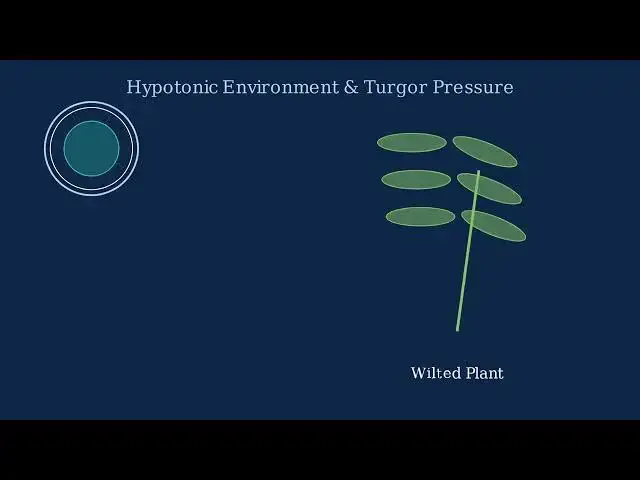
hydrostatic pressure is called turgore
2:48
pressure it's what gives plants their
2:51
structural rigidity and support a plant
2:53
cell in an isotonic solution may be
2:56
flaxid with the cell membrane partially
2:58
pulled away from the cell wall but when
3:01
placed in a hypotonic solution water
3:03
flows in and the cell becomes turgid as
3:05
the membrane pushes tightly against the
3:07
cell
3:09
wall unlike animal cells which can swell
3:12
and potentially burst in hypotonic
3:14
solutions plant cells are protected by
3:16
their rigid cell
3:18
wall turg pressure provides essential
3:21
structural support for plants allowing
3:23
them to maintain their upright position
3:26
when plant cells lose water and become
3:28
flaxid plants wilt when cells are turgid
3:31
the plant stands upright and firm to
3:34
summarize plant cells in hypotonic
3:36
solutions absorb water through osmosis
3:39
creating turgore pressure as the cell
3:41
membrane pushes against the cell wall
3:43
this provides essential structural
3:45
support and prevents the cells from
3:49
bursting hypotonic environments play a
3:51
crucial role in plant health and
3:53
function when a plant cell is in a
3:55
hypotonic environment water molecules
3:58
move into the cell through osmosis as
4:00
water enters the cell it creates tur
4:03
pressure pushing outward against the
4:05
rigid cell wall this tur pressure is
4:07
essential for maintaining plant rigidity
4:10
and upright growth when plants cannot
4:12
maintain adequate turgor pressure such
4:14
as in drought conditions or hypertonic
4:16
environments they begin to wilt unlike
4:20
animals with skeletal systems plants
4:22
rely entirely on tur pressure to support
4:24
their structures hypotonic conditions
4:27
are also crucial for nutrient uptake
4:29
through plant roots root cells create a
4:32
hypotonic environment that draws water
4:34
and dissolved nutrients from the soil
4:36
into the plant once absorbed by the
4:39
roots water and nutrients are
4:41
transported throughout the plant through
4:42
vascular tissues
4:45
the continuous flow of water through
4:46
plant tissues made possible by hypotonic
4:49
conditions is essential for
4:51
photosynthesis nutrient distribution and
4:54
overall plant health osmo regulation is
4:57
the process by which animals maintain
4:59
proper water and solute balance in their
5:01
bodies this process is critical for
5:03
survival as it prevents cell damage
5:06
maintains cellular function and is
5:08
essential in varying environments
5:10
in hypotonic environments where the
5:12
surrounding water has fewer solutes than
5:14
the animal cells water constantly enters
5:17
the cells through
5:20
osmosis single-sellled organisms like
5:23
protests have evolved specialized
5:25
structures called contractile vacules to
5:27
manage excess water water enters the
5:30
protest through osmosis because the cell
5:32
has a higher solute concentration than
5:34
its surroundings the contractile vacule
5:37
collects this excess water gradually
5:39
expanding as it fills when full the
5:42
vacule contracts forcefully expelling
5:45
the water outside the cell this cycle
5:47
repeats continuously to maintain proper
5:49
cell
5:51
volume freshwater fish face a similar
5:54
challenge since their bodies contain
5:56
more solutes than the surrounding water
5:59
water constantly enters through their
6:01
gills and skin water flows into the fish
6:04
primarily through the thin membranes of
6:06
the gills which are designed for gas
6:08
exchange but also allow water to enter
6:11
through osmosis to counteract this
6:14
constant influx of water the fish's
6:16
kidneys play a crucial role in osmo
6:18
regulation unlike terrestrial animals
6:21
freshwater fish produce large volumes of
6:23
very dilute urine their kidneys filter
6:25
out salts to be reabsorbed while
6:28
allowing excess water to be excreted
6:32
osmo regulation is an energyintensive
6:35
process both the contractile vacules in
6:37
protests and the kidney functions in
6:39
fish require cellular energy in the form
6:41
of
6:44
ATP in summary osmo regulation is a
6:47
vital process for animals living in
6:49
hypotonic environments through
6:51
specialized structures and mechanisms
6:53
animals maintain proper water balance
6:55
despite the constant challenge of
6:57
osmosis
7:01
the kidneys play a crucial role in
7:03
regulating the body's osmotic balance
7:05
through the formation of hypotonic urine
7:08
this process occurs in specialized
7:10
structures called nephrons which are the
7:12
functional units of the kidney each
7:14
nephron consists of several key
7:16
components the glomemeilus proximal
7:19
tubule loop of henl distal tubule and
7:21
collecting duct the process begins with
7:23
filtration blood enters the nephron
7:26
through the afrant arterial and reaches
7:29
the glomemeilus in the proximal tubule
7:31
and loop of henley selective
7:32
reabsorption occurs essential solutes
7:35
like sodium and water are reabsorbed
7:37
back into the bloodstream in the loop of
7:40
henla and collecting duct a
7:42
concentration gradient allows for more
7:44
water to be reabsorbed without solutes
7:46
this process creates hypotonic urine
7:49
this selective reabsorption process
7:51
results in urine that is hypotonic
7:53
compared to blood it contains fewer
7:56
solutes relative to water this ability
7:58
to create hypotonic urine is crucial for
8:01
maintaining proper blood concentration
8:03
regulating fluid volume and ensuring
8:06
optimal cellular
8:09
function marine organisms face very
8:12
different environmental challenges
8:13
compared to freshwater species in
8:16
freshwater environments the surrounding
8:18
water is hypotonic meaning it has a
8:21
lower salt concentration than the
8:22
animals body fluids in contrast marine
8:26
environments are hypertonic with a
8:28
higher salt concentration than the
8:29
organism's internal
8:32
fluids marine fish have developed
8:34
specialized adaptations to prevent
8:36
dehydration in their salty environment
8:39
unlike freshwater fish marine fish
8:41
actively drink seawater to replace water
8:43
lost through osmosis their specialized
8:46
kidneys filter the seawater retaining
8:48
water while removing excess salts they
8:51
then excrete highly concentrated salt
8:53
solutions through specialized cells in
8:56
their gills and in their
8:58
urine marine birds and reptiles have
9:00
evolved specialized salt glands as
9:02
additional adaptation
9:04
mechanisms marine birds like seagulls
9:07
and albatrosses have salt glands located
9:09
above their eyes these glands extract
9:12
excess salt from the bloodstream and
9:14
secrete a highly concentrated salt
9:16
solution that drips out through the
9:18
nostrils similarly marine reptiles like
9:21
sea turtles and marine iguanas have salt
9:23
glands that excrete excess salt as tears
9:26
these secretions can be remarkably
9:28
concentrated up to five times saltier
9:31
than seawater itself
9:34
these specialized adaptations in marine
9:36
organisms provide critical survival
9:38
advantages in salty environments first
9:41
they prevent dehydration by maintaining
9:43
proper water balance despite living in a
9:45
hypertonic
9:47
environment second these adaptations
9:49
conserve energy by efficiently
9:51
regulating salt levels without expending
9:53
excessive metabolic resources finally
9:56
these adaptations have allowed species
9:58
to expand into marine habitats enabling
10:01
them to thrive in oceans
10:03
worldwide cells have evolved
10:06
sophisticated mechanisms to regulate
10:08
their volume despite osmotic challenges
10:10
from the environment in a hypotonic
10:13
solution water flows into the cell due
10:15
to osmosis causing it to swell if left
10:18
unchecked this swelling could lead to
10:20
cell damage or even rupture
10:23
to counteract swelling cells employ a
10:25
mechanism called regulatory volume
10:27
decrease or RVD this involves activating
10:30
specific ion channels in the cell
10:32
membrane during RVD cells release
10:34
potassium and chloride ions to the
10:36
outside environment as ions flow out
10:39
water follows due to osmosis reducing
10:41
cell volume back to normal for example
10:44
red blood cells use this regulatory
10:46
volume decrease mechanism to prevent
10:48
rupturing when exposed to hypotonic
10:50
blood conditions
10:53
beyond RVD cells use multiple mechanisms
10:55
to regulate their volume including
10:57
specialized ion transporters
10:59
cytokeleletal rearrangement and organic
11:02
osmolytes these volume regulation
11:04
mechanisms are crucial for cell survival
11:07
and maintaining normal physiological
11:09
function in changing osmotic
11:13
environments understanding hypotonic
11:15
solutions has important applications in
11:18
medicine and everyday life in medical
11:20
settings hypotonic IV solutions like
11:22
halfnormal saline and D5W are commonly
11:25
used however these solutions must be
11:27
administered carefully as they can cause
11:30
cells to swell due to water moving into
11:32
cells by
11:34
osmosis hypotonic eye drops present
11:36
another medical application when applied
11:39
to the eye they can cause corial cells
11:41
to swell this swelling occurs as water
11:44
moves into corial cells by osmosis
11:46
leading to blurred vision and discomfort
11:50
sports drinks are carefully formulated
11:52
to prevent hypotonic conditions during
11:54
intense
11:55
exercise unlike plain water sports
11:58
drinks contain electrolytes and
12:00
carbohydrates that help maintain proper
12:02
osmotic balance in the body drinking
12:04
only water during prolonged exercise can
12:07
lead to hyponetriia a potentially
12:09
dangerous condition where sodium levels
12:11
in the blood become too diluted
12:15
maintaining proper osmotic balance is
12:17
critical for cellular health and
12:19
function health care providers must
12:21
carefully consider fluid tenicity when
12:23
treating patients as improper use of
12:25
hypotonic solutions can lead to serious
12:28
complications understanding hypotonic
12:31
solutions is essential for medical
12:33
safety and optimal health
#Biological Sciences