live_tv
Livestream Starting Soon
00
Hours
:
00
Minutes
:
00
Seconds
Up next in 10

How Embryos Evolve Over Time
In this enlightening video, we delve into the fascinating world of embryonic development and evolution. Explore how embryos undergo significant changes over time, influenced by genetic, environmental, and evolutionary factors. We will discuss key concepts such as embryogenesis, evolutionary developmental biology, and the role of natural selection in shaping the developmental pathways of various species. Join us as we uncover the intricate processes that govern the evolution of embryos and their implications for understanding biodiversity. Don't forget to like, share, and subscribe for more insights into the wonders of biology! #EmbryonicDevelopment #EvolutionaryBiology #Biodiversity
Website: https://biologynotesonline.com/
Facebook: https://www.facebook.com/biologynotesonline
Instagram: https://www.instagram.com/biologynotesonline/?hl=en
embryo,embryos,development of embryo,growing embryos,time lapse embryo,how many embryos to transfer,how the embryo folds,embryo growth,time lapse embryo development,embryo folding,time lapse embryo to baby,embryo transfer,time lapse embryo imaging,embryo foetal development,embryo grading and timeline,ivf embryo,development of embryo in human,folding of the embryo,7 day embryo,5 day embryo,embryo grade,implantation of embryo in uterus
Show More Show Less View Video Transcript
0:00
what is embryology embryology is the
0:02
scientific study of embryos and their
0:04
development from fertilization through
0:07
to the formation of a complete
0:09
organism Embryos begin as fertilized
0:12
eggs when a sperm cell fertilizes an egg
0:14
cell creating a
0:16
zygote These embryos undergo a series of
0:18
developmental stages specific to their
0:21
species The process begins with a single
0:23
cell that divides multiple times
0:26
eventually forming specialized cells and
0:28
tissues
0:30
Embryology is an interdisciplinary field
0:33
combining aspects of developmental
0:35
biology genetics and evolutionary
0:37
biology to understand how organisms form
0:39
and
0:42
evolve In summary embryology is the
0:45
scientific study of how organisms
0:48
develop from a single cell into complex
0:50
fully formed individuals revealing
0:52
fascinating insights into both
0:54
development and
0:56
evolution Early in development embryos
0:59
of different vertebrate species show
1:01
remarkable
1:03
similarities During the first stages of
1:05
development vertebrate embryos from fish
1:07
to mammals look strikingly similar They
1:10
all have a simple curved body plan with
1:12
basic structures forming These
1:14
remarkable similarities suggest that all
1:17
vertebrates share a common evolutionary
1:19
ancestor The basic body plan was
1:22
established early in evolutionary
1:24
history and has been conserved across
1:27
species As development progresses
1:29
species specific characteristics become
1:31
more apparent Fish develop fins birds
1:34
form wings and mammals show their
1:36
distinctive limb structure This
1:39
divergence in development demonstrates
1:41
evolutionary adaptation Different
1:43
species evolved specific traits that
1:45
allowed them to thrive in their
1:47
particular environments
1:50
This pattern of early similarity
1:52
followed by later divergence known as
1:54
vonbear's law provides compelling
1:56
evidence for evolution It shows how
1:59
developmental biology reveals our shared
2:02
evolutionary history while also
2:04
demonstrating the process of adaptation
2:06
The study of embryionic development
2:08
across species continues to reveal
2:10
important insights about our
2:11
evolutionary connections Charles Darwin
2:14
revolutionized our understanding of
2:16
embryology by incorporating it into his
2:19
groundbreaking theory of evolution In
2:22
his landmark work on the origin of
2:24
species Darwin noted how embionic
2:26
similarities provided compelling
2:28
evidence for common ancestry between
2:30
seemingly different
2:32
species Darwin recognized a profound
2:35
pattern Early embryos of different
2:37
vertebrate species share remarkable
2:39
structural similarities He observed that
2:42
vertebrate embryos fish amphibians
2:44
reptiles birds and mammals all display
2:47
similar features during early
2:48
development such as gill arches and
2:51
tails Darwin viewed embryology as a
2:54
remarkable window to the past that
2:57
revealed evolutionary connections not
2:58
always visible in adult forms These
3:01
embryionic patterns revealed to Darwin
3:04
that seemingly different animals share a
3:06
common evolutionary history with shared
3:09
developmental features pointing to
3:10
common
3:12
ancestors Darwin's insights established
3:15
embryology as a key line of evidence for
3:17
his theory of evolution by natural
3:20
selection Darwin's key contributions
3:22
included recognizing that embryionic
3:24
similarities represent evidence of
3:26
common descent using embryological
3:28
patterns to identify ancestral
3:30
relationships and establishing
3:32
embryionic development as a crucial
3:34
window into evolutionary
3:37
history Darwin's embryological insights
3:40
have had a lasting impact on biology
3:43
From the publication of origin of
3:44
species in 1859 through the expansion of
3:48
comparative embryology to the modern
3:50
integration of genetics and development
3:52
in today's evolutionary developmental
3:55
biology By connecting embryology to
3:57
evolution Darwin provided a powerful
4:00
framework that continues to guide
4:02
research into the development and
4:04
evolution of
4:10
life Vestigial structures are features
4:13
that had important functions in
4:15
ancestors but have reduced or no
4:17
function in current
4:19
species These structures are
4:21
particularly fascinating when observed
4:23
in embryos as they provide compelling
4:25
evidence of evolutionary history and
4:30
adaptation Darwin documented several
4:32
compelling examples of vestigial
4:34
structures in embryos One fascinating
4:37
example is found in mole embryos In
4:39
early development moles form fully
4:41
developed eyelike structures However as
4:44
development progresses these eyes become
4:46
covered by skin resulting in the reduced
4:49
vision we observe in adult
4:55
moles Another remarkable example occurs
4:57
in boline whale embryos Early in
5:00
development these embryos form tooth
5:02
buds just like tooththed whales However
5:05
these tooth buds completely disappear
5:07
before birth and instead the whales
5:09
develop bine plates which they use to
5:11
filter
5:13
food The evolutionary significance of
5:16
these vestigial structures cannot be
5:18
overstated First these structures reveal
5:21
ancestral traits that are no longer
5:23
needed in the species current
5:24
environment
5:26
Second the transient nature of these
5:29
structures during embryionic development
5:31
suggests they are genetic remnants that
5:32
the organism's DNA still
5:35
carries Third these structures provide
5:38
compelling evidence of shared ancestry
5:40
with species where these features are
5:42
fully
5:44
functional Vestigial structures in
5:46
embryos provide a window into
5:47
evolutionary history showing how
5:49
organisms retain traces of their
5:51
ancestral past even as they adapt to new
5:54
environments
5:56
These examples that Darwin noted remain
5:58
compelling evidence for evolution today
6:01
revealing the deep connections between
6:02
all life forms on
6:06
Earth Darwin developed two complimentary
6:09
views on how evolution occurs through
6:11
what he called descent with
6:18
modification
6:23
His first view focused on natural
6:26
selection as the mechanism of evolution
6:28
Darwin proposed that species evolve when
6:31
natural selection acts on variations
6:33
within populations According to this
6:35
view individuals with advantageous
6:38
traits are more likely to survive and
6:40
reproduce passing those traits to their
6:42
offspring Over time these beneficial
6:45
traits accumulate leading to adaptation
6:50
Darwin's second view focused on
6:51
embryionic development as evidence for
6:54
evolution He observed that embryos of
6:57
different vertebrate species look
6:58
remarkably similar in early stages This
7:01
suggested to him that early embriionic
7:04
stages reveal ancestral traits common to
7:06
all vertebrates while later stages show
7:08
the specialized adaptations of each
7:10
species
7:14
These two views complemented each other
7:16
to form Darwin's comprehensive theory of
7:18
evolution Natural selection explained
7:21
the mechanism while embriionic
7:23
development provided supporting
7:25
evidence Together these perspectives
7:27
helped Darwin form a unified theory that
7:30
incorporated both adult adaptations and
7:32
the patterns seen during development
7:34
strengthening his case for descent with
7:36
modification
7:42
Homology and analogy represent two
7:44
important concepts when examining
7:46
embryionic structures from an
7:48
evolutionary
7:49
perspective Homologous structures have
7:51
fundamental similarities because they
7:53
are derived from the same ancestral
7:56
structures even if they now serve
7:58
different
7:59
functions In contrast analogous
8:01
structures perform similar functions but
8:04
evolved independently from different
8:06
ancestral structures
8:08
A classic example of homology is the
8:11
comparison between a human arm and a
8:13
bird wing Despite having different
8:15
functions grasping in humans versus
8:17
flying in birds these structures share
8:19
similar bone patterns The humorous
8:22
radius and ulna are present in both
8:24
arranged in a similar
8:26
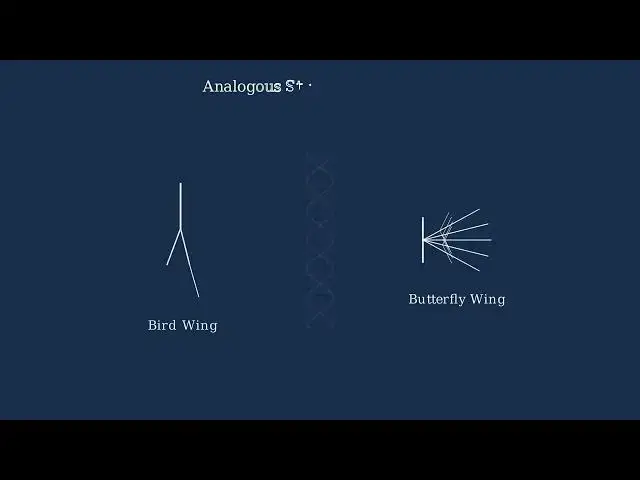
pattern In contrast an example of
8:29
analogy would be comparing a bird wing
8:31
to a butterfly wing Both structures
8:34
serve the function of flight but they
8:35
evolved independently and have
8:37
fundamentally different structures Bird
8:40
wings contain bones while butterfly
8:42
wings consist of chitan membranes
8:44
supported by
8:46
veins What makes embryology particularly
8:49
valuable for identifying homologies is
8:51
that embryionic development often
8:53
reveals similarities not obvious in
8:55
adult forms In early embryionic stages
8:58
human and bird embryos look remarkably
9:01
similar with nearly identical limb buds
9:03
As development progresses these
9:05
structures begin to differentiate with
9:07
human limb buds developing into arms
9:09
with fingers while bird limb buds
9:12
develop into wings By late stages of
9:14
development the adult structures show
9:17
clear differences but their shared
9:19
developmental origin reveals their
9:21
homology
9:23
Let's summarize the key differences
9:25
between homology and analogy in
9:27
embryionic structures Homologous
9:29
structures share a common embryionic
9:31
origin and developmental pattern
9:33
regardless of their adult functions
9:36
Analogous structures on the other hand
9:38
may serve similar functions but develop
9:41
through different embryionic pathways
9:43
Through embryological evidence we can
9:45
identify homologies that might be
9:47
obscured in adult forms providing
9:49
crucial evidence for evolutionary
9:51
relationships between
9:56
species Embryionic development provides
9:59
compelling evidence for evolution Early
10:01
vertebrate embryos share remarkable
10:03
structural similarities despite
10:05
developing into very different adult
10:07
forms Fangial arches are a key example
10:10
of these shared embryionic structures
10:13
These appear as a series of grooves in
10:15
the neck region of all vertebrate
10:17
embryos Despite starting from similar
10:19
structures fernal arches develop into
10:22
very different adult structures across
10:24
species In fish they form gill
10:27
structures In birds they develop into
10:29
parts of the beak and throat And in
10:31
mammals they form parts of the ear and
10:34
throat These developmental patterns
10:36
provide strong evidence for evolution
10:38
and shared ancestry among vertebrates
10:41
The presence of common embryionic
10:43
structures suggest that all vertebrates
10:45
descended from a common ancestor The
10:48
developmental patterns we observe
10:49
reflect evolutionary history and similar
10:52
genes regulate development across
10:54
diverse species This developmental
10:57
evidence powerfully supports Darwin's
10:59
theory that diverse species share common
11:01
ancestry
11:03
Modern evolutionary developmental
11:05
biology or evo bridges classical
11:08
embryology with evolutionary biology
11:11
investigating how developmental
11:13
processes inform our understanding of
11:15
evolution The field emerged from
11:17
classical embryology but has been
11:19
revolutionized by modern genetic and
11:22
molecular techniques Genome sequencing
11:25
allows us to compare developmental genes
11:27
across species Gene expression analysis
11:30
tracks when and where genes activate
11:33
during development And technologies like
11:35
crisper gene editing help us modify
11:37
genes to study their
11:39
functions A groundbreaking discovery in
11:42
Evodvo has been hawk genes which control
11:44
body patterning during development Hawk
11:47
genes are master regulators of body
11:50
patterning They are highly conserved
11:52
across animal species Yet small changes
11:54
in their expression can create entirely
11:57
new body
11:59
structures One of the most fascinating
12:01
discoveries in Evodo is how small
12:04
changes in gene regulation can lead to
12:06
dramatic evolutionary innovations For
12:09
example insect wings evolved from genes
12:11
originally used for leg development The
12:14
same genes that control fin development
12:16
in fish were repurposed for limb
12:18
development in mammals and a common
12:21
genetic toolkit controls eye development
12:23
across diverse animal groups despite
12:26
their independent
12:28
evolution Recent discoveries continue to
12:31
connect embryionic development with
12:33
evolutionary processes Scientists have
12:35
discovered that gene regulatory networks
12:38
help explain how body plans evolve
12:41
Epigenetic mechanisms can influence
12:43
development without changing the DNA
12:45
sequence itself and developmental
12:47
plasticity allows organisms to adapt to
12:50
their environment during
12:54
development Embryological studies have
12:56
profound implications for our
12:58
understanding of evolution and open
13:01
exciting directions for future
13:03
research Embryological evolution
13:06
enhances our understanding of life's
13:08
diversity and interconnectedness through
13:10
shared developmental pathways These
13:13
studies reveal how evolutionary
13:15
innovations arise from modifications to
13:17
existing developmental programs
13:20
Comparative embryology helps reconstruct
13:22
phogenetic relationships between species
13:25
that might otherwise be difficult to
13:28
determine Several exciting research
13:30
areas are emerging at the intersection
13:32
of embryology and evolution
13:34
Developmental plasticity explores how
13:37
embryos can develop differently in
13:39
response to environmental factors
13:41
potentially influencing evolutionary
13:43
trajectories Epigenetics investigates
13:46
how gene expression can be modified
13:48
without changing the underlying DNA
13:50
sequence providing a mechanism for
13:52
developmental memory across generations
13:56
Studies of gene regulatory networks
13:58
reveal how complex developmental
14:00
processes are coordinated and how
14:02
changes to these networks can lead to
14:04
evolutionary
14:06
innovation Embryological studies
14:08
continue to provide valuable insights
14:10
and open new research directions These
14:13
studies help refine evolutionary theory
14:15
by providing mechanistic explanations
14:17
for morphological change Integration of
14:20
embryological data with molecular and
14:22
genetic information creates a more
14:25
complete picture of evolutionary
14:26
processes Embryological insights are
14:29
being applied to conservation efforts
14:31
and medical research highlighting the
14:33
field's broader
14:36
relevance In conclusion embryological
14:39
studies provide critical evidence for
14:41
evolution while continually expanding
14:43
our understanding of life's diversity
14:46
and development As we continue to
14:48
integrate embryological data with other
14:50
fields we strengthen the foundation of
14:52
evolutionary theory and open exciting
14:55
new avenues for research
#Biological Sciences
#Ecology & Environment
#Genetics