Up next in 10


BT Cotton – Definition, Features, Development, Advantages, Limitations
Website: https://biologynotesonline.com/
Facebook: https://www.facebook.com/biologynotesonline
Instagram: https://www.instagram.com/biologynotesonline/?hl=en
Show More Show Less View Video Transcript
0:00
Let's discover what Bt cotton is and why
0:02
it's significant in modern agriculture.
0:05
Bt cotton is a genetically modified
0:07
variety of cotton. It has been
0:09
engineered to contain specific genes
0:11
from a soil bacterium called basillus
0:13
thringensis. These genes enable the
0:16
cotton plant to produce proteins that
0:18
act as natural insecticides against
0:20
specific pests, particularly bullworms,
0:22
which are major cotton pests. This
0:25
genetic modification represents one of
0:27
the most widely adopted agricultural
0:29
biotechnologies worldwide. Bt cotton
0:32
exemplifies how biotechnology can be
0:35
used to address agricultural challenges.
0:39
The science behind Bt cotton relies on
0:41
specific proteins derived from a soil
0:43
bacterium. Basillusensis bacteria
0:46
produce insecttoidal proteins called
0:48
cryoproteins and vipro proteins.
0:52
When certain pests, particularly
0:53
bullworms, ingest these proteins by
0:55
feeding on Bt cotton plants, a specific
0:58
molecular interaction occurs.
1:01
These proteins bind to specific
1:03
receptors in the insect's gut, creating
1:05
pores that disrupt the digestive system.
1:09
This disruption ultimately leads to the
1:11
pest's death, preventing damage to the
1:13
cotton plant.
1:16
Importantly, these proteins are highly
1:18
specific to certain insect groups. They
1:20
affect harmful pests like bowlworms but
1:23
don't affect humans, animals or
1:24
beneficial insects.
1:30
The journey of Bt cotton began in 1983
1:33
with the first genetic engineering
1:35
experiments. In 1983, initial genetic
1:38
engineering experiments. In 1985, lab
1:41
testing phase. In 1987, first
1:44
commercially viable BT cotton. In 1989,
1:47
field testing begins. In 1990s, global
1:50
expansion of Bt cotton.
1:52
The development of Bt cotton represented
1:55
a significant breakthrough in
1:56
agricultural biotechnology.
1:59
It was one of the first genetically
2:00
modified cropping
2:03
engineered rather than herbicide
2:05
tolerance or other.
2:06
>> This represented a major advancement in
2:08
how biotechnology could be applied to
2:10
agriculture. Scientists targeted the
2:13
cotton bullworm, a devastating pest that
2:15
caused significant crop losses. This
2:18
development preceded many of the
2:19
herbicide tolerant crops that would
2:21
later become common. The success of
2:23
early Bt cotton development laid the
2:26
groundwork for future innovations in
2:28
agricultural biotechnology.
2:30
The genetic engineering process for
2:31
creating Bt cotton involves several
2:34
sophisticated laboratory techniques.
2:36
This systematic approach requires
2:38
precision and rigorous testing at each
2:40
stage. Let's explore the five key steps
2:42
involved in developing BT cotton. First,
2:45
scientists identify and isolate specific
2:48
BT genes from basillus thringensis
2:50
bacteria. These genes produce proteins
2:52
toxic to certain insect pests but
2:54
harmless to humans and other organisms.
2:57
Next, researchers develop transfer
2:59
technologies to insert these genes into
3:02
cotton plant cells. The two main methods
3:04
are agroacterium mediated transformation
3:07
and particle bombardment. The third step
3:09
involves regenerating complete cotton
3:12
plants from the modified cells.
3:14
This requires specialized growth media
3:17
and carefully controlled laboratory
3:19
conditions. Controlling gene expression
3:21
ensures the BT protein is produced at
3:24
effective levels in the right plant
3:26
tissues. Scientists use specific
3:28
promoters and regulatory elements to
3:30
achieve this. Finally, researchers must
3:33
ensure the BT genes are stably
3:35
integrated into the cotton genome and
3:37
inherited by future generations. This
3:40
involves extensive testing across
3:42
multiple plant generations. This
3:44
sophisticated genetic engineering
3:46
process has revolutionized cotton
3:48
farming by creating plants that produce
3:50
their own insecttoidal proteins.
3:54
Gene transfer technologies are crucial
3:56
for creating BT cotton. These methods
3:58
allow scientists to insert the basillus
4:00
thringensis genes into cotton plants.
4:03
The primary method used is agroacterium
4:06
mediated gene transfer. Agroacterium
4:08
tumopacins is a soil bacterium that
4:10
naturally transfers DNA to plant cells.
4:13
It's nature's own genetic engineer.
4:15
Scientists modify this bacterium to
4:18
carry the BT genes instead of its
4:20
natural disease-causing genes. The
4:22
bacterium attaches to the plant cell and
4:24
transfers the BT gene into the plant's
4:27
genome.
4:30
An alternative method used in BT cotton
4:32
development is particle bombardment,
4:34
also known as the gene gun technique.
4:37
This method uses microscopic gold or
4:39
tungsten particles coated with BT genes.
4:42
These particles are shot at high
4:44
velocity directly into plant cells using
4:46
a gene gun device. While less efficient
4:48
than agroacterium, particle bombardment
4:51
has been used as an alternative method
4:53
for developing Bt cotton.
4:56
Let's compare these two gene transfer
4:58
methods used in BT cotton development.
5:02
These gene transfer technologies have
5:04
revolutionized cotton breeding, allowing
5:06
the development of cotton varieties with
5:08
built-in pest resistance.
5:11
One of the most significant advantages
5:13
of Bt cotton is the substantial
5:15
reduction in chemical pesticide
5:17
applications. Conventional cotton
5:20
farming typically requires numerous
5:22
pesticide sprays to control bullworms.
5:25
In contrast, BT cotton can reduce these
5:27
applications by 50 to 80%. The exact
5:30
reduction depends on several factors.
5:33
This significant reduction in pesticide
5:35
usage leads to several important
5:37
benefits. These benefits make Bt cotton
5:40
an environmentally friendlier
5:41
alternative to conventional cotton
5:43
farming.
5:45
Despite higher seed costs, Bt cotton
5:48
offers significant economic benefits to
5:50
farmers through multiple mechanisms.
5:52
Let's examine the key economic
5:54
advantages that make Bt cotton
5:56
profitable.
5:58
Farmers using Bt cotton typically reduce
6:00
their pesticide applications by 50 to
6:03
70% resulting in substantial savings on
6:06
chemical inputs.
6:09
Bt cotton significantly reduces labor
6:11
requirements for pesticide application.
6:14
Farmers typically need fewer workers for
6:16
spraying and handling chemicals.
6:19
Bt cotton's built-in pest resistance
6:21
protects the crop from bworm damage.
6:24
This saves 20 to 40% of the yield that
6:26
would otherwise be lost to pest damage.
6:30
Under similar growing conditions, Bt
6:32
cotton typically yields 20 to 30% more
6:35
than conventional varieties, especially
6:37
in regions with high pest pressure.
6:41
Let's look at the overall economic
6:43
picture. Despite higher seed costs, Bt
6:46
cotton typically provides a
6:47
substantially greater profit margin for
6:49
farmers. This economic advantage is
6:52
particularly notable in regions with
6:54
high pest pressure. These economic
6:56
benefits make Bt cotton an attractive
6:58
option for farmers worldwide, especially
7:01
in regions where pest pressure is high
7:03
and conventional cotton would suffer
7:05
significant losses.
7:07
Bt cotton offers significant
7:09
environmental benefits compared to
7:11
conventional cotton production. A major
7:14
environmental advantage is the
7:16
significant reduction in chemical runoff
7:18
into water systems. Bt cotton reduces
7:21
pesticide use by 50 to 80% which means
7:24
fewer harmful chemicals washing into
7:26
lakes, rivers, and groundwater. Another
7:28
critical benefit is decreased soil
7:31
contamination from pesticides. With
7:33
fewer pesticides applied, the soil
7:35
maintains better health with reduced
7:37
toxic residue, improving long-term soil
7:40
fertility and structure. Bt cotton also
7:43
has a lower impact on non-target
7:44
organisms compared to conventional
7:46
cotton. The BD toxin specifically
7:49
targets bullworms and other pests that
7:51
damage cotton while preserving
7:53
beneficial insects, birds, and soil
7:55
microorganisms essential for a healthy
7:57
ecosystem. Finally, Bt cotton
8:00
contributes to reduced fossil fuel usage
8:02
in agriculture. Fewer pesticide
8:04
applications mean less fuel used for
8:07
spraying equipment and reduced emissions
8:09
from pesticide manufacturing and
8:11
transportation.
8:12
These environmental advantages
8:14
collectively make Bt cotton a more
8:16
sustainable option compared to
8:18
conventional cotton production systems
8:22
by reducing chemical inputs and their
8:24
associated environmental impacts. Bt
8:27
cotton helps protect ecosystems while
8:29
maintaining agricultural productivity.
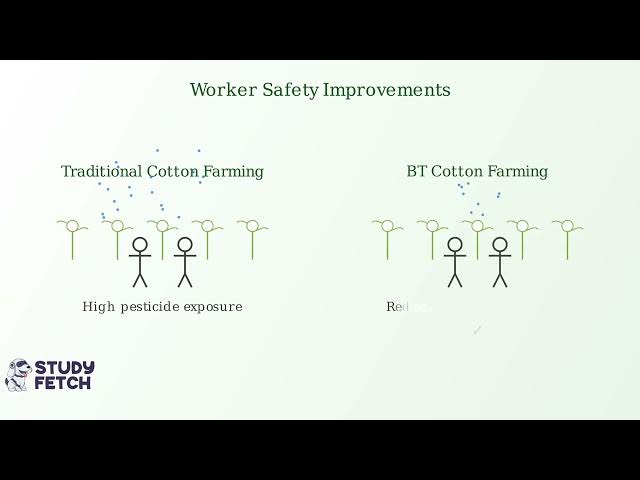
8:34
Cotton farming traditionally involves
8:36
significant pesticide exposure for farm
8:38
workers. Let's compare traditional
8:40
cotton farming with Bt cotton
8:42
cultivation.
8:47
Pesticide exposure in traditional cotton
8:49
farming presents significant health
8:52
risks particularly in developing
8:54
countries where protective equipment may
8:56
be limited. Bt cotton significantly
8:59
improves worker safety by reducing the
9:01
number of pesticide applications needed
9:03
throughout the growing season. The
9:05
reduction in pesticide applications is
9:08
substantial. Traditional cotton farming
9:10
can require 8 to 10 applications per
9:12
season, while BT cotton typically needs
9:15
only two to three. This significant
9:17
reduction in pesticide use translates
9:20
directly to improved safety for farm
9:22
workers, reducing cases of pesticide
9:25
poisoning and long-term health issues
9:27
while maintaining crop productivity
9:30
by reducing worker exposure to harmful
9:33
chemicals. Bt cotton technology
9:35
represents an important advancement in
9:37
agricultural worker safety. Bt cotton
9:40
has an important advantage when it comes
9:42
to preserving beneficial insects in
9:44
agricultural ecosystems. Unlike
9:47
broadspectctrum chemical insecticides,
9:49
Bt cotton specifically targets certain
9:51
pests like bullworms. Conventional
9:53
chemical insecticides kill all insects
9:56
indiscriminately. They eliminate target
9:58
pests but also destroy beneficial
10:00
insects. BT cotton however produces
10:03
proteins that only affect specific pests
10:05
like bullworms while leaving beneficial
10:07
insects unharmed.
10:11
Let's look at the types of beneficial
10:13
insects that Bt cotton helps preserve
10:16
and their important roles in
10:17
agricultural ecosystems.
10:20
By preserving these beneficial insects,
10:23
Bt cotton helps maintain a more balanced
10:25
agricultural ecosystem. Pollinators can
10:28
continue to support plant reproduction.
10:30
Predatory insects provide natural pest
10:32
control and paricettoids help regulate
10:35
pest populations naturally. This
10:37
preservation of beneficial insects
10:39
contributes to more balanced
10:41
agricultural ecosystems, reducing the
10:43
need for additional pest control
10:44
measures and supporting sustainable
10:47
cotton production.
10:49
Bt cotton has been extensively studied
10:52
for its potential effects on soil
10:54
health. Research indicates that Bt
10:56
cotton cultivation does not adversely
10:58
affect soil health or soil
11:00
microorganisms.
11:01
In fact, the reduced need for chemical
11:04
pesticides can actually benefit soil
11:06
microbial communities that would
11:08
otherwise be harmed by these
11:09
applications.
11:11
One key consideration is how BT proteins
11:14
interact with the soil environment. The
11:16
Bt proteins produced by genetically
11:18
modified cotton naturally break down in
11:20
the soil and don't accumulate over time.
11:25
Studies comparing Bt cotton fields with
11:27
conventional cotton have found that soil
11:30
microbial diversity and activity can be
11:32
higher in Bt cotton fields due to
11:34
reduced pesticide applications. Overall,
11:38
the soil health considerations for Bt
11:40
cotton are generally positive,
11:42
especially when compared to conventional
11:44
cotton production that relies heavily on
11:46
chemical insecticides.
11:49
A significant limitation of Bt cotton is
11:52
the higher cost of seeds compared to
11:54
conventional cotton varieties. Bt cotton
11:57
seeds can cost two to four times more
11:59
than conventional cotton seeds, creating
12:02
a significant upfront investment for
12:04
farmers. Seed companies charge premium
12:06
prices for Bt cotton to recoup their
12:09
substantial research and development
12:11
investments, which often amount to
12:13
millions of dollars over many years.
12:17
These higher upfront costs can be
12:19
especially challenging for small-scale
12:21
farmers with limited capital,
12:23
particularly in developing countries
12:25
where access to credit may be
12:26
restricted. The financial burden of high
12:29
seed costs varies significantly by
12:31
region with farmers in developing areas
12:34
facing greater challenges due to limited
12:36
financial infrastructure and support
12:38
systems. Despite these high costs, many
12:41
farmers still adopt Bt cotton due to
12:44
potential long-term savings from reduced
12:46
pesticide use and higher yields.
12:50
Unlike traditional crops, Bt cotton
12:52
requires farmers to purchase new seeds
12:54
each planting season. This requirement
12:56
creates a fundamental shift in how
12:58
cotton farming operates compared to
13:00
traditional practices.
13:02
There are two main reasons why farmers
13:04
must purchase new Bt cotton seeds
13:07
annually. First, intellectual property
13:09
protections. Bt cotton seeds are
13:12
patented technology. Legal agreements
13:14
prohibit farmers from saving and
13:16
replanting seeds with potential legal
13:18
consequences for violations. Second,
13:21
genetic segregation in subsequent
13:22
generations creates practical issues.
13:25
When Bt cotton plants reproduce
13:27
naturally, the pest resistant traits may
13:29
not be expressed consistently in the
13:31
offspring. This leads to reduced and
13:33
unpredictable pest protection in crops
13:36
grown from saved seeds. This requirement
13:39
represents a significant shift from
13:41
traditional farming practices.
13:43
Traditionally, farmers would save a
13:45
portion of their harvest for the next
13:47
planting season, allowing for
13:48
self-sufficiency and lower input costs.
13:52
With BT cotton, farmers must purchase
13:54
new seeds each season, creating
13:56
dependency on seed companies and
13:58
increasing production costs. Though it
14:00
ensures consistent genetic traits, this
14:03
annual purchase requirement has broader
14:05
economic implications.
14:07
Farmers face increased production costs
14:10
while seed companies gain a stable
14:12
revenue stream. This changes economic
14:14
dynamics in farming communities,
14:16
particularly in developing regions. This
14:19
creates an ongoing dependency
14:21
relationship between farmers and seed
14:23
suppliers, fundamentally altering the
14:25
economic model of cotton farming.
14:28
Understanding this requirement is
14:29
essential for evaluating the full
14:31
economic impact of Bt cotton adoption.
14:35
One of the most significant concerns
14:37
with Bt cotton is the potential for
14:39
target pests to develop resistance to
14:41
the Bt proteins over time.
14:45
Resistance develops through natural
14:47
selection. Initially, most pests are
14:49
vulnerable to the Bt toxin, but a few
14:52
naturally resistant individuals survive.
14:54
These resistant survivors breed, passing
14:57
their resistance genes to offspring.
14:59
Over multiple generations, the resistant
15:01
genes become dominant in the population.
15:05
Several bullworm species have already
15:07
shown resistance in some regions.
15:09
Documented cases exist in India, China,
15:12
and parts of the United States.
15:15
To combat resistance, farmers implement
15:17
refuge strategies. This involves
15:19
planting nonBT cotton areas near Bt
15:22
cotton fields.
15:24
Another approach is gene pyramiding
15:26
where multiple BT genes are incorporated
15:28
into the same plant. This creates
15:31
multiple modes of action against pests.
15:34
Despite these strategies, their
15:36
effectiveness varies widely. Poor
15:38
compliance with refuge requirements and
15:40
cross resistance between BT proteins
15:43
remain significant challenges.
15:45
Success rates vary significantly by
15:47
region with better outcomes in areas
15:49
with strong regulatory enforcement and
15:52
farmer education programs.
15:55
While Bt cotton effectively controls
15:57
primary pests like bullworms, it can
15:59
sometimes lead to unintended
16:01
consequences. Bt cotton produces
16:03
proteins that are toxic to bullworms,
16:06
effectively controlling these primary
16:08
pests.
16:09
However, a limitation of Bt cotton is
16:12
the emergence of secondary pests. These
16:14
are insects that were previously
16:16
controlled by broadspectctrum
16:17
insecticides. Common secondary pests
16:20
include aphids, white flies, and marid
16:23
bugs, which have become significant
16:24
problems in certain Bt cotton growing
16:26
regions.
16:29
After Bt cotton introduction, we often
16:31
see a population shift. While primary
16:33
pest numbers decline, secondary pests
16:36
that were previously suppressed by
16:37
broadspectctrum insecticides begin to
16:40
increase.
16:42
Addressing secondary pest issues
16:44
requires additional management
16:45
strategies, including targeted
16:47
insecticides, integrated pest
16:49
management, beneficial insect
16:51
conservation, and crop rotation.
16:55
Understanding these secondary pest
16:56
dynamics is crucial for sustainable Bt
16:59
cotton cultivation.
17:02
Section 17. Limited information on
17:04
long-term effects of Bt cotton.
17:07
Despite decades of commercial use since
17:09
the 1990s, some researchers argue that
17:12
there is still limited information about
17:14
the long-term ecological and health
17:16
effects of Bt cotton cultivation.
17:19
Ongoing research continues to monitor
17:21
potential unforeseen consequences in
17:23
several key areas.
17:28
While numerous studies have found no
17:30
significant adverse effects from Bt
17:32
cotton, most research spans only 5 to 10
17:35
years, which may not be sufficient to
17:37
detect all potential long-term impacts.
17:40
Scientific monitoring programs continue
17:42
to collect data on BT cotton's effects
17:45
on various ecosystems, beneficial
17:47
organisms, and human health to provide a
17:50
more complete understanding of its
17:52
long-term safety profile.
17:55
Cross-pollination between Bt cotton and
17:57
conventional cotton raises several
17:59
concerns for agriculture and
18:01
biodiversity. Cotton is primarily
18:03
self-pollinating with about 95% of
18:06
pollination occurring within the same
18:08
plant.
18:10
However, insects like bees can
18:12
facilitate some cross-pollination
18:14
between different cotton plants. Studies
18:16
show that while cotton predominantly
18:18
self-pollinates, cross-pollination rates
18:21
of up to 5% can occur under certain
18:24
conditions. This low level of
18:26
cross-pollination still raises several
18:28
important concerns. The first concern is
18:31
genetic contamination. BT genes can
18:33
transfer to non-GM cotton varieties
18:35
through cross-pollination.
18:37
Second, this gene flow may affect
18:39
genetic diversity in wild cotton
18:41
relatives, potentially impacting natural
18:44
ecosystems. Third, cross-pollination
18:46
creates challenges for organic cotton
18:48
farmers who need to maintain GM-free
18:50
certification. To minimize these risks,
18:53
regulatory agencies often recommend
18:55
buffer zones between Bt cotton and
18:57
conventional or organic cotton fields.
19:01
Understanding these cross-pollination
19:03
dynamics is crucial for sustainable
19:05
management of both Bt and nonBT cotton
19:08
varieties. BT cotton faces varying
19:10
regulatory requirements across different
19:13
countries creating a complex landscape
19:16
for development and commercialization.
19:19
The regulatory landscape varies
19:21
significantly from country to country.
19:23
Some nations have streamlined approval
19:25
processes while others maintain strict
19:28
regulatory requirements.
19:31
These regulations cover four main areas:
19:33
safety assessments, environmental impact
19:36
studies, labeling requirements, and
19:38
postmarket monitoring.
19:41
Navigating these diverse regulatory
19:43
frameworks add significant costs and
19:46
complexity to BT cotton deployment
19:48
globally. Companies must address country
19:50
specific requirements that can vary
19:52
dramatically.
19:55
These regulatory challenges can delay BT
19:58
cotton deployment by several years and
20:00
increase development costs by millions
20:03
of dollars, creating barriers,
20:05
particularly for smaller companies and
20:07
developing nations. Harmonizing
20:09
regulatory frameworks while maintaining
20:11
robust safety standards remains a key
20:14
challenge for the global adoption of Bt
20:16
Cotton.
20:19
Despite these challenges, efforts
20:21
continue to develop more streamlined and
20:24
internationally consistent regulatory
20:26
approaches.
20:29
Public perception of BT cotton varies
20:31
widely across different stakeholders and
20:32
regions.
20:34
Some view it as a beneficial technology
20:37
that solves critical agricultural
20:39
challenges, while others express
20:41
concerns about genetic modification in
20:43
agriculture.
20:45
These perception issues significantly
20:47
influence market acceptance, regulatory
20:50
decisions, and adoption rates of BT
20:52
cotton.
20:54
Addressing public concerns presents
20:56
ongoing challenges for scientists,
20:58
companies, and policy makers.
21:00
Communication barriers include
21:01
scientific complexity, media portrayal,
21:04
and varying cultural perspectives.
21:07
Transparent communication and education
21:10
are key strategies to address public
21:12
perception issues. Ultimately,
21:14
addressing these perception issues is
21:16
essential for ensuring the sustainable
21:18
adoption and acceptance of BT cotton
21:21
technology.
21:22
Bt cotton has been widely adopted around
21:25
the world, but the patterns of adoption
21:27
vary significantly between regions and
21:30
countries. Several major cotton
21:32
producing countries have embraced this
21:33
technology, including the United States,
21:36
India, China, Australia, and Brazil.
21:40
When we look at adoption percentages,
21:42
the highest rates are found in the
21:43
United States, Australia, and India,
21:46
where Bt cotton accounts for more than
21:48
90% of total cotton cultivation.
21:52
China and Brazil also have significant
21:54
adoption rates with Bt cotton
21:56
representing approximately 80 and 75% of
22:00
their cotton production, respectively.
22:02
In contrast, adoption in Europe is
22:04
minimal, while across the diverse
22:06
African continent, adoption varies
22:08
widely with an average around 30%.
22:15
Several key factors influence BT cotton
22:17
adoption rates. Regulatory frameworks
22:20
vary widely with some countries having
22:22
streamlined approval processes while
22:24
others maintain strict limitations.
22:27
Farmer access to technology is another
22:29
crucial factor, including seed
22:31
availability, affordability, and
22:33
technical knowledge. Local pest pressure
22:35
plays a significant role. In regions
22:38
with severe bullworm infestations,
22:40
farmers have greater incentive to adopt
22:42
BT cotton. Economic considerations,
22:45
including seed costs versus potential
22:47
savings on pesticides and increased
22:49
yields, heavily influence adoption
22:51
decisions.
22:53
Looking at specific regional case
22:55
studies gives us more insight into
22:57
adoption patterns. In India, Bt cotton
23:00
has been widely embraced due to severe
23:02
bullworm pressure and significant yield
23:04
improvements. In Europe, adoption is
23:07
minimal, largely due to strict GMO
23:09
regulations, consumer resistance to
23:12
genetically modified crops, and
23:14
relatively lower pest pressure. Across
23:16
Africa, adoption varies dramatically.
23:18
South Africa has high adoption rates
23:20
while Burkinaaso initially adopted BT
23:23
cotton but later withdrew it. Many other
23:25
African nations face regulatory
23:27
barriers.
23:29
The global adoption of Bt cotton has
23:31
followed a clear trajectory since its
23:33
first commercial release in the United
23:35
States in 1996. India's approval in 2002
23:40
marked a significant expansion as it
23:42
later became the country with the
23:44
largest area of Bt cotton cultivation.
23:47
By 2008, Bt cotton had reached 50%
23:50
global adoption, showing its rapid
23:52
acceptance in many major cotton
23:54
producing regions. Today, over 75% of
23:58
the world's cotton is genetically
23:59
modified, primarily with BT technology,
24:02
demonstrating its widespread
24:04
agricultural impact.
24:06
In summary, while BT cotton has achieved
24:09
remarkable global adoption, patterns
24:11
vary considerably between regions,
24:13
shaped by multiple interconnected
24:15
factors.
24:18
Researchers continue to advance BT
24:20
cotton technology to address current
24:22
limitations and enhance its
24:24
effectiveness. A key development is the
24:26
stacking of multiple BT genes in a
24:28
single cotton variety. This approach
24:31
combines different BT proteins like Cry
24:33
1A, CRY 2AB and VIP 3A. These stack
24:36
traits provide broader pest control,
24:39
significantly slow resistance
24:40
development, and offer more sustainable
24:42
protection for farmers.
24:45
Researchers are working to combine BT
24:47
pest resistance with other valuable
24:49
traits. The goal is to create cotton
24:52
varieties that address multiple
24:54
agricultural challenges simultaneously.
24:57
These combined traits will help cotton
24:59
plants withstand drought, heat, and
25:02
other climate challenges while
25:04
maintaining strong pest protection. This
25:06
combination provides greater resilience
25:09
and higher yields in difficult growing
25:11
conditions.
25:13
Effective resistance management is
25:15
crucial for the long-term viability of
25:17
Bt cotton. Researchers are developing
25:20
more sophisticated approaches to prevent
25:22
pests from adapting to BT toxins. These
25:25
strategies include improved refuge
25:27
designs, coordinated planting patterns,
25:29
and AI powered monitoring systems that
25:31
can detect early signs of resistance
25:33
development in pest populations.
25:37
In summary, the future of BT cotton
25:40
focuses on multiple complimentary
25:42
approaches that address current
25:43
limitations while enhancing
25:45
sustainability.
25:47
These developments aim to create more
25:49
resilient cotton varieties that can
25:51
withstand environmental challenges while
25:54
providing effective and sustainable pest
25:56
management. Bt cotton has had profound
25:59
effects on global cotton markets since
26:01
its introduction. Countries with high Bt
26:04
cotton adoption rates such as India,
26:06
China, and the United States have
26:08
experienced significant changes in their
26:10
production capacity. When we examine
26:13
production volumes over time, we see a
26:16
clear divergence between countries that
26:18
have adopted BT cotton and those that
26:20
haven't.
26:22
This increase in production has
26:23
influenced global cotton prices and
26:25
market dynamics. Bt cotton's impact on
26:28
prices stems from several factors. The
26:31
economic implications are significantly
26:34
different for nations that have adopted
26:36
BT cotton versus those that haven't.
26:43
These production and economic changes
26:46
have reshaped global cotton trade
26:47
patterns with BT cotton adopters gaining
26:50
larger export market shares. As BT
26:53
cotton continues to be adopted
26:55
worldwide, these market dynamics are
26:57
likely to further evolve, potentially
27:00
creating both opportunities and
27:02
challenges for different cotton
27:03
producing regions. ET cotton's role in
27:06
sustainable agriculture continues to be
27:08
a topic of debate among agricultural
27:10
experts. Sustainable agriculture is
27:13
built on three key pillars: economic
27:15
viability, environmental stewardship,
27:17
and social responsibility.
27:20
Proponents of Bt cotton highlight
27:22
several contributions to sustainable
27:24
agriculture. The technology has been
27:26
shown to reduce pesticide use by 50 to
27:29
80% resulting in a lower environmental
27:32
footprint. In many regions, reduced
27:35
chemical applications mean less fossil
27:37
fuel for spraying and compatibility with
27:39
other ecologically friendly practices.
27:43
Critics, however, question whether a
27:45
system that requires annual purchased
27:48
inputs can truly be considered
27:50
sustainable. They point to potential
27:52
ecological disruptions and corporate
27:54
control of seed systems. There are also
27:56
concerns about unintended consequences
27:58
that might emerge over longer time
28:00
frames, such as shifts in pest
28:02
populations or impacts on soil biology.
28:06
The sustainability of Bt cotton
28:09
ultimately depends on how it's
28:10
implemented within broader agricultural
28:12
systems. Integration with complimentary
28:15
practices like cover crops, crop
28:17
rotation, and reduced tillage enhances
28:20
its sustainability potential.
28:23
In conclusion, BT cotton technology
28:25
itself is neither inherently sustainable
28:28
nor unsustainable. Its contribution to
28:30
agricultural sustainability depends on
28:33
the broader context and farming system
28:35
in which it's deployed.
28:38
Assessing BT cotton requires balancing
28:40
its benefits against its limitations. On
28:43
one side, Bt cotton offers significant
28:45
benefits, including effective pest
28:47
management, higher crop yields, and
28:49
reduced chemical usage. On the other
28:51
side, we must consider limitations such
28:53
as high seed costs, the development of
28:56
pest resistance, and various
28:58
socioeconomic impacts. The appropriate
29:00
role of Bt cotton varies significantly
29:03
based on local contexts, agricultural
29:05
conditions, economic situations,
29:08
environmental factors, social
29:09
considerations, regulatory frameworks,
29:12
and cultural contexts all influence the
29:14
value proposition of Bt cotton. A
29:16
balanced approach recognizes that BT
29:19
cotton offers significant advantages in
29:21
certain contexts while acknowledging
29:23
that its limitations require management
29:25
strategies. Ultimately, decisions about
29:29
BT cotton adoption should be tailored to
29:31
local agricultural, economic, and
29:33
environmental conditions.
#Biological Sciences