Up next in 10

Bioinformatics Databases Explained
Website: https://biologynotesonline.com/
Facebook: https://www.facebook.com/biologynotesonline
Instagram: https://www.instagram.com/biologynotesonline/?hl=en
Show More Show Less View Video Transcript
0:00
Welcome to our exploration of
0:01
biioinformatics,
0:03
a revolutionary field that's
0:05
transforming biological research.
0:08
Biioinformatics is an interdicciplinary
0:10
field that combines four key areas of
0:12
study. It brings together biology to
0:14
understand living systems, computer
0:17
science for data processing, mathematics
0:19
for modeling, and statistics for
0:21
analysis.
0:23
This field emerged from a critical need
0:25
in modern biology. Managing and
0:27
analyzing massive biological data sets
0:30
from megabytes in the 1990s to pabytes
0:33
today. Biological data has grown
0:35
exponentially.
0:37
Biioinformatics provides the
0:39
computational methods and tools needed
0:41
to make sense of this complex biological
0:43
information. Through sophisticated
0:45
algorithms and statistical methods,
0:47
biioinformatics transforms raw
0:50
biological data into meaningful
0:52
scientific discoveries.
0:55
This interdicciplinary approach has
0:57
revolutionized how we study life at the
0:59
molecular level. Biioinformatics has
1:02
four core applications that
1:04
revolutionize biological research.
1:07
First, genomic analysis processes vast
1:10
amounts of DNA sequence data to identify
1:12
genes and understand genetic variations.
1:21
Protein structure prediction uses
1:23
computational methods to determine how
1:25
proteins fold and function.
1:33
Evolutionary studies reconstruct
1:35
phogenetic relationships and track how
1:37
species evolved over time.
1:45
Drug discovery uses computational
1:47
approaches to identify and optimize
1:49
potential therapeutic compounds.
1:56
These applications process data at
1:58
scales impossible with manual methods,
2:01
analyzing millions of sequences and
2:03
structures in minutes rather than years.
2:14
These applications form the backbone of
2:16
modern biological research and
2:17
personalized medicine, enabling
2:19
discoveries that drive healthcare
2:21
innovation.
2:28
Biological databases are structured
2:30
collections of biological data that are
2:33
stored electronically for easy access
2:35
and retrieval.
2:37
Think of them as organized digital
2:39
repositories that help scientists manage
2:42
the vast amounts of information
2:44
generated by modern biological research.
2:52
These databases store many different
2:54
types of biological information, each
2:57
serving specific research needs.
3:01
DNA sequences represent the genetic code
3:03
of organisms. Protein structures show
3:06
how proteins fold and function.
3:08
Metabolic pathways describe biochemical
3:10
reaction networks.
3:13
The organization of this vast amount of
3:15
biological data is crucial for
3:17
scientific progress.
3:22
Modern research generates enormous
3:24
amounts of biological data that must be
3:27
stored, organized, and made accessible
3:29
to researchers worldwide. These
3:31
databases serve as essential
3:33
repositories that enable data sharing,
3:36
facilitate research collaboration, and
3:38
accelerate scientific discovery.
3:47
Understanding biological databases is
3:49
fundamental to modern biioinformatics
3:52
research. Biological databases serve
3:54
three fundamental purposes in modern
3:56
research. First, they efficiently store
3:59
and organize vast amounts of biological
4:01
information. Data is structured in
4:03
organized formats, making retrieval fast
4:06
and reliable. Second, databases enable
4:09
data integration by connecting different
4:11
types of biological information.
4:13
Researchers can link genomic data with
4:15
protein structures, metabolic pathways,
4:18
and scientific literature. Third,
4:20
biological databases facilitate global
4:23
data sharing among scientists worldwide.
4:25
Research laboratories across continents
4:27
can access and contribute to the same
4:29
databases. Finally, standardized
4:32
databases enable reproducible research
4:34
by providing consistent data access.
4:36
Scientists can repeat experiments using
4:39
the same data sources, ensuring reliable
4:41
and verifiable results. These four
4:44
functions make biological databases
4:46
essential infrastructure for modern
4:48
biioinformatics research.
4:52
Understanding these purposes helps
4:54
researchers choose the right databases
4:55
for their specific needs.
4:58
Three major organizations dominate the
5:00
management of biological databases
5:02
worldwide.
5:04
Let's explore each organization starting
5:06
with the National Center for
5:08
Biotechnology Information. NCBI
5:11
established in 1988 as part of the
5:13
National Institutes of Health serves as
5:16
the primary repository for nucleotide
5:18
sequences and biomedical literature in
5:20
the United States. NCBI maintains
5:23
several critical databases including
5:25
Genbank for nucleotide sequences, PubMed
5:28
for scientific literature, and BLAST for
5:30
sequence alignment searches.
5:33
Next, let's examine the European
5:35
Biioinformatics Institute. The European
5:37
Biioinformatics Institute, established
5:39
in 1994 as part of EML, serves as
5:42
Europe's hub for biological data
5:44
management and analysis. EBI specializes
5:47
in protein databases like UnipROT,
5:49
genome browsers like Ensemble, and
5:51
chemical biology resources like Chel.
5:55
Finally, let's look at the protein datab
5:57
bank, a unique global collaboration. The
5:59
protein datab bank established in 1971
6:02
was the first biological database and
6:05
remains the primary global repository
6:07
for three-dimensional protein
6:09
structures. PDB houses over 200,000
6:12
protein structures determined by X-ray
6:15
crystalallography, NMR, and other
6:17
methods with standardized formats
6:19
accessible worldwide.
6:22
These organizations collaborate
6:23
extensively on data standardization and
6:26
access protocols. These three major
6:28
organizations work together to establish
6:30
common standards for biological data.
6:33
Their collaborative efforts include
6:35
standardizing data formats like FATA and
6:37
XML, developing unified access
6:40
protocols, and establishing quality
6:42
control standards that enable seamless
6:44
data integration across platforms.
6:49
Together, NCBI, EBI, and PDB form the
6:52
backbone of global biological data
6:54
management, ensuring that researchers
6:56
worldwide have access to highquality
6:58
standardized biological information.
7:01
These foundational organizations enable
7:03
the primary and secondary databases
7:05
we'll explore next. Primary databases
7:08
are fundamental repositories in
7:10
biioinformatics that store
7:11
experimentally derived data submitted
7:13
directly by researchers. These databases
7:16
have three key characteristics. They
7:19
contain original unprocessed biological
7:21
data, receive direct submissions from
7:23
research laboratories, and archive
7:26
experimental results and observations.
7:29
Let's visualize how data flows from the
7:31
laboratory bench to these primary
7:33
databases.
7:39
Now, let's examine the three major
7:41
primary databases that form the
7:43
foundation of biioinformatics.
7:47
Genbank is the primary database for
7:49
nucleotide sequences containing DNA and
7:52
RNA sequences from all organisms
7:54
maintained by the National Center for
7:56
Biotechnology Information. Uniprott
7:59
serves as the comprehensive protein
8:00
sequence database storing amino acid
8:03
sequences along with functional
8:04
annotations for proteins from all
8:06
species.
8:08
The protein datab bank or PDB houses
8:11
three-dimensional protein structures
8:12
determined through experimental methods
8:14
like X-ray crystalallography, NMR
8:16
spectroscopy, and cryeleron microscopy.
8:21
These primary databases work together to
8:23
preserve the fundamental experimental
8:25
data that drives biological research and
8:28
discovery.
8:34
Secondary databases are a crucial
8:36
component of bioinformatics
8:37
infrastructure. Unlike primary databases
8:40
that store raw experimental data,
8:42
secondary databases contain processed
8:44
and curated information derived from
8:46
primary sources. Let's compare primary
8:49
and secondary databases to understand
8:51
their differences. Primary databases
8:53
contain raw experimental data with
8:56
minimal processing, while secondary
8:58
databases feature curated information
9:00
with added annotations and better
9:02
organization. Let's examine some key
9:04
examples of secondary databases.
9:06
Ensemble is a comprehensive secondary
9:09
database that provides genome
9:10
annotation, gene predictions, and
9:13
comparative genomics data. NCBI RefSeek
9:16
provides reference sequences with
9:17
quality validation and comprehensive
9:19
annotation across multiple species.
9:22
Secondary databases add significant
9:24
value through several key mechanisms.
9:27
First, they provide extensive annotation
9:29
including functional predictions and
9:31
literature curation. Second, they
9:34
organize data using standardized formats
9:36
and consistent naming conventions.
9:38
Third, they integrate information from
9:40
multiple sources with cross references
9:43
and unified access points. These
9:45
features make secondary databases
9:47
essential tools for researchers.
9:49
Secondary databases accelerate research
9:51
by providing faster data discovery,
9:54
reduced pre-processing time, enhanced
9:56
reliability, simplified queries, and
9:58
comprehensive biological context.
10:03
This foundation enables researchers to
10:05
focus on analysis rather than data
10:07
management. Specialized biological
10:10
databases focus on specific domains,
10:12
organisms, or diseases, providing
10:14
in-depth information that general
10:16
databases cannot match.
10:19
Specialized databases exist because they
10:22
can provide expert curation, detailed
10:24
annotations, and community specific
10:26
tools that general databases cannot
10:28
offer.
10:31
OMI is a comprehensive database of human
10:34
genetic disorders. It provides detailed
10:37
clinical descriptions and gene phenotype
10:40
relationships that are essential for
10:42
medical genetics research.
10:45
Flybase specializes in Drosophila
10:47
genetics, providing comprehensive
10:49
genetic maps, developmental data, and
10:52
standardized phenotype classifications
10:54
crucial for model organism research.
10:58
TAR focuses exclusively on arabidopsis,
11:01
the primary plant model organism. It
11:04
provides plant specific gene annotations
11:06
and metabolic pathway information
11:08
essential for plant biology research.
11:12
While general databases provide broad
11:14
coverage across many organisms,
11:17
specialized databases offer deep expert
11:19
curated information for specific
11:21
research domains.
11:24
Many other specialized databases serve
11:26
specific research communities including
11:29
MGI for mouse genetics, SGD for yeast
11:31
research, Wormbase for C elegance, and
11:34
Cosmic for cancer genomics.
11:38
Specialized databases provide expert
11:40
curation, custom tools, communitydriven
11:43
standards, and seamless integration with
11:45
research literature, making them
11:47
indispensable compliments to general
11:49
databases.
11:53
Researchers typically use general
11:55
databases for initial data discovery,
11:58
then turn to specialized databases for
12:00
detailed analysis and domain specific
12:02
insights.
12:05
Specialized databases are essential
12:08
components of the biioinformatics
12:09
ecosystem, providing the depth and
12:12
expertise needed for advanced biological
12:14
research. Nucleotide sequence databases
12:17
are essential repositories that store
12:19
DNA and RNA sequence information from
12:21
organisms worldwide.
12:25
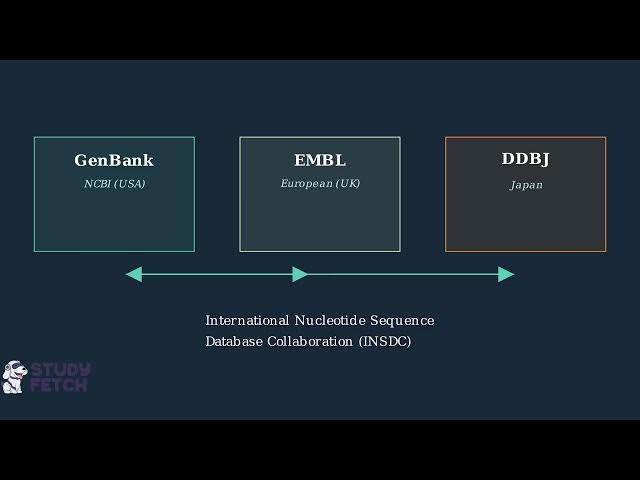
The three major nucleotide sequence
12:27
databases are Genbank from NCBI in the
12:29
USA, EML from Europe, and DDBJ from
12:31
Japan. These databases collaborate
12:34
through the international nucleotide
12:36
sequence database collaboration, sharing
12:39
data daily to ensure global access to
12:41
sequence information.
12:45
First, these databases store raw
12:46
nucleotide sequences, the actual DNA and
12:49
RNA letter codes that make up genetic
12:51
material. Second, they include
12:53
annotations that describe the biological
12:55
features within sequences, such as gene
12:58
locations, and regulatory elements.
13:01
Third, they store metadata, including
13:03
information about the source organism,
13:05
associated publications, and
13:07
experimental conditions.
13:10
This comprehensive information makes
13:11
nucleotide sequence databases invaluable
13:14
resources for genetic research,
13:16
comparative genomics and biotechnology
13:19
applications.
13:22
These databases form the foundation for
13:24
all nucleotide sequence analysis in
13:26
biioinformatics. Protein sequence
13:28
databases are specialized repositories
13:31
that store amino acid sequences and
13:33
comprehensive information about
13:35
proteins.
13:38
Uniprott the universal protein resource
13:40
is the world's most comprehensive
13:42
protein sequence database. Uniprott
13:45
consists of two main components. Swiss
13:48
which contains manually annotated
13:50
highquality entries and tremble which
13:52
provides comprehensive coverage through
13:54
automated annotation.
13:58
Protein sequence databases store various
14:00
types of information including amino
14:02
acid sequences, functional annotations,
14:05
cross references to other databases, and
14:08
gene information.
14:11
Protein sequence databases serve as
14:13
central repositories collecting
14:14
experimental data and providing it for
14:17
functional analysis and research
14:19
applications.
14:21
Protein sequence data is crucial for
14:23
understanding protein function because
14:26
sequence determines structure and
14:28
function, enables comparative analysis,
14:30
supports drug discovery, and facilitates
14:33
evolutionary studies.
14:38
Protein sequence databases provide the
14:40
essential foundation for modern
14:42
proteomics research and drug discovery
14:44
efforts.
14:48
Structural databases are specialized
14:50
repositories that store
14:52
three-dimensional structures of
14:53
biological macroolecules providing
14:56
crucial insights into molecular
14:58
architecture and function.
15:01
The protein datab bank or PDB serves as
15:04
the central worldwide repository for
15:07
structural information of biological
15:09
macroolelecules containing over 200,000
15:12
structures contributed by researchers
15:14
globally.
15:17
Structural data in these databases comes
15:19
from three primary experimental
15:21
techniques. X-ray crystalallography
15:23
provides highresolution atomic details.
15:26
NMR spectroscopy reveals solution
15:28
structures and dynamics and cryeleron
15:31
microscopy captures large molecular
15:33
complexes.
15:36
Structural databases are essential for
15:38
drug design, allowing researchers to
15:41
identify binding sites and design
15:43
molecules that fit precisely into
15:45
protein active sites. These databases
15:48
also enhance our understanding of
15:49
protein function by revealing active
15:52
sites, confirmational changes, and
15:54
interaction interfaces between
15:56
molecules.
15:58
The workflow begins with experimental
16:01
structure determination followed by
16:03
standardized storage in databases
16:06
enabling widespread applications in drug
16:08
discovery and functional analysis.
16:12
Structural databases thus serve as the
16:15
critical bridge between experimental
16:17
structural biology and practical
16:19
applications in medicine and
16:21
biotechnology. Genomic databases store
16:23
complete genome sequences along with
16:26
comprehensive annotations for entire
16:28
organisms.
16:30
Ensemble is one of the leading genomic
16:33
databases providing genome assemblies
16:35
for over 200 species with comprehensive
16:38
gene annotations.
16:41
The UCSC genome browser provides
16:43
interactive visualization tools for
16:45
exploring genomic data with custom track
16:48
integration.
16:51
Genomic databases store three main types
16:53
of information. Gene sequences with
16:56
their structures, regulatory elements
16:58
that control gene expression, and
17:00
genetic variations between individuals.
17:05
Genomic databases enable comparative
17:07
genomics by aligning genome sequences
17:09
across species to identify conserved
17:12
regions and evolutionary relationships.
17:16
These databases support evolutionary
17:18
studies by enabling researchers to trace
17:21
evolutionary history, identify common
17:23
ancestors, and study how gene families
17:26
have evolved over time.
17:29
Genomic databases like Ensemble and UCSC
17:33
provide the foundation for modern
17:34
genomics research and evolutionary
17:36
biology. Gene expression databases store
17:38
crucial information about when and where
17:41
genes are expressed in different
17:43
biological conditions.
17:47
The two major gene expression databases
17:49
are the gene expression omnibus or EO
17:51
maintained by NCBI and array express
17:54
maintained by EMLBI. GIO is maintained
17:56
by NCBI and contains over 5 million
17:59
samples from expression experiments. It
18:02
serves as a public repository following
18:04
M standards for microarray data. Array
18:07
Express is the European counterpart
18:09
maintained by EEBY with a strong focus
18:11
on RNA seek data and functional genomics
18:14
experiments.
18:17
These databases store two main types of
18:19
expression data microarray data and RNA
18:22
sequencing data each with distinct
18:24
characteristics and applications.
18:26
Microarray data uses probe based
18:29
detection for known sequences and
18:31
provides quantitative expression levels
18:33
in a cost-effective manner. RNA seek
18:35
data captures the whole transcriptto
18:38
enabling discovery of novel transcripts
18:40
with single cell resolution and higher
18:42
dynamic range.
18:46
Gene expression databases have critical
18:48
applications in understanding disease
18:50
mechanisms, developmental biology and
18:52
drug discovery in disease studies. These
18:55
databases enable cancer profiling,
18:57
biomarker discovery, and pathway
18:59
analysis to understand disease
19:01
mechanisms for developmental biology.
19:04
They reveal tissue specific expression
19:06
patterns, temporal changes, and cell
19:08
differentiation processes. In drug
19:11
discovery, expression databases aid in
19:13
target identification, understanding
19:15
mechanisms of action, and predicting
19:17
potential side effects. These
19:19
comprehensive databases enable
19:21
researchers to understand gene function
19:23
and regulation across diverse biological
19:26
conditions and disease states, making
19:28
them essential tools in modern
19:30
biological research.
19:33
Gene expression databases provide the
19:35
foundation for understanding how genes
19:38
respond to different conditions,
19:40
supporting advances in personalized
19:42
medicine and therapeutic development.
19:44
Metabolic pathway databases store
19:47
comprehensive information about
19:48
biochemical pathways and reactions in
19:51
living organisms.
19:54
The two most prominent metabolic pathway
19:56
databases are keg and biocych each
19:59
offering unique perspectives on
20:01
biochemical networks.
20:04
These databases map complex networks
20:07
where metabolites are connected through
20:08
enzyatic reactions creating intricate
20:11
biochemical pathways.
20:15
Metabolic pathway databases organize
20:17
information systematically, storing
20:19
pathway identifiers, reaction details,
20:22
enzyme classifications, and metabolite
20:24
information.
20:27
These databases are crucial for
20:29
understanding cellular metabolism and
20:31
identifying potential drug targets by
20:33
revealing critical enzymes and pathways.
20:39
Metabolic pathway databases provide
20:41
comprehensive coverage, enable
20:43
cross-species comparisons, and integrate
20:45
with other biological data sources.
20:50
Interaction databases store information
20:53
about how molecules interact within
20:55
cells, forming complex networks that
20:57
drive biological processes.
21:01
String database contains protein protein
21:04
interaction data showing how proteins
21:06
work together in cellular pathways and
21:08
complexes.
21:11
Transfac database stores transcription
21:13
factor binding site data showing how
21:16
regulatory proteins control gene
21:18
expression by binding to specific DNA
21:20
sequences.
21:23
These interaction databases enable
21:25
network analysis, helping researchers
21:27
identify drug targets, understand
21:29
disease mechanisms, and map biological
21:32
pathways.
21:35
In systems biology, interaction
21:37
databases provide the foundation for
21:39
understanding how molecular networks
21:41
create complex cellular behaviors and
21:43
responses.
21:46
Interaction databases are essential
21:48
tools for mapping the complex web of
21:51
molecular relationships that govern
21:53
life. Literature and citation databases
21:56
are essential tools in biioinformatics
21:58
that store and organize scientific
22:00
publications.
22:02
PubMed is the most widely used
22:04
biomedical literature database
22:06
maintained by the national library of
22:08
medicine.
22:14
Web of Science provides broader
22:16
scientific coverage and powerful
22:17
citation tracking capabilities across
22:20
multiple disciplines.
22:26
PubMed Central is a free full text
22:28
archive that provides complete access to
22:31
biomedical research articles.
22:38
Researchers use these databases in an
22:40
integrated workflow to discover
22:41
literature, track citations, and access
22:44
full text content.
22:53
These literature databases form the
22:55
foundation for evidence-based research
22:57
in biioinformatics and biomedical
22:59
sciences. Sequence analysis tools are
23:02
fundamental in bioinformatics for
23:04
comparing and analyzing biological
23:06
sequences.
23:08
BLAST is the most fundamental tool in
23:10
biioinformatics, allowing researchers to
23:12
search for similar sequences in vast
23:14
databases. The BLAST workflow involves
23:17
inputting a query sequence, searching
23:19
databases, finding alignments, and
23:21
ranking results by similarity.
23:25
Sequence alignment compares two
23:26
sequences to identify regions of
23:28
similarity. Scoring matches and
23:30
mismatches. Alignment algorithms score
23:33
matches, mismatches, and gaps to
23:35
determine the best possible alignment
23:37
between sequences.
23:39
BLAST identifies homologous sequences by
23:42
measuring statistical significance
23:44
through E values and similarity scores.
23:47
E values measure the likelihood that
23:49
observed similarity occurred by chance
23:51
with lower values indicating more
23:53
significant matches.
23:56
Sequence analysis tools enable function
23:58
prediction by finding homologous
24:00
sequences with known functions in
24:02
databases.
24:04
Sequence analysis tools help study
24:06
evolutionary relationships by comparing
24:09
similarities between species and
24:11
constructing phogenetic trees. These
24:13
tools form the foundation of
24:15
computational biology, connecting raw
24:17
sequence data to functional and
24:19
evolutionary insights.
24:23
Sequence analysis tools continue to
24:25
evolve, enabling deeper understanding of
24:27
biological systems. Comparative genomics
24:30
tools enable scientists to compare
24:32
genomes across different species to
24:34
understand evolution and function.
24:39
Here we see genome representations from
24:41
three different species, each containing
24:43
genes arranged in chromosomeal segments.
24:45
Mauv is a powerful tool that aligns
24:48
multiple genomes to identify conserved
24:50
regions shown here in yellow. These
24:52
connections show how conserved sequences
24:55
maintain their relationships across
24:56
species despite chromosomeal
24:58
rearrangements.
25:02
Orthoinder identifies gene families by
25:04
grouping genes that evolved from a
25:06
common ancestor. These tools also
25:09
construct phoggenetic trees showing
25:11
evolutionary relationships between
25:13
species based on genome similarities.
25:18
Comparative genomics tools have three
25:20
major applications in research. First,
25:22
they help discover functional elements
25:24
by identifying conserved non-coding
25:26
regions that likely have regulatory
25:29
functions. Second, they enable disease
25:32
gene analysis by comparing pathogen
25:34
genomes to identify potential drug
25:36
targets. Third, they support
25:38
evolutionary studies by tracking gene
25:40
duplication and loss events across
25:42
lineages.
25:45
The comparative genomics workflow starts
25:47
with genome input, proceeds through
25:49
alignment using tools like mauv,
25:52
identifies gene families with
25:53
orthoinder, and produces comprehensive
25:56
evolutionary analysis.
25:59
Comparative genomics tools are essential
26:01
for understanding how genomes evolve and
26:04
identifying functional elements
26:06
conserved across species.
26:11
Gene expression analysis tools help
26:13
researchers understand which genes are
26:16
active under different conditions. These
26:18
tools analyze large gene expression data
26:20
matrices to identify patterns and
26:23
differences.
26:25
Desiq 2 is a powerful tool for analyzing
26:27
RNA sequencing data using a statistical
26:30
framework. It uses a negative binomial
26:32
model to handle count data and provides
26:34
proper normalization. DCQ2 also includes
26:38
multiple testing correction to control
26:40
false discovery rates.
26:42
Lima uses linear models for differential
26:44
expression analysis particularly
26:47
effective for microarray data. The lima
26:49
workflow involves fitting linear models,
26:52
applying empirical bay moderation, and
26:55
performing statistical testing.
26:57
Results from differential expression
26:59
analysis are often visualized using
27:02
volcano plots. These plots show
27:04
upregulated genes in green,
27:06
downregulated genes in orange, and
27:08
non-significant genes in blue. Gene
27:11
expression analysis tools have crucial
27:13
applications in understanding disease
27:16
mechanisms. They are also essential for
27:18
biomarker discovery, helping identify
27:20
potential therapeutic targets. The
27:22
typical workflow involves collecting
27:24
samples, generating expression data,
27:27
applying analysis tools, and validating
27:29
findings.
27:32
Network analysis tools are essential for
27:34
understanding complex biological systems
27:37
through their interaction patterns.
27:40
Citescape is a popular open-source
27:42
platform for visualizing molecular
27:44
interaction networks and biological
27:46
pathways.
27:49
Network X is a Python library that
27:51
provides tools for creating,
27:52
manipulating, and analyzing complex
27:55
networks programmatically.
27:57
These tools transform raw biological
28:00
data into interpretable network
28:01
visualizations, revealing hidden
28:04
patterns and important relationships.
28:07
Network analysis tools help understand
28:09
various cellular systems, including
28:11
protein interactions, gene regulation,
28:14
and metabolic pathways.
28:16
Network analysis tools use centrality
28:19
metrics to identify key regulatory nodes
28:21
that control important cellular
28:23
processes. These network analysis tools
28:26
enable researchers to uncover the
28:28
organizational principles of biological
28:30
systems and identify potential
28:32
therapeutic targets.
28:35
Data visualization tools transform
28:37
overwhelming biological data sets into
28:39
clear, interpretable formats that reveal
28:41
patterns and insights. Instead of
28:44
staring at endless rows of raw sequence
28:46
data and numbers, researchers can see
28:48
genomic features, expression patterns,
28:51
and biological pathways.
28:54
Let's explore the key types of
28:55
visualization tools used in
28:57
biioinformatics. Genome browsers like
28:59
IGV allow researchers to visualize
29:02
genomic data across chromosomal
29:04
coordinates. They display multiple data
29:06
tracks simultaneously, showing reference
29:08
sequences, gene annotations, expression
29:11
data, and varants all aligned to genomic
29:14
positions.
29:15
Another crucial category is pathway
29:17
visualization tools. Pathway
29:19
visualization tools like path vis
29:21
represent biological processes as
29:24
interconnected networks of molecules and
29:26
reactions. They show metabolites,
29:28
enzymes, and regulatory relationships,
29:31
helping researchers understand how
29:33
biological systems function and respond
29:35
to changes.
29:37
Biioinformatics employs many other
29:39
specialized visualization approaches.
29:42
Expression heat maps reveal gene
29:43
activity patterns across conditions.
29:46
Phogenetic trees show evolutionary
29:48
relationships. Protein networks display
29:51
molecular interactions.
29:53
Why are these visualization tools so
29:55
critical for biological research?
29:58
Effective visualization enables pattern
30:00
recognition in complex data sets,
30:02
integrates diverse data types, generates
30:04
new hypotheses, and communicates
30:06
findings clearly.
30:09
The best biioinformatics visualization
30:11
tools share several important
30:13
characteristics. Interactive
30:15
exploration, format flexibility,
30:17
customization options, publication ready
30:19
exports, and pipeline integration make
30:22
visualization tools truly powerful for
30:24
biological research.
30:27
Data visualization tools transform
30:30
biological complexity into actionable
30:32
insights, making them indispensable for
30:34
modern biioinformatics research.
30:37
Database retrieval systems consist of
30:39
three essential components that work
30:41
together to process biological data
30:43
queries.
30:45
The user interface handles query input
30:47
and result presentation. The query
30:49
processor interprets and executes
30:51
searches and data storage contains the
30:54
biological databases. Data flows from
30:56
the user interface through the query
30:58
processor to the storage systems, then
31:01
back with results.
31:03
Let's examine the detailed workflow of
31:05
how a biological database query is
31:07
processed step by step. The workflow
31:10
begins when a user submits a query
31:11
through the interface.
31:13
The query processor then parses and
31:16
validates the input checking for proper
31:18
syntax and parameters. Next, the system
31:20
executes searches across relevant
31:22
biological databases simultaneously.
31:25
Results are compiled from multiple
31:27
sources and ranked by relevance and
31:28
quality scores. Finally, results are
31:31
formatted and presented to the user in a
31:33
readable format.
31:36
Biological database retrieval systems
31:38
have specialized features for handling
31:40
complex biological data types.
31:43
Sequence-based queries use specialized
31:45
algorithms like BLAST for similarity
31:47
searching and pattern matching. These
31:50
systems also integrate annotations,
31:52
cross references, and functional data to
31:55
provide comprehensive biological
31:56
context.
31:58
These systems employ advanced
32:00
optimization techniques including
32:02
indexing, parallel processing, and
32:05
caching to handle large biological data
32:07
sets efficiently.
32:10
Database retrieval systems form the
32:12
backbone of biological data access,
32:15
enabling researchers to efficiently
32:17
query and retrieve information from vast
32:19
biological databases. Query processing
32:22
in biological databases involves a
32:24
systematic workflow to handle user
32:26
requests efficiently. The process
32:28
consists of three main stages. Parsing
32:30
the user query, optimizing it for
32:32
efficient execution, and finally
32:34
executing the query to retrieve results.
32:37
Let's examine each stage in detail,
32:39
starting with query parsing. Query
32:41
parsing validates the syntax, identifies
32:43
tokens, analyzes structure, and extracts
32:46
parameters from user input. For example,
32:49
a blast search query would be parsed to
32:51
extract the sequence, search parameters,
32:53
and validation criteria. Next is query
32:56
optimization which improves performance.
32:58
Optimization includes index selection,
33:01
query rewriting, resource planning and
33:03
execution plan generation. The optimizer
33:06
transforms inefficient queries into
33:08
optimized versions for better
33:10
performance. Finally, the execution
33:12
stage processes the optimized query.
33:14
Execution involves data access,
33:17
algorithm application, result filtering,
33:19
and output formatting. Now, let's
33:21
explore different types of queries used
33:23
in biological databases. Biological
33:25
databases support three main query
33:27
types. Keyword searches for textbased
33:30
retrieval, sequence similarity searches
33:32
for finding related sequences, and
33:34
structured queries for complex data
33:36
filtering. These queries are implemented
33:39
through various languages and
33:41
interfaces. Query languages include SQL
33:43
for relational databases, BLAST syntax
33:46
for sequence searches, REST APIs for
33:48
programming, web forms for users, and
33:50
GraphQL for flexible retrieval. Each
33:53
interface provides different levels of
33:54
complexity and functionality for
33:57
accessing biological data. Query
33:59
processing in biological databases
34:01
combines efficient parsing,
34:03
optimization, and execution to handle
34:05
diverse query types through multiple
34:07
interfaces, enabling researchers to
34:10
access biological data effectively.
34:13
Data presentation and integration are
34:16
crucial final steps in biioinformatics
34:18
workflows.
34:21
Biological databases present data in
34:23
multiple formats to meet different user
34:25
needs. Text formats include FASTA for
34:28
sequences, XML for structured data, and
34:30
JSON for programmatic access. Graphical
34:33
displays provide visual representations
34:35
like sequence alignments and protein
34:37
structures. Download options allow users
34:40
to export data in various formats for
34:42
further analysis.
34:45
Integrating data from multiple
34:47
biological databases presents several
34:49
significant challenges. Format diversity
34:52
means databases use different file
34:54
formats and data schemas. Naming
34:56
conventions vary, requiring cross
34:58
references to link related data across
35:00
databases. Data quality varies
35:03
significantly between databases in terms
35:05
of annotation depth and accuracy.
35:09
Several approaches help overcome
35:11
integration challenges in
35:12
biioinformatics.
35:14
Standardized APIs provide consistent
35:16
programmatic access to different
35:18
databases. Common data models establish
35:21
shared formats and structures across
35:23
databases. Cross references link related
35:26
entries between different database
35:27
systems. Federated search systems allow
35:30
simultaneous querying of multiple
35:32
databases.
35:35
Several powerful tools provide
35:37
integrated access to multiple biological
35:39
databases. NCBI onres provides unified
35:42
search across over 40 databases with
35:45
cross database linking. Uniprott offers
35:47
protein centric integration with cross
35:49
references to over 150 databases.
35:54
Modern biioinformatics platforms create
35:57
seamless data flow from multiple sources
35:59
to users.
36:02
Effective data presentation and
36:04
integration are essential for making
36:06
biological data accessible and useful to
36:08
researchers worldwide.
36:12
Thanks for learning about
36:13
biioinformatics databases and tools with
36:16
Sparky.
Jobs & Education
Biological Sciences