Up next in 10



“The way my mind works is just out of anxiety and catastrophization.”
Show More Show Less View Video Transcript
0:00
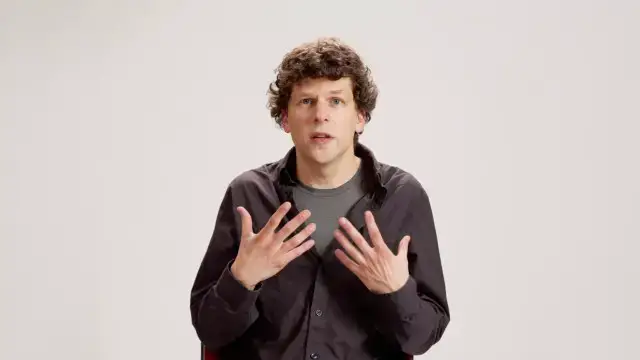
Hi, my name is Jesse Eisenberg
0:01
I'm known as an actor. I also write and direct. And I forgot the other thing that I was supposed to say
0:08
because I was, sorry. I'm going to get better by this in the next answer
0:13
What is the thing it was supposed to be like? I have an anxiety that's a performance anxiety
0:18
I have what you might call stage fright. I think my therapist calls it something a little more
0:23
medical, but I have those feelings quite deeply. Every other year or so, I would write a play and perform a play that I had written
0:41
And I would perform the show, you know, 150 times. That's, you know, when you do a run of a play, you know, that's how many performances you do
0:49
which might sound just, you know, crazy to an outsider that you do that same play 150 times
0:55
But as the performer in it, every one of those 150 times feels so different
1:00
And so I would notice that as the play went on, the run of the play went on, when we would get to performance 100 out of, let's say, 150, it would just get worse and worse and worse
1:09
Now, it's totally counterintuitive because you would assume that if you've done 100 performances and they've all gone well, why would the 101st go bad
1:16
But the way my mind works, which is just out of anxiety and catastrophization, is that I assume that because the 101st performances went well, the 101st is definitely not going to go well
1:27
that you can't land on red 100 times without hitting black. And so that's how I think
1:34
So I would be most anxious by the 150th performance that I cannot believe we've done 149 shows
1:40
and they've all gone so well. Tonight's the night where I'm not only going to screw it up, but I'm going to turn to the audience
1:44
and say the most embarrassing thing that I would never even tell my best friend
1:49
Okay, so this is kind of how I think. I think a lot of people can relate to that in other industries
1:54
because we all have this feeling that, you know, if something's going right, you know, if you're a person who worries
2:01
the next thing's going to go wrong. And it's so strange because when I'm having these kind of like
2:05
anxiety kind of panic attacks before the performances, my colleagues who have been like
2:13
uniformly amazing colleagues, especially dealing with somebody who is like kind of emotional like
2:19
I am, you know, they're kind of like laughing at me, which is nice because it shows that
2:23
what I'm feeling is not to be fretted over. And they just know that that's how I am
2:30
And then oftentimes, I'll ask them the same question that I asked them the night before. Do you think it going to go well tonight Do you think it going to go well tonight I remember my one friend Michael Zegan the actor is this great actor He would be backstage every night and he would just be so sweet He would just say yeah I told you that yesterday And I said but do you think tonight going to go well too
2:45
He's like, yeah, yeah, I told you that two nights ago too. And so I'm kind of surrounded by sweet people
2:50
In my industry, I'm sure like a lot of industries, but in particular, kind of the arts, it attracts oftentimes empathetic people
2:56
And so it's good for my personality to be around that, or maybe it enables my personality to get worse
3:03
But if somebody were to come to me and said, you know, I'm panicking, and I said, why
3:09
And they said, I did 149 shows, and I know the 150th is going to be the worst one
3:15
You know, of course, I would say, how could you possibly think that? You have to look at those 149 as evidence, foolproof evidence, that the 150th is going to be exactly the same
3:26
For something bad to go wrong, it would have to be such an unbelievable fluke, because it would have gone wrong before
3:30
And it probably would have gone wrong in the beginning, those first 10 performances
3:35
And so it's funny, I am able to both see outside myself and see that kind of what is worrying
3:42
or rankling me is probably not healthy or totally rational. But when it feels that way, it's hard to not believe it because, you know, feelings are
3:52
oftentimes so much more powerful than rational thoughts can be. I've been on movie sets before where I had what I would call like legitimate panic attacks
4:07
like where your body kind of, you know, sometimes it races and you, you know, kind of feeling like
4:11
your breath is, you know, racing and your heart's racing and you feel like you're hyperventilating
4:16
But I've also had these other kind of weird panic attacks where your body just kind of shuts down. And in scenes where I was supposed to be, you know, kind of open, I felt closed
4:26
And that was like its own kind of very scary panic attack. and I was doing a movie called Adventureland
4:31
where I had a scene, it was kind of a simple scene but I was like saying goodbye to my parents because I was moving to New York City
4:37
And my body just shut down. I just had a panic attack and I asked if we can stop filming
4:44
and I went over to the director and I just said, I'm so sorry, I don't know what happened. I just froze
4:48
And it was this very sweet, wonderful director, Greg Mottola, who every actor who works with him
4:53
wants to work with him again. He's just this lovely, sensitive person. And he took me aside, he said
4:57
Oh, take a break, everybody, for five minutes. He took me aside and he said, I just want to let you know that not only do I understand what you're
5:03
experiencing right now, but I'd be so surprised if you didn't experience it all the time
5:07
You're doing a job that's kind of emotional, that is demanding, and yet you also worrying if your hair looks not dumb And so I couldn understand how anybody would do the job you do I certainly would never be able to And I just had this like you know incredibly cathartic experience hearing that advice And I went back and did the scene and it was great The scene was you know great because
5:25
I, the kind of weight off my shoulders was removed because I, the expectations I had for myself
5:32
of being like, you know, perfect in every moment were just taken away. I just said, oh yeah
5:37
this job that I do does have difficult aspects to it. And I shouldn't try to kind of, let's say
5:43
ignore those things. I should try to just understand that they're there. They're probably
5:47
always going to be there. And let me just try to embrace them. And, you know, that applies to
5:53
any profession because, you know, all professions have unusual quirks, unusual difficulties that
6:00
you know, you probably think are pretty difficult to explain to somebody not in that field. But what I found is what I felt that day on that set was very normal, very common
6:11
You know, my cousin is a sports journalist and he panics the day before a deadline writing about football
6:16
Again, it's something that I think is totally unrelated to my experience as an actor in a movie
6:21
And yet we commiserate about that same fear. I do find that when I'm around people who kind of have similar emotional experiences that I do
6:36
which is to say kind of self-doubt, panic about future things, catastrophizing otherwise benign
6:43
experiences, I love being in the position of giving advice, of helping somebody, of calming them down
6:48
because it feels wonderful to help somebody. And then for the selfish reason of you seeing
6:54
that actually their fears are oftentimes your fear. You know, giving that advice can also
6:59
you know, help you be able to receive it the next time. When I was on the set of my own movie as a
7:06
director, I was not acting in my first movie. Finn Wolfhard was the main character, and he's just the
7:12
loveliest, most talented young man. You know, he's a rock star. He's a famous movie star. And so you
7:19
think, wow, this kid must be so comfortable. It must be so cool. And yet, like everybody I meet
7:24
who's very good at their thing, he was panicked the whole time. He was worried the whole time that
7:28
he wanted to be good. And I saw it was like the second day he had like a monologue, the second
7:32
day of the shoot. And I asked him how he was in the morning. And he said, actually, I had a really
7:37
tough night. I was kind of panicking about the scene today. And I was so happy to be able to
7:42
to impart this wonderful advice I got so many years ago as an actor
7:48
I took him aside and I said the thing I've always wanted to tell another actor, which is like listen I understand what you do I understand it can be very difficult I understand you putting yourself out there emotionally while also trying to remember three pages of dialogue while also worrying that the makeup that you wearing today maybe makes you look vain or more
8:08
attractive than the character should look, and that you're worried that the audience is going to think maybe you're a vain person. You're trying to be natural and emotional that whole time. And
8:16
you know what? That's very difficult. And I just want to tell you, Finn, I just want to tell you
8:21
what I heard from a wonderful other director, that all of that's normal. The fact that you don't feel
8:26
that every second is probably a miracle. And when you do feel it, use it. Have it be part of the
8:32
scene. Have that anxiety come through in the character. Don't deny that anxiety. Have it come
8:37
through and you'll never worry about anything. Because his character in that scene was really
8:41
anxious to talk to this young person at this club that they were at. And he was feeling very nervous
8:47
And I said, you know, that feeling, you shouldn't deny it. Just feel that feeling. And so once you stop kind of like denying the kind of feelings that you're having and try to maybe redirect them to a healthy outcome, you know, you don't worry as much
9:02
I'll just say, also, I go to an acting coach. So when I have a new role, I'll go to the acting coach and we'll do some esoteric, some
9:10
practical work together, dream exercises, but also kind of practical stuff about, you
9:15
know, how to think, what to think on set in between takes. And, you know, I had stage fright for a long time and she gave me the best advice
9:22
She just said to me, you know, when you're experiencing that anxiety on set, that's the
9:26
character experiencing anxiety. So use it. And what it taught me in kind of like a macro way was to kind of like not be fearful that I'm going to have a bad feeling
9:35
In fact, have that bad feeling remind me that I am motivated to be feeling things on stage
9:42
And so when I have a bad feeling on stage of panic, of worry, I now use it as a motivator
9:48
Sometimes I think this is the character having that panic attack. And you know what? The character might have a panic, even if he's having a confident scene here
9:55
You know, most characters are dealing with other things. And I think this would also apply to other industries because oftentimes that panic attack
10:03
could really just mean that you really care about what you're doing. And instead of worrying that I might have a panic attack during this presentation or this meeting
10:10
you could think, you know what, if I have a panic attack during this meeting, it's because I really care about it. I'm going to take a second, I'm going to breathe, and I'm going to remind myself that
10:17
this anxiety comes from a place of really, you know, investing in what I'm talking about
10:22
To watch the full class, become a member at bigthink.com slash membership
10:28
Thank you
#Mental Health
#Anxiety & Stress
#Self-Help & Motivational