Up next in 10

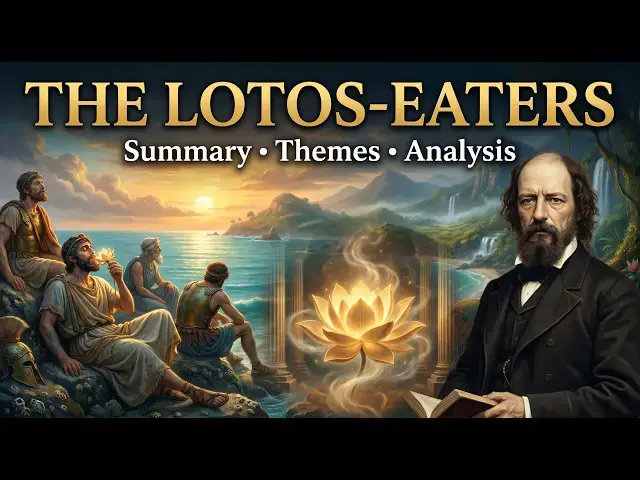
The Lotos-Eaters by Alfred Lord Tennyson | Complete Summary, Themes & Analysis | English Literature
Jun 20, 2026

In this lecture, we explore The Lotos-Eaters by Alfred Lord Tennyson in detail. The video explains the poem's mythological background, historical and literary context, detailed summary, major themes, symbolism, literary devices, and critical interpretations.
Topics covered in this lecture:
✔ Introduction to The Lotos-Eaters
✔ Alfred Lord Tennyson and Victorian Poetry
✔ Relationship with Homer's Odyssey
✔ Mythological Background of Odysseus and the Lotus-Eaters
✔ Detailed Summary of the Poem
✔ Major Themes:
Weariness and Exhaustion
Escape from Reality
Rest versus Duty
Nature and Peace
Human Responsibility
The Meaning of Human Existence
✔ Literary Devices and Poetic Techniques:
Imagery
Symbolism
Simile
Personification
Repetition
Alliteration
Musical Language and Rhythm
✔ Critical Interpretation of the Poem
✔ Important Questions for Literature Students
This lecture is designed for undergraduate students, English literature learners, competitive examinations, and anyone who wants a clear and comprehensive understanding of Tennyson's famous poem.
📚 Recommended for:
BA English Literature Students
BS English Students
MA English Students
Literature Teachers
Competitive Exam Preparation
General Readers Interested in Poetry
🔔 Subscribe for more English Literature lectures:
https://youtube.com/@askliterature
#TheLotosEaters #AlfredLordTennyson #EnglishLiterature #VictorianPoetry #PoetryAnalysis #LiteraryAnalysis #PoetrySummary #Tennyson #EnglishLiteratureLecture #LiteratureStudents #TheOdyssey #GreekMythology #AskLiterature
Show More Show Less View Video Transcript
0:00
The Lotus Eaters is one of the best
0:01
known poems of Alfred, Lord Tennyson.
0:05
Tennyson was born in 1809 and died in
0:08
1892.
0:10
He was one of the major poets of the
0:12
Victorian age and served as poet
0:14
laureate of Britain from 1850 until his
0:16
death.
0:18
His poetry is admired for its musical
0:20
language, rich imagery, and thoughtful
0:23
exploration of human emotions and
0:24
experiences.
0:27
The Lotus Eaters was first published in
0:29
1832 in Tennyson's early volume of
0:32
poems.
0:33
He later revised it extensively and
0:36
republished it in 1842.
0:39
The revised version of 1842 is the
0:42
version that is generally studied today.
0:45
The poem is based on a brief episode in
0:47
the Odyssey, the ancient Greek epic
0:50
traditionally attributed to Homer.
0:53
In Homer's narrative, Odysseus and his
0:55
companions arrive at the land of the
0:57
Lotus Eaters during their long journey
0:59
home after the Trojan War.
1:02
Some of the sailors eat the lotus fruit
1:04
and lose their desire to continue the
1:06
voyage.
1:08
Tennyson takes this short incident and
1:10
develops it into a long and reflective
1:12
poem.
1:13
He explores questions about work,
1:16
suffering, rest, and human
1:17
responsibility.
1:19
The poem examines a feeling that many
1:21
people experience at different times in
1:23
their lives.
1:25
After periods of hardship, people may
1:27
long for relief, peace, and freedom from
1:30
constant demands.
1:32
At the same time, the poem does not
1:34
simply praise escape from
1:36
responsibility.
1:38
It also raises difficult questions.
1:41
Why does human life involve so much
1:43
labor? Why do people become weary? Is
1:46
complete withdrawal from duty desirable?
1:49
By asking these questions, the Lotus
1:51
Eaters becomes both a beautiful poem and
1:53
a thoughtful meditation on human
1:55
existence.
1:57
Mythological background.
2:00
To understand the Lotus-Eaters, students
2:03
should know something about the story of
2:04
Odysseus.
2:07
In Greek mythology, Odysseus was the
2:09
king of Ithaca and one of the Greek
2:11
leaders during the Trojan War.
2:14
According to Greek legend, the war
2:15
lasted for 10 years.
2:18
After the war ended, Odysseus and his
2:20
companions began their voyage home.
2:24
Their return journey proved extremely
2:26
difficult.
2:28
Instead of reaching Ithaca quickly, they
2:30
wandered for another 10 years.
2:33
They encountered storms, monsters,
2:35
magical beings, and many dangerous
2:37
situations.
2:39
These adventures form the subject of
2:40
Homer's Odyssey.
2:43
One of these adventures took place in
2:45
the land of the Lotus-Eaters.
2:48
According to Homer, strong winds carried
2:50
Odysseus and his men to an unknown
2:52
island.
2:54
The inhabitants of this island were
2:56
called the Lotus-Eaters because they
2:57
lived by eating the fruit of the lotus
2:59
plant.
3:01
Odysseus sent some of his men to
3:03
investigate the island.
3:05
The inhabitants welcomed them and gave
3:07
them lotus fruit to eat.
3:10
After eating the fruit, the sailors no
3:12
longer wished to return home.
3:15
They wanted to remain on the island and
3:16
live peacefully among the Lotus-Eaters.
3:20
The poem does not describe the sailors
3:22
as becoming mad or violent.
3:25
Rather, they lose their desire to
3:27
continue their journey.
3:29
The lotus causes forgetfulness and
3:31
indifference toward their previous aims.
3:35
In Homer's account, this episode is very
3:37
brief.
3:39
Odysseus immediately forced his men back
3:41
to the ships and sailed away before more
3:43
sailors could eat the lotus.
3:46
Tennyson transforms this short incident
3:49
into a major philosophical poem.
3:52
He imagines what the sailors might think
3:54
after eating the lotus.
3:56
He explores their weariness and their
3:58
desire to escape from suffering and
4:00
responsibility.
4:04
The lotus therefore becomes an important
4:06
symbol in the poem.
4:08
It may be understood as a symbol of
4:10
forgetfulness, rest, and escape from
4:12
difficult duties.
4:15
Through this symbol, Tennyson explores a
4:17
universal aspect of human experience.
4:21
Many people occasionally wish to escape
4:23
pressure and enjoy complete peace.
4:26
Historical and literary context.
4:30
Tennyson lived during the Victorian age.
4:33
This period was marked by industrial
4:36
growth, scientific developments, and
4:38
major social changes.
4:40
Britain became increasingly powerful and
4:43
modern during this time.
4:45
Many Victorian writers and social
4:47
thinkers valued hard work, discipline,
4:50
duty, and progress.
4:52
These ideas became important features of
4:55
Victorian culture.
4:57
People were often encouraged to work
4:59
diligently and fulfill their
5:00
responsibilities.
5:03
However, the period was also marked by
5:05
anxiety and uncertainty.
5:08
Industrial and social changes created
5:10
new pressures.
5:12
Many people experienced feelings of
5:14
stress and exhaustion.
5:17
The Lotos-Eaters reflects some of these
5:19
concerns.
5:21
The poem explores the desire to escape
5:23
from continuous labor and struggle.
5:27
The poem also shows the influence of
5:29
romanticism.
5:31
Romantic writers often emphasized
5:33
imagination, emotion, individual
5:36
experience, and the beauty and spiritual
5:38
power of nature.
5:40
They frequently portrayed nature as a
5:42
source of comfort and inspiration.
5:46
The dream-like landscape in The
5:48
Lotos-Eaters shows this romantic
5:49
influence.
5:51
Yet the poem's questions about work,
5:53
duty, and exhaustion connect it strongly
5:56
to Victorian concerns.
5:58
In this way, the poem combines romantic
6:01
imagination with Victorian thought.
6:04
Detailed summary of the poem.
6:08
The poem opens with Odysseus encouraging
6:10
his companions. "Courage," he said and
6:13
pointed toward the land.
6:16
The sailors approach an unknown island.
6:19
The landscape immediately appears
6:21
unusual.
6:23
The air seems calm and sleepy.
6:26
Streams move gently through valleys.
6:29
The mountains rise silently into the
6:31
sky.
6:33
Everything appears peaceful and still.
6:36
The descriptions create the impression
6:38
that the island exists outside ordinary
6:40
time.
6:42
Nothing seems hurried.
6:44
Nothing appears disturbed.
6:47
The sailors meet the inhabitants of the
6:49
island and eat the lotus fruit.
6:53
After eating the lotus, their state of
6:54
mind changes.
6:56
Their desire to continue the voyage
6:58
gradually disappears.
7:01
They become calm and detached from their
7:03
former concerns.
7:05
The second and larger part of the poem
7:07
is called the Choric Song.
7:10
The title refers to the chorus in
7:12
ancient Greek drama.
7:15
In Greek plays, the chorus commented on
7:17
events and expressed collective
7:18
feelings.
7:21
Similarly, Tennyson gives the sailors a
7:23
collective voice through which they
7:25
express their shared thoughts.
7:28
The sailors describe the island as a
7:30
place where in which it seemed always
7:32
afternoon. The image of perpetual
7:35
afternoon suggests calmness and freedom
7:37
from urgency.
7:39
It creates the impression of a world
7:41
where struggle and activity have almost
7:43
ceased.
7:45
The sailors then begin to reflect on
7:47
human life.
7:49
They observe that many things in nature
7:51
eventually come to rest.
7:53
Clouds drift quietly.
7:56
Leaves fall from trees.
7:59
Flowers bloom and fade.
8:01
Even natural processes seem gentle and
8:04
unhurried.
8:06
The sailors wonder why human beings
8:08
alone appear destined for endless labor.
8:11
They ask the famous question, "Why
8:13
should life all labor be?" This question
8:16
lies at the center of the poem.
8:19
The sailors feel that human life
8:21
consists of continuous effort and
8:23
repeated suffering.
8:25
They compare themselves to waves that
8:27
rise and fall endlessly.
8:30
They also think about their homes and
8:32
families.
8:33
However, these memories no longer
8:35
inspire them to continue the journey.
8:38
They believe that their loved ones may
8:40
have changed during their long absence.
8:43
Gradually, the sailors reject the heroic
8:46
values that once guided them.
8:49
They no longer wish to continue their
8:50
difficult mission.
8:52
Instead, they wish to remain on the
8:54
island.
8:56
They describe the beauty of the place.
8:59
"There is sweet music here that softer
9:00
falls than petals from blown roses on
9:03
the grass."
9:05
The island appears to offer peace,
9:07
beauty, and relief from suffering.
9:10
By the end of the Choric Song, the
9:12
sailors argue that they should remain on
9:14
the island and abandon their voyage.
9:18
Major themes.
9:20
Weariness and exhaustion form the
9:22
central theme of the poem.
9:25
The sailors have endured many hardships.
9:28
They have fought in a long war and have
9:30
wandered for years.
9:32
Their exhaustion is physical, emotional,
9:35
and mental.
9:36
They no longer possess the desire to
9:38
continue struggling.
9:41
Many readers sympathize with the sailors
9:43
because fatigue and discouragement are
9:45
common human experiences.
9:48
Tennyson explores these feelings with
9:50
understanding and seriousness.
9:53
Another major theme is escape from
9:55
reality.
9:57
The lotus may be understood as a symbol
9:59
of escape.
10:01
After eating it, the sailors no longer
10:03
wish to continue their difficult
10:05
journey.
10:07
They prefer peace and forgetfulness to
10:09
struggle and responsibility.
10:13
The poem explores why escape can appear
10:15
attractive.
10:17
The island offers calmness and freedom
10:19
from pain.
10:21
However, the poem also shows that such
10:23
peace may require the abandonment of
10:25
duties and commitments.
10:28
The conflict between rest and duty is
10:30
equally important.
10:33
Odysseus can be seen as representing
10:35
perseverance and determination.
10:38
The sailors increasingly desire rest and
10:40
withdrawal.
10:42
The poem therefore presents a conflict
10:44
between action and inactivity.
10:48
The poem does not provide a simple
10:50
solution.
10:52
Instead, it invites readers to think
10:53
carefully about the relationship between
10:55
work and rest.
10:58
Nature also plays a significant role.
11:01
The island is described through images
11:03
of streams, valleys, flowers, and soft
11:06
light.
11:08
The natural landscape creates an
11:09
atmosphere of peace and stillness.
11:13
For the sailors, this environment
11:15
appears to offer an escape from
11:17
suffering.
11:19
The beauty of the island strengthens
11:20
their desire to remain there.
11:24
The poem also explores the universal
11:26
desire for peace.
11:28
Many people experience moments of
11:30
stress, weariness, or disappointment.
11:34
During such times, rest and escape can
11:36
seem deeply attractive.
11:39
For this reason, readers from different
11:41
cultures and historical periods often
11:43
respond strongly to the poem.
11:46
Finally, the poem reflects on human
11:48
existence itself.
11:51
The sailors ask why life involves so
11:52
much labor.
11:54
They wonder why human beings struggle
11:56
continuously while many processes in
11:58
nature seem peaceful and cyclical.
12:02
The poem does not answer these questions
12:04
directly.
12:06
Instead, it encourages reflection on the
12:08
meaning of work, suffering, and human
12:10
responsibility.
12:13
Literary devices and poetic techniques.
12:17
Tennyson's use of imagery is one of the
12:19
poem's greatest strengths.
12:22
Imagery refers to language that appeals
12:24
to the senses.
12:26
The descriptions of streams, mountains,
12:29
valleys, and flowers allow readers to
12:31
imagine the island vividly.
12:33
These images create the poem's
12:35
dream-like atmosphere.
12:38
The poem also employs symbolism.
12:42
The lotus may be interpreted as a symbol
12:44
of forgetfulness, rest, and escape.
12:47
The island itself may be understood as a
12:49
place that seems free from pressure and
12:52
responsibility.
12:54
Tennyson uses similes to make his
12:56
descriptions more vivid.
12:59
One famous example compares a descending
13:01
stream to a downward smoke.
13:04
The comparison creates an impression of
13:06
slow and gentle movement.
13:09
The poem also uses personification.
13:13
At several points, the landscape appears
13:15
almost sleepy and alive.
13:18
This technique strengthens the sense
13:20
that the island belongs to a world of
13:21
dreams and stillness.
13:25
Repetition is another important feature.
13:29
Words and ideas associated with sleep,
13:31
rest, and calmness occur repeatedly
13:33
throughout the poem.
13:35
This repetition reinforces the central
13:38
themes and contributes to the hypnotic
13:40
atmosphere.
13:42
Alliteration also contributes to the
13:44
poem's musical quality.
13:47
The repetition of consonant sounds
13:49
creates softness and harmony.
13:52
Perhaps most importantly, the rhythm of
13:54
the poem moves slowly and smoothly.
13:57
The movement of the lines often
13:59
resembles the calm and dreamy world that
14:01
the sailors experience.
14:04
The poem's language, therefore, does not
14:06
merely describe peace.
14:08
It also allows readers to feel it.
14:12
Critical interpretation.
14:15
Critics have interpreted The
14:16
Lotos-Eaters in different ways.
14:19
Some readers view the sailors
14:21
sympathetically.
14:23
They believe that the poem recognizes
14:25
the limits of human endurance and the
14:27
genuine need for rest.
14:30
Other readers see the sailors as
14:31
irresponsible because they are prepared
14:33
to abandon their duties entirely.
14:37
Some critics interpret the poem as a
14:39
reflection on modern life.
14:42
Human beings often experience stress,
14:44
fatigue, and pressure.
14:46
The sailors' feelings, therefore, seem
14:48
familiar even to modern readers.
14:52
Others view the island symbolically and
14:54
see it as representing any form of
14:56
escape that encourages people to
14:57
withdraw from their responsibilities.
15:01
The poem remains powerful partly because
15:03
it allows these different
15:04
interpretations.
15:07
Readers may understand the sailors'
15:08
longing for peace while also questioning
15:11
the wisdom of their choice.
15:14
Conclusion.
15:16
The Lotos-Eaters is much more than a
15:18
retelling of a Greek myth.
15:21
Through the story of exhausted sailors,
15:23
Tennyson explores fundamental questions
15:26
about work, suffering, rest, and human
15:28
responsibility.
15:30
The poem combines beautiful language,
15:33
rich imagery, and thoughtful reflection.
15:37
Its central conflict between duty and
15:39
the desire for peace remains meaningful
15:41
in every age.
15:43
Most readers understand the temptation
15:45
to escape from pressure and find
15:47
complete rest.
15:49
At the same time, the poem invites
15:51
readers to think critically about the
15:53
consequences of abandoning
15:55
responsibilities altogether.
15:58
For undergraduate students encountering
16:00
the poem for the first time, The
16:02
Lotos-Eaters offers both literary beauty
16:04
and intellectual depth.
16:07
Its enduring appeal lies in its ability
16:09
to transform an ancient myth into a
16:11
profound exploration of human
16:13
experience.
Literary Classics
Poetry
Jobs & Education
Education