Up next in 10

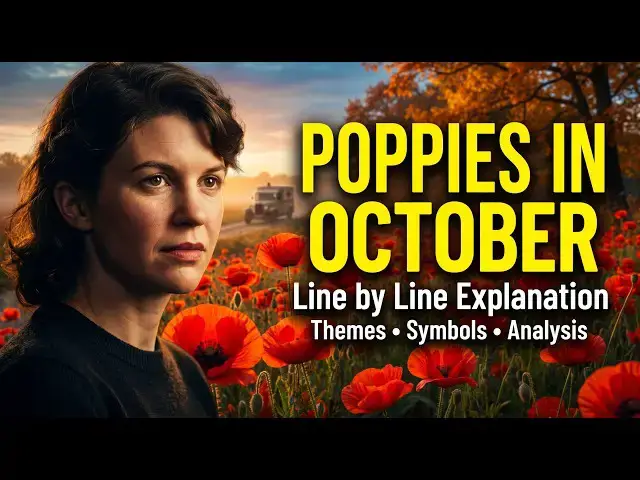
Sylvia Plath's Poppies in October Explained | Themes, Symbols & Literary Devices
Jun 23, 2026

In this video, we study Poppies in October by Sylvia Plath in a simple and easy way. This lecture is specially designed for students who are beginners in English literature and want to understand the poem for examinations.
In this lecture, you will learn:
✔ Introduction to Sylvia Plath
✔ Confessional Poetry and its characteristics
✔ Meaning and significance of the title "Poppies in October"
✔ Complete Line-by-Line Explanation
✔ Difficult words and literary meanings explained simply
✔ Themes of the poem
✔ Symbols and Symbolism
✔ Imagery and Poetic Devices
✔ Tone and Mood of the poem
✔ Critical Appreciation
✔ Exam-oriented analysis and important points
This lecture explains how Sylvia Plath presents unexpected beauty, hope in difficult circumstances, human sensitivity, wonder, and the deep connection between nature and emotions.
By the end of this video, you will fully understand Poppies in October even if you have no prior knowledge of poetry.
📚 Perfect for:
BA English Students
BS English Students
Intermediate Students
Literature Beginners
Competitive Exam Preparation
Subscribe for more lectures on English Literature, Poetry, Novels, Literary Criticism, and Exam Preparation.
#EnglishLiterature #SylviaPlath #PoppiesInOctober #PoetryAnalysis #LineByLineExplanation #LiteraryAnalysis #CriticalAppreciation #AskLiterature
Show More Show Less View Video Transcript
0:00
When we read poetry, we often think that
0:02
poems are difficult and full of
0:03
complicated words.
0:06
Many students become afraid of poetry
0:08
because they believe they will never
0:09
understand it.
0:11
However, good poetry does not always use
0:13
difficult language.
0:16
Sometimes a very short poem can express
0:18
deep feelings and important ideas.
0:21
One such poem is Poppies in October by
0:24
Sylvia Plath.
0:26
At first glance, this poem seems simple
0:29
because it talks about flowers.
0:31
However, when we read it carefully, we
0:34
realize that it is not only about
0:35
flowers.
0:37
It is also about human emotions,
0:39
surprise, beauty, sadness, and hope.
0:43
Most importantly, it shows how small
0:45
things in nature can suddenly touch our
0:47
hearts and affect our feelings.
0:50
Before studying the poem, we should know
0:52
something about the poet who wrote it.
0:55
Sylvia Plath was one of the most famous
0:57
poets of the 20th century.
0:59
She was born on October 27th, 1932 in
1:03
Boston, Massachusetts in the United
1:05
States.
1:06
From an early age, she loved reading and
1:09
writing.
1:10
She was an intelligent student and began
1:13
writing poems when she was still a
1:14
child.
1:16
As she grew older, she showed her talent
1:19
through writing.
1:20
Her only novel, The Bell Jar, also
1:23
became famous, but she is remembered
1:25
mainly for her poetry.
1:28
Sylvia Plath belonged to a literary
1:30
movement known as confessional poetry.
1:34
In this kind of poetry, poets write
1:36
openly about personal feelings,
1:38
experiences, struggles, fears, and
1:40
thoughts.
1:42
Confessional poets made poetry more
1:44
personal and emotionally honest.
1:47
The title of the poem is particularly
1:49
important.
1:51
The first important word is poppies.
1:55
Poppies are flowers famous for bright
1:57
red color.
1:59
Because of their striking appearance,
2:01
they immediately attract attention and
2:03
are difficult to ignore.
2:05
In literature, flowers often symbolize
2:08
beauty, life, freshness, and strong
2:10
feelings.
2:12
Their bright colors remind us that
2:14
nature can be beautiful and full of
2:16
energy.
2:18
The second important word is October.
2:22
October usually falls in autumn.
2:25
During this season, the weather becomes
2:27
cooler, leaves change color, and many
2:29
begin to fall from the trees.
2:32
In literature, autumn is commonly
2:34
associated with change, maturity,
2:36
decline, and the gradual movement toward
2:38
winter.
2:40
When we think about the title again, we
2:42
notice an interesting contrast.
2:45
The bright red poppies suggest life,
2:47
warmth, brightness, and energy, whereas
2:49
October is commonly associated with
2:51
change and the fading of one season into
2:53
another.
2:56
The reader naturally wonders why such
2:57
bright flowers are appearing during a
2:59
season usually associated with change
3:01
and decline.
3:03
The title, therefore, introduces one of
3:05
the poem's central ideas. Unexpected
3:08
beauty often creates the strongest
3:10
emotions.
3:12
This is exactly what Sylvia Plath
3:14
explores in Poppies in October.
3:17
Line by line explanation of Poppies in
3:20
October by Sylvia Plath.
3:23
Now that we know something about Sylvia
3:25
Plath and understand the importance of
3:27
the title, we can begin studying the
3:29
poem itself.
3:31
We should remember one important thing.
3:34
Poetry is not like a story.
3:37
In a story, events usually happen in a
3:38
clear order.
3:40
Poetry often works differently.
3:43
Poets try to capture a feeling, an
3:45
emotion, or a particular moment.
3:49
They frequently use images instead of
3:51
direct explanations and describe what
3:53
they see in a way that allows readers to
3:55
discover deeper meanings.
3:58
Poppies in October is one such poem.
4:01
The speaker notices bright red poppies
4:03
in October and feels deeply moved by
4:05
them.
4:07
For the speaker, these flowers become
4:09
something extraordinary.
4:12
The poem begins with the lines, "Even
4:14
the sun clouds this morning cannot
4:16
manage such skirts."
4:20
The first word, "even," is important
4:22
because it immediately suggests
4:24
comparison.
4:26
The speaker is already comparing one
4:27
thing with another.
4:29
Then we read the expression "sun clouds
4:32
this morning."
4:34
These are clouds illuminated by
4:35
sunlight.
4:37
We can imagine soft, glowing clouds in
4:40
the morning sky.
4:42
The poet immediately creates a clear
4:44
picture in our minds.
4:46
This is called visual imagery, which
4:48
means language that helps readers
4:50
imagine something vividly.
4:53
Morning often symbolizes freshness,
4:55
light, and a new beginning.
4:58
Therefore, the opening of the poem
5:00
creates a bright and pleasant
5:01
atmosphere.
5:03
Then comes the expression "cannot manage
5:06
such skirts."
5:08
At first, this phrase may seem strange
5:10
because the speaker talks about clouds
5:12
as if they are wearing skirts.
5:14
This is an example of figurative
5:16
language.
5:18
The clouds are imagined like people
5:20
dressed in colorful clothing.
5:23
The word "skirts" probably refers to
5:25
shapes and colors spreading across the
5:27
sky.
5:29
More importantly, it emphasizes
5:31
comparison.
5:33
The speaker says that even the beautiful
5:35
morning clouds cannot produce colors as
5:37
magnificent as those of the poppies.
5:41
Immediately, we understand how strongly
5:43
the speaker is affected by the flowers.
5:46
Their colors are so brilliant that even
5:48
the glowing sky cannot compete with
5:50
them.
5:52
The next line says, "Nor the woman in
5:54
the ambulance."
5:57
This line surprises many readers because
5:59
the poem suddenly moves from clouds and
6:01
flowers to a woman in an ambulance.
6:04
An ambulance is usually associated with
6:07
illness, pain, suffering, or emergency.
6:11
The mood changes abruptly.
6:13
A moment ago, we were imagining a
6:15
beautiful morning sky, and now we are
6:18
confronted with an image of human
6:19
suffering.
6:22
This sudden shift creates contrast.
6:25
Beauty and suffering now exist side by
6:27
side.
6:29
Brightness and pain appear together.
6:32
Joy and sadness stand near each other.
6:35
This reflects real life, which is rarely
6:38
completely happy or completely sad.
6:41
Beautiful moments often exist beside
6:43
painful experiences, and we sometimes
6:46
notice something lovely even during
6:48
difficult times.
6:50
The poem captures this complexity of
6:52
human life.
6:54
The next line says, "Whose red heart
6:57
blooms through her coat so
6:58
astoundingly."
7:01
This is one of the most powerful lines
7:03
in the poem.
7:04
The first important words are red heart.
7:08
The color red immediately reminds us of
7:10
the poppies.
7:12
The flowers are bright red, and the
7:14
woman's heart is also described as red.
7:17
This color creates a connection between
7:19
the flowers and the woman.
7:22
Red is often associated with strong
7:24
emotions and intensity.
7:27
It may suggest energy, passion,
7:29
vitality, or life itself.
7:32
Then comes the word blooms.
7:35
Usually, flowers bloom, but here the
7:37
woman's heart is described as blooming.
7:40
This comparison closely links the woman
7:42
and the flowers.
7:45
Her heart becomes flower-like and the
7:46
flowers become almost human.
7:50
Nature and human emotions are brought
7:51
together.
7:53
The word astoundingly means
7:55
astonishingly or surprisingly.
7:59
The speaker is amazed by what she sees.
8:02
The image of the flowers and the woman's
8:04
red heart fills the speaker with wonder.
8:07
This sense of wonder is an important
8:09
emotion throughout the poem.
8:12
The speaker sees something unexpected
8:13
and cannot ignore it.
8:16
The next lines say,
8:18
a gift, a love gift utterly unasked for.
8:23
These lines are central to the poem's
8:25
meaning.
8:26
The speaker first calls the flowers a
8:28
gift and then repeats the idea by
8:30
calling them a love gift.
8:33
A gift is something unexpected.
8:36
It often brings happiness and is freely
8:38
given rather than earned.
8:41
The speaker did not search for these
8:42
flowers or expect to see them.
8:45
They simply appeared.
8:49
The beauty of the flowers feels like a
8:51
present from nature.
8:53
The phrase utterly unasked for
8:56
emphasizes that the speaker did not ask
8:58
for this experience.
9:00
The flowers arrived unexpectedly and
9:02
this idea carries deep meaning.
9:06
Many beautiful experiences in life come
9:08
without warning.
9:10
A kind word, a beautiful sunset, a
9:12
rainbow, a flower in bloom, or a small
9:15
act of kindness may suddenly brighten
9:17
our lives and become lasting memories.
9:20
The speaker experiences the poppies in
9:22
exactly this way.
9:25
They seem like an unexpected gift of
9:26
beauty.
9:28
This idea gives the poem emotional
9:30
warmth and suggests that beauty can
9:32
suddenly enter our lives and transform
9:34
ordinary moments.
9:37
By a sky.
9:39
This phrase continues the previous idea
9:41
of the flowers being a gift.
9:44
The speaker now begins to describe the
9:46
surroundings in which the poppies
9:48
appear.
9:49
The flowers are seen beneath a
9:51
particular sky.
9:53
The shortness of the expression creates
9:55
a pause and makes readers pay attention
9:57
to the scene.
10:00
The sky becomes an important part of the
10:02
atmosphere of the poem.
10:04
Nature is not simply background scenery.
10:08
The sky, the flowers, and the speaker's
10:10
emotions are all closely connected.
10:13
Palely and flamily.
10:17
This expression is unusual and highly
10:19
imaginative.
10:21
The word palely means in a pale or
10:23
light-colored manner.
10:26
It suggests softness and a lack of
10:27
brightness.
10:29
The word flamily is not a standard
10:32
English word.
10:34
Sylvia Plath created it from the word
10:36
flame.
10:38
It suggests something fiery, glowing, or
10:40
burning.
10:42
At first, these two ideas seem
10:43
contradictory.
10:45
Something pale is usually not fiery.
10:49
By placing the words together, Plath
10:51
creates an image of a sky that is softly
10:53
glowing, delicate, yet burning with
10:55
light at the same time.
10:58
This unusual combination increases the
11:00
dreamlike quality of the poem.
11:03
The morning appears magical and
11:05
extraordinary.
11:07
Igniting its carbon monoxides by eyes.
11:11
The verb igniting means setting
11:13
something on fire or causing it to glow.
11:16
Carbon monoxide is a gas produced by
11:19
combustion.
11:21
In the poem, the expression is not meant
11:23
to be understood scientifically.
11:26
Instead, it creates an image of the sky
11:28
becoming filled with fiery colors and
11:30
glowing gases.
11:33
The phrase suggests that the sky itself
11:35
seems to be burning or lighting up.
11:38
Plath mixes scientific language with
11:40
poetic imagery.
11:42
This combination is unusual and makes
11:44
the description vivid and modern.
11:47
The image also strengthens the idea of
11:49
transformation.
11:51
The sky appears alive and filled with
11:53
energy, just as the poppies seem alive
11:56
with their brilliant red color.
11:59
By eyes {slash} dulled to a halt under
12:01
bowlers.
12:03
The word dulled means made less sharp,
12:05
less bright, or less sensitive.
12:08
The expression dulled to a halt suggests
12:11
people whose senses and emotions have
12:13
become tired or inactive.
12:16
Bowlers are bowler hats, which were
12:18
commonly worn by business and
12:20
professional men in Britain.
12:22
The phrase therefore suggests ordinary
12:24
people moving through daily life, busy
12:27
with routine and responsibilities.
12:31
These people are represented by eyes
12:33
that no longer notice beauty.
12:36
Their eyes have become dull and
12:37
insensitive.
12:40
This image creates an important contrast
12:42
in the poem.
12:44
Most people pass through life without
12:46
noticing extraordinary moments.
12:49
They are too occupied with routine and
12:50
habit.
12:53
The speaker, however, notices the
12:54
flowers and is deeply moved by them.
12:58
The poem therefore praises sensitivity
13:00
and careful observation.
13:03
It encourages readers not to become
13:05
emotionally blind to the beauty around
13:07
them.
13:09
Oh my God, what am I?
13:12
This line marks the emotional climax of
13:14
the poem.
13:16
The exclamation "Oh my God" shows
13:18
amazement and wonder.
13:21
The speaker is overwhelmed by the
13:23
experience.
13:25
The question "What am I?" is not asking
13:27
about identity in an ordinary sense.
13:31
Instead, it expresses astonishment.
13:34
The speaker cannot understand why such
13:36
unexpected beauty has been given to her.
13:39
She feels humbled and deeply moved.
13:42
The flowers have created an emotional
13:44
experience so powerful that the speaker
13:47
begins questioning herself and her place
13:49
in the world.
13:51
This moment reveals intense wonder and
13:53
gratitude.
13:55
That these late mouths should cry open.
13:59
The expression late mouths refers to the
14:01
poppies.
14:03
Flowers are compared to mouths that have
14:05
opened.
14:07
This is an example of personification
14:09
because the flowers are given human
14:11
qualities.
14:13
The word late is important.
14:16
The flowers are called late because they
14:18
bloom unexpectedly in October, later
14:20
than one might normally expect such
14:22
brilliant flowers.
14:24
The expression cry open suggests sudden,
14:27
passionate opening.
14:30
The flowers seem alive.
14:32
They seem to call out or express
14:34
themselves.
14:36
This personification makes the poppies
14:38
appear energetic and emotionally
14:40
powerful.
14:41
The flowers are no longer merely plants.
14:45
They become living symbols of unexpected
14:47
beauty and vitality.
14:50
In a forest of frost, in a dawn of
14:52
cornflowers.
14:55
The phrase forest of frost creates a
14:57
striking image.
15:00
Frost is associated with coldness,
15:02
winter, and decline.
15:04
It suggests a world moving toward
15:06
lifelessness and dormancy.
15:09
Against this cold setting, the bright
15:11
poppies become even more extraordinary.
15:14
The contrast increases their symbolic
15:16
importance.
15:18
The flowers seem to resist coldness and
15:21
decline.
15:22
The phrase "a dawn of cornflowers"
15:25
introduces another image of beauty and
15:27
freshness.
15:29
Dawn usually symbolizes a new beginning,
15:31
hope, and possibility.
15:34
Cornflowers are blue flowers, so the
15:37
speaker imagines a landscape filled with
15:39
delicate color and light.
15:42
The poem therefore ends with two
15:43
opposing images.
15:45
Frost suggests coldness, decline, and
15:47
endings.
15:49
Dawn suggests renewal, hope, and
15:51
beginnings.
15:53
This combination perfectly expresses one
15:55
of the central ideas of the poem.
15:59
Beauty and hope can appear even in
16:01
circumstances that seem cold, difficult,
16:03
or close to ending.
16:06
Critical appreciation of Poppies in
16:08
October by Sylvia Plath.
16:11
One of the most important themes of the
16:13
poem is beauty in unexpected places.
16:17
People usually expect bright flowers
16:19
during spring and summer.
16:21
They do not normally expect them in
16:23
October.
16:25
This season is commonly associated with
16:27
change, fading leaves, and the approach
16:29
of winter.
16:31
Yet, the speaker suddenly sees bright
16:33
red poppies.
16:35
Their appearance is surprising and
16:36
teaches an important lesson about life.
16:40
Beautiful moments often arrive
16:41
unexpectedly.
16:44
Sometimes we receive good news when we
16:45
are worried, meet kind people when we
16:47
are lonely, or find happiness in a small
16:50
and simple experience.
16:53
The poppies represent these unexpected
16:55
moments of beauty.
16:58
Another important theme is hope during
17:00
difficult times.
17:03
The poem does not create a completely
17:05
cheerful atmosphere.
17:07
The mention of October suggests change
17:09
and decline, while the ambulance
17:11
suggests pain and suffering.
17:14
Yet, in the middle of these images, the
17:16
speaker sees bright red flowers.
17:19
The flowers do not remove sadness from
17:21
the world.
17:23
The ambulance still exists, and October
17:25
still exists.
17:27
However, the flowers remind us that
17:29
beauty and hope can exist even in
17:31
difficult situations.
17:34
People do not experience happiness only
17:36
during perfect times.
17:38
Often, moments of beauty become even
17:40
more meaningful because life is
17:42
challenging.
17:44
The poppies symbolize this kind of hope.
17:47
The poem also explores human
17:49
sensitivity.
17:51
Different people observe the world in
17:53
different ways.
17:55
Two people may walk along the same road,
17:57
but one notices nothing while the other
17:59
notices flowers, clouds, birds, and
18:02
colors.
18:03
Poets are usually sensitive observers.
18:07
They pay attention to details and see
18:09
meanings that other people often ignore.
18:12
The speaker in this poem is highly
18:14
sensitive.
18:16
The sight of the flowers creates a deep
18:18
emotional response because the speaker
18:20
looks at them with careful attention.
18:23
Another important theme is the
18:25
relationship between nature and human
18:27
emotions.
18:29
In this poem, nature is not simply
18:31
background scenery.
18:33
The flowers, clouds, and colors are all
18:36
connected with human feelings.
18:38
The woman's red heart is linked with the
18:40
flowers, and everything in the poem
18:42
seems emotionally alive.
18:45
This connection between nature and
18:47
emotion is one of the reasons the poem
18:49
feels so powerful.
18:51
The poem also explores the theme of
18:53
wonder and surprise.
18:56
The speaker is astonished by what she
18:58
sees.
18:59
The flowers appear almost miraculous and
19:02
feel like a gift.
19:04
The sense of wonder is important because
19:05
people often lose it as they grow older.
19:09
As children, we are amazed by rainbows,
19:11
butterflies, and flowers, but with age
19:13
many things begin to seem ordinary.
19:17
The poem reminds us that ordinary things
19:19
can still be extraordinary.
19:22
A flower can still surprise us. A color
19:24
can still move us, and a small moment
19:27
can still become unforgettable.
19:30
This feeling of wonder gives the poem
19:31
warmth and emotional depth.
19:35
The most important symbol in the poem is
19:37
the poppies themselves.
19:39
Literally, they are simply flowers, but
19:41
symbolically they represent much more.
19:44
They symbolize beauty, life, energy,
19:47
emotional intensity, hope, and
19:49
unexpected happiness.
19:52
Above all, they symbolize the sudden
19:54
appearance of something beautiful in
19:55
ordinary life.
19:58
Since symbols often carry several
19:59
meanings, different readers may
20:01
interpret the poppies differently.
20:04
This is natural because literature
20:06
frequently allows more than one
20:08
interpretation.
20:10
The color red is another important
20:12
symbol.
20:14
Red is a powerful and attention-grabbing
20:16
color.
20:18
In literature, it often suggests
20:20
intensity, energy, vitality, and strong
20:23
emotions.
20:24
In this poem, the bright red color makes
20:27
the flowers seem especially alive and
20:29
vibrant.
20:31
The color itself becomes part of the
20:33
poem's emotional experience.
20:36
October is also symbolic.
20:39
It is not merely the name of a month.
20:42
It carries emotional associations and
20:45
often represents change, transition, and
20:47
the movement from one season to another.
20:50
Because of these associations, October
20:53
can create feelings of seriousness or
20:55
sadness.
20:56
The appearance of bright flowers during
20:58
this season becomes even more surprising
21:01
and emotionally powerful.
21:04
The morning sky and clouds also have
21:06
symbolic significance.
21:08
Morning often symbolizes freshness,
21:11
hope, and new beginnings.
21:14
The shining clouds are beautiful, yet
21:16
even they cannot match the brightness of
21:18
the poppies.
21:20
This comparison emphasizes how
21:22
extraordinary the flowers seem to the
21:24
speaker.
21:27
The ambulance is equally important as a
21:29
symbol.
21:30
Usually reminds us of illness,
21:32
suffering, weakness, and human
21:34
vulnerability.
21:36
Its presence prevents the poem from
21:38
becoming merely cheerful or sentimental.
21:42
Instead, it makes the poem more
21:43
realistic by showing that beauty and
21:45
suffering, joy and pain, hope and
21:48
sadness often exist together in human
21:50
life.
21:52
The poem employs several poetic devices
21:55
that make it vivid and memorable.
21:58
One of the most important devices is
21:59
imagery.
22:01
Imagery is language that creates
22:03
pictures in our minds.
22:05
The poem is filled with visual images.
22:09
We can imagine shining morning clouds,
22:11
bright red poppies, a woman in an
22:13
ambulance, and the image of a red heart
22:16
blooming through her coat.
22:18
The poem almost feels like a painting.
22:22
Color imagery also plays a major role in
22:24
the poem.
22:26
The color red dominates the poem and
22:28
immediately attracts our attention.
22:31
It creates emotional intensity and gives
22:33
the flowers much of their power and
22:35
significance.
22:37
Without the bright red color, the
22:39
flowers would not have produced the same
22:41
emotional effect.
22:44
Another important device is contrast.
22:47
The poem repeatedly places opposite
22:49
ideas together.
22:51
It presents brightness and dullness,
22:54
beauty and suffering, flowers and
22:56
ambulances, hope and sadness, and life
22:58
and decline.
23:00
These contrasts make the poem richer and
23:02
more meaningful.
23:04
They also reflect reality because
23:06
opposite emotions often exist together
23:09
in human experience.
23:11
Symbolism is another major poetic device
23:14
in the poem.
23:16
The poet never directly tells us to have
23:18
hope or appreciate beauty.
23:21
Instead, she presents images and symbols
23:23
and allows readers to discover their
23:25
meanings for themselves.
23:28
This indirect method makes poetry
23:30
powerful because readers actively
23:31
participate in finding meaning rather
23:33
than simply receiving information.
23:37
The poem also uses figurative language.
23:41
The clouds are imagined as wearing
23:43
skirts and the woman's red heart is
23:45
described as blooming.
23:47
These imaginative descriptions transform
23:50
ordinary observations into artistic
23:52
experiences and make the poem more vivid
23:55
and memorable.
23:57
The tone of Poppies in October is
23:59
difficult to describe in a single word
24:01
because it combines several emotions.
24:04
The poem contains wonder, surprise,
24:07
admiration, and sensitivity.
24:10
At the same time, it shows a quiet
24:12
awareness of human suffering.
24:15
The poem is neither completely happy nor
24:17
completely sad.
24:19
Instead, it brings together different
24:21
emotions and this emotional complexity
24:23
is one of its greatest strengths.
24:26
In the end, Poppies in October is much
24:28
more than a poem about flowers.
24:31
It is a poem about discovering beauty
24:33
where we do not expect it, remaining
24:35
open to wonder, and noticing the
24:37
extraordinary hidden within ordinary
24:40
life.
24:42
Perhaps its most important message is
24:43
this: even when life seems dull,
24:46
difficult, or uncertain, moments of
24:48
unexpected beauty can still bloom before
24:50
us, just like bright red poppies in
24:53
October.
Poetry
Jobs & Education
Teaching & Classroom Resources