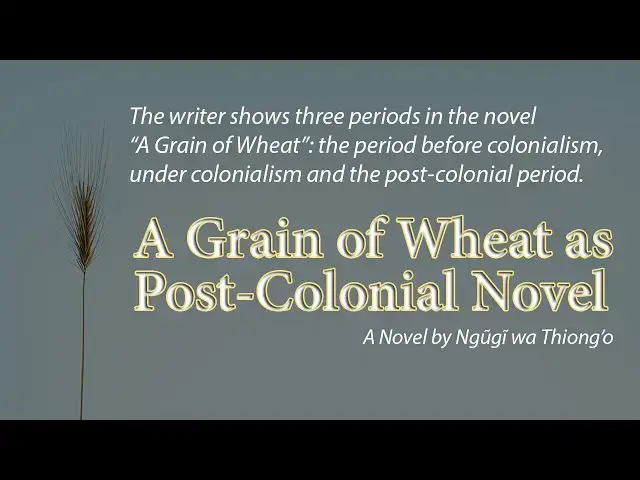

A Grain of Wheat as a Post Colonial Novel
Jun 14, 2024

In this video, we'll discuss A Grain of Wheat as a post colonial novel and explore its themes of oppression, identity, and resistance.
A Grain of Wheat by Ngugi wa Thiong'o is a powerful novel that sheds light on the effects of colonialism in Africa. Through the stories of its diverse characters, it delves into the complexities of post-colonial society and the struggle for independence. Join us as we analyze and discuss this important literary work.
Kenyan writer Ngugi wa Thiong’o wrote a post-colonial novel “A Grain of Wheat” in order to explore the impact of colonialism on the people of Kenya. It also shows the people’s struggles for independence. The setting of the novel is based on the period leading up to Kenya’s independence in 1963. Thus, the novel portrays the effects of colonialism on the colonised nation.
Colonialism is one of the main themes in “A Grain of Wheat”. The writer tells the story of those people who were exploited by British colonists. The oppressed people of Kenya had very little to do against exploiting resources and exploiting labour, poverty and deprivation.
Colonialism does not only snatch the right of living freely but also changes the identity of a nation. The writer shows this principle through different major characters. For instance, the protagonist of the novel Mugo struggles with a sense of guilt and shame because of the complicity in the colonial system. He was being taught that the colonists were superior to him.
The novel is a complete illustration of events that imposed colonialism on Kenya. In addition, the writer also talks about the resistance that people had shown. They struggled for independence and stood against the violence that affected them not only physically but also psychologically.
Period of Colonialism in A Grain of Wheat
One of the main impacts of colonialism was land dispossession. The colonial forces seize land and transfer it to white settlers. Resultantly, violent conflicts arose. The political repression was also there on the arrival of whitemen. None of them was ready to listen to the elders of the nation. They use force to maintain control over those people. For instance, Mugo and Kihika were imprisoned by the colonial authorities.
The authorities use the “divide and rule” strategy to maintain their control over the country. They create divisions among the various ethnic groups. For example, they successfully create a conflict between the Kikuyu and Luo communities. All these tactics led the people to the Mau Mau rebellion.
In short, the period of colonialism portrays the complex effects of colonialism in “A Grain of Wheat”.
Read more at:
https://askliterature.com/novel/a-grain-of-wheat-as-a-post-colonial-novel
00:00 - Introduction
00:56 - What is Post Colonial Literature?
01:16 - Colonialism in Africa
01:42 - Colonialism in the Novel A Grain of Wheat
02:18 - The Mau Mau Movement
03:08 - Role of Characters in Post Colonialism
03:21 - Role of Mugo
04:05 - Role of Gikonyo and Mumbi
05:26 - Role of Kihika
05:59 - Role of Karanja
06:32 - Role of General R
06:53 - Role of Muthoni and Mrs Mugo
07:46 - Conclusion
Show More Show Less