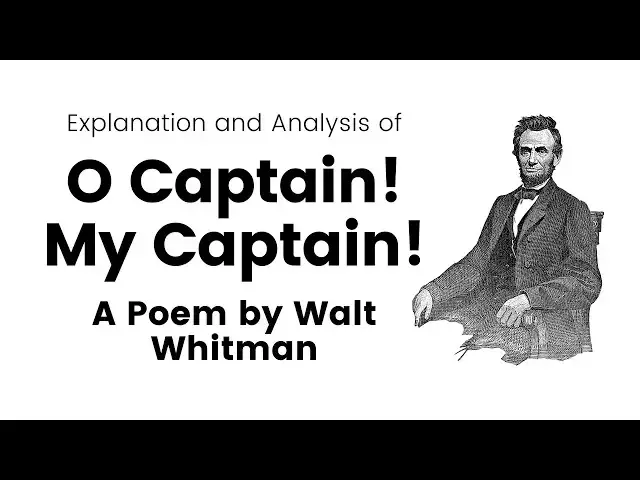

O Captain! My Captain! By Walt Whitman | Explanation and Analysis
Mar 8, 2025

Walt Whitman’s poem "O Captain! My Captain!" is one of the most famous poems in American literature. It was written in 1865 as a tribute to Abraham Lincoln, the 16th president of the United States. The poem expresses both joy and sorrow.
This video covers the explanation and analysis of “O Captain! My Captain!” by Walt Whitman.
Explanation of “O Captain! My Captain!” by Walt Whitman.
The poem celebrates the end of the American Civil War, but it also mourns the tragic death of Lincoln. Abraham Lincoln was assassinated shortly after the war ended. The poem is written in the form of an elegy. An elegy is a type of poem that expresses sadness for someone who has died. The poem uses the metaphor of a ship and its captain to describe the war and Lincoln’s leadership. The captain represents Lincoln, the ship represents the United States, and the "fearful trip" represents the Civil War.
Analysis of “O Captain! My Captain!” by Walt Whitman.
The poem consists of three stanzas, and each stanza follows a similar structure. The speaker represents the American people. He first celebrates the victory and safe arrival of the ship. Then, he expresses his shock and grief at the Captain’s death. Finally, he acknowledges the painful reality that his beloved leader is gone forever.
In the first stanza, the speaker declares that the American Civil War is over but the leader who guided them through the journey did not live to see the final success.
In the second stanza, the speaker refuses to accept that the Captain is dead. He calls out to him and urges him to “rise up and hear the bells”.
In the final stanza, the speaker faces the truth. He acknowledges that his Captain does not respond, his lips are pale, and he has no pulse.
One of the most important literary devices in the poem is the extended metaphor. An extended metaphor is a comparison that continues throughout a literary work. In this poem, the ship represents the United States, the Captain represents Abraham Lincoln, and the fearful trip represents the Civil War. By using this metaphor, Whitman conveys the idea that Lincoln was the leader who guided the country through a dangerous and difficult journey. Although the ship reached safety, the leader did not survive to enjoy the victory.
Another important literary device in the poem is repetition. Words and phrases like “heart! heart! heart!” and “fallen cold and dead” are repeated to emphasize the speaker’s grief and emotional pain. The poem also uses imagery, which means descriptions that appeal to the senses. For example, the speaker describes the “bleeding drops of red,” the “pale and still” lips, and the ringing bells. These images help the reader visualize the scene and feel the contrast between celebration and mourning.
The tone of the poem shifts between triumph and sorrow. In the beginning, there is a sense of relief and victory as the ship reaches its destination. However, this quickly changes to shock and sadness when the Captain is revealed to be dead. This shifting tone reflects the emotions that many Americans felt when Lincoln was assassinated. They were joyful about the end of the war but heartbroken over the loss of their leader.
The poem also explores themes such as leadership, sacrifice, and mourning. Lincoln’s leadership saved the country. However, he did not live to see the peace he worked so hard to achieve. His sacrifice is deeply felt by those who loved and respected him. The poem captures the sorrow of losing a great leader and the difficulty of moving forward after such a loss. Thank you for watching. I hope this video on explanation and analysis of “O Captain! My Captain!” by Walt Whitman has helped you in understanding the poem.
00:00 - Introduction
00:53 - Explanation of “O Captain! My Captain!” by Walt Whitman
15:07 - Analysis of “O Captain! My Captain!” by Walt Whitman
Show More Show Less