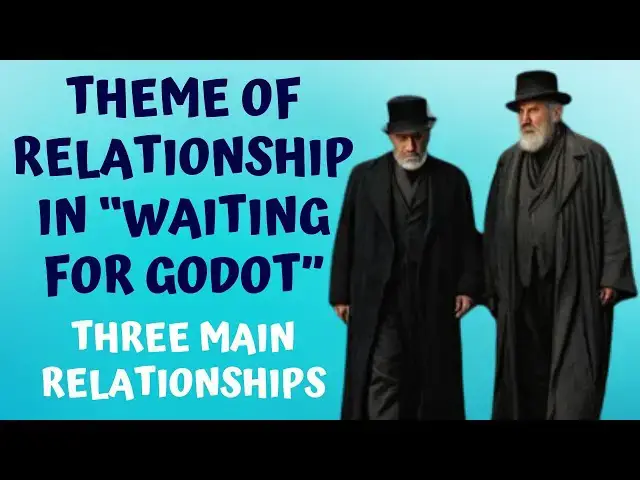

Theme of Relationship in “Waiting for Godot” | Three Main Relationships
Sep 18, 2022

Explore the theme of relationships in Samuel Beckett's "Waiting for Godot." Discover the three main relationships in the play and how they reflect the overall theme of human connection and dependence.
Through the characters of Vladimir, Estragon, Pozzo, and Lucky, we see the complexities of relationships and the constant search for companionship and purpose. Dive into the themes of waiting for Godot and the power of relationships in this thought-provoking video.
The theme of relationship is a prominent theme of “Waiting for Godot”. Samuel Becket portrays different types of human relationships. There are four kinds of individuals in it. Every character is a separate entity. Individually, they refer to something but in a relationship, they indicate something else. Vladimir’s problems are mental; Estragon’s physical. Pozzo and Lucky are presented to show two human races. But when these individuals are put into relations, they perform very important roles in the play. Three types of associations portray the theme of relationship in “Waiting for Godot”.
Relationship between Estragon and Vladimir
Association of Pozzo and Lucky
Relationship of Estragon and Vladimir with Godot.
Relationship between Estragon and Vladimir:
The first relationship is between Estragon and Vladimir. They both are dependent on each other. Vladimir is more eloquent, intellectual, and cultured than Estragon. He knows Latin. He is politer than Estragon. On the other hand, Estragon is volatile. He likes telling funny stories. He is less intellectual as compared to Vladimir. The difference between both of them can be seen in the beautiful dialogue of Estragon. “He has stinking breath and I have stinking feet” Although their personalities are in contrast to each other they both make a strong relationship. Samuel Becket depicts the relationship between two contrasting personalities. They fight each other but still, they are friends. The exact period of their friendship is unknown but we know that their past is more promising than their future. Of course, there is a strange friendship between them. They are companions on a long journey. They fight but cannot live separately. There is a difference in their thinking, in their style of living, in their speaking and finally in their philosophy. Both don’t know their future and waiting for hope i.e. Godot. Their life is miserable but a strong relationship between both of them gives them hope. They can’t survive if separated. Their bond is strong. Neither Estragon can leave Vladimir nor can Vladimir leave Estragon. Their relationship lays “somewhere between fatigue and ennui”. Vladimir’s dialogue in this regard is helpful. While recalling his memory he says:-
“In the nineties, hand in hand, from the top of the Eiffel Tower, among the first. We were presentable in those days. Now it's too late. They wouldn’t even let us up.”
Waiting for Godot
Thus, they are friends. Since when? We don’t know. But they need each other. It is evident from the famous dialogue between the two;
“Don’t touch me! Don’t question me! Don’t speak to me! Stay with me!”
Waiting for Godot
When one gives up waiting for Godot, the second gives hope. When the second gives up, the first motivates him. The whole play goes on in this way. When Estragon is beaten by strangers, Vladimir shows kindness and pretends like he is protecting him. They need to fight and abuse each other in order to pass their time. A strong relationship between these two is evident that Samuel Becket willfully portrayed the theme of relationship in “Waiting for Godot”.
Read more at:
https://askliterature.com/drama/samuel-beckett/waiting-for-godot/theme-of-relationship-in-waiting-for-godot/
Show More Show Less