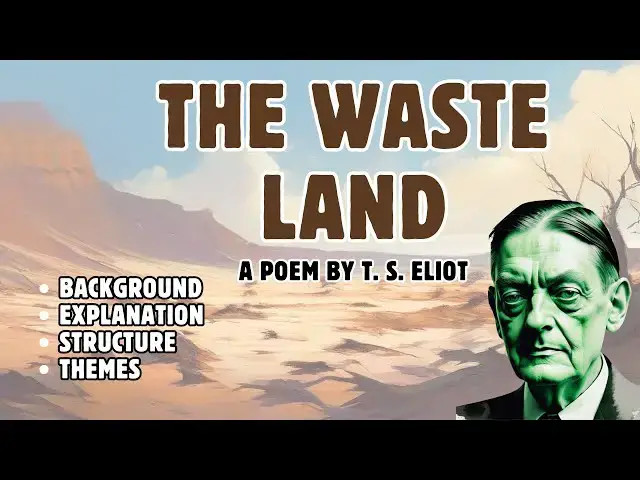

The Waste Land | A Poem by T. S. Eliot | Background, Explanation, Structure and Themes
Oct 30, 2024

Hello students! Today, we will discuss "The Waste Land" by T S Eliot. This poem was written a long time ago, in 1922, but it is still studied today because it has important ideas and messages.
T S Eliot was an American poet who later became a British citizen. He wrote this poem to express his feelings about the world. At the time he wrote it, people were feeling lost and sad after World War I. T S Eliot felt that people were losing their values, and he wanted to show this by describing a "waste land," which is a place that is empty, dry, and sad.
This poem is hard to understand because Eliot used many references from history, literature, and different religions. But don't worry! We'll carefully review each part so you understand what Eliot was trying to say.
The Title: The Waste Land.
The title of the poem, The Waste Land, is significant. A "waste land" means a place that is empty, dry, and dead. Imagine a desert where nothing can grow, where there is no water, and where everything feels sad and hopeless.
Eliot wanted to show that people felt empty because they lost touch with things that once gave life meaning, like religion, tradition, and values. In a way, he was saying that people needed to find hope and meaning again.
The Structure of the Poem.
T S Eliot divided The Waste Land into five sections. Each section has a different focus, but together, they tell the story of a world that has lost its way.
Let's go over these five sections one by one.
Section 1: The Burial of the Dead.
Section 2: A Game of Chess.
Section 3: The Fire Sermon.
Section 4: Death by Water.
Section 5: What the Thunder Said.
Themes in The Waste Land.
Let's discuss some central themes in The Waste Land by T S Eliot.
Isolation and Loneliness.
Eliot shows that people feel alone and disconnected, even when they are around others. This isolation makes people feel empty, and it's part of why the world feels like a waste land.
Spiritual Emptiness.
Eliot believes that people have forgotten about spiritual values and are only focused on things that don't matter. This emptiness makes people feel lost and purposeless.
Searching for Meaning.
Throughout the poem, Eliot shows that people seek meaning in their lives. They are trying to find something that will give them happiness and hope. This search is difficult, but Eliot believes it is possible.
The Need for Renewal.
Eliot wants people to renew their lives by finding meaning, controlling their desires, and being kind to others. He believes that people can change and bring hope back to the waste land.
Why is The Waste Land Important?
You might wonder, why is The Waste Land important? Why do people still study it? Well, this poem is important because it discusses problems that people still face today, like feeling lonely, finding meaning in life, and understanding what matters. Even though the poem was written over a hundred years ago, its messages are still relevant.
Eliot also showed how poetry can mix different ideas from different places. He used references from other poems, religions, and historical events. This made The Waste Land unique and powerful. It inspired many other writers to think about the problems in their own times and be creative.
Conclusion.
The Waste Land by T S Eliot is a poem about an empty and meaningless world. Eliot uses images of dry, lifeless land to show how people felt lost after World War I. He talks about loneliness, desires, and the need to find meaning through different sections. He believes people can bring hope and happiness back by renewing their lives with generosity, compassion, and self-control.
Thank you for watching!
00:00 - Introduction
00:51 - The Title: The Waste Land
01:32 - The Structure of the Poem
01:48 - Section 1: The Burial of the Dead
02:38 - Section 2: A Game of Chess
03:23 - Section 3: The Fire Sermon
04:12 - Section 4: Death by Water
04:44 - Section 5: What the Thunder Said
05:51 - Themes in The Waste Land
06:51 - Why is The Waste Land Important?
07:34 - Conclusion.
Show More Show Less