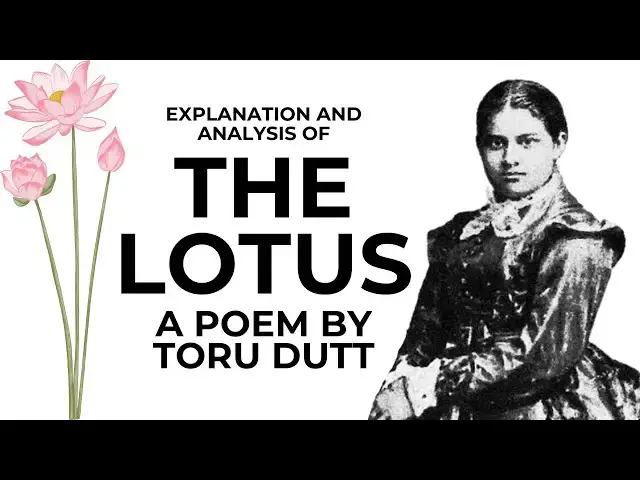

The lotus | A Poem by Toru Dutt | Explanation and Analysis
Feb 8, 2025

Welcome students!
Today we are going to discuss the beautiful and meaningful poem "The Lotus" by Toru Dutt. We will go through the poem line by line to understand its deeper meaning, language, and imagery. I will explain everything in simple words so that you can easily grasp each concept. Let us start by learning a little bit about the poet and the theme of the poem.
Toru Dutt was a famous Indian poet and writer who lived in the 19th century. She is well-known for her poems and writings in both English and French. Toru Dutt often explored themes from Indian culture and mythology in her work. Her poem "The Lotus" reflects her deep knowledge of literature, love for nature, and skill in using poetic language.
The poem centers on a discussion between Love and Flora. Love represents the god of love, often associated with Cupid in Western mythology, while Flora is the goddess of flowers. They are trying to find the perfect flower, a flower that is both beautiful and regal—one that can be called the queen of all flowers. The poem also conveys a symbolic meaning where flowers represent qualities and ideals.
Detailed Analysis and Symbolism.
The poem “The Lotus” by Toru Dut not only describes a simple discussion about flowers but also conveys a deeper symbolic meaning. The lily and the rose represent different qualities. The rose is often associated with love, passion, and beauty. On the other hand, the lily symbolizes purity, dignity, and elegance.
By choosing the lotus, Flora combines the best qualities of both flowers. The lotus is a significant flower in Indian culture and mythology. It represents purity, beauty, and enlightenment. It grows in muddy water but remains clean and beautiful. It symbolizes the ability to rise above difficulties and remain pure.
The poem can also be seen as a commentary on the blending of different cultures and ideals. Just as the lotus combines the qualities of the lily and the rose, people can combine the best aspects of different traditions to create something harmonious and beautiful.
Poetic Devices Used in the Poem.
The poem "The Lotus" by Toru Dutt uses several poetic devices to enhance its beauty and meaning. Let me explain some of these devices.
Personification. Love and Flora are personified as characters who can speak and make decisions.
Imagery. The poet uses vivid descriptions to create mental images of the flowers and their qualities.
Symbolism. The lily, rose, and lotus symbolize different qualities and ideals.
Alliteration. The repetition of consonant sounds, such as in "flower-factions," adds a musical quality to the poem.
The Structure of the Poem.
The poem "The Lotus" by Toru Dutt follows a traditional sonnet structure with 14 lines. It is divided into an octave (the first eight lines) and a sestet (the last six lines). The rhyme scheme is A B B A A B B A for the octave and C D C D D C for the sestet. This structure allows the poet to present a conflict or problem in the octave and provide a resolution in the sestet. The transition between the octave and sestet is called the volta, or turn, which marks a shift in tone or argument.
Conclusion.
Toru Dutt's "The Lotus" by Toru Dutt is a beautifully crafted poem that uses simple imagery to convey a profound message. It teaches us that the best things in life often come from a harmonious combination of different qualities. The lotus, with its dual colors and symbolic significance, becomes a perfect representation of this idea.
I hope this detailed explanation has helped you understand the poem thoroughly. Remember to focus on the meaning of each line, the symbolism of the flowers, and the poetic devices used by the poet. If you have any questions, feel free to ask. Happy learning, and best of luck in your exams!
00:00 - Introduction
01:10 - Expalnation of the Poem
05:08 - Detailed Analysis and Symbolism
06:10 - Poetic Devices Used in the Poem
06:52 - The Structure of the Poem
07:26 - Conclusion
Show More Show Less