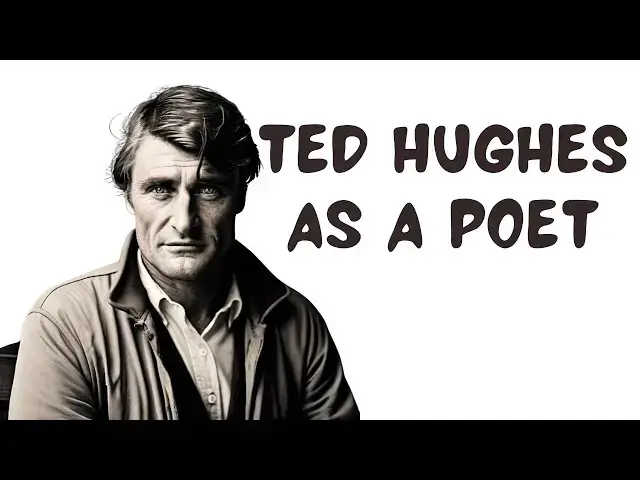

Ted Hughes as a Poet | The Poet Laureate of the United Kingdom in 1984
Jul 6, 2024

Ted Hughes is known for his powerful and vivid poetry that focuses on nature and the animal world. This video explores his life, his style of writing, and some examples from his poems to help you understand Ted Hughes as a Poet.
Who is Ted Hughes?
Ted Hughes was born on August 17, 1930, in a small village called Mytholmroyd in Yorkshire, England. He grew up in a rural area, which greatly influenced his poetry. His love for nature and animals started when he was a child, and we can see this love in many of his poems.
He attended Cambridge University, where he studied English but later switched to archaeology and anthropology. This change in subjects gave him a unique perspective on the world. He combined literature with the study of human cultures and history.
Hughes married the American poet Sylvia Plath in 1956. Their relationship was both passionate and turbulent. They had two children together, but their marriage faced many challenges. Plath's tragic death in 1963 deeply affected Hughes.
Ted Hughes' Writing Style.
Ted Hughes as a poet is known for its strong imagery and descriptive language in his poetry. Imagery is when a poet uses vivid and descriptive language to create pictures in the reader's mind. Hughes was very good at this, especially when writing about nature and animals. His poems often feel very alive and real, as if you can see, hear, and feel everything he describes.
One of the key features of Hughes' poetry is his focus on nature and the natural world. He often wrote about animals, plants, and the elements like the wind and the sea. His descriptions are powerful and sometimes quite dark. These descriptions show both the beauty and the brutality of nature.
Another important aspect of his poetry is the use of myth and history. Hughes was fascinated by ancient myths and legends, and he incorporated these themes into his work. This gives his poetry a timeless quality and connects the present with the past.
Examples from His Poems.
One of his most famous poems is "The Thought-Fox". This poem describes the process of writing a poem, using the image of a fox creeping through the snow as a metaphor for the poet's thoughts coming to life.
In this poem, Hughes uses strong imagery to describe the fox. He writes about the fox's "shadow" and "nose touches twig, leaf". These images make us feel like we are there in the snowy forest, watching the fox move silently. The fox represents the poet's imagination and creativity and shows how ideas can appear suddenly and quietly, like a fox in the night.
Another famous poem is "Hawk Roosting". Ted Hughes as a poet writes from the perspective of a hawk, a powerful bird of prey. The hawk talks about its control over its environment and its superiority over other creatures.
Themes in Ted Hughes' Poetry.
Nature and animals are central to Hughes' work. He had a deep respect for the natural world and often wrote about its beauty and power. His poems show a keen observation of wildlife and the environment and makes us appreciate the complexity and wonder of nature.
Ted Hughes being a poet also explores the human condition in his poetry. He talks about the experiences and emotions that are common to all people. He writes about life, death, love, and loss and uses nature as a way to reflect human emotions. For example, in his poem "Wind", he describes a stormy night to convey feelings of turmoil and instability.
Myth and History.
Ted Hughes as a poet incorporates myths and historical references into his poetry. He was fascinated by ancient stories and legends. He uses them to add depth and meaning to his work. These elements give his poems a sense of timelessness and connect the present with the past.
Hughes' Later Life and Legacy.
In the later years of his life, Ted Hughes as a poet continued to write and publish poetry. He received many awards and honors for his work. He was also appointed as the Poet Laureate of the United Kingdom in 1984. The Poet Laureate is a special title given to a poet who is recognized for their significant contribution to literature.
Conclusion.
In conclusion, Ted Hughes was a remarkable poet who used his love of nature and his understanding of human emotions to create powerful and vivid poetry. His use of imagery and descriptive language brings his poems to life. Whether writing about the silent movements of a fox, the commanding presence of a hawk, or the dual nature of a pike, Hughes captures the beauty and brutality of the natural world and connects it to the human experience.
00:00 - Intro
00:15 - Who is Ted Hughes?
01:12 - Ted Hughes' Writing Style
02:18 - Examples from His Poems
04:10 - Themes in Ted Hughes' Poetry
05:29 - Hughes' Later Life and Legacy
06:16 - Conclusion
#askliterature #tedhughes #tedhughessapoet
Show More Show Less