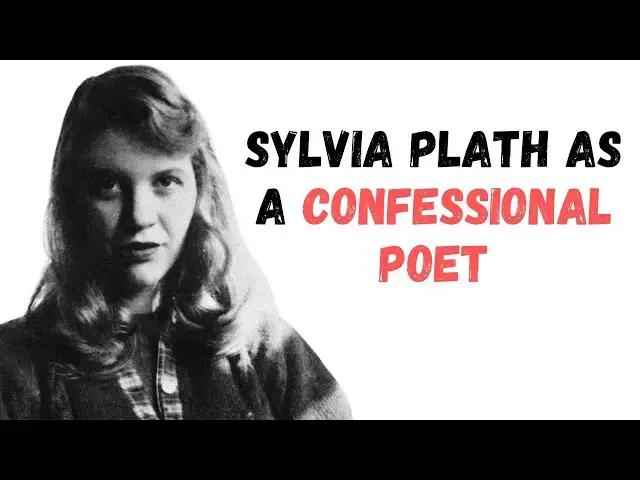

Sylvia Plath as a Confessional Poet | Sylvia Plath and Confessional Poetry
Sep 23, 2025

Hello and welcome to today’s video. In this video, we will study Sylvia Plath as a confessional poet.
First, let us understand the term "confessional poetry". The word "confession" means admitting or revealing personal truths. In religion, confession is when a person admits sins or secrets. In literature, confessional poetry means a kind of poetry where the poet shares very private experiences. The poet talks about personal pain, trauma, emotions, and struggles. The poet does not hide behind characters. The poet speaks directly about the self.
This style of poetry became popular in America in the mid-twentieth century. The 1950s and 1960s saw many poets write in this style. The most famous confessional poets include Robert Lowell, Anne Sexton, Sylvia Plath, and W. D. Snodgrass. They wrote about subjects that earlier poets avoided. They wrote about mental illness, family conflict, depression, marriage problems, and even death.
Sylvia Plath is one of the most important confessional poets. Her poetry is deeply personal. She writes about her feelings, her marriage, her children, her depression, and her desire for freedom. She does not hide her emotions. She presents them directly and honestly. This is why she is called a confessional poet.
Now let us look at her poems and see how they support this idea.
One of her most famous poems is Lady Lazarus. In this poem, Sylvia Plath talks about her own attempts to end her life. In this poem, the confessional element is very strong. She compares herself to Lazarus, a man in the Bible who was brought back from the dead. The poet does not use symbolic characters. She speaks about her own body, her skin, her breath, her suffering. She calls herself a walking miracle. She also expresses anger at those who watch her. At the end, she even speaks to her oppressors. She says she will rise and eat men like air. This shows her personal rage. The poem is both a confession of suffering and a statement of power.
Another famous poem is Daddy.
In this poem, Sylvia Plath speaks about her father. Her father died when she was very young. She felt abandoned. She felt both love and anger toward him. In the poem, she compares him to a Nazi, and herself to a Jew. This shocking comparison shows the intensity of her emotions. She says, "I thought every German was you". She says she felt trapped in his shadow. Later, she connects the memory of her father with her troubled marriage. She says, "I made a model of you," speaking of her husband, Ted Hughes.
This poem also supports Sylvia Plath as a confessional poet. It shows her pain, her anger, and her feeling of being controlled by male figures.
Now let us understand why this is important.
Earlier poets often wrote about universal themes like love, nature, or beauty, but in general terms. They did not usually talk about their private pain. Confessional poets changed this. They made poetry more personal, more honest, and more open. Sylvia Plath is one of the strongest voices in this movement.
Her confessional poetry also uses strong images and metaphors. For example, in Daddy, she uses Nazi and Jew imagery to describe her relationship with her father. This is not literal but shows the intensity of her emotions. In Lady Lazarus, she uses the image of the phoenix rising from ashes to describe her survival. In Ariel, she uses the image of an arrow to describe her transformation. These metaphors make her personal experiences universal. Other people can understand and feel her suffering through these images.
She also uses symbolism. In Tulips, the flowers symbolize life’s demands. In Ariel, the sun symbolizes both life and death. These symbols make her confessional voice more powerful.
Sylvia Plath’s confessional poetry is also connected to her life. She struggled with depression. She had a troubled marriage. She felt pressure as a wife, a mother, and a poet. She tried to end her life more than once but failed. Sadly, she succeeded in 1963. Her poems reflect this struggle. They are her voice, her truth, her confession.
To conclude, Sylvia Plath is one of the greatest confessional poets. She opened her heart in her poems. She spoke about pain, suffering, love, motherhood, death, and despair. She used powerful imagery, metaphors, and symbols. Her famous poems like Lady Lazarus, Daddy, Ariel, and Tulips are strong examples of confessional poetry.
Thank you for watching.
Show More Show Less