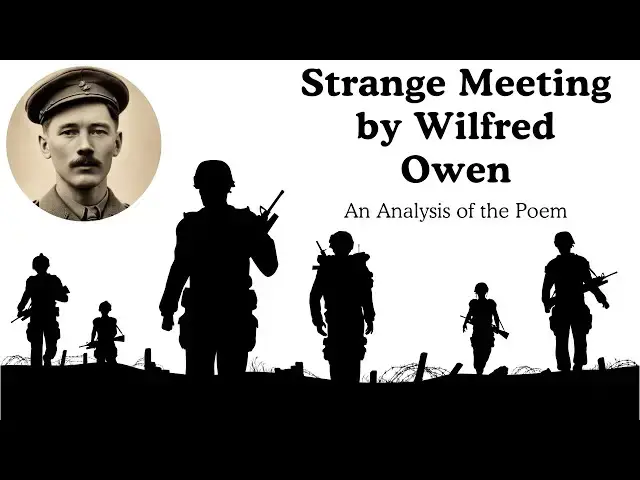

Strange Meeting by Wilfred Owen | An Analysis of the Poem
Nov 13, 2024

Hello students!.
Today, we are going to learn about a famous poem called "Strange Meeting"" by "Wilfred Owen". Wilfred Owen was a British poet and soldier during "World War 1". He wrote many poems about the war because he fought in it himself. His poems often talk about the pain and suffering of soldiers, as well as the cruelty of war.
Wilfred Owen wrote "Strange Meeting" to show people the truth about war. Many people in his time thought war was noble and heroic. They believed it was an honor to die for your country. But Owen had experienced war firsthand, and he knew it was full of pain and suffering. He wanted to show people the reality of war, not just the stories of bravery and victory that people often hear.
In the poem, the narrator or speaker is a soldier. He has recently died, and he finds himself in a dark, silent place. This place seems to be underground, like a tunnel. As he walks, he sees other soldiers who are also dead. Some of them are awake, and some of them are still asleep. He keeps walking until he meets one particular soldier. This soldier is his enemy, someone he fought against. But instead of hating each other, they begin to talk and understand each other.
Themes of the Poem.
The first theme in "Strange Meeting" by Wilfred Owen is the "horror of war". The poet shows us how terrible war is. He describes the pain and suffering of soldiers, both during and after the battle. The poem makes us feel sorry for the soldiers and angry about the cruelty of war.
The second theme is the "humanity of enemies". Owen shows us that soldiers on both sides of the war are just people. They are not truly enemies—they are just forced to fight. The speaker and the dead man could have been friends in another life, but war turned them into enemies.
The third theme is "regret". The dead man talks about what he could have done if he had not died in the war. He could have written poems, made the world better, or lived a happy life. But war took all of that away from him. This shows us that war destroys not just lives, but also dreams and potential.
The Structure of the Poem.
The poem "Strange Meeting" by Wilfred Owen is written in "iambic pentameter". This means each line has ten syllables, with a pattern of unstressed and stressed syllables. For example.
It seemed that out of battle I escaped.
This rhythm gives the poem a steady, flowing sound. However, the poem does not have a regular rhyme scheme. Some lines rhyme, but not all of them. This makes the poem feel natural, like someone is speaking to us.
The poem is also written in one long stanza. This creates a feeling of continuity, as if the story is unfolding without any breaks.
Language and Imagery.
Wilfred Owen uses many powerful words and images in this poem. Let us look at some examples.
The "profound dull tunnel" creates a strong image of the afterlife. It makes us imagine a dark, endless passage that is both scary and mysterious.
The "encumbered sleepers" give us a picture of dead soldiers lying still, weighed down by death. This shows us the physical and emotional burden of war.
The "dead smile" of the enemy is a very haunting image. It shows us the sadness and regret of someone who has lost everything because of war.
Owen also uses contrast in the poem. For example, the dead man calls the speaker "my friend" even though he is an enemy. This contrast makes us think deeply about the nature of war and humanity.
Conclusion.
"Strange Meeting" is a powerful poem by Wilfred Owen that teaches us important lessons about war and humanity. It reminds us that war is not just about victory and loss. It is about real people who suffer and die. It also shows us that enemies are not so different from each other. They are all human beings with dreams, hopes, and fears.
I hope this explanation has helped you understand the poem. Remember, if you still have questions, do not hesitate to ask. Thank you for watching, and good luck with your studies!.
Show More Show Less