0:00
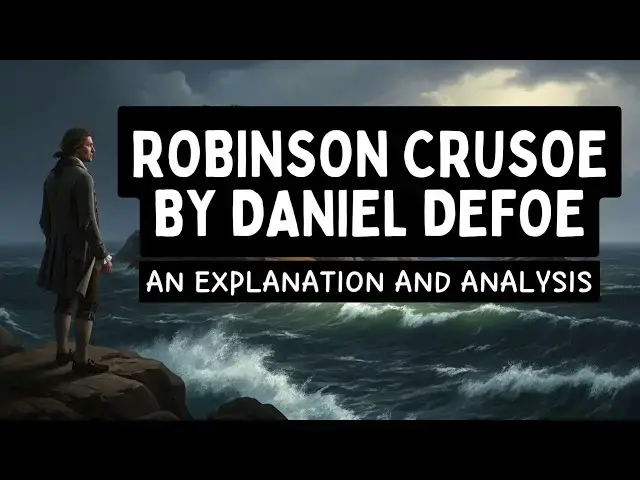
A storm destroys the ship.
0:04
A single man survives.
0:09
Then the real story begins.
0:14
Not the story of adventure.
0:19
The story of isolation.
0:23
What happens to the human mind when
0:30
What remains of a person after years of
0:32
silence, fear, labor, and loneliness?
0:38
This is the question at the center of
0:39
Robinson Crusoe by Daniel Defoe.
0:44
Published in 1719, the novel is often
0:47
considered one of the earliest English
0:52
But its lasting power comes from
0:56
Robinson Crusoe transforms survival into
0:59
a psychological, spiritual, and
1:01
philosophical struggle.
1:04
At the beginning of the novel, Crusoe
1:06
believes freedom means escape.
1:11
Escape from responsibility.
1:13
Escape from ordinary life.
1:16
But the island teaches him a brutal
1:19
A human being can escape society.
1:22
He cannot escape himself.
1:25
Robinson Crusoe is born into a
1:27
middle-class family in York, England.
1:30
His father believes the middle class
1:32
offers the safest and most balanced life
1:34
because it avoids both poverty and
1:38
He warns Crusoe never to go to sea.
1:41
But Crusoe is restless.
1:43
Stability feels like limitation to him.
1:46
He wants movement, risk, discovery, and
1:50
Adventure becomes an obsession.
1:53
Ignoring his parents' warnings, he
1:55
secretly leaves home and joins a sea
1:58
That decision shapes the entire novel.
2:01
Again and again, Crusoe remembers his
2:03
father's advice and realizes something
2:05
painful. Many of his sufferings begin
2:07
with pride and disobedience.
2:11
During his first voyage, a violent storm
2:13
nearly destroys the ship.
2:15
Terrified, Crusoe promises God that he
2:17
will return home if he survives.
2:20
The moment the storm ends, he breaks the
2:24
This moment reveals an important
2:25
weakness in Crusoe's character.
2:28
Desire controls him more than wisdom.
2:31
Later, pirates from North Africa capture
2:33
his ship and Crusoe is taken to Sallee
2:37
After years of captivity, he escapes
2:39
with the help of a boy named Xury.
2:42
Eventually, Crusoe reaches Brazil and
2:44
becomes the owner of a successful
2:47
But success only increases his ambition.
2:50
Wanting greater profit, he joins another
2:53
sea expedition connected to the slave
2:56
The voyage ends in disaster.
2:58
A violent storm destroys the ship and
3:01
Crusoe becomes the only survivor.
3:03
He reaches a deserted island near the
3:05
mouth of the Orinoco River in South
3:08
In a single moment, civilization
3:10
vanishes from his life.
3:14
At first, fear overwhelms him.
3:17
He may never return home.
3:19
He may never see another human being
3:22
For the first time in his life, survival
3:24
matters more than ambition.
3:26
Fortunately, the broken ship remains
3:29
near the shore for several days.
3:31
Crusoe repeatedly returns to it and
3:33
carries supplies back to the island,
3:35
tools, weapons, food, ropes, wood,
3:38
gunpowder, and clothes.
3:40
He does not collapse into despair.
3:43
He observes, calculates, plans, and
3:47
Daniel Defoe describes these survival
3:49
activities with extraordinary detail.
3:52
Readers watch Crusoe build shelters,
3:54
organize supplies, measure time, grow
3:57
crops, and solve problems step-by-step.
4:00
This realism changed English fiction.
4:03
The novel feels convincing because
4:05
survival is presented as labor, not
4:09
Slowly, Crusoe transforms the island.
4:15
He grows barley and rice.
4:18
He domesticates goats.
4:22
He creates furniture and pottery.
4:25
Piece by piece, chaos becomes order.
4:28
But Crusoe is not simply building a
4:31
He is building psychological control.
4:34
The island constantly threatens him with
4:36
uncertainty, loneliness, and fear.
4:39
Through routine and labor, he fights
4:41
back against mental collapse.
4:43
Crusoe also keeps a journal.
4:46
Writing becomes a way of preserving
4:47
structure, memory, and identity.
4:50
Without discipline, isolation could
4:52
destroy his mind long before hunger
4:56
The island tests every part of him.
5:00
Before the shipwreck, religion means
5:04
He rarely reflects seriously on morality
5:08
Isolation changes that.
5:11
At first, he sees himself as unlucky.
5:14
But suffering forces him into
5:17
Illness, loneliness, and fears strip
5:22
Crusoe begins reading the Bible
5:23
regularly and starts confronting his
5:25
past actions honestly for the first
5:28
Gradually, he believes his suffering is
5:30
connected to pride, selfishness, and
5:34
At the same time, he believes God has
5:38
This spiritual transformation becomes
5:40
central to the novel.
5:42
The island turns Crusoe inward.
5:44
He can no longer escape himself through
5:46
movement or ambition.
5:48
His greatest struggle is no longer
5:50
against nature alone.
5:52
It is against fear, guilt, despair, and
5:58
Even after learning how to survive
5:59
physically, Crusoe suffers emotionally
6:01
from extreme loneliness.
6:04
The silence becomes heavy.
6:10
human presence itself.
6:13
Sometimes fear overwhelms him so
6:15
completely that he can barely think
6:18
To protect himself psychologically, he
6:20
creates strict routines and follows them
6:24
Through Crusoe's isolation, Defoe
6:26
reveals an important truth about human
6:29
Survival requires more than food and
6:33
Human beings need society.
6:37
One day, Crusoe discovers a single human
6:39
footprint in the sand.
6:41
This is one of the most famous scenes in
6:43
English literature because it completely
6:45
changes the emotional atmosphere of the
6:48
Until this moment, Crusoe fears
6:52
Now he fears other people.
6:54
The footprint destroys his sense of
6:57
Suddenly, the island no longer feels
7:01
Crusoe immediately imagines violence,
7:03
cannibals, and death.
7:08
He becomes suspicious, defensive, and
7:12
The footprint symbolizes uncertainty
7:14
itself, the terrifying realization that
7:16
the unknown may already be watching.
7:20
Later, Crusoe sees cannibals bringing
7:22
prisoners to the island.
7:24
He rescues one prisoner from death and
7:26
names him Friday because they meet on a
7:30
Friday becomes Crusoe's companion after
7:34
Crusoe teaches him English and converts
7:38
Friday proves intelligent, courageous,
7:40
adaptable, and loyal.
7:42
For the first time in many years, Crusoe
7:47
Yet, their relationship also reveals the
7:49
colonial attitudes inside the novel.
7:52
Crusoe immediately renames Friday
7:54
instead of asking his real name.
7:56
He assumes European religion, language,
7:59
and culture are naturally superior.
8:02
Friday is expected to obey Crusoe and
8:04
adopt Crusoe's way of life.
8:06
Defoe presents this authority as normal,
8:08
revealing how deeply colonial thinking
8:10
shaped 18th century Europe.
8:13
Because of this, modern critics often
8:15
study Robinson Crusoe not only as a
8:17
survival story, but also as a colonial
8:19
text connected to imperial expansion and
8:25
After many years, an English ship
8:26
arrives near the island.
8:29
However, the sailors have rebelled
8:30
against their captain in a mutiny.
8:33
Crusoe helps the captain defeat the
8:35
rebels and regain control of the ship.
8:38
As a reward, Crusoe is finally rescued
8:40
after living on the island for 28 years,
8:43
2 months, and 19 days.
8:45
When he returns to England, he discovers
8:47
that his plantation in Brazil has made
8:51
Yet, one truth remains unchanged.
8:54
The desire for adventure still exists
8:57
The island transformed Crusoe,
9:00
but it did not erase him.
9:03
The novel explores several major themes,
9:06
but all of them grow naturally from
9:09
Survival is the central theme.
9:12
Crusoe survives through discipline,
9:14
patience, intelligence, and
9:18
Defoe presents survival as continuous
9:20
labor rather than heroic fantasy.
9:23
But, survival in the novel is not only
9:26
Crusoe must survive mentally and
9:31
Another major theme is individualism and
9:35
Crusoe depends mainly on his own
9:39
Through labor and discipline, he
9:40
transforms wilderness into structure and
9:44
To Defoe's society, Crusoe represented
9:46
the ideal individual, productive,
9:48
resourceful, practical, and economically
9:53
Religion is equally important.
9:56
Isolation forces Crusoe into spiritual
10:00
Suffering becomes the experience that
10:02
pushes him towards self-understanding
10:03
and religious faith.
10:05
The novel suggests that hardship can
10:07
transform human character by forcing
10:09
people to confront their weaknesses
10:13
The conflict between civilization and
10:15
wilderness also shapes the story.
10:18
Crusoe recreates aspects of European
10:20
civilization on the island through
10:21
farming, construction, organization, and
10:24
control over nature.
10:26
For Crusoe, civilization is something
10:29
built manually against chaos.
10:32
Colonialism remains one of the most
10:34
important themes in modern
10:38
Crusoe claims authority over both the
10:42
He assumes European culture is superior
10:44
and believes he has the right to educate
10:48
These attitudes reflect the realities of
10:50
European imperial expansion during the
10:55
Crusoe himself is one of the most
10:56
psychologically important characters in
10:58
early English fiction.
11:00
At the beginning, he is impulsive,
11:02
ambitious, proud, and impatient.
11:06
Adventure matters more to him than
11:07
wisdom or stability.
11:09
But isolation changes him slowly.
11:12
The reckless traveler becomes
11:14
disciplined, practical, reflective, and
11:18
Yet Crusoe never becomes perfect.
11:21
He remains capable of arrogance,
11:23
control, and cultural superiority.
11:26
That complexity makes him believable.
11:30
Friday is equally important to the
11:34
He is intelligent, loyal, brave, and
11:38
He becomes Crusoe's companion after
11:40
years of emotional isolation.
11:42
At the same time, his relationship with
11:44
Crusoe exposes the unequal power
11:46
structures of colonial society.
11:49
Friday is both a companion and a symbol
11:51
of imperial control.
11:54
One of the most important literary
11:56
features of Robinson Crusoe is realism.
11:59
Defoe fills the novel with practical
12:01
details about survival, construction,
12:04
farming, hunting, cooking, and
12:07
These details make the story feel
12:09
authentic and believable.
12:11
The first-person narration strengthens
12:13
this realism because readers experience
12:15
events directly through Crusoe's mind.
12:18
Symbolism also plays an important role.
12:21
The island symbolizes isolation and
12:25
The footprint symbolizes fear and
12:29
Friday symbolizes both companionship and
12:33
Through these symbols, Defoe transforms
12:35
a survival narrative into a deeper
12:37
exploration of psychology, society,
12:39
religion, and power.
12:43
Students should remember that Robinson
12:44
Crusoe is never just an adventure novel.
12:48
It is a survival story,
12:50
a psychological study of isolation,
12:54
a spiritual journey,
12:56
a novel about self-reliance,
12:58
and a colonial text connected to
13:00
European imperialism.
13:03
For examinations, students should focus
13:07
Crusoe's character development,
13:09
his spiritual transformation,
13:12
the psychological effects of loneliness,
13:15
the theme of self-reliance,
13:17
the relationship between Crusoe and
13:21
colonial attitudes in the novel,
13:24
and Defoe's realistic narrative style.
13:27
Strong literary analysis always combines
13:29
story details with interpretation.
13:33
Robinson Crusoe remains influential
13:35
because it transforms external adventure
13:37
into internal struggle.
13:39
The novel asks questions that still feel
13:43
What happens when civilization
13:46
Can isolation transform personality?
13:49
What keeps human beings mentally strong
13:53
And does survival alone make someone
13:57
Crusoe fights storms, hunger, fear,
13:59
loneliness, guilt, uncertainty, and
14:03
But his greatest battle is against
14:06
That is why the novel still feels
14:08
powerful centuries later.
14:10
Daniel Defoe created more than a story
14:14
He created a study of human nature under
14:18
Crusoe escapes the island,
14:21
but he never escapes the person the
14:22
island forced him to become.