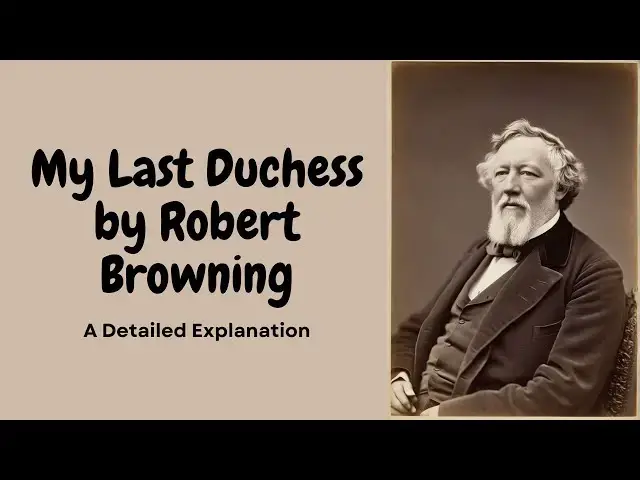

My Last Duchess by Robert Browning | A Detailed Explanation
Nov 11, 2024

Hello students!.
Today, we will explore a poem called "My Last Duchess" by Robert Browning. The poem tells a story but it is in the form of a "dramatic monologue". This means that only one character speaks and he tells us a story through his own words. In this poem, the Duke is speaking to a visitor about a portrait of his late wife, who is referred to as his "last duchess". The poem shows us how the Duke feels about his wife, what kind of person he is, and how he views relationships and power. We will go through the poem line by line to understand every word and idea.
The first line of the poem is, "That's my last Duchess painted on the wall". Here, the Duke is talking about a painting of his wife. "Duchess" is a title, like "queen" or "princess," that shows someone is a noblewoman, or a woman from a royal family. "My last Duchess" means that she was his last wife, but she is not alive anymore. She has passed away, and now there is only a painting of her on the wall. The Duke seems proud as he shows the painting to his visitor. This tells us that he thinks it is a valuable piece of art.
Then, he says, "I repeat, The Count your master's known munificence Is ample warrant that no just pretense Of mine for dowry will be disallowed". Here, the Duke starts talking about the Count, who is the father of the woman he wants to marry next. The Duke is speaking to a servant of the Count, who has come to discuss the marriage. A "dowry" is money or property that a bride's family gives to the groom when they get married. The Duke says that he knows the Count is generous, or "munificent," and he expects that the Count will agree to give him a large dowry.
This part of the poem shows us that the Duke is thinking more about money and status than about love or companionship. He is very business-minded about marriage, as if it is a transaction or deal. He wants to marry the Count's daughter because it will give him more wealth and power. The Duke is not interested in love; he is interested in what he can gain from the marriage.
In the final lines, the Duke mentions a statue he owns. He says, "Though his fair daughter's self, as I avowed At starting, is my object. Nay, we'll go Together down, sir. Notice Neptune, though, Taming a sea-horse, thought a rarity, Which Claus of Innsbruck cast in bronze for me!" Here, the Duke tells his guest that his main interest is the Count's daughter. He says this to make it sound like he is genuinely interested in her, but the way he speaks shows that he sees her as another possession, like the painting or the statue he mentions.
He then points to a statue of Neptune, a Roman god of the sea, who is shown "taming a sea-horse". "Taming" means controlling or calming down an animal. The Duke says that this statue is very rare, and it was made by a famous sculptor, Claus of Innsbruck. This statue is a symbol of power, showing Neptune controlling a powerful creature. By showing this to his guest, the Duke is once again showing his need for control. The statue represents how the Duke sees himself: as someone who should have power and control over others, especially over his wife or his future bride.
This final part of the poem helps us understand the Duke's personality even more. He is a man who values art, power, and control, but he does not value love or kindness. He sees people as objects that he can own and control. He does not care about their feelings or desires; he only cares about how they make him look and feel. This makes the Duke seem like a very selfish and dangerous person, someone who values his own power above all else.
In "My Last Duchess", Robert Browning uses the Duke's words to tell us about his character without directly saying it. The Duke reveals his own cruelty and possessiveness by the way he describes his last Duchess and by the hints he gives about her fate. The Duke's treatment of the Duchess shows that he has a very twisted view of relationships. He believes that love is about control and power, not about care and understanding. By the end of the poem, we understand that the Duke's next wife may face a similar fate if she does not act exactly the way he wants.
"My Last Duchess" is a powerful poem by Robert Browning because it makes us think about the dangers of jealousy, possessiveness, and the desire for control. It reminds us that love should be about respecting and valuing other people as they are, not trying to control them or make them behave a certain way. Through this story, Browning teaches us to look out for people who may seem charming on the outside but have dark motives underneath.
This poem can be difficult to understand, but by breaking down each line, we can see that it is a story about power, control, and the consequences of treating people as possessions.
Show More Show Less