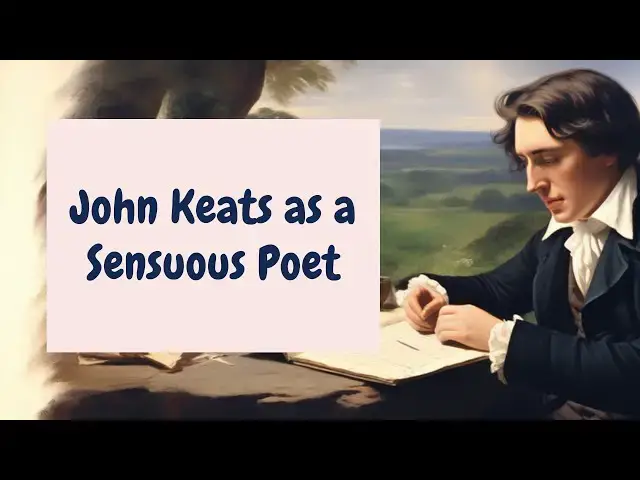

John Keats as a Sensuous Poet
Feb 25, 2024

The poetry that engages the senses, particularly the senses of sight, sound, touch, taste, and smell is called "Sensuous poetry". Sensuous poetry often focuses on vivid and detailed descriptions that aim to evoke sensory experiences in the reader's mind. The poetry of John Keats also aims to evoke sensory experiences, therefore, he is also called a sensuous poet.
John Keats as a Sensuous Poet.
John Keats is widely recognized as a sensuous poet. His work is celebrated for its rich imagery, vivid descriptions, and intense engagement with the senses.
Keats's poetry is replete with lush and vivid sensory imagery that appeals to various senses. For instance, in his famous ode, "Ode to a Nightingale," he describes the "embalmed darkness," "purple-stained mouth," and "full-throated ease" of the nightingale. In this way, he creates a sensory experience for the reader.
Keats often explores the natural world in his poetry. He describes landscapes, seasons, and elements with a keen focus on sensory details. In poems like "To Autumn," he captures the sights, sounds, and scents of the season to portray a deep connection with nature.
John Keats was fascinated by the concept of beauty. His poems are filled with descriptions that celebrate the beauty of art, nature, and human experiences. In "Ode to a Grecian Urn," he explores the beauty frozen in time on the urn. He highlights the visual and imaginative aspects of beauty.
Keats's poetry often delves into the sensuality of physical and emotional experiences. In poems like "Bright Star," he intertwines the themes of love and sensuality to express the eternal nature of love through sensory images.
Keats is renowned for his odes. These odes are characterized by their elaborate and sensuous language. "Ode to a Nightingale," "Ode to a Grecian Urn," and "To Autumn," showcase his ability to convey profound emotions through rich sensory experiences.
The poet occasionally employs synesthesia. It is a literary device that blends different sensory experiences. In "Ode to a Nightingale," he writes about "beaded bubbles winking at the brim," combining the visual image of bubbles with the tactile sense of winking.
Keats's concept of "Negative Capability" encourages poets to embrace uncertainty and the mysterious without pursuing logical explanations. This openness to the inexplicable aligns with the sensory richness found in his poetry, where the focus is on experiencing and feeling rather than rationalizing.
In summary, John Keats's poetry is characterized by its immersive sensory experiences, detailed descriptions, and a profound appreciation for the beauty of the natural and emotional world. The ability of John Keats to evoke a multisensory response in the reader solidifies his place as a quintessential sensuous poet of the Romantic era.
Show More Show Less