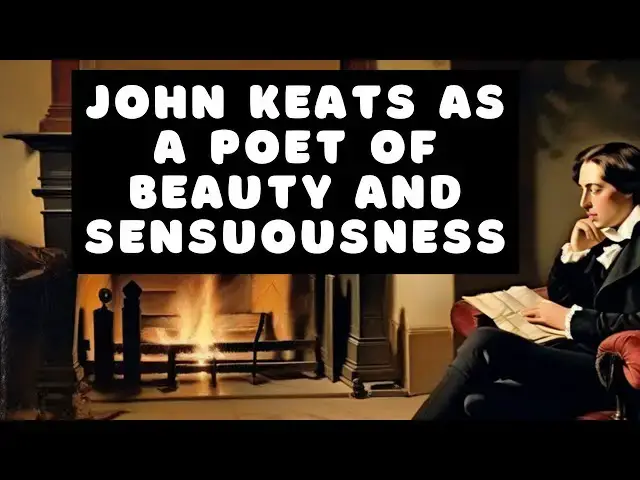

John Keats as a Poet of Beauty and Sensuousness
Feb 21, 2024

Learn about John Keats, one of the most renowned poets of the Romantic era, known for his sensuous and beautiful writing. This video explores how Keats captured beauty and sensuousness in his poetry, making him a timeless figure in literature.
If you're studying English literature or want to learn more about Keats and his works, this video is a great resource. We'll dive into some of his most famous poems and discuss how his unique writing style made him stand out as a poet of beauty and sensuousness.
John Keats is often known as a poet of beauty and sensuousness. Beauty and sensuousness are complex and subjective concepts that often overlap but have distinct meanings.
Beauty is a multifaceted and subjective quality that is often associated with the visual appeal of an object, person, idea, or experience. Beauty can be found in art, nature, relationships, and various aspects of life.
Sensuousness involves the enjoyment and appreciation of the senses. It goes beyond the visual and includes the engagement of other senses like touch, taste, smell, and hearing. Sensuousness can be expressed through art, music, literature, and everyday experiences that involve sensory pleasure.
John Keats as a Poet of Beauty and Sensuousness.
Beauty and sensuousness are there in the poetry of the poet John Keats. He appreciates beauty and his poetry feels to the senses. Keats is a master of vivid imagery that appeals to the senses.
In "Ode to a Nightingale," he describes the nightingale's song as "Thou still unravish'd bride of quietness, / Thou foster-child of Silence and slow Time." He creates a sensory experience that goes beyond hearing to evoke a sense of stillness and timelessness.
Keats frequently celebrates the beauty of the natural world in his poetry. In "To Autumn," he vividly depicts the sights, sounds, and sensations of the season, such as the "maturing sun," "plump the hazel shells," and "soft-dying day." These details immerse the reader in the sensory richness of autumn.
Appraisal of beauty is a recurring theme in the poetry of John Keats. In "Ode to a Grecian Urn," he reflects on the enduring beauty captured in art: "Beauty is truth, truth beauty,—that is all / Ye know on earth, and all ye need to know." This suggests a philosophical acceptance of the fleeting nature of life contrasted with the timeless beauty of art.
John Keats drew inspiration from art and mythology. He infuses his poems with sensuous details. In "Ode to a Nightingale," he refers to "bacchus and his pards" and "flora and the country green," weaving in mythological and natural elements that contribute to the sensory richness of the poem.
Keats's personal letters provide insights into his sensory experiences and appreciation of beauty. In a letter to George and Georgiana Keats, he describes a walk and expresses the pleasure derived from nature:
"How beautiful the season is now—How fine the air. A temperate sharpness about it...I never lik'd stubble fields so much as now—Aye better than the chilly green of the spring."
In summary, the poet John Keats appreciates beauty and captures the sensuousness of the world. His use of rich imagery, celebration of nature, exploration of transience, and the intimate connection between beauty and truth all contribute to his legacy as a poet deeply engaged with the aesthetic and sensory dimensions of human experience.
Show More Show Less