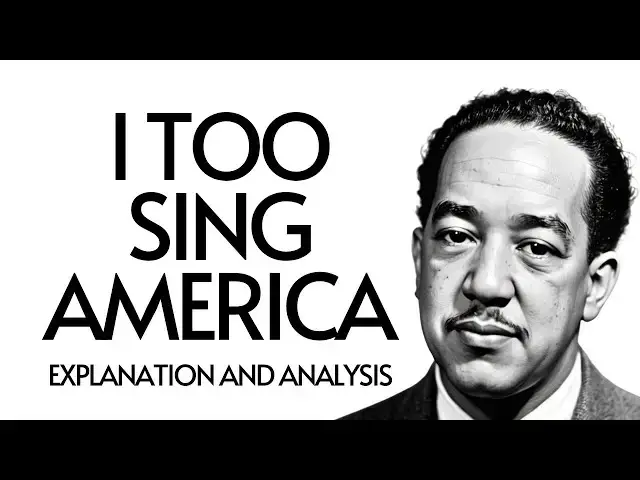

I Too Sing America | A Poem by Langston Hughes | Explanation and Analysis
Dec 30, 2024

Hello students!
Today we are going to talk about a very important poem called “I Too Sing America”. It was written by Langston Hughes, a famous African American poet. This poem talks about equality, freedom, and the strength of hope. Langston Hughes wrote this poem in 1926 during a time when there was a lot of racism in the United States.
Explanation of the Poem.
The poem “I Too Sing America” by Langston Hughes is very short, but it says a lot. Let us go through it line by line.
“I Too Sing America”.
This is the first line of the poem. The poet says, “I Too Sing America”. He is saying that he is also a part of America. He wants everyone to know that he belongs to this country just like anyone else. The word “sing” here is very important. It does not mean just singing a song. It means celebrating something. When you sing, you are happy, and you are showing your love for something. So, Langston Hughes is saying that he celebrates America and that he is proud to be an American.
However, during the time this poem was written, many African Americans were not treated as equals. They were not given the same rights as white people. By saying “I, too,” Langston Hughes shows that he is demanding his rightful place in America. He wants to be seen as equal.
“I am the darker brother”.
In this line, the poet calls himself “the darker brother.” He is saying that he is part of the American family, but he is different because of his skin color. The word “brother” is very important. It shows that he sees all Americans as one family, even if they do not see him the same way. By saying “darker brother,” he is pointing out that his skin color has made people treat him unfairly.
At that time, African Americans were often excluded from many things. They could not go to the same schools, eat at the same restaurants, or even live in the same neighborhoods as white people. Langston Hughes uses this line to show that this unfair treatment is wrong.
“They send me to eat in the kitchen”.
“When company comes”.
In these lines, the poet talks about how he is treated. He says that when guests come to visit, he is sent to eat in the kitchen. This means that he is not allowed to sit with everyone else. The “kitchen” here represents a place of shame and separation. It shows how African Americans were often pushed aside and treated as less important.
But notice that the poet does not sound angry. Instead, he is calm. He does not shout or complain. He is just explaining the situation. This makes his words even more powerful because he is speaking the truth in a simple way.
“But I laugh”.
“And eat well”.
“And grow strong”.
The poet shows his strength. Even though he is treated unfairly, he does not let it break him. He says, “But I laugh.” This means that he does not let racism make him sad. He stays strong and confident. He eats well, which shows that he takes care of himself. He grows strong, both physically and emotionally.
These lines are very important because they show hope. The poet is saying that even if life is unfair, you should never give up. Instead, you should keep growing and becoming stronger.
“Tomorrow, I’ll be at the table”.
“When company comes”.
Now, the poet talks about the future. He says, “Tomorrow,” which does not mean the literal next day. It means the future. He believes that in the future, he will no longer be sent to the kitchen. Instead, he will sit at the table with everyone else. The “table” here is a symbol of equality and respect. It means that one day, he will be treated as an equal.
These lines show the poet’s hope and determination. He believes that things will change. He knows that one day, African Americans will have the same rights and opportunities as everyone else.
“Nobody’ll dare”.
“Say to me".
“‘Eat in the kitchen,’ Then”.
In this part, the poet is very confident. He says that in the future, no one will have the courage to treat him unfairly. The word “dare” means to have the courage to do something. He believes that the day will come when racism will end, and people will respect him.
“Besides”.
“They’ll see how beautiful I am”.
“And be ashamed—”.
Here, the poet talks about beauty, but he is not talking about physical beauty. He is talking about the beauty of his character, his strength, and his culture. He believes that one day, people will realize how valuable African Americans are to America. When they see this, they will feel ashamed of how they treated him in the past.
“I, too, am America”.
The poem ends with this powerful line. The poet repeats the idea that he is also a part of America. By saying “I, too, am America,” he is claiming his identity and his place in the country. He is saying that America belongs to everyone, no matter their skin color.
Thank you for watching and good luck with your studies!.
00:00 - Introduction
00:27 - Explana
Show More Show Less