Up next in 10

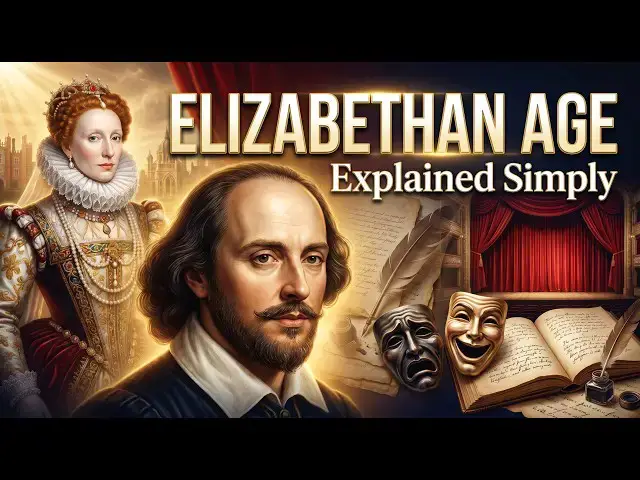
Elizabethan Age in English Literature Explained | Renaissance, Shakespeare, Features & Writers
Jun 17, 2026

In this comprehensive lecture, you will learn everything about the Elizabethan Age in English Literature, one of the greatest periods in the history of English literature. This video explains the historical background, Renaissance influence, characteristics of Elizabethan literature, development of drama and poetry, important literary terms, major writers, and the lasting impact of the age.
The Elizabethan Age remains the most influential period in English history for literature and culture. Learn how political stability shaped the era.
This breakdown examines why the Elizabethan Age became a golden era for arts and letters. We explore how patronage, a growing public appetite for theater, and relative stability allowed writers like William Shakespeare to flourish. Whether you are a student of history or simply interested in the origins of English drama, this overview clarifies the conditions that made such massive cultural production possible.
By analyzing the intersection of politics and creativity, you will gain a clearer understanding of how Elizabethan literature evolved during this time. We connect the dots between the societal structures of the late 16th century and the lasting legacy of Elizabethan culture that persists today. You will leave with a solid grasp of why this specific historical window produced the most significant works of poetry and prose in the English language.
Subscribe for weekly history breakdowns, and comment which era of English history you want to explore next.
Topics Covered:
✔ What is the Elizabethan Age?
✔ Queen Elizabeth I and her reign (1558–1603)
✔ Renaissance and Humanism
✔ Historical background of the Elizabethan period
✔ Political stability and national pride
✔ Growth of education and the printing press
✔ Characteristics of Elizabethan literature
✔ Elizabethan drama and public theatres
✔ Tragedy, comedy, revenge tragedy, and history plays
✔ Sonnets and poetic devices
✔ Blank verse and iambic pentameter
✔ William Shakespeare and his major works
✔ Christopher Marlowe, Edmund Spenser, Sir Philip Sidney, and Ben Jonson
✔ Development of prose and the English language
✔ Patronage and cultural influences
✔ Lasting importance of the Elizabethan Age
✔ Important examination points and common misconceptions
This lecture is specially designed for:
BA English Literature students
BS English students
Intermediate and A-Level students
Competitive examination preparation
Beginners who want to understand English literature in simple language
📚 Learn English Literature step by step with Ask Literature.
🔔 Subscribe for more lectures on:
English Literary Periods | Literary Terms | Poetry | Drama | Novels | Literary Criticism | Writers and Their Works
#ElizabethanAge #EnglishLiterature #WilliamShakespeare #Renaissance #HistoryOfEnglishLiterature #EnglishLiteratureLecture #LiteratureStudents #EnglishLiteratureNotes #AskLiterature #BAEnglish #BSEnglish
Show More Show Less View Video Transcript
0:00
Have you ever wondered why one period in
0:02
English history produced some of the
0:03
greatest writers, poems, plays, and
0:06
ideas the world has ever known?
0:09
Why do students still study works
0:11
written more than 400 years ago?
0:14
Why is one writer from this period,
0:16
William Shakespeare, still read and
0:18
performed across the world today?
0:22
The answer takes us to a remarkable
0:24
period known as the Elizabethan age.
0:27
This was a time of great change,
0:29
discovery, creativity, and literary
0:32
achievement.
0:33
During this period, English literature
0:35
reached new heights.
0:37
Writers experimented with new forms of
0:39
poetry and drama.
0:42
The English language became richer and
0:44
more expressive.
0:46
Many literary traditions that continue
0:48
today developed during this age.
0:51
To understand English literature
0:53
properly, it is important to understand
0:56
the Elizabethan age.
0:58
This period shaped not only English
1:00
writing, but also world literature.
1:03
Let us explore this fascinating age step
1:05
by step.
1:08
The Elizabethan age is the period in
1:10
English history during the reign of
1:12
Queen Elizabeth the first.
1:14
A reign is the period during which a
1:16
king or queen rules a country.
1:19
Queen Elizabeth the first ruled England
1:22
from 1558 to 1603.
1:25
Because she ruled during these years,
1:27
the literary and cultural developments
1:29
of this period are called the
1:31
Elizabethan age.
1:34
The Elizabethan age was the English
1:36
phase of the Renaissance.
1:38
The Renaissance had begun earlier in
1:40
Italy and later spread to other parts of
1:42
Europe, including England.
1:45
The word Renaissance means rebirth.
1:48
It refers to a period in Europe when
1:50
people showed renewed interest in
1:52
learning, art, science, literature, and
1:55
the achievements of ancient Greece and
1:57
Rome.
1:58
The Renaissance encouraged people to
2:00
think, question, learn, and create.
2:04
Before the Renaissance, much of European
2:06
intellectual life was strongly
2:08
influenced by religious institutions.
2:11
Religion remained important during the
2:13
Renaissance, but people also became
2:15
interested in human abilities, human
2:18
experiences, and the natural world.
2:21
This new way of thinking influenced
2:23
literature deeply.
2:26
To understand why the Elizabethan age
2:28
became such an important literary
2:30
period, we must first look at the
2:32
historical background.
2:34
England in the 16th century was changing
2:37
rapidly.
2:38
The country was becoming more stable
2:41
after earlier periods of political
2:42
conflict.
2:44
Political stability means a situation in
2:47
which the government remains secure and
2:49
society functions peacefully.
2:51
Stable governments often support
2:53
cultural growth because people have more
2:55
opportunities to focus on education,
2:58
art, and literature.
3:01
Queen Elizabeth the first played an
3:03
important role in creating this
3:05
stability.
3:06
She was a skilled ruler who guided
3:08
England through many challenges.
3:11
During her reign, England became
3:13
stronger economically, politically, and
3:15
culturally.
3:17
Events such as England's victory over
3:19
the Spanish Armada in 1588 strengthened
3:22
national pride.
3:25
National pride means a strong feeling of
3:27
love and confidence in one's country.
3:30
When people feel proud of their nation,
3:32
they often celebrate its language,
3:34
culture, and achievements.
3:37
This pride encouraged writers to create
3:39
literature in English rather than
3:41
relying heavily on Latin or other
3:43
languages.
3:46
Another important factor was the growth
3:48
of education.
3:50
More people learned to read and write
3:52
than before.
3:53
Schools became more common.
3:56
As literacy increased, the demand for
3:58
books also increased.
4:00
Literacy means the ability to read and
4:03
write.
4:04
When more people can read, writers gain
4:06
larger audiences and literature develops
4:09
more rapidly.
4:12
Printing also played a major role.
4:14
The printing press had been introduced
4:17
into England in the late 15th century.
4:20
A printing press is a machine used to
4:22
produce books and written materials
4:24
quickly.
4:25
Before printing, books had to be copied
4:27
by hand, which was slow and expensive.
4:32
The printing press made books cheaper
4:34
and easier to obtain.
4:36
As a result, ideas spread more quickly.
4:39
Writers could reach more readers.
4:42
Literature became an important part of
4:44
everyday intellectual life.
4:49
At the same time, England was becoming
4:51
involved in exploration and overseas
4:54
travel.
4:55
Explorers visited new lands and brought
4:57
back stories about distant places and
4:59
cultures.
5:01
These discoveries expanded people's
5:03
understanding of the world.
5:05
Writers gained new subjects and ideas
5:07
for their works.
5:10
Religious changes also influenced the
5:12
Elizabethan age.
5:14
Earlier in the 16th century, England had
5:17
separated from the authority of the
5:19
Roman Catholic Church.
5:21
This period of religious change is often
5:24
called the Reformation.
5:26
The Reformation transformed religious
5:28
life and affected politics, education,
5:31
and culture.
5:33
Although religious disagreements
5:35
continued, Elizabeth the First
5:37
established a religious settlement that
5:39
brought greater stability than the
5:40
intense conflicts of earlier decades.
5:44
Greater stability allowed cultural
5:45
activities, including literature, to
5:48
flourish.
5:49
Now that we understand the historical
5:51
background, we can examine the major
5:53
characteristics of Elizabethan
5:55
literature.
5:57
One of the most important
5:58
characteristics was optimism.
6:01
Optimism means hopefulness and
6:03
confidence about the future.
6:06
Many Elizabethan writers believed that
6:07
human beings could achieve great things
6:10
through intelligence, effort, and
6:11
imagination.
6:13
This optimistic spirit came partly from
6:16
Renaissance thinking.
6:17
People believed that education and
6:19
knowledge could improve society.
6:22
Writers often celebrated human potential
6:25
and achievement.
6:27
Another important characteristic was
6:29
humanism.
6:31
Humanism was a Renaissance intellectual
6:33
movement that focused on human life,
6:36
human experiences, and human abilities.
6:39
Humanism emphasized the study of
6:41
classical Greek and Roman texts, and
6:44
encouraged interest in human abilities,
6:46
education, ethics, and public life.
6:50
Humanism did not reject religion.
6:53
Instead, it encouraged greater interest
6:55
in human nature alongside religious
6:57
concerns.
6:59
As a result, Elizabethan literature
7:01
often explored emotions, ambitions,
7:03
fears, strengths, and weaknesses.
7:08
A third important characteristic was
7:10
curiosity.
7:11
Elizabethan writers were interested in
7:13
many subjects.
7:15
They wrote about love, politics,
7:17
history, science, exploration, morality,
7:21
religion, and human psychology.
7:24
Psychology refers to the study of the
7:26
human mind and behavior.
7:28
This curiosity helped create rich and
7:31
varied literature.
7:32
Writers explored complex questions about
7:35
life and society.
7:38
The Elizabethan age is especially famous
7:40
for its drama.
7:42
Drama is literature written to be
7:44
performed on stage.
7:46
Plays became one of the most popular
7:48
forms of entertainment during this
7:50
period.
7:51
Public theaters appeared in and around
7:53
London.
7:55
Public theaters attracted people from
7:57
many social classes.
7:59
Wealthy spectators often sat in
8:01
galleries, while poorer spectators stood
8:03
in the open yard near the stage.
8:06
Rich and poor audiences often watched
8:08
the same plays.
8:10
This broad audience encouraged
8:12
playwrights to write works that appealed
8:14
to many kinds of people.
8:17
The growth of theaters transformed
8:18
English literature.
8:20
Playwrights had opportunities to present
8:22
stories directly to large audiences.
8:26
Drama became one of the greatest
8:28
achievements of the Elizabethan age.
8:31
Elizabethan drama developed several
8:33
important features.
8:35
One feature was its mixture of different
8:37
emotions.
8:39
A play could include serious scenes,
8:41
humorous scenes, romantic scenes, and
8:43
exciting action.
8:45
This variety kept audiences interested.
8:50
Another feature was the use of complex
8:52
characters.
8:54
Instead of presenting simple heroes and
8:55
villains, playwrights often created
8:58
characters with strengths and
8:59
weaknesses.
9:01
These characters felt realistic because
9:03
they reflected the complexity of human
9:05
nature.
9:07
Unlike many classical dramatists,
9:10
Elizabethan playwrights often ignored
9:12
the strict unities of time, place, and
9:14
action.
9:16
The classical unities were rules derived
9:18
from interpretations of ancient Greek
9:20
and Roman drama.
9:22
These rules suggested that a play should
9:24
focus on one main action, occur in one
9:27
location, and take place within a short
9:29
period of time.
9:31
Many Elizabethan playwrights did not
9:33
strictly follow these rules.
9:36
They moved freely between different
9:37
places, extended events across months or
9:40
years, and included several storylines.
9:44
This freedom allowed them to create
9:46
larger and more dramatic stories.
9:51
One of the most important literary forms
9:53
of the Elizabethan age was tragedy.
9:56
A tragedy is a serious play that usually
9:58
ends in suffering, disaster, or death.
10:02
Tragic plays often explore human
10:04
weaknesses such as ambition, jealousy,
10:06
pride, or revenge.
10:09
Another important dramatic form was the
10:12
revenge tragedy.
10:13
A revenge tragedy is a play in which a
10:16
character seeks revenge for a real or
10:18
imagined wrong.
10:20
Such plays often include murder,
10:22
violence, and moral conflict.
10:25
The genre became popular in the late
10:27
Elizabethan period.
10:30
Comedy was another important form.
10:33
A comedy is a play that generally ends
10:35
happily.
10:36
Comedies often include
10:37
misunderstandings, humorous situations,
10:40
love stories, and reconciliation between
10:43
characters.
10:46
History plays also became popular.
10:49
These plays presented events from the
10:51
history of England.
10:53
They helped strengthen national pride
10:55
and allowed audiences to reflect on
10:57
political leadership and historical
10:59
events.
11:01
Poetry flourished alongside drama.
11:04
Elizabethan poets experimented with new
11:07
styles and forms.
11:09
Poetry became more sophisticated and
11:11
expressive.
11:14
One important poetic form was the
11:15
sonnet.
11:17
A sonnet is a poem of 14 lines written
11:19
according to a specific pattern.
11:22
Sonnets often explore themes such as
11:24
love, beauty, time, and mortality.
11:27
Mortality means the fact that all humans
11:30
eventually die.
11:32
The sonnet became extremely popular
11:33
during the Elizabethan age.
11:36
Writers used it to express complex
11:38
thoughts and emotions in a structured
11:40
form.
11:42
A major literary device used in
11:44
Elizabethan poetry was imagery.
11:47
Imagery means language that creates
11:49
mental pictures.
11:51
Writers used vivid descriptions to help
11:53
readers imagine scenes, emotions, and
11:56
experiences.
11:59
Another common literary device was
12:01
metaphor.
12:02
A metaphor is a comparison in which one
12:04
thing is described as another thing to
12:07
create deeper meaning.
12:09
For example, a poet might describe life
12:12
as a journey.
12:14
Simile was also widely used.
12:17
A simile compares two things using words
12:20
such as like or as.
12:22
For example, someone might be described
12:25
as brave as a lion.
12:28
Personification appeared frequently in
12:30
Elizabethan literature.
12:32
Personification gives human qualities to
12:35
non-human things.
12:37
For example, a writer might describe the
12:39
wind as whispering or the sun as
12:41
smiling.
12:44
Symbolism was another important
12:46
technique.
12:47
A symbol is something that represents a
12:49
larger idea.
12:51
A rose, for example, may symbolize love.
12:56
Writers also used irony.
12:59
Irony occurs when there is a difference
13:00
between what seems to happen and what
13:03
actually happens.
13:05
Irony often creates surprise and deeper
13:07
meaning.
13:09
One of the most important features of
13:11
Elizabethan drama was the use of blank
13:14
verse.
13:15
Blank verse is poetry written in
13:17
unrhymed lines of iambic pentameter.
13:20
Unrhymed means the lines do not end with
13:23
matching sounds.
13:25
Iambic pentameter is a rhythmic pattern
13:27
with 10 syllables, usually arranged in
13:29
five pairs.
13:31
Shakespeare and Marlowe used blank verse
13:33
extensively because it sounded natural
13:36
in speech while still providing poetic
13:38
beauty.
13:40
Now we come to the most famous writer of
13:43
the Elizabethan age, William
13:45
Shakespeare.
13:47
Shakespeare is widely regarded as one of
13:50
the most influential writers in world
13:52
literature.
13:53
He wrote tragedies, comedies, histories,
13:56
and poems.
13:57
His works continue to be studied,
13:59
translated, and performed around the
14:02
world.
14:05
One reason for Shakespeare's greatness
14:07
is his understanding of human nature.
14:10
His characters often face difficult
14:12
choices and emotional conflicts.
14:15
Readers and audiences continue to
14:17
recognize these experiences because many
14:20
aspects of human nature remain similar
14:22
across time.
14:25
His tragedies include works such as
14:27
Hamlet, Othello, King Lear, and Macbeth.
14:30
These plays examine themes such as
14:32
ambition, revenge, jealousy, power, and
14:35
responsibility.
14:38
His comedies include A Midsummer Night's
14:40
Dream, Twelfth Night, and As You Like
14:42
It.
14:43
These plays often explore love,
14:45
identity, friendship, and
14:47
reconciliation.
14:50
His history plays include works such as
14:53
Richard III and Henry V.
14:55
These dramas examine leadership,
14:57
politics, and national identity.
15:01
Shakespeare also wrote many sonnets that
15:04
remain famous today.
15:06
His sonnets explore love, beauty, time,
15:09
memory, and mortality.
15:12
However, Shakespeare was not the only
15:15
important writer of the Elizabethan age.
15:19
Christopher Marlowe was another major
15:21
playwright.
15:22
He was one of the most talented
15:24
dramatists of the period.
15:26
His play Doctor Faustus tells the story
15:29
of a scholar who seeks unlimited
15:30
knowledge and power.
15:32
The play explores ambition, temptation,
15:35
and the consequences of human choices.
15:38
Marlowe helped expand the possibilities
15:41
of English drama.
15:42
His powerful language influenced later
15:44
playwrights, including Shakespeare.
15:48
Edmund Spenser was one of the greatest
15:51
poets of the age.
15:53
His most famous work is The Faerie
15:55
Queene.
15:56
This long poem combines adventure,
15:58
morality, and allegory.
16:01
An allegory is a story in which
16:03
characters and events represent larger
16:05
ideas.
16:07
For example, a character may represent
16:09
virtue, wisdom, or justice rather than
16:12
only being an individual person.
16:14
Spenser's poetry celebrated moral ideals
16:17
and reflected Renaissance values.
16:21
Sir Philip Sidney was another important
16:23
figure.
16:24
He was a poet, scholar, and critic.
16:28
A critic is someone who studies and
16:29
evaluates literature.
16:32
Sidney's writings helped shape literary
16:34
theory in England.
16:36
Literary theory refers to ideas about
16:38
how literature works and how it should
16:40
be understood.
16:42
Sidney argued that literature could
16:44
educate and inspire readers while also
16:46
entertaining them.
16:49
Ben Jonson belongs mainly to the late
16:51
Elizabethan and early Jacobean periods.
16:55
His career began during the Elizabethan
16:57
age, but many of his most famous works
17:00
were written after Queen Elizabeth's
17:02
death in 1603.
17:04
Although some of his most important
17:06
works appeared slightly after
17:07
Elizabeth's reign, he developed
17:09
important dramatic techniques and became
17:12
one of the leading writers of the
17:13
broader Elizabethan and early Jacobean
17:16
period.
17:18
The Elizabethan age also saw important
17:21
developments in prose.
17:23
Prose refers to ordinary written
17:25
language that is not written in poetic
17:27
form.
17:28
Essays, translations, histories, and
17:31
other prose works became increasingly
17:33
popular.
17:35
Writers translated important classical
17:37
texts into English.
17:39
These translations made ancient
17:41
knowledge available to larger audiences.
17:45
As readers gained access to new ideas,
17:47
English intellectual life expanded
17:49
further.
17:51
Language itself changed during the
17:54
Elizabethan age.
17:56
The English language became more
17:57
flexible and expressive.
18:00
Writers experimented with vocabulary,
18:02
sentence structures, and styles.
18:05
New words entered the language from
18:07
other European languages and from
18:09
classical sources.
18:11
This expansion helped writers express
18:13
increasingly complex ideas.
18:17
The social structure of Elizabethan
18:19
society also influenced literature.
18:22
Society was divided into different
18:24
social classes.
18:26
Writers often explored relationships
18:28
between kings, nobles, merchants,
18:31
workers, and ordinary citizens.
18:34
Literature reflected both the
18:35
opportunities and tensions within
18:37
society.
18:39
Through stories and plays, writers
18:41
examined questions about authority,
18:43
justice, wealth, and social
18:45
responsibility.
18:47
Cultural influences were equally
18:49
important.
18:50
Music, art, fashion, education, and
18:53
court life all contributed to literary
18:55
creativity.
18:57
The royal court served as an important
18:59
center of cultural activity.
19:03
Patronage also played a significant
19:06
role.
19:07
Patronage means financial support given
19:09
to artists and writers by wealthy
19:11
individuals.
19:13
Many authors depended on patrons for
19:15
income and protection.
19:17
Patronage allowed writers to devote more
19:20
time to their work.
19:23
The Elizabethan age had a lasting impact
19:25
on literature.
19:27
It established English as a major
19:29
literary language.
19:31
It produced works that became models for
19:33
future generations.
19:35
It expanded the possibilities of drama,
19:37
poetry, and prose.
19:40
Later writers frequently studied and
19:42
imitated Elizabethan authors.
19:45
Many literary techniques developed
19:47
during this period continued to
19:48
influence literature for centuries.
19:51
The age also affected society beyond
19:54
literature.
19:55
Plays encouraged public discussion of
19:57
political, moral, and social questions.
20:01
Literature became an important part of
20:03
cultural life.
20:05
The period demonstrated how creative
20:07
expression could shape national
20:09
identity.
20:11
Students should also understand some
20:13
common misconceptions about the
20:15
Elizabethan age.
20:18
One misconception is that all
20:20
Elizabethan literature was written by
20:22
Shakespeare.
20:24
Shakespeare was the most famous writer,
20:26
but many other important authors
20:28
contributed to the literary richness of
20:30
the period.
20:32
Another misconception is that
20:34
Elizabethan literature was only
20:36
entertainment.
20:38
In reality, it often explored serious
20:40
issues such as morality, politics,
20:43
religion, leadership, ambition, and
20:45
human behavior.
20:48
A third misconception is that
20:50
Elizabethan writers simply copied
20:51
ancient Greek and Roman works.
20:54
They certainly learned from classical
20:56
literature, but they also created
20:58
original forms, themes, and styles that
21:01
reflected their own society and
21:03
experiences.
21:06
For examinations, students should
21:08
remember several key points.
21:10
The Elizabethan age refers to the period
21:13
during the reign of Queen Elizabeth the
21:15
first from 1558 to 1603.
21:19
It was part of the Renaissance movement.
21:22
It was marked by political stability,
21:24
growing national pride, educational
21:26
expansion, the spread of printing, and
21:29
flourishing literature.
21:31
Drama became the dominant literary form.
21:34
Shakespeare, Marlowe, Spenser, Sidney,
21:37
and Jonson were major literary figures.
21:40
Humanism, optimism, curiosity, and
21:43
creativity were central characteristics
21:45
of the age.
21:47
The period produced lasting achievements
21:49
in drama, poetry, and prose.
Literary Classics
Jobs & Education
Education