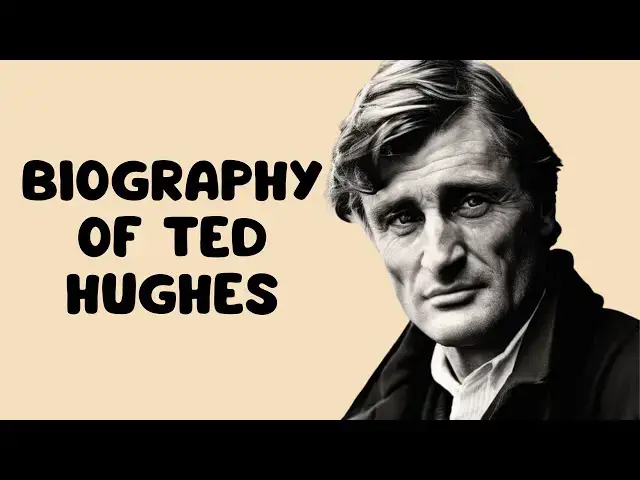

Biography of Ted Hughes | The Poet of Myth
Jul 14, 2024

Welcome to this detailed exploration of the life, work and the biography of Ted Hughes. He was one of the most significant British poets of the twentieth century. This video aims to guide you through every major event and incident in Hughes's life, and provides a comprehensive understanding.
Ted Hughes was born in a small town called Mytholmroyd in Yorkshire, England. Yorkshire is a region known for its beautiful and rugged landscapes. It had a profound influence on Hughes's poetry throughout his life. His connection to nature began early and later became a defining characteristic of his work.
After completing his early education, Hughes served in the Royal Air Force. This experience exposed him to the discipline and structure that later influenced his poetic craft. After his military service, Hughes attended the prestigious Cambridge University, where he studied archeology and anthropology. His academic interests were diverse, but he was particularly drawn to myths and legends, which played a significant role in shaping his poetic themes.
In 1956, a pivotal moment in Hughes's life occurred when he met and married Sylvia Plath, an American poet. The biography of Ted Hughes reveals that their relationship was intense and deeply influential for both poets. Plath encouraged Hughes to submit his manuscript to a first-book contest run by the Poetry Center. The judges, notable figures such as Marianne Moore, W H Auden, and Stephen Spender, awarded Hughes the first prize for his collection "The Hawk in the Rain". This publication in 1957 established Hughes as a poet of international repute.
Hughes's poetry was distinct from the prevalent styles of his time. The period's typical poetry was often polite, domestic, understated, and mildly ironic. In stark contrast, Hughes's work was bold, employing a language rich in resemblance to Shakespeare. He explored themes that were mythic and elemental, breaking away from the conventions of the era.
It is evident from the biography of Ted Hughes that he published several best-selling volumes that cemented his status as a leading poet. Some of these include "Lupercal" in 1960, "Crow" in 1970, "Selected Poems 1957–1981" in 1982, and "Birthday Letters" in 1998. His work wasn't limited to poetry for adults; he also wrote beloved children's books, such as "The Iron Man", published in 1968 and later adapted into the animated film "The Iron Giant" in 1999.
The rural landscapes of Yorkshire, where Hughes grew up, had a lasting influence on his work. His poetry often immerses readers in a world dominated by nature, particularly animals. This thematic focus is evident from his earliest collections like "The Hawk in the Rain" to later works such as "Wolfwatching" and "Moortown Diary", both published in 1989.
The biography of Ted Hughes shows that the publication of "Collected Poems" in 2003 shed further light on Hughes's writing process. Critics noted that Hughes seemed to conduct multiple lives as a poet. These poems were sometimes experimental, reflecting Hughes's interest in the process of writing rather than just the final outcome. He needed to be writing constantly, and many of his uncollected poems have an unfinished, provisional quality, resting for a moment before potentially being completed.
To conclude the biography of Ted Hughes, suffice is to say that his poetry takes readers into a world where nature is both a backdrop and a central character. His work is imbued with the raw power of the natural world and explores themes of life, death, and the primal forces that shape our existence. Hughes's ability to capture the essence of animals and the mythic dimensions of human experience has left an indelible mark on the literary world.
#askliterature #tedhughes #biographyoftedhughes
Show More Show Less